Species · Fishes
Sharpnose Stingray Telatrygon acutirostra
The scientific name of the Sharpnose Stingray is Telatrygon acutirostra. It is a species of fish in the family Dasyatidae (whiptail stingray), order Myliobatiformes. The name dates from 1988.
- Scientific name
- Telatrygon acutirostra (Nishida & Nakaya, 1988)
- Common name
- Sharpnose Stingray
- Genus
- Telatrygon
- Family
- Dasyatidae (Whiptail Stingray)
- Order
- Myliobatiformes
- Class
- Elasmobranchii
- Red List category
- VU Vulnerable
- Environment
- marine
- Recorded in
- 3 countries
- Name status
- accepted in the Catalogue of Life
Overview
Telatrygon acutirostra is known from waters off southern Japan and the East China Sea. It has a long, triangular snout projecting from the front of its disc and a whip-like tail longer than its disc.
Written 27 November 2026 from the sources listed below. Each statement was checked against the passage it cites; statements that could not be supported were removed.
Appearance
The pectoral fin disc is approximately as wide as it is long, with rounded outer margins and concave leading margins. A long, triangular snout projects from the front of the disc.[1][2]
The eyes are small and are followed by larger spiracles. A fringed skin curtain with a straight posterior margin separates the nostrils.[3][4]
The mouth is slightly curved and lacks papillae on the floor. The upper jaw has 40–51 tooth rows, while the lower jaw has 39–49 tooth rows.[5][6]
The teeth are arranged in a quincunx pattern that forms pavement-like surfaces. Adult males have pointed tooth cusps, unlike juveniles and females.[7][8]
The pelvic fins are wide and triangular. The whip-like tail is longer than the disc and carries one or two stinging spines on its upper surface.[9][10]
The tail has a subtle dorsal keel and a low ventral fin fold behind the spine. It lacks the dorsal fin fold that distinguishes Telatrygon zugei.[11][12]
There are 30 tubercles along the middle of the back and another 16 in front of the spine. Small denticles cover the portion of the tail behind the spine.[13][14]
The upper body is light brown and the underside is white.[15]
Habitat
The species is benthic and occurs at recorded depths of 53–142 m.[16][17]
Similar species
The Sharpnose Stingray resembles the smaller pale-edged stingray (Telatrygon zugei). It differs by having larger eyes.[18][19]
It lacks the dorsal fin fold on the tail that distinguishes Telatrygon zugei. It also has a larger maturation size.[12][20]
Reproduction and life cycle
The species is presumed to reproduce through aplacental viviparity. A recorded male specimen measuring 35.4 cm was immature, while a male measuring 72.5 cm across was mature.[21][22][23]
Conservation
The International Union for Conservation of Nature has assessed the species as Vulnerable. Its restricted geographic distribution makes it vulnerable to increasing fishing pressure.[24][25]
Uses
The species likely occurs in coastal bottom-trawl fishery catches operating off Japan and elsewhere. It likely also occurs in set-net fishery catches operating off Japan and elsewhere.[26][27]
Classification of the Sharpnose Stingray
| Kingdom | Animalia |
|---|---|
| Phylum | Chordata |
| Subphylum | Vertebrata |
| Infraphylum | Gnathostomata |
| Parvphylum | Chondrichthyes |
| Class | Elasmobranchii |
| Subclass | Neoselachii |
| Infraclass | Batoidea |
| Order | Myliobatiformes |
| Family | Dasyatidae (Whiptail Stingray) |
| Genus | Telatrygon (Sharpnose Stingrays) |
| Species | Telatrygon acutirostra (Nishida & Nakaya, 1988) |
Where the Sharpnose Stingray is found
Checklists and occurrence records place Telatrygon acutirostra in 3 countries. GBIF holds 15 georeferenced records of it.
Countries
A number beside a place is its count of GBIF occurrence records. A place without a number comes from a checklist alone. Records show where a species has been observed or collected, which can include escapes and vagrants.
Common names
English
- Sharpnose Stingray
- Sharpnose Ray
Names in 4 other languages
- Czech
- trnucha ostrorypá
- Dutch
- Scherpsnuitpijlstaartrog
- German
- Spitznasen-Stechrochen
- Japanese
- Yajiri-ei, ヤジリエイ
Synonyms
One other scientific name has been used for this species and is now treated as a synonym of Telatrygon acutirostra.
- Dasyatis acutirostra Nishida & Nakaya, 1988
Related species
- Indonesian Sharpnose RayTelatrygon biasa
- Indian Sharpnose RayTelatrygon crozieri
- Pale-edge Sharpnose RayTelatrygon zugei
-
 Bluespotted Ribbontail RayTaeniura lymma
-
 Common StingrayDasyatis pastinaca
-
 Pelagic StingrayPteroplatytrygon violacea
-
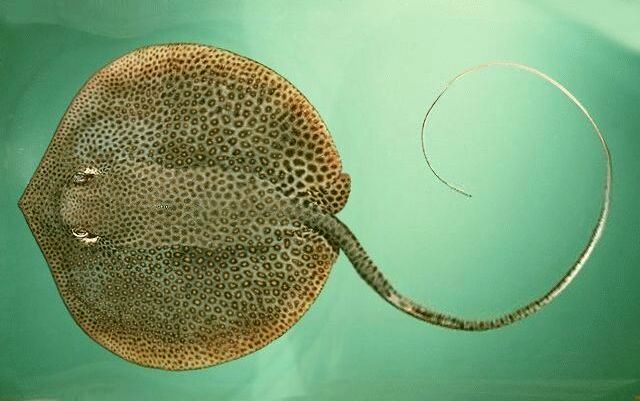 Reticulate WhiprayHimantura uarnak
-
 Leopard WhiprayHimantura leoparda
Compare
Questions and answers
What is the scientific name of the Sharpnose Stingray?
The scientific name of the Sharpnose Stingray is Telatrygon acutirostra. Written with its author, the full name is Telatrygon acutirostra (Nishida & Nakaya, 1988).
Which family does the Sharpnose Stingray belong to?
Telatrygon acutirostra belongs to the family Dasyatidae, in the order Myliobatiformes and the class Elasmobranchii.
Where is the Sharpnose Stingray found?
Checklists and occurrence records place Telatrygon acutirostra in 3 countries: Taiwan, Japan and China.
What is the conservation status of the Sharpnose Stingray?
The IUCN Red List category recorded for Telatrygon acutirostra is Vulnerable (VU).
What other names does the Sharpnose Stingray have?
Telatrygon acutirostra is also known in English as Sharpnose Ray.
Sources
Passages the profile rests on
- The species has a pectoral fin disc approximately as wide as it is long, with rounded outer margins and concave leading margins. Source passage: “The pectoral fin disc of T. acutirostra is about as wide as it is long, with rounded outer margins” — English Wikipedia
- The species has a long, triangular snout projecting from the front of its disc. Source passage: “concave leading margins merging with a long, triangular snout.” — English Wikipedia
- Its eyes are small and are followed by larger spiracles. Source passage: “The eyes are small and followed by larger spiracles.” — English Wikipedia
- A fringed skin curtain with a straight posterior margin separates its nostrils. Source passage: “There is a curtain of skin between the nares, with a fringed, straight posterior margin.” — English Wikipedia
- Its mouth is slightly curved and lacks papillae on the floor. Source passage: “The mouth is slightly curved and lacks papillae on the floor.” — English Wikipedia
- Its upper jaw has 40–51 tooth rows, while its lower jaw has 39–49 tooth rows. Source passage: “There are 40–51 upper tooth rows and 39–49 lower tooth rows” — English Wikipedia
- Its teeth are arranged in a quincunx pattern that forms pavement-like surfaces. Source passage: “arranged with a quincunx pattern into pavement-like surfaces.” — English Wikipedia
- Adult males have pointed tooth cusps, unlike juveniles and females. Source passage: “The teeth of adult males have pointed cusps unlike in juveniles and females.” — English Wikipedia
- Its pelvic fins are wide and triangular. Source passage: “The pelvic fins are wide and triangular.” — English Wikipedia
- Its whip-like tail is longer than its disc and carries one or two stinging spines on its upper surface. Source passage: “The tail is whip-like and longer than the disc, and bears 1-2 stinging spines on the upper surface.” — English Wikipedia
- Its tail has a subtle dorsal keel and a low ventral fin fold behind the spine. Source passage: “A subtle dorsal keel and low ventral fin fold are present behind the spine.” — English Wikipedia
- Telatrygon acutirostra lacks the dorsal fin fold on the tail that distinguishes it from Telatrygon zugei. Source passage: “the absence of a dorsal fin fold on the tail” — English Wikipedia
- It has 30 tubercles along the middle of its back and another 16 tubercles in front of its spine. Source passage: “There is a row of 30 tubercles along the midline of the back, and another row of 16 tubercles in front of the spine.” — English Wikipedia
- Small denticles cover the portion of its tail behind the spine. Source passage: “The tail behind the spine is covered by small denticles.” — English Wikipedia
- Its upper body is light brown and its underside is white. Source passage: “The coloration is light brown above and white below.” — English Wikipedia
- The species occurs at recorded depths of 53–142 m. Source passage: “at a depth of 53–142 m (174–466 ft)” — English Wikipedia
- The species is benthic in nature. Source passage: “Like most other stingrays this species is benthic in nature.” — English Wikipedia
- The species resembles the smaller pale-edged stingray (Telatrygon zugei). Source passage: “T. acutirostra resembles (and was historically confused with) the smaller pale-edged stingray (T. zugei).” — English Wikipedia
- Telatrygon acutirostra differs from Telatrygon zugei by having larger eyes. Source passage: “including larger eyes” — English Wikipedia
- Telatrygon acutirostra has a larger maturation size than Telatrygon zugei. Source passage: “a larger maturation size” — English Wikipedia
- The species is presumed to reproduce through aplacental viviparity. Source passage: “It is presumably aplacental viviparous like other stingrays.” — English Wikipedia
- A recorded male specimen measuring 35.4 cm was immature. Source passage: “One male specimen 35.4 cm (13.9 in) was immature” — English Wikipedia
- A recorded male specimen measuring 72.5 cm across was mature. Source passage: “while another 72.5 cm (28.5 in) across was mature.” — English Wikipedia
- The International Union for Conservation of Nature has assessed the species as Vulnerable. Source passage: “The International Union for Conservation of Nature (IUCN) has assessed this species as Vulnerable” — English Wikipedia
- Its restricted geographic distribution makes the species vulnerable to increasing fishing pressure. Source passage: “as its restricted distribution renders it vulnerable to increases in fishing pressure.” — English Wikipedia
- The species likely occurs in coastal bottom-trawl fishery catches operating off Japan and elsewhere. Source passage: “Telatrygon acutirostra likely forms part of coastal bottom trawl and set net fishery catches operating off Japan and elsewhere” — English Wikipedia
- The species likely occurs in set-net fishery catches operating off Japan and elsewhere. Source passage: “coastal bottom trawl and set net fishery catches operating off Japan and elsewhere” — English Wikipedia
Data
- Catalogue of Life, 2026-10-16 XR cc by
- Global Biodiversity Information Facility CC BY 4.0
- Wikidata CC0
- GeoNames CC BY 4.0
- Within the Catalogue of Life, this name comes from World Register of Marine Species cc by
This species in other databases
- Catalogue of Life 555GH
- Wikidata Q28532789
- iNaturalist 607441
- WoRMS urn:lsid:marinespecies.org:taxname:1011795
Page built on 28 November 2026. See how the catalog is made and all sources and licences.
Cite this page
ScientificNames.org. (2026). Telatrygon acutirostra (Sharpnose Stingray). Retrieved November 28, 2026, from https://scientificnames.org/species/telatrygon-acutirostra
“Telatrygon acutirostra (Sharpnose Stingray).” ScientificNames.org, 2026, scientificnames.org/species/telatrygon-acutirostra. Accessed 28 Nov. 2026.
ScientificNames.org. “Telatrygon acutirostra (Sharpnose Stingray).” Accessed November 28, 2026. https://scientificnames.org/species/telatrygon-acutirostra.
@misc{scientificnames_telatrygon_acutirostra_sharpnose_stingray,
  author = {{ScientificNames.org}},
  title = {Telatrygon acutirostra (Sharpnose Stingray)},
  year = {2026},
  url = {https://scientificnames.org/species/telatrygon-acutirostra},
  note = {Accessed 2026-11-28}
}