Species · Fishes
Indonesian Sharpnose Ray Telatrygon biasa
The scientific name of the Indonesian Sharpnose Ray is Telatrygon biasa. It is a species of fish in the family Dasyatidae (whiptail stingray), order Myliobatiformes. The name dates from 2016.
- Scientific name
- Telatrygon biasa Last, White & Naylor, 2016
- Common name
- Indonesian Sharpnose Ray
- Genus
- Telatrygon
- Family
- Dasyatidae (Whiptail Stingray)
- Order
- Myliobatiformes
- Class
- Elasmobranchii
- Red List category
- VU Vulnerable
- Environment
- marine
- Recorded in
- 3 countries
- Name status
- accepted in the Catalogue of Life
Overview
Telatrygon biasa inhabits shallow coastal waters at depths of up to approximately 40 m and is reported from Indonesia, Malaysia, Singapore, Brunei Darussalam, and Thailand. It has a relatively short snout and disc, small eyes, between 107 and 114 pectoral radials, and between 85 and 94 vertebral centra in total.
Written 27 November 2026 from the sources listed below. Each statement was checked against the passage it cites; statements that could not be supported were removed.
Appearance
The Indonesian Sharpnose Ray has a relatively short snout and disc and small eyes. It has between 107 and 114 pectoral radials and between 85 and 94 vertebral centra in total.[1][2][3]
The maximum recorded disc width is 29 cm. Birth size is approximately 7–9 cm in disc width.[4][5]
Habitat
The Indonesian Sharpnose Ray is a demersal species that inhabits shallow coastal waters at depths of up to approximately 40 m.[6]
Uses
The species is caught by local or national fisheries for consumption as fresh or salted seafood. It is retained by local fisheries for human consumption.[7][8]
The species name biasa derives from an Indonesian and Malaysian word meaning ordinary, common, or normal. The name refers to its frequent occurrence in local fish markets.[9][10]
Conservation
The species is experiencing a population decrease associated with capture by small-scale local fisheries. It was most recently assessed for the IUCN Red List in 2020.[11][12]
Classification of the Indonesian Sharpnose Ray
| Kingdom | Animalia |
|---|---|
| Phylum | Chordata |
| Subphylum | Vertebrata |
| Infraphylum | Gnathostomata |
| Parvphylum | Chondrichthyes |
| Class | Elasmobranchii |
| Subclass | Neoselachii |
| Infraclass | Batoidea |
| Order | Myliobatiformes |
| Family | Dasyatidae (Whiptail Stingray) |
| Genus | Telatrygon (Sharpnose Stingrays) |
| Species | Telatrygon biasa Last, White & Naylor, 2016 |
Origin of the name. Etymology. Noun in apposition of the Indonesian and Malaysian word ' biasa' meaning ' ordinary, common or normal' used herein to reflect the frequent occurrence of this species in local fish markets. In Malaysian Borneo, the ray is known as Pari Biasa or Common Ray. Vernacular: Indonesian Sharpnose Ray.
Where the Indonesian Sharpnose Ray is found
Checklists and occurrence records place Telatrygon biasa in 3 countries. GBIF holds 28 georeferenced records of it.
Countries
Regions and cities with the most records
- Sabah, Malaysia 10
- Donggongon, Malaysia 9
- Kinarut, Malaysia 9
- Kota Kinabalu, Malaysia 9
- Petagas, Malaysia 9
- Putatan, Malaysia 9
A number beside a place is its count of GBIF occurrence records. A place without a number comes from a checklist alone. Records show where a species has been observed or collected, which can include escapes and vagrants.
Common names
English
- Indonesian Sharpnose Ray
- Indonesian Sharpnose Stingray
Names in 2 other languages
- Italian
- Pastinaca muso lungo indonesiana
- Thai
- ปลากระบางครีบเหลี่ยม
Related species
- Sharpnose StingrayTelatrygon acutirostra
- Indian Sharpnose RayTelatrygon crozieri
- Pale-edge Sharpnose RayTelatrygon zugei
-
 Bluespotted Ribbontail RayTaeniura lymma
-
 Common StingrayDasyatis pastinaca
-
 Pelagic StingrayPteroplatytrygon violacea
-
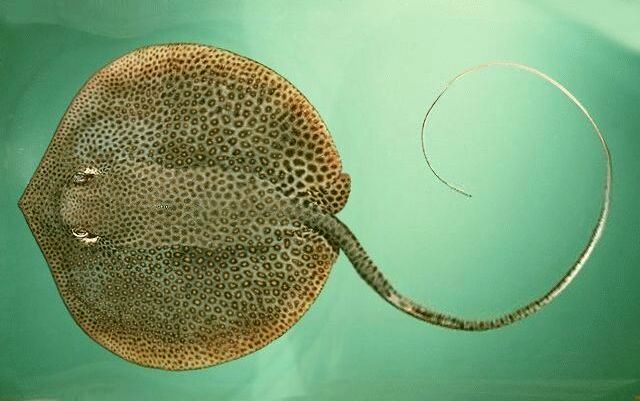 Reticulate WhiprayHimantura uarnak
-
 Leopard WhiprayHimantura leoparda
Compare
Questions and answers
What is the scientific name of the Indonesian Sharpnose Ray?
The scientific name of the Indonesian Sharpnose Ray is Telatrygon biasa. Written with its author, the full name is Telatrygon biasa Last, White & Naylor, 2016.
Which family does the Indonesian Sharpnose Ray belong to?
Telatrygon biasa belongs to the family Dasyatidae, in the order Myliobatiformes and the class Elasmobranchii.
Where is the Indonesian Sharpnose Ray found?
Checklists and occurrence records place Telatrygon biasa in 3 countries: Malaysia, Thailand and Singapore.
What is the conservation status of the Indonesian Sharpnose Ray?
The IUCN Red List category recorded for Telatrygon biasa is Vulnerable (VU).
What other names does the Indonesian Sharpnose Ray have?
Telatrygon biasa is also known in English as Indonesian Sharpnose Stingray.
Sources
Passages the profile rests on
- The species has a relatively short snout and disc and small eyes. Source passage: “relatively short snout and disc, small eyes” — English Wikipedia
- The species has between 107 and 114 pectoral radials. Source passage: “107-114 pectoral radials” — English Wikipedia
- The species has between 85 and 94 vertebral centra in total. Source passage: “85-94 vertebral centra in total.” — English Wikipedia
- The maximum recorded disc width of this species is 29 cm. Source passage: “It can reach the maximum size of 29 cm disc width” — English Wikipedia
- The birth size of this species is approximately 7–9 cm in disc width. Source passage: “the birth size is around 7-9 cm disc width.” — English Wikipedia
- This demersal species inhabits shallow coastal waters at depths of up to approximately 40 m. Source passage: “This demersal species is found living at the depths of up to 40 m in the coastal regions” — English Wikipedia
- The species is retained by local fisheries for human consumption. Source passage: “retained as human consumption.” — English Wikipedia
- The species is caught by local or national fisheries for consumption as fresh or salted seafood. Source passage: “often caught by local or national fisheries as fresh or salted seafood delicacies for local communities.” — English Wikipedia
- The species name biasa derives from an Indonesian and Malaysian word meaning ordinary, common, or normal. Source passage: “The fish's name is an Indonesian and Malaysian word meaning “ordinary, common or normal,”” — English Wikipedia
- The name biasa refers to the species' frequent occurrence in local fish markets. Source passage: “referring to its frequent occurrence in the local fish markets of the western North Pacific” — English Wikipedia
- The species is experiencing a population decrease associated with capture by small-scale local fisheries. Source passage: “currently experiencing population decrease due to being captured by small-scale local fisheries” — English Wikipedia
- The species was most recently assessed for the IUCN Red List in 2020. Source passage: “has most recently been assessed for The IUCN Red List of Threatened Species in 2020.” — iucnredlist.org
Data
- Catalogue of Life, 2026-10-16 XR cc by
- Global Biodiversity Information Facility CC BY 4.0
- Wikidata CC0
- GeoNames CC BY 4.0
- Within the Catalogue of Life, this name comes from World Register of Marine Species cc by
References
- Last, P. R., White, W. T., & Naylor, G. (2016). Three new stingrays (Myliobatiformes: Dasyatidae) from the Indo–West Pacific. Zootaxa, 4147. https://doi.org/10.11646/zootaxa.4147.4.2 Link where the name was published
This species in other databases
- Catalogue of Life 555GJ
- Wikidata Q26260488
- iNaturalist 607442
- WoRMS urn:lsid:marinespecies.org:taxname:1043626
Page built on 28 November 2026. See how the catalog is made and all sources and licences.
Cite this page
ScientificNames.org. (2026). Telatrygon biasa (Indonesian Sharpnose Ray). Retrieved November 28, 2026, from https://scientificnames.org/species/telatrygon-biasa
“Telatrygon biasa (Indonesian Sharpnose Ray).” ScientificNames.org, 2026, scientificnames.org/species/telatrygon-biasa. Accessed 28 Nov. 2026.
ScientificNames.org. “Telatrygon biasa (Indonesian Sharpnose Ray).” Accessed November 28, 2026. https://scientificnames.org/species/telatrygon-biasa.
@misc{scientificnames_telatrygon_biasa_indonesian_sharpnose_ray,
  author = {{ScientificNames.org}},
  title = {Telatrygon biasa (Indonesian Sharpnose Ray)},
  year = {2026},
  url = {https://scientificnames.org/species/telatrygon-biasa},
  note = {Accessed 2026-11-28}
}