Species · Flowering plants
Toadshade Trillium sessile
The scientific name of the Toadshade is Trillium sessile. It is a species of flowering plant in the family Melanthiaceae (bunchflower family), order Liliales.
- Scientific name
- Trillium sessile L.
- Common name
- Toadshade
- Genus
- Trillium
- Family
- Melanthiaceae (Bunchflower Family)
- Order
- Liliales
- Class
- Liliopsida
- Red List category
- LC Least Concern
- Recorded in
- 1 country
- Name status
- accepted in the Catalogue of Life

Overview
Toadshade (Trillium sessile L.) is a long-lived, perennial, clump-forming herbaceous flowering plant in the family Melanthiaceae, order Liliales, and class Liliopsida. It is endemic to the eastern half of the United States, growing in rich woodlands, floodplains, and riverbanks.
Written 26 November 2026 from the sources listed below. Each statement was checked against the passage it cites; statements that could not be supported were removed.
Appearance
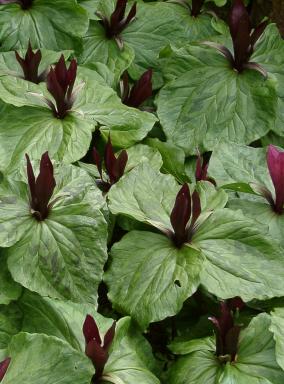
The flower is erect, stalkless, and positioned among three elliptic bracts measuring approximately 4 to 10 cm long and 2 to 8 cm wide. The bracts may have mottled coloration or be uniformly colored.[1][2][3][4]
The flower typically has three reddish-purple petals measuring approximately 1.5 to 4 cm long, six stamens, and three predominantly green sepals that sometimes have purple streaks. Petal shape and color vary, ranging from dark maroon and brownish-maroon to green, yellow, or bronze; a naturally occurring form produces yellow-green petals.[5][6][7][8][9][10]
The mature fruit is ovoid or nearly spherical, whitish-green with a light pinkish tint, and contains golden-yellow seeds.[11][12]
Habitat
The species also occurs on alluvial floodplains and riverbanks, and occasionally in dry calcareous woods at higher elevations. It can persist in lightly grazed areas, along fence rows, and in brushy areas following logging.[13][14][15]
Behaviour
Toadshade generally flowers in April, with flowering beginning in late March in southern populations and extending to mid-May in northern populations. Its flowering period ranges from early to late spring depending on latitude.[16][17]
The flowers produce a spicy, pungent, unpleasant smell. This odor attracts flies and beetles, and the species flowers earlier than other sessile-flowered trilliums where their ranges overlap.[18][19][20]
The above-ground parts of the plant usually die back by mid-summer.[21]
Reproduction and life cycle
The flowers are trimerous, containing three sepals, three petals, six stamens, and three carpels. Flies and beetles are the primary pollinators.[22][23]
The seeds have nutrient-rich elaiosomes attached, which attract ants and facilitate seed dispersal.[24][25]
In Tennessee, the fruits have been observed to ripen and fall between June 20 and July 5.[26]
Conservation
Toadshade is globally secure but vulnerable or more threatened in eight US states. It is critically imperiled in the District of Columbia, New York, North Carolina, and Oklahoma.[27][28]
Uses
Toadshade is sometimes cultivated in woodland wildflower gardens.[29]
The cooked greens have been reported as a possible emergency food, although the plant is known to induce vomiting. The fruit is considered a suspected poison.[30][31]
The species has been used medicinally to treat tumors.[32]
Classification of the Toadshade
| Kingdom | Plantae |
|---|---|
| Subkingdom | Pteridobiotina |
| Phylum | Tracheophyta |
| Class | Liliopsida |
| Order | Liliales |
| Family | Melanthiaceae (Bunchflower Family) |
| Genus | Trillium (Toadshade) |
| Species | Trillium sessile L. |
Where the Toadshade is found
Checklists and occurrence records place Trillium sessile in 1 country across North America. GBIF holds 10,376 georeferenced records of it.
Countries
Regions and cities with the most records
- Ohio, United States 2,796
- Kentucky, United States 1,302
- Indiana, United States 1,106
- Great Falls, United States 706
- Reston, United States 703
- Wolf Trap, United States 698
- North Potomac, United States 693
- Potomac, United States 685
- Virginia, United States 684
- Norwood, United States 673
- Herndon, United States 665
- Tysons, United States 663
- Vienna, United States 657
- McLean, United States 655
- North Bethesda, United States 640
- Rockville, United States 634
- Oakton, United States 633
- Cincinnati, United States 623
- Idylwood, United States 607
- Bethesda, United States 593
- Newport, United States 592
- Covington, United States 585
- Merrifield, United States 582
- West Falls Church, United States 578
- Fort Thomas, United States 567
- Wheaton, United States 558
- Aspen Hill, United States 556
- Missouri, United States 548
- Silver Spring, United States 547
- Gaithersburg, United States 532
- Sterling, United States 529
- Maryland, United States 517
- White Oak, United States 502
- Oak Hill, United States 493
- Broad Ripple, United States 465
- Arlington, United States 461
1 more country has a few records outside this range
These countries hold a few records of Trillium sessile but lie outside the range the checklists give for it. Such records are often zoo or garden specimens, museum material or vagrants, so the species is not counted as occurring there.
A number beside a place is its count of GBIF occurrence records. A place without a number comes from a checklist alone. Records show where a species has been observed or collected, which can include escapes and vagrants.
Common names
English
- Toadshade
- Sessile Trillium
- Toad Trillium
- Sessile-flowered Wake-robin
Names in 10 other languages
- Belarusian
- Приседналоцветен трилиум
- Chinese
- 红延龄草
- Danish
- Hvidplettet treblad
- Estonian
- raotu kolmiklill
- Finnish
- kastanjakolmilehti
- French
- Trille sessile
- Polish
- trójlist siedzący
- Russian
- Триллиум сидячецветковый
- Slovak
- trojlist sediaci
- Swedish
- paddtreblad
Synonyms
11 other scientific names have been used for this species and are now treated as synonyms of Trillium sessile.
- Esdra sessilis (L.) Salisb.
- Phyllantherum sessile (L.) Nieuwl.
- Trillium isanthum Raf.
- Trillium longiflorum Raf.
- Trillium membranaceum Raf.
- Trillium rotundifolium Raf.
- Trillium sessile f. sessile
- Trillium sessile f. viridiflorum Beyer
- Trillium sessile var. boreale Nutt.
- Trillium sessile var. sessile
- Trillium tinctorium Raf.
Related species
-
 White TrilliumTrillium grandiflorum
-
 Red TrilliumTrillium erectum
-
 Pacific TrilliumTrillium ovatum
-
 Nodding TrilliumTrillium cernuum
-
 Painted TrilliumTrillium undulatum
-
 Prairie TrilliumTrillium recurvatum
-
 Little Sweet TrilliumTrillium cuneatum
-
 Giant TrilliumTrillium chloropetalum
Compare
Questions and answers
What is the scientific name of the Toadshade?
The scientific name of the Toadshade is Trillium sessile. Written with its author, the full name is Trillium sessile L..
Which family does the Toadshade belong to?
Trillium sessile belongs to the family Melanthiaceae, in the order Liliales and the class Liliopsida.
Where is the Toadshade found?
Checklists and occurrence records place Trillium sessile in 1 country: United States.
What is the conservation status of the Toadshade?
The IUCN Red List category recorded for Trillium sessile is Least Concern (LC).
What other names does the Toadshade have?
Trillium sessile is also known in English as Sessile Trillium, Toad Trillium and Sessile-flowered Wake-robin.
What are sessile flowers?
Sessile flowers have no stalk. Toadshade has an erect, stalkless flower positioned among its three bracts.[3][33][34]
How rare are Trillium flowers?
Toadshade is globally secure but vulnerable or more threatened in eight US states. It is critically imperiled in the District of Columbia, New York, North Carolina, and Oklahoma.[27][28]
Sources
Passages the profile rests on
- The plant's three bracts are elliptic and can reach 10 cm long and 8 cm wide. Source passage: “The sessile (stalkless) bracts are elliptic, up to 10 cm (3.9 in) long and 8 cm (3.1 in) wide.” — English Wikipedia
- The bracts may have mottled coloration or be uniformly colored. Source passage: “The bracts may or may not be mottled.” — English Wikipedia
- The flower is erect, stalkless, and positioned among the three bracts. Source passage: “The erect, sessile flower nestled in the middle of the three bracts has a spicy, pungent odor.” — English Wikipedia
- The bracts measure approximately 4 to 10 cm long and 2 to 8 cm wide. Source passage: “Leaves (actually bracts) are three, green, often mottled, sessile, oval, rounded, apiculate, base rounded and sessile, 4 to 10 cm long , 2 to 8 cm wide.” — fs.usda.gov
- The plant typically produces three reddish-purple petals and six stamens. Source passage: “It has a single trimerous flower with three reddish-purple petals and six distinctive stamens that aid identification.” — English Wikipedia
- The flower has three sepals that are predominantly green and sometimes streaked with purple. Source passage: “The sepals are mostly green but often streaked with purple along the edges or at the base of each sepal.” — English Wikipedia
- The petals are typically elliptic and reddish-purple, although their shape and color vary. Source passage: “Although their shape and color are variable, a typical plant will have elliptic, reddish-purple petals.” — English Wikipedia
- The species can produce yellow-green petals in a naturally occurring form. Source passage: “Some authorities recognize the name Trillium sessile f. viridiflorum Beyer, a form with yellow-green petals that occurs spontaneously throughout the range of the species.” — English Wikipedia
- The petals can range from dark maroon and brownish-maroon to green, yellow, or bronze. Source passage: “petals three, dark maroon, brownish-maroon, green, yellow, bronze” — fs.usda.gov
- The petals measure approximately 1.5 to 4 cm long. Source passage: “petals three, dark maroon, brownish-maroon, green, yellow, bronze, erect to inwardly recurved, oblanceolate to oblong, 1.5 to 4 cm long.” — fs.usda.gov
- The mature fruit is whitish-green with a light pinkish tint and contains golden-yellow seeds. Source passage: “A mature fruit is whitish-green with a light pinkish tint, bearing 15–25 golden yellow seeds.” — English Wikipedia
- The fruit is ovoid or nearly spherical. Source passage: “The fruit is ovoid or nearly round with an average height of 1.2 cm (0.5 in).” — English Wikipedia
- The species also occurs on alluvial floodplains and riverbanks. Source passage: “It is also found on alluvial floodplains and riverbanks, and occasionally on less fertile soils.” — English Wikipedia
- The species can persist in lightly grazed areas, along fence rows, and in brushy areas following logging. Source passage: “It can withstand substantial disturbance and habitat degradation, persisting under light pasturing, along fence rows, and in brushy areas after lumbering.” — English Wikipedia
- The species occurs in rich deciduous woodlands, floodplains, and riverbanks, as well as occasionally in dry calcareous woods at higher elevations. Source passage: “The species occurs in a range of habitats in rich deciduous woodlands often calcareous, floodplains and riverbanks; occasionally found in higher elevation dry, calcareous woods.” — fs.usda.gov
- The species generally flowers in April, with flowering beginning in late March in southern populations and extending to mid-May in northern populations. Source passage: “Trillium sessile flowers in April in most areas. In the southern part of its range it flowers as early as late March, while its northernmost populations may not flower until mid-May.” — English Wikipedia
- The species flowers from early to late spring depending on latitude. Source passage: “Trillium sessile flowers from early to late spring, depending on latitude.” — fs.usda.gov
- The flowers produce a spicy, pungent odor. Source passage: “The erect, sessile flower nestled in the middle of the three bracts has a spicy, pungent odor.” — English Wikipedia
- The species flowers earlier than other sessile-flowered trilliums where their ranges overlap. Source passage: “In locales where two or more sessile-flowered Trillium species come in contact, T. sessile usually flowers earlier.” — English Wikipedia
- The flowers have an unpleasant smell that attracts flies and beetles. Source passage: “The foul smelling flowers attract its primary pollinators, flies and beetles.” — English Wikipedia
- The above-ground parts of the plant usually die back by mid-summer. Source passage: “The above ground parts of the plant die back by mid-summer but may persist longer in areas that do not completely dry out.” — English Wikipedia
- The flowers are trimerous, containing three sepals, three petals, six stamens, and three carpels. Source passage: “Like all trilliums, it has a whorl of three bracts (leaves) and a single trimerous flower with 3 sepals, 3 petals, two whorls of 3 stamens each, and 3 carpels” — English Wikipedia
- The primary pollinators of the species are flies and beetles. Source passage: “The foul smelling flowers attract its primary pollinators, flies and beetles.” — English Wikipedia
- The seeds have attached elaiosomes that presumably facilitate dispersal by ants. Source passage: “Since the seeds of T. sessile have attached elaiosomes, presumably its seeds are dispersed by ants as well.” — English Wikipedia
- The species produces seeds with nutrient-rich elaiosomes that attract ants and facilitate seed dispersal. Source passage: “Plants that do this are “myrmecochorous,” and trilliums accomplish this by producing a seed with an elaiosome, a nutrient-rich bit attached to a seed.” — news.maryland.gov
- The fruits in Tennessee have been observed to ripen and fall between June 20 and July 5. Source passage: “In Tennessee, fruits were observed to ripen and drop off between June 20 and July 5.” — English Wikipedia
- The species is globally secure but vulnerable or more threatened in eight US states. Source passage: “As of October 2019, T. sessile is globally secure but it is vulnerable (or worse) in eight U.S. states.” — English Wikipedia
- The species is critically imperiled in the District of Columbia, New York, North Carolina, and Oklahoma. Source passage: “In particular, it is critically imperiled in the District of Columbia, New York, North Carolina, and Oklahoma.” — English Wikipedia
- The species is sometimes cultivated in woodland wildflower gardens. Source passage: “Trillium sessile is sometimes grown in woodland wildflower gardens.” — English Wikipedia
- The cooked greens have been reported as a possible emergency food, although the plant is known to induce vomiting. Source passage: “Although some accounts indicate that the cooked greens of this plant may be edible as an emergency food, the entire plant, and especially the root, is known to induce vomiting.” — English Wikipedia
- The fruit is considered a suspected poison. Source passage: “The fruit is considered a suspected poison.” — English Wikipedia
- The species has been used medicinally to treat tumors. Source passage: “Trillium sessile has been used medicinally to treat tumors.” — English Wikipedia
- The specific epithet sessile refers to the plant's stalkless flower. Source passage: “The specific epithet sessile means "attached without a distinct stalk", an apparent reference to its stalkless flower.” — English Wikipedia
- The word sessile derives from Latin and refers to the flower having no stalk. Source passage: ““Sessile” is from the Latin “sessil”, for sessile, stalkless, which refers to the flower having no pedicel.” — fs.usda.gov
- Trillium sessile is endemic to the eastern half of the United States. Source passage: “Trillium sessile is endemic to the eastern half of the United States.” — English Wikipedia
- Its distribution extends from Maryland westward to the Ozarks and from the southern Great Lakes region to northern Alabama. Source passage: “ranging from Maryland in the east to the Ozarks in the heart of the Mississippi Basin, and from the southern Great Lakes region to northern Alabama.” — English Wikipedia
Data
- Catalogue of Life, 2026-10-16 XR cc by
- Global Biodiversity Information Facility CC BY 4.0
- Wikidata CC0
- GeoNames CC BY 4.0
- Wikimedia Commons per image; credit shown with each image
- Within the Catalogue of Life, this name comes from The World Checklist of Vascular Plants (WCVP) cc by
References
- Sp. Pl.: 840 (1753) where the name was published
This species in other databases
- Catalogue of Life 58TZJ
- Wikidata Q3005858
- iNaturalist 116339
- World Flora Online wfo-0000750817
- GRIN 457188
Page built on 27 November 2026. See how the catalog is made and all sources and licences.
Cite this page
ScientificNames.org. (2026). Trillium sessile (Toadshade). Retrieved November 27, 2026, from https://scientificnames.org/species/trillium-sessile
“Trillium sessile (Toadshade).” ScientificNames.org, 2026, scientificnames.org/species/trillium-sessile. Accessed 27 Nov. 2026.
ScientificNames.org. “Trillium sessile (Toadshade).” Accessed November 27, 2026. https://scientificnames.org/species/trillium-sessile.
@misc{scientificnames_trillium_sessile_toadshade,
  author = {{ScientificNames.org}},
  title = {Trillium sessile (Toadshade)},
  year = {2026},
  url = {https://scientificnames.org/species/trillium-sessile},
  note = {Accessed 2026-11-27}
}