Species · Flowering plants
Prairie Trillium Trillium recurvatum
The scientific name of the Prairie Trillium is Trillium recurvatum. It is a species of flowering plant in the family Melanthiaceae (bunchflower family), order Liliales.
- Scientific name
- Trillium recurvatum L.C.Beck
- Common name
- Prairie Trillium
- Genus
- Trillium
- Family
- Melanthiaceae (Bunchflower Family)
- Order
- Liliales
- Class
- Liliopsida
- Red List category
- LC Least Concern
- Recorded in
- 2 countries
- Name status
- accepted in the Catalogue of Life

Overview
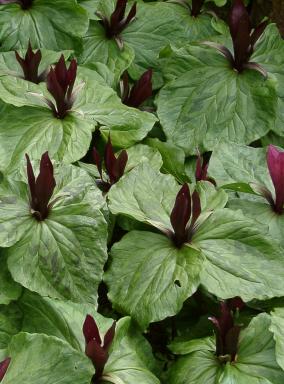
Trillium recurvatum grows in deciduous forests, ravines, floodplain forests, mesic forests, and moist oak savannas, particularly on moist soils rich in limestone. It is distinguished from other sessile-flowered trilliums by its sepals, which bend backward and point downward when the flower is fully open.
Written 26 November 2026 from the sources listed below. Each statement was checked against the passage it cites; statements that could not be supported were removed.
Appearance
The plant bears three mottled-green bracts that range from ovate to lanceolate in shape. Its flowers have three brown to maroon petals with tips that arch over the stamens.[1][2]
The sepals bend backward and point downward when the flower is fully open. Its anthers are dark purple and can reach 16 mm in length, while the tips of its stigmas curve backward.[3][4][5]
Its fruit is green and sometimes has purple or white streaks and six prominent ridges.[6]
The plant can grow to a height of 40 cm. Its mature bracts measure 6–18 cm long and 2–6.5 cm wide, while its petals measure 1.8–4.8 cm long and 0.9–2 cm wide.[7][8][9]
Habitat
Prairie Trillium grows in mesic forests and savannas, frequently on calcareous soils. It particularly favors moist soils rich in limestone.[10][11]
Its habitats include ravines, floodplain forests, mesic forests, moist oak savannas, and southern hardwood forests. It occurs in deciduous forests throughout its geographic range.[12][13][14]
Behaviour
The plant generally grows individually or in clusters rather than in large groups.[15]
It emerges in early spring and becomes dormant in midsummer when flowering or early summer when not flowering. Younger plants become dormant earlier than mature plants, which can remain in bloom throughout early summer.[16][17]
Reproduction and life cycle
Prairie Trillium reproduces sexually through insect pollination and asexually through rhizomatous growth. It is self-incompatible and depends on pollinators to deliver sufficient pollen for seed production.[18][19]
Pollinated mature plants can produce berries shortly before becoming dormant. The plant produces many seeds following pollination, but very few develop successfully.[20][21]
Its seeds possess oil-rich elaiosomes that promote dispersal by ants and other foraging insects.[22]
Diet
The plant provides food for ants, small mammals, and deer.[23]
Similar species
Prairie Trillium is distinguished from other sessile-flowered trilliums, including Trillium sessile, by its reflexed sepals.[24]
Its pollen most closely resembles that of Trillium lancifolium.[25]
Conservation
Prairie Trillium is common across much of its geographic range and is not globally threatened. Its conservation status is considered secure.[26][27]
Wisconsin classifies the species as rare or uncommon (S3) and a species of special concern. Michigan classifies it as threatened at the state level and protects it by law.[28][29]
Habitat fragmentation and habitat loss are identified as threats to the species. Excessive browsing by white-tailed deer reduces its growth and flowering.[30][31]
Vinca minor, Alliaria petiolata, and Hesperis matronalis compete with the species for space and resources.[32]
Classification of the Prairie Trillium
| Kingdom | Plantae |
|---|---|
| Subkingdom | Pteridobiotina |
| Phylum | Tracheophyta |
| Class | Liliopsida |
| Order | Liliales |
| Family | Melanthiaceae (Bunchflower Family) |
| Genus | Trillium (Toadshade) |
| Species | Trillium recurvatum L.C.Beck |
Where the Prairie Trillium is found
Checklists and occurrence records place Trillium recurvatum in 2 countries across North America. GBIF holds 15,980 georeferenced records of it.
Countries
Regions and cities with the most records
- Illinois, United States 7,204
- Indiana, United States 2,759
- Wisconsin, United States 1,190
- Bensenville, United States 1,127
- Westmont, United States 1,116
- Woodridge, United States 1,080
- Westchester, United States 1,079
- Darien, United States 1,069
- West Chicago, United States 1,040
- Northbrook, United States 1,027
- Hinsdale, United States 1,021
- Downers Grove, United States 1,015
- Des Plaines, United States 1,014
- Bolingbrook, United States 1,011
- Melrose Park, United States 1,008
- Mount Prospect, United States 1,006
- Wheaton, United States 993
- Park Ridge, United States 984
- Elmhurst, United States 983
- Morton Grove, United States 970
- Carol Stream, United States 963
- Glenview, United States 961
- Prospect Heights, United States 957
- Niles, United States 950
- Bellwood, United States 941
- Addison, United States 938
- Franklin Park, United States 936
- Elk Grove Village, United States 934
- Brookfield, United States 930
- Glen Ellyn, United States 930
- Naperville, United States 929
- Lisle, United States 926
- Lemont, United States 917
- Lombard, United States 915
- Wheeling, United States 904
- Deerfield, United States 899
A number beside a place is its count of GBIF occurrence records. A place without a number comes from a checklist alone. Records show where a species has been observed or collected, which can include escapes and vagrants.
Common names
English
- Prairie Trillium
- Bloody Butcher
- Bloody Noses
- Prairie Wakerobin
- Toadshade
- Prairie Wake-robin
- Purple Trillium
- Recurved Trillium
- Red Trillium
- Reflexed Trillium
Names in 4 other languages
- Danish
- treblad
- Estonian
- käänd-kolmiklill
- Polish
- trójlist odgięty
- Russian
- Триллиум отогнутый
Synonyms
10 other scientific names have been used for this species and are now treated as synonyms of Trillium recurvatum.
- Phyllantherum recurvatum (L.C.Beck) Nieuwl.
- Trillium recurvatum f. esepalum J.D.Freeman & Heineke
- Trillium recurvatum f. foliosum Steyerm.
- Trillium recurvatum f. luteum Clute
- Trillium recurvatum f. luteum Friesner
- Trillium recurvatum f. petaloideum Steyerm.
- Trillium recurvatum f. recurvatum
- Trillium recurvatum f. shayi E.J.Palmer & Steyerm.
- Trillium unguiculatum Nutt.
- Trillium unguiculatum Raf.
Related species
-
 White TrilliumTrillium grandiflorum
-
 Red TrilliumTrillium erectum
-
 Pacific TrilliumTrillium ovatum
-
 Nodding TrilliumTrillium cernuum
-
 Painted TrilliumTrillium undulatum
-
 ToadshadeTrillium sessile
-
 Little Sweet TrilliumTrillium cuneatum
-
 Giant TrilliumTrillium chloropetalum
Compare
Questions and answers
What is the scientific name of the Prairie Trillium?
The scientific name of the Prairie Trillium is Trillium recurvatum. Written with its author, the full name is Trillium recurvatum L.C.Beck.
Which family does the Prairie Trillium belong to?
Trillium recurvatum belongs to the family Melanthiaceae, in the order Liliales and the class Liliopsida.
Where is the Prairie Trillium found?
Checklists and occurrence records place Trillium recurvatum in 2 countries: United States and Canada.
What is the conservation status of the Prairie Trillium?
The IUCN Red List category recorded for Trillium recurvatum is Least Concern (LC).
What other names does the Prairie Trillium have?
Trillium recurvatum is also known in English as Bloody Butcher, Bloody Noses, Prairie Wakerobin, Toadshade, Prairie Wake-robin and Purple Trillium.
Where are trilliums native to?
Prairie Trillium is native to central and eastern parts of the United States. Its geographic range extends from eastern Oklahoma to western North Carolina, north to central Wisconsin, and south to southeastern Texas. Illinois and Indiana form the center of its geographic range.[33][34][35]
Sources
Passages the profile rests on
- The plant bears three mottled-green bracts that range from ovate to lanceolate in shape. Source passage: “three ovate to lanceolate bracts, mottled green” — English Wikipedia
- Its flowers have three brown to maroon petals with tips that arch over the stamens. Source passage: “The flower has three brown to maroon petals that are 1.8 to 4.8 cm (1 to 2 in) long and 0.9 to 2 cm (0 to 1 in) across, with the petal tips arching over the stamens.” — English Wikipedia
- The sepals bend backward and point downward when the flower is fully open. Source passage: “The sepals are recurved, pointing downwards when the flower has fully opened.” — English Wikipedia
- Its anthers are dark purple and can reach 16 mm in length. Source passage: “The anthers are also dark purple, up to 16 mm (1 in) long.” — English Wikipedia
- The tips of its stigmas curve backward. Source passage: “The stigmas are recurved at the tips.” — English Wikipedia
- Its fruit is green and sometimes has purple or white streaks and six prominent ridges. Source passage: “The fruit is green, sometimes streaked with purple or white, with six well-developed ridges.” — English Wikipedia
- The plant can grow to a height of 40 cm. Source passage: “Trillium recurvatum grows up to 40 cm (16 in) tall” — English Wikipedia
- Its mature bracts measure 6–18 cm long and 2–6.5 cm wide. Source passage: “6 to 18 cm (2 to 7 in) long and 2 to 6.5 cm (1 to 3 in) across” — English Wikipedia
- Its petals measure 1.8–4.8 cm long and 0.9–2 cm wide. Source passage: “1.8 to 4.8 cm (1 to 2 in) long and 0.9 to 2 cm (0 to 1 in) across” — English Wikipedia
- The species grows in mesic forests and savannas, frequently on calcareous soils. Source passage: “It grows in mesic forests and savannas, often in calcareous soils.” — English Wikipedia
- It particularly favors moist soils rich in limestone. Source passage: “although it especially prefers moister, limestone-rich soil.” — English Wikipedia
- It occurs in deciduous forests throughout its geographic range. Source passage: “The plant can be found in deciduous forests throughout its range” — English Wikipedia
- Its habitats include ravines, floodplain forests, mesic forests, and moist oak savannas. Source passage: “This includes ravines, floodplain and mesic forests, moist oak savannas” — English Wikipedia
- It also occurs in southern hardwood forests. Source passage: “and southern hardwood forests.” — English Wikipedia
- The plant generally grows individually or in clusters rather than in large groups. Source passage: “The plant grows both individually and in clusters, though usually not in large groups.” — English Wikipedia
- It emerges in early spring and becomes dormant in midsummer when flowering or early summer when not flowering. Source passage: “A spring ephemeral, T. recurvatum emerges in early spring, and becomes dormant in midsummer if flowering, and early summer if not.” — English Wikipedia
- Younger plants become dormant earlier than mature plants, which can remain in bloom throughout early summer. Source passage: “Younger plants, therefore, become dormant earlier than mature plants (roughly six to seven years old), which can remain in bloom throughout early summer.” — English Wikipedia
- The species reproduces both sexually through insect pollination and asexually through rhizomatous growth. Source passage: “T. recurvatum can reproduce asexually by spreading through rhizomatous growth, as well as sexually through insect pollination.” — English Wikipedia
- The species is self-incompatible and depends on pollinators to deliver sufficient pollen for seed production. Source passage: “Because the species is self-incompatible, it relies on pollinators to deliver enough pollen to produce seeds” — English Wikipedia
- Pollinated mature plants can produce berries shortly before becoming dormant. Source passage: “Mature T. recurvatum can also produce berries when pollinated, shortly before dormancy.” — English Wikipedia
- The plant produces many seeds following pollination, but very few develop successfully. Source passage: “The plant produces a high number of seeds when pollinated, although very few grow successfully.” — English Wikipedia
- Its seeds possess oil-rich elaiosomes that promote dispersal by ants and other foraging insects. Source passage: “The seeds have an oil-rich structure called an elaiosome, which promotes dispersal by ants and other foraging insects.” — English Wikipedia
- The plant provides food for ants, small mammals, and deer. Source passage: “provides food for ants, small mammals, and deer.” — English Wikipedia
- Trillium recurvatum is distinguished from other sessile-flowered trilliums, including Trillium sessile, by its reflexed sepals. Source passage: “It is distinguished from other sessile-flowered Trillium species, such as Trillium sessile, by its reflexed sepals.” — English Wikipedia
- Its pollen most closely resembles that of Trillium lancifolium. Source passage: “T. recurvatum pollen bears the closest resemblance to that of Trillium lancifolium” — English Wikipedia
- The species is common across much of its geographic range and is not globally threatened. Source passage: “T. recurvatum is common throughout much of its range. It is not considered to be globally threatened” — English Wikipedia
- Its conservation status is considered secure. Source passage: “and its status is considered secure.” — English Wikipedia
- Wisconsin classifies the species as rare or uncommon (S3) and a species of special concern. Source passage: “in Wisconsin it is considered rare or uncommon (S3) and therefore a species of special concern.” — English Wikipedia
- Michigan classifies the species as threatened at the state level and protects it by law. Source passage: “In Michigan, it is considered a state threatened species and is protected by law.” — English Wikipedia
- Habitat fragmentation and habitat loss are identified as threats to the species. Source passage: “Threats to T. recurvatum include habitat fragmentation and loss” — English Wikipedia
- Excessive browsing by white-tailed deer reduces the plant's growth and flowering. Source passage: “The overabundance of white-tailed deer leads to increased browsing and decreased growth and flowering in the plant” — English Wikipedia
- Vinca minor, Alliaria petiolata, and Hesperis matronalis compete with the species for space and resources. Source passage: “Invasive species, including Vinca minor, Alliaria petiolata, and Hesperis matronalis, compete with T. recurvatum for space and resources throughout much of its range.” — English Wikipedia
- The species is native to central and eastern parts of the United States. Source passage: “It is native to parts of central and eastern United States” — English Wikipedia
- Its geographic range extends from eastern Oklahoma to western North Carolina, north to central Wisconsin, and south to southeastern Texas. Source passage: “from eastern Oklahoma to western North Carolina, north to central Wisconsin and south to southeastern Texas.” — English Wikipedia
- Illinois and Indiana form the center of its geographic range. Source passage: “centered in Illinois and Indiana” — English Wikipedia
Data
- Catalogue of Life, 2026-10-16 XR cc by
- Global Biodiversity Information Facility CC BY 4.0
- Wikidata CC0
- GeoNames CC BY 4.0
- Wikimedia Commons per image; credit shown with each image
- Within the Catalogue of Life, this name comes from The World Checklist of Vascular Plants (WCVP) cc by
References
- Amer. J. Sci. Arts 11: 178 (1826) where the name was published
This species in other databases
- Catalogue of Life 7CTSY
- Wikidata Q3009702
- iNaturalist 126334
- World Flora Online wfo-0000750906
- GRIN 482287
Page built on 29 November 2026. See how the catalog is made and all sources and licences.
Cite this page
ScientificNames.org. (2026). Trillium recurvatum (Prairie Trillium). Retrieved November 29, 2026, from https://scientificnames.org/species/trillium-recurvatum
“Trillium recurvatum (Prairie Trillium).” ScientificNames.org, 2026, scientificnames.org/species/trillium-recurvatum. Accessed 29 Nov. 2026.
ScientificNames.org. “Trillium recurvatum (Prairie Trillium).” Accessed November 29, 2026. https://scientificnames.org/species/trillium-recurvatum.
@misc{scientificnames_trillium_recurvatum_prairie_trillium,
  author = {{ScientificNames.org}},
  title = {Trillium recurvatum (Prairie Trillium)},
  year = {2026},
  url = {https://scientificnames.org/species/trillium-recurvatum},
  note = {Accessed 2026-11-29}
}