Species · Flowering plants
Pacific Trillium Trillium ovatum
The scientific name of the Pacific Trillium is Trillium ovatum. It is a species of flowering plant in the family Melanthiaceae (bunchflower family), order Liliales.
- Scientific name
- Trillium ovatum Pursh
- Common name
- Pacific Trillium
- Genus
- Trillium
- Family
- Melanthiaceae (Bunchflower Family)
- Order
- Liliales
- Class
- Liliopsida
- Red List category
- LC Least Concern
- Recorded in
- 2 countries
- Name status
- accepted in the Catalogue of Life

Overview
Pacific Trillium is a perennial herbaceous plant that spreads through underground rhizomes. It grows from Monterey County in central California northward to Vancouver Island and southwestern British Columbia, with additional populations extending through parts of the Rocky Mountains. Its flowers typically open white and turn pink as they age, while petals in the Smith River Canyon area can become almost barn-red.
Written 26 November 2026 from the sources listed below. Each statement was checked against the passage it cites; statements that could not be supported were removed.
Similar species
Pacific Trillium closely resembles the eastern North American species Trillium grandiflorum. The two species are difficult to distinguish using characteristics other than their geographic locations.[1][2]
Appearance
Pacific Trillium has generally ovate-rhombic leaves. Its flowers typically open white and turn pink as they age, although petals in the Smith River Canyon area of northern California and southern Oregon can become almost barn-red.[3][4][5]
Mature plants produce one or two flowering scapes measuring 20–50 cm in length. Its leaves measure 7–12 cm long and 5–20 cm wide, while its flower pedicels measure 2–6 cm long.[6][7][8]
Its sepals measure 15–50 mm long and 6–20 mm wide. Its petals measure 15–70 mm long and 10–40 mm wide.[9][10]
Habitat
Pacific Trillium commonly grows in coniferous and mixed coniferous-deciduous forests, including areas around alder thickets and shrubs. It grows in moist forest habitats in the western United States.[11][12]
Along the California coast, it commonly grows beneath coast redwood and mixed evergreen forests. At Lolo Pass in Montana, it grows beneath spruce and Douglas fir in ravines alongside mountain streams.[13][14]
Pacific Trillium does not grow in dry chaparral inland from California and Oregon's redwood and Douglas fir forests or on sparsely wooded ridges.[15]
Behaviour
Pacific Trillium is a long-lived spring ephemeral. Flowering begins in late February in the southern part of its range and generally occurs in March or April elsewhere.[16][17]
Citizen science observations of flowering plants peak during the first week of April. Individuals can undergo extended dormancy, ceasing above-ground growth for one or more years.[18][19]
Reproduction and life cycle
The reproductive life-cycle stage of Pacific Trillium is characterized by three leaves and flowering. Approximately one-quarter of reproductive plants revert to a nonflowering state in a given year.[20][21]
Conservation
The global conservation status of Pacific Trillium was assessed as Secure (G5) in 2019.[22]
Uses
Pacific Trillium is occasionally cultivated outside its native range as far north as Sitka, Alaska. It generally performs poorly as a cultivated plant because it lacks the winter hardiness of other garden plants.[23][24]
Classification of the Pacific Trillium
| Kingdom | Plantae |
|---|---|
| Subkingdom | Pteridobiotina |
| Phylum | Tracheophyta |
| Class | Liliopsida |
| Order | Liliales |
| Family | Melanthiaceae (Bunchflower Family) |
| Genus | Trillium (Toadshade) |
| Species | Trillium ovatum Pursh |
Where the Pacific Trillium is found
Checklists and occurrence records place Trillium ovatum in 2 countries across North America. GBIF holds 43,316 georeferenced records of it.
Countries
Regions and cities with the most records
- California, United States 12,250
- Oregon, United States 9,366
- Washington, United States 9,185
- British Columbia, Canada 8,918
- Portland, United States 2,741
- Tigard, United States 2,656
- Milwaukie, United States 2,618
- Lake Oswego, United States 2,551
- Oak Grove, United States 2,501
- Beaverton, United States 2,500
- Tualatin, United States 2,427
- Happy Valley, United States 2,411
- Bethany, United States 2,393
- Aloha, United States 2,365
- San Rafael, United States 2,120
- Vancouver, United States 1,958
- Langford, Canada 1,927
- Hazel Dell, United States 1,847
- Colwood, Canada 1,815
- Esquimalt, Canada 1,778
- Victoria, Canada 1,670
- Central Saanich, Canada 1,640
- Live Oak, United States 1,625
- West Linn, United States 1,615
- Oak Bay, Canada 1,602
- Santa Cruz, United States 1,601
- Saanich, Canada 1,596
- Orchards, United States 1,526
- Pitt Meadows, Canada 1,376
- Oregon City, United States 1,299
- Fleetwood, Canada 1,242
- Port Coquitlam, Canada 1,214
- Bellevue, United States 1,195
- Maple Ridge, Canada 1,157
- Coquitlam, Canada 1,150
- Redmond, United States 1,143
A number beside a place is its count of GBIF occurrence records. A place without a number comes from a checklist alone. Records show where a species has been observed or collected, which can include escapes and vagrants.
Common names
English
- Pacific Trillium
- Coast Trillium
- Coast Wakerobin
- Pacific Wakerobin
- Western White Trillium
- Western White Wakerobin
- White Trillium
- Western Trillium
- Western Wakerobin
- Wood-lily
Names in 10 other languages
- Chinese
- 卵葉延齢草
- Estonian
- munajas kolmiklill
- French
- trille à feuilles ovées
- Polish
- trójlist jajowaty
- Russian
- Триллиум яйцевидный
- Spanish
- Trillium del Pacífico
- Swedish
- mysktreblad
- Ukrainian
- Триліум яйцеподібний
- dtd
- chaachaawaʕs
- nuk
- haw̓aḥ
Synonyms
6 other scientific names have been used for this species and are now treated as synonyms of Trillium ovatum.
- Trillium californicum Kellogg
- Trillium ovatum f. maculosum Case & R.B.Case
- Trillium ovatum subsp. ovatum
- Trillium scouleri Rydb. ex Gleason
- Trillium venosum R.R.Gates
- Trillium obovatum Hook. ambiguous synonym
Subspecies and varieties
- Trillium ovatum var. ovatum (Pacific Trillium) variety
Related species
-
 White TrilliumTrillium grandiflorum
-
 Red TrilliumTrillium erectum
-
 Nodding TrilliumTrillium cernuum
-
 Painted TrilliumTrillium undulatum
-
 ToadshadeTrillium sessile
-
 Prairie TrilliumTrillium recurvatum
-
 Little Sweet TrilliumTrillium cuneatum
-
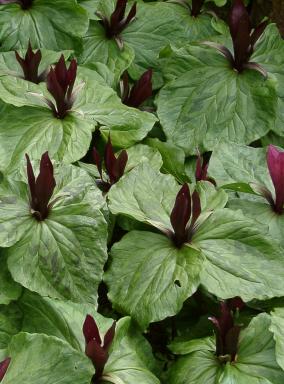 Giant TrilliumTrillium chloropetalum
Compare
Questions and answers
What is the scientific name of the Pacific Trillium?
The scientific name of the Pacific Trillium is Trillium ovatum. Written with its author, the full name is Trillium ovatum Pursh.
Which family does the Pacific Trillium belong to?
Trillium ovatum belongs to the family Melanthiaceae, in the order Liliales and the class Liliopsida.
Where is the Pacific Trillium found?
Checklists and occurrence records place Trillium ovatum in 2 countries: United States and Canada.
What is the conservation status of the Pacific Trillium?
The IUCN Red List category recorded for Trillium ovatum is Least Concern (LC).
What other names does the Pacific Trillium have?
Trillium ovatum is also known in English as Coast Trillium, Coast Wakerobin, Pacific Wakerobin, Western White Trillium, Western White Wakerobin and White Trillium.
Sources
Passages the profile rests on
- Trillium ovatum closely resembles the eastern North American species Trillium grandiflorum. Source passage: “Despite this, T. ovatum closely resembles the eastern T. grandiflorum.” — English Wikipedia
- Trillium ovatum and Trillium grandiflorum are difficult to distinguish using characteristics other than their geographic locations. Source passage: “Apart from geographic location, the two species are not easily distinguished.” — English Wikipedia
- Its leaves are generally ovate-rhombic in shape. Source passage: “The latter are generally ovate-rhombic, 7 to 12 cm (3 to 5 in) long by 5 to 20 cm (2 to 8 in) wide.” — English Wikipedia
- Its flowers typically open white and turn pink as they age. Source passage: “Typically the flower opens white and becomes pink with age” — English Wikipedia
- In the Smith River Canyon area of northern California and southern Oregon, its flower petals can become almost barn-red. Source passage: “in the Smith River Canyon area of northern California and southern Oregon, the petals become almost barn-red.” — English Wikipedia
- Mature plants produce one or two flowering scapes measuring 20–50 cm in length. Source passage: “At maturity, each plant has one or two flowering scapes, each 20 to 50 cm (8 to 19.5 in) in length.” — English Wikipedia
- Its leaves measure 7–12 cm long and 5–20 cm wide. Source passage: “7 to 12 cm (3 to 5 in) long by 5 to 20 cm (2 to 8 in) wide.” — English Wikipedia
- Its flower pedicels measure 2–6 cm long. Source passage: “The flower sits on a pedicel 2 to 6 cm (1 to 2.5 in) in length.” — English Wikipedia
- Its sepals measure 15–50 mm long and 6–20 mm wide. Source passage: “The sepals are 15 to 50 mm (0.59 to 1.97 in) long and 6 to 20 mm (0.24 to 0.79 in) wide” — English Wikipedia
- Its petals measure 15–70 mm long and 10–40 mm wide. Source passage: “the petals are 15 to 70 mm (0.59 to 2.76 in) long and 10 to 40 mm (0.39 to 1.57 in) wide.” — English Wikipedia
- The species commonly grows in coniferous and mixed coniferous-deciduous forests, including areas around alder thickets and shrubs. Source passage: “It is often found growing in coniferous and mixed coniferous-deciduous forests, in and around alder thickets and shrubs.” — English Wikipedia
- The species grows in moist forest habitats in the western United States. Source passage: “grows in moist forest habitats of the western United States.” — scholarworks.umt.edu
- Along the California coast, it commonly grows beneath coast redwood and mixed evergreen forests. Source passage: “Along the California coast, it is commonly found under coast redwood and mixed evergreen forest.” — English Wikipedia
- At Lolo Pass in Montana, the species grows beneath spruce and Douglas fir in ravines alongside mountain streams. Source passage: “At Lolo Pass, Montana, it grows under spruce and Douglas fir in ravines along mountain streams.” — English Wikipedia
- The species does not grow in dry chaparral inland from California and Oregon's redwood and Douglas fir forests or on sparsely wooded ridges. Source passage: “It does not grow in the dry chaparral inland from the redwood and Douglas fir forests of California and Oregon, nor on ridges where the trees are sparse.” — English Wikipedia
- The species is described as a long-lived spring ephemeral. Source passage: “Trillium ovatum is a long-lived, spring ephemeral” — scholarworks.umt.edu
- Flowering begins in late February in the southern part of its range and generally occurs in March or April elsewhere. Source passage: “Flowers bloom late February in the southern part of its range, and in March or April elsewhere.” — English Wikipedia
- Citizen science observations of flowering plants peak during the first week of April. Source passage: “Citizen science observations of flowering plants of this species peak during the first week of April.” — English Wikipedia
- Individuals can undergo extended dormancy, ceasing above-ground growth for one or more years. Source passage: “Under the right conditions, individuals may undergo extended dormancy, that is, they may cease above-ground growth for one or more years.” — English Wikipedia
- The species has a reproductive life-cycle stage characterized by three leaves and flowering. Source passage: “a three-leaf reproductive (flowering) stage” — English Wikipedia
- Approximately one-quarter of reproductive plants revert to a nonflowering state in a given year. Source passage: “Approximately one of every four reproductive plants regresses to a nonflowering state in any given year.” — English Wikipedia
- The global conservation status of Trillium ovatum was assessed as Secure (G5) in 2019. Source passage: “In 2019, the global conservation status of Trillium ovatum was determined to be Secure (G5).” — English Wikipedia
- The species is occasionally cultivated outside its native range as far north as Sitka, Alaska. Source passage: “Trillium ovatum is occasionally cultivated outside its native range as far north as Sitka, Alaska.” — English Wikipedia
- The species generally performs poorly as a cultivated plant because it lacks the winter hardiness of other garden plants. Source passage: “As a cultivated plant, it usually does not perform well since it lacks the winter hardiness of other garden plants.” — English Wikipedia
Data
- Catalogue of Life, 2026-10-16 XR cc by
- Global Biodiversity Information Facility CC BY 4.0
- Wikidata CC0
- GeoNames CC BY 4.0
- Wikimedia Commons per image; credit shown with each image
- Within the Catalogue of Life, this name comes from The World Checklist of Vascular Plants (WCVP) cc by
References
- Fl. Amer. Sept. 1: 245 (1813) where the name was published
This species in other databases
- Catalogue of Life 58TYW
- Wikidata Q3024360
- iNaturalist 49463
- World Flora Online wfo-0000750666
- GRIN 430899
Page built on 27 November 2026. See how the catalog is made and all sources and licences.
Cite this page
ScientificNames.org. (2026). Trillium ovatum (Pacific Trillium). Retrieved November 27, 2026, from https://scientificnames.org/species/trillium-ovatum
“Trillium ovatum (Pacific Trillium).” ScientificNames.org, 2026, scientificnames.org/species/trillium-ovatum. Accessed 27 Nov. 2026.
ScientificNames.org. “Trillium ovatum (Pacific Trillium).” Accessed November 27, 2026. https://scientificnames.org/species/trillium-ovatum.
@misc{scientificnames_trillium_ovatum_pacific_trillium,
  author = {{ScientificNames.org}},
  title = {Trillium ovatum (Pacific Trillium)},
  year = {2026},
  url = {https://scientificnames.org/species/trillium-ovatum},
  note = {Accessed 2026-11-27}
}