Species · Flowering plants
Tripladenia Tripladenia cunninghamii
The scientific name of the Tripladenia is Tripladenia cunninghamii. It is a species of flowering plant in the family Colchicaceae (meadow saffron family), order Liliales.
- Scientific name
- Tripladenia cunninghamii D.Don
- Common name
- Tripladenia
- Genus
- Tripladenia
- Family
- Colchicaceae (Meadow Saffron Family)
- Order
- Liliales
- Class
- Liliopsida
- Recorded in
- 1 country
- Name status
- accepted in the Catalogue of Life

Overview
Tripladenia cunninghamii is the sole species in the genus Tripladenia. It is native to New South Wales and is also recorded in Queensland. It is a rhizomatous geophyte.
Written 26 November 2026 from the sources listed below. Each statement was checked against the passage it cites; statements that could not be supported were removed.
Habitat
Tripladenia grows primarily in the subtropical biome. It grows in rainforest and wet sclerophyll forest.[1][2]
Appearance
The plant is approximately glabrous, apart from scabrous ridges on its stems. Its leaves range from ovate to lanceolate and are 40–90 cm long and 1–4.5 cm wide.[3][4][5]
Its leaves have acute apices, approximately cordate bases and approximately undulate margins.[6]
Its flowers are mauve or pink and measure 15–25 mm in diameter. The flower peduncles are 3–6 cm long, and the pedicels are 1–3 cm long.[7][8][9][10]
Its tepals are 7–12 mm long and 4–7 mm wide. Its basal appendages are 2–3 mm long.[11][12]
Its capsule is ovoid and wrinkled. Its seeds are yellow or brown.[13][14]
Reproduction and life cycle
Tripladenia flowers from October through January.[15]
Classification of the Tripladenia
| Kingdom | Plantae |
|---|---|
| Subkingdom | Pteridobiotina |
| Phylum | Tracheophyta |
| Class | Liliopsida |
| Order | Liliales |
| Family | Colchicaceae (Meadow Saffron Family) |
| Genus | Tripladenia |
| Species | Tripladenia cunninghamii D.Don |
Where the Tripladenia is found
Checklists and occurrence records place Tripladenia cunninghamii in 1 country across Oceania. GBIF holds 1,840 georeferenced records of it.
Countries
Regions and cities with the most records
- New South Wales, Australia 1,471
- Queensland, Australia 337
- Coffs Harbour, Australia 188
- Port Macquarie, Australia 61
- Gold Coast, Australia 41
- Taree, Australia 38
- Capalaba, Australia 16
- Logan City, Australia 15
- Maitland, Australia 12
- Narangba, Australia 5
- Victoria, Australia 3
A number beside a place is its count of GBIF occurrence records. A place without a number comes from a checklist alone. Records show where a species has been observed or collected, which can include escapes and vagrants.
Common names
English
- Tripladenia
- Kreysigia
Names in 2 other languages
- Russian
- Трипладения Куннингама
- Slovak
- tripladénia Cunninghamova
Synonyms
2 other scientific names have been used for this species and are now treated as synonyms of Tripladenia cunninghamii.
- Kreysigia cunninghamii (D.Don) F.Muell.
- Kreysigia tripladenia F.Muell.
Related species
-
 Autumn CrocusColchicum autumnale
-
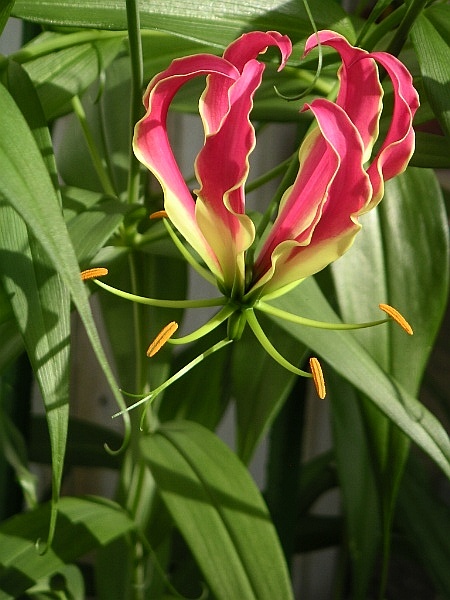 Flame LilyGloriosa superba
-
 ChristmasbellsSandersonia aurantiaca
-
 Giant Meadow SaffronColchicum speciosum
-
 MilkmaidsBurchardia umbellata
-
 Large-flowered BellwortUvularia grandiflora
-
 Early NancyWurmbea dioica
-
 Spring Meadow SaffronColchicum bulbocodium
Compare
Questions and answers
What is the scientific name of the Tripladenia?
The scientific name of the Tripladenia is Tripladenia cunninghamii. Written with its author, the full name is Tripladenia cunninghamii D.Don.
Which family does the Tripladenia belong to?
Tripladenia cunninghamii belongs to the family Colchicaceae, in the order Liliales and the class Liliopsida.
Where is the Tripladenia found?
Checklists and occurrence records place Tripladenia cunninghamii in 1 country: Australia.
What other names does the Tripladenia have?
Tripladenia cunninghamii is also known in English as Kreysigia.
Sources
Passages the profile rests on
- The species grows primarily in the subtropical biome. Source passage: “grows primarily in the subtropical biome.” — powo.science.kew.org
- The species grows in rainforest and wet sclerophyll forest. Source passage: “grows in rainforest and wet sclerophyll forest,” — plantnet.rbgsyd.nsw.gov.au
- The plant is approximately glabrous, apart from scabrous ridges on its stems. Source passage: “± glabrous except for scabrous ridges on stems.” — plantnet.rbgsyd.nsw.gov.au
- Its leaves range from ovate to lanceolate in shape. Source passage: “Leaves ovate to lanceolate” — plantnet.rbgsyd.nsw.gov.au
- Its leaves are 40–90 cm long and 1–4.5 cm wide. Source passage: “40–90 cm long, 1–4.5 cm wide” — plantnet.rbgsyd.nsw.gov.au
- Its leaves have acute apices, approximately cordate bases and approximately undulate margins. Source passage: “apex acute, base ± cordate, margins ± undulate.” — plantnet.rbgsyd.nsw.gov.au
- Its flowers are mauve or pink. Source passage: “Flowers 15–25 mm diam., mauve or pink;” — plantnet.rbgsyd.nsw.gov.au
- Its flowers measure 15–25 mm in diameter. Source passage: “Flowers 15–25 mm diam.” — plantnet.rbgsyd.nsw.gov.au
- Its flower peduncles are 3–6 cm long. Source passage: “peduncle 3–6 cm long;” — plantnet.rbgsyd.nsw.gov.au
- Its flower pedicels are 1–3 cm long. Source passage: “pedicels 1–3 cm long.” — plantnet.rbgsyd.nsw.gov.au
- Its tepals are 7–12 mm long and 4–7 mm wide. Source passage: “Tepals 7–12 mm long, 4–7 mm wide;” — plantnet.rbgsyd.nsw.gov.au
- Its basal appendages are 2–3 mm long. Source passage: “basal appendages 2–3 mm long.” — plantnet.rbgsyd.nsw.gov.au
- Its capsule is ovoid and wrinkled. Source passage: “Capsule ovoid, wrinkled,” — plantnet.rbgsyd.nsw.gov.au
- Its seeds are yellow or brown. Source passage: “seeds yellow or brown.” — plantnet.rbgsyd.nsw.gov.au
- The species flowers from October through January. Source passage: “Flowering: October–January” — plantnet.rbgsyd.nsw.gov.au
Data
- Catalogue of Life, 2026-10-16 XR cc by
- Global Biodiversity Information Facility CC BY 4.0
- Wikidata CC0
- GeoNames CC BY 4.0
- Wikimedia Commons per image; credit shown with each image
- Within the Catalogue of Life, this name comes from The World Checklist of Vascular Plants (WCVP) cc by
References
- Proc. Linn. Soc. London 1: 46 (1839) where the name was published
This species in other databases
Page built on 27 November 2026. See how the catalog is made and all sources and licences.
Cite this page
ScientificNames.org. (2026). Tripladenia cunninghamii (Tripladenia). Retrieved November 27, 2026, from https://scientificnames.org/species/tripladenia-cunninghamii
“Tripladenia cunninghamii (Tripladenia).” ScientificNames.org, 2026, scientificnames.org/species/tripladenia-cunninghamii. Accessed 27 Nov. 2026.
ScientificNames.org. “Tripladenia cunninghamii (Tripladenia).” Accessed November 27, 2026. https://scientificnames.org/species/tripladenia-cunninghamii.
@misc{scientificnames_tripladenia_cunninghamii_tripladenia,
  author = {{ScientificNames.org}},
  title = {Tripladenia cunninghamii (Tripladenia)},
  year = {2026},
  url = {https://scientificnames.org/species/tripladenia-cunninghamii},
  note = {Accessed 2026-11-27}
}