Species · Amphibians
Shovel-headed Treefrog Triprion spatulatus
The scientific name of the Shovel-headed Treefrog is Triprion spatulatus. It is a species of amphibian in the family Hylidae (hylids), order Anura. The name dates from 1882.

Overview
Triprion spatulatus is restricted to the Pacific lowlands of western Mexico, between Sinaloa and Oaxaca. Its head has broad labial flanges that give it a spoon-like shape.
Written 26 November 2026 from the sources listed below. Each statement was checked against the passage it cites; statements that could not be supported were removed.
Appearance
Adult males reach 87 mm in snout–vent length, while adult females reach 101 mm. The head has broad labial flanges that give it a spoon-like shape.[1][2][3]
The eyes are moderately large, protruding, and oriented anterolaterally. The tympanum is visible but partly obscured by labial or postorbital ridges.[4][5]
The fingers have large discs and some rudimentary webbing. The toes are approximately two-thirds webbed.[6][7]
The nominotypical subspecies is pale green or yellowish tan with green to yellow flecks, and its head is somewhat darker than its back. Its flanks are yellowish, and its venter is white, except for grayish-brown flecks in the vocal sac of breeding males.[8][9][10][11]
The reticulatus subspecies has pale yellowish-tan or olive-green coloration with dark brown or black reticulations and spots.[12]
Habitat
The Shovel-headed Treefrog inhabits lowland xeric scrub, thorn-scrub forests, and tropical deciduous forest. It occurs at elevations up to 350 m above sea level.[13][14][15]
Reproduction and life cycle
Breeding occurs in temporary streams and ponds formed by rainfall. The breeding period is restricted to the rainy season.[16][17]
Conservation
The Shovel-headed Treefrog is considered common and is not currently facing significant threats. Fire and changes in rainfall patterns are identified as potential threats.[18][19][20][21]
Its geographic range includes the Chamela-Cuixmala Biosphere Reserve.[22]
Classification of the Shovel-headed Treefrog
| Kingdom | Animalia |
|---|---|
| Phylum | Chordata |
| Subphylum | Vertebrata |
| Infraphylum | Gnathostomata |
| Parvphylum | Osteichthyes |
| Megaclass | Tetrapoda |
| Class | Amphibia (Amphibians) |
| Order | Anura (Frogs) |
| Family | Hylidae (Hylids) |
| Genus | Triprion (Shovel-headed Tree Frogs) |
| Species | Triprion spatulatus Günther, 1882 |
Where the Shovel-headed Treefrog is found
Checklists and occurrence records place Triprion spatulatus in 1 country across North America. GBIF holds 877 georeferenced records of it.
Countries
Regions and cities with the most records
- Sinaloa, Mexico 153
- Colima, Mexico 116
- La Cruz, Mexico 72
- Guerrero, Mexico 60
- Jalisco, Mexico 58
- Tecomán, Mexico 49
- Colima, Mexico 40
- Ciudad de Villa de Álvarez, Mexico 37
- Oaxaca, Mexico 36
- Mazatlán, Mexico 23
- Santo Domingo Tehuantepec, Mexico 22
- Michoacán, Mexico 16
- Cihuatlán, Mexico 15
- Puerto Vallarta, Mexico 14
- Salina Cruz, Mexico 13
- Ixtapa, Mexico 11
- Mezcales, Mexico 11
- San José del Valle, Mexico 9
- Crucecita, Mexico 8
- Bucerías, Mexico 4
- Ciudad Guzmán, Mexico 4
- Nayarit, Mexico 4
- Nueva Italia de Ruiz, Mexico 4
- Tamazula de Gordiano, Mexico 4
- Tuxpan, Mexico 4
- Zapotiltic, Mexico 4
- Ixtepec, Mexico 3
- Manzanillo, Mexico 3
Range as the checklists state it
Middle America
A number beside a place is its count of GBIF occurrence records. A place without a number comes from a checklist alone. Records show where a species has been observed or collected, which can include escapes and vagrants.
Common names
English
- Shovel-headed Treefrog
- Duck-bill Hylid Frog
- Duck-billed Tree Frog
- Mexican Shovel-headed Treefrog
- Shovel-nosed Tree Frog
- Shovelhead Treefrog
Names in 5 other languages
- Czech
- víčkovnice lopatonosá
- Dutch
- Pantserkopboomkikker, Schoffelkopboomkikker
- German
- Panzerkopf-Laubfrosch
- Russian
- лопатоносая квакша
- Spanish
- Rana de árbol cabeza de pala, Rana pico de pato, Rana pico de pato del Pacífico, Rana-de árbol cabeza de pala
Synonyms
7 other scientific names have been used for this species and are now treated as synonyms of Triprion spatulatus.
- Diaglena reticulata Taylor, 1942
- Diaglena spatulata (Günther, 1882)
- Diaglena spatulata reticulata Taylor, 1942
- Diaglena spatulata spatulata (Günther, 1882)
- Hyla spatulata (Günther, 1882)
- Triprion spatulatus reticulatus (Taylor, 1942)
- Triprion spatulatus spatulatus Günther, 1882
Related species
-
 Spiny-headed TreefrogTriprion spinosus
-
 Yucatecan Casque-headed TreefrogTriprion petasatus
-
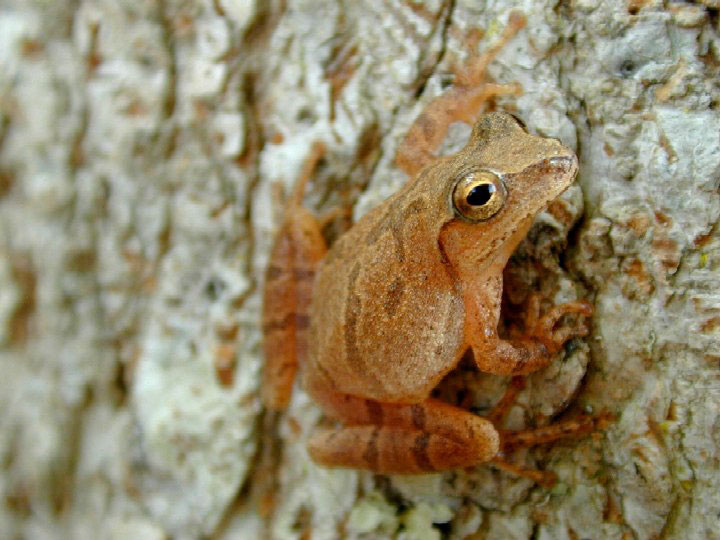 Spring PeeperPseudacris crucifer
-
 Cuban Tree FrogOsteopilus septentrionalis
-
 Pacific Tree FrogPseudacris regilla
-
 Rabbs' Fringe-limbed TreefrogEcnomiohyla rabborum
- European Tree FrogHyla arborea
-
 Mission Golden-eyed Tree FrogTrachycephalus resinifictrix
Compare
Questions and answers
What is the scientific name of the Shovel-headed Treefrog?
The scientific name of the Shovel-headed Treefrog is Triprion spatulatus. Written with its author, the full name is Triprion spatulatus Günther, 1882.
Which family does the Shovel-headed Treefrog belong to?
Triprion spatulatus belongs to the family Hylidae, in the order Anura and the class Amphibia.
Where is the Shovel-headed Treefrog found?
Checklists and occurrence records place Triprion spatulatus in 1 country: Mexico.
What is the conservation status of the Shovel-headed Treefrog?
The IUCN Red List category recorded for Triprion spatulatus is Least Concern (LC).
What other names does the Shovel-headed Treefrog have?
Triprion spatulatus is also known in English as Duck-bill Hylid Frog, Duck-billed Tree Frog, Mexican Shovel-headed Treefrog, Shovel-nosed Tree Frog and Shovelhead Treefrog.
Sources
Passages the profile rests on
- Adult males reach 87 mm in snout–vent length. Source passage: “males reaching 87 mm (3.4 in)” — English Wikipedia
- Adult females reach 101 mm in snout–vent length. Source passage: “females 101 mm (4.0 in) in snout–vent length.” — English Wikipedia
- The head has broad labial flanges that give it a spoon-like shape. Source passage: “The head has broad labial flanges, giving it a spoon-like shape” — English Wikipedia
- The eyes are moderately large, protruding, and oriented anterolaterally. Source passage: “The eyes are protuberant, moderately large, and anterolaterally oriented.” — English Wikipedia
- The tympanum is visible but partly obscured by labial or postorbital ridges. Source passage: “The tympanum is visible but partially obscured by labial and/or postorbital ridges.” — English Wikipedia
- The fingers have large discs and some rudimentary webbing. Source passage: “The fingers bear large discs and some rudimentary webbing.” — English Wikipedia
- The toes are approximately two-thirds webbed. Source passage: “The toes are about two-thirds webbed.” — English Wikipedia
- The nominotypical subspecies is pale green or yellowish tan with green to yellow flecks. Source passage: “The general coloration in the nominotypical subspecies is pale green or yellowish tan with green to yellow flecks.” — English Wikipedia
- The head is somewhat darker than the back in the nominotypical subspecies. Source passage: “The head is somewhat darker than the back.” — English Wikipedia
- The flanks have a yellowish coloration in the nominotypical subspecies. Source passage: “The flanks have a yellowish cast.” — English Wikipedia
- The venter is white in the nominotypical subspecies, except for grayish-brown flecks in the vocal sac of breeding males. Source passage: “The venter is white apart from grayish brown flecks in the voval sac of breedings males.” — English Wikipedia
- The reticulatus subspecies has pale yellowish-tan or olive-green coloration with dark brown or black reticulations and spots. Source passage: “T. s. reticulatus has pale yellowish tan or olive-green coloration with dark brown or black reticulations and spots.” — English Wikipedia
- The species inhabits lowland xeric scrub and thorn-scrub forests. Source passage: “occurs in lowland xeric and thorn-scrub forest” — English Wikipedia
- The species also occurs in tropical deciduous forest. Source passage: “and tropical deciduous forest” — English Wikipedia
- The species occurs at elevations up to 350 m above sea level. Source passage: “at elevations up to 350 m (1,150 ft) asl.” — English Wikipedia
- Breeding occurs in temporary streams and ponds formed by rainfall. Source passage: “Breeding takes place in the temporary streams and ponds formed by rainfall” — English Wikipedia
- The breeding period is restricted to the rainy season. Source passage: “and is therefore constrained to the rainy season.” — English Wikipedia
- The species is considered common. Source passage: “It is a common species” — English Wikipedia
- The species is not currently facing significant threats. Source passage: “that is not facing significant threats.” — English Wikipedia
- Fire is identified as a potential threat to the species. Source passage: “Fire and changes in rainfall patterns are potential threats.” — English Wikipedia
- Changes in rainfall patterns are identified as a potential threat to the species. Source passage: “Fire and changes in rainfall patterns are potential threats.” — English Wikipedia
- The species' geographic range includes the Chamela-Cuixmala Biosphere Reserve. Source passage: “Its range includes the Chamela-Cuixmala Biosphere Reserve.” — English Wikipedia
Data
- Catalogue of Life, 2026-10-16 XR cc by
- Global Biodiversity Information Facility CC BY 4.0
- Wikidata CC0
- GeoNames CC BY 4.0
- Wikimedia Commons per image; credit shown with each image
- Within the Catalogue of Life, this name comes from The Integrated Taxonomic Information System cc0
References
- Flores-Villela, Oscar / McCoy, C. J., ed. (1993). Herpetofauna Mexicana: Lista anotada de las especies de anfibios y reptiles de México, cambios taxonómicos recientes, y nuevas especies. Carnegie Museum of Natural History Special Publication, No. 17.
This species in other databases
Page built on 27 November 2026. See how the catalog is made and all sources and licences.
Cite this page
ScientificNames.org. (2026). Triprion spatulatus (Shovel-headed Treefrog). Retrieved November 27, 2026, from https://scientificnames.org/species/triprion-spatulatus
“Triprion spatulatus (Shovel-headed Treefrog).” ScientificNames.org, 2026, scientificnames.org/species/triprion-spatulatus. Accessed 27 Nov. 2026.
ScientificNames.org. “Triprion spatulatus (Shovel-headed Treefrog).” Accessed November 27, 2026. https://scientificnames.org/species/triprion-spatulatus.
@misc{scientificnames_triprion_spatulatus_shovel_headed_treefrog,
  author = {{ScientificNames.org}},
  title = {Triprion spatulatus (Shovel-headed Treefrog)},
  year = {2026},
  url = {https://scientificnames.org/species/triprion-spatulatus},
  note = {Accessed 2026-11-27}
}