Species · Mammals
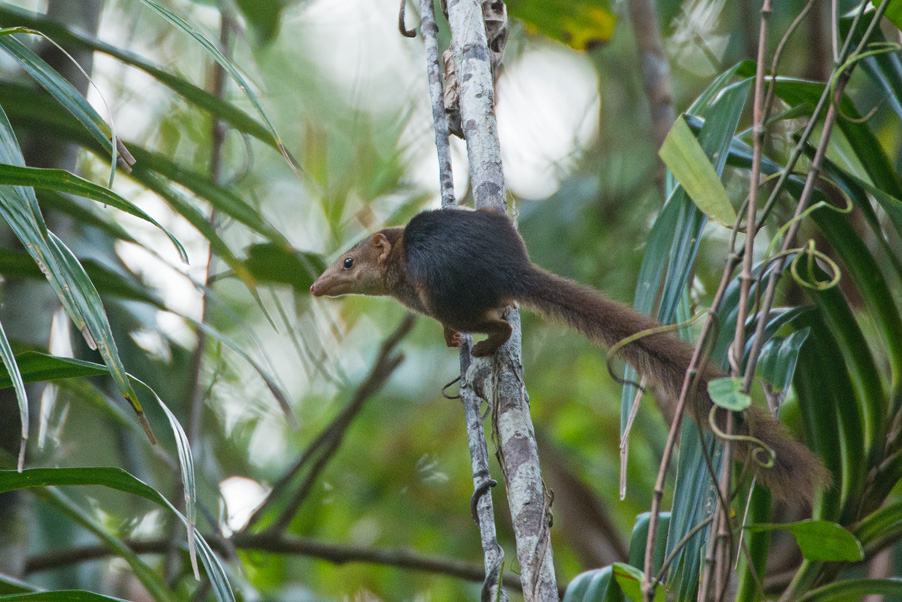
Striped Treeshrew Tupaia dorsalis
The scientific name of the Striped Treeshrew is Tupaia dorsalis. It is a species of mammal in the family Tupaiidae (treeshrews), order Scandentia. The name dates from 1857.
- Scientific name
- Tupaia dorsalis Schlegel, 1857
- Common name
- Striped Treeshrew
- Genus
- Tupaia
- Family
- Tupaiidae (Treeshrews)
- Order
- Scandentia
- Class
- Mammalia
- Red List category
- DD Data Deficient
- Recorded in
- 2 countries
- Name status
- accepted in the Catalogue of Life

Overview
Tupaia dorsalis is endemic to Borneo and has been recorded in Sabah, Sarawak, Brunei, and Kalimantan, excluding the southeastern region. It is distinguished by a black stripe extending along its back from the neck to the base of the tail.
Written 26 November 2026 from the sources listed below. Each statement was checked against the passage it cites; statements that could not be supported were removed.
Conservation
No specimens have been recorded in Sabah during the twenty years preceding the source's report.[1]
Appearance
The Striped Treeshrew has relatively sparse body hair and a bushy tail with a hairless underside. Its dorsal coloration is generally speckled olive-brown but can also be olive, reddish, brown, or black, while its underside is typically grey-buff and lighter than the rest of its body.[2][3][4][5][6]
A distinctive black stripe extends along the back from the neck to the base of the tail. The hind limbs are slightly longer than the forelimbs, and the fingers and toes have curved, pointed claws.[7][8][9]
The ears are small, cartilaginous, immobile, and positioned flat against the head. The species has relatively large eyes and a glandular rhinarium consisting of wet skin on its snout.[10][11][12]
Its overall appearance resembles that of a squirrel, although it has a more pointed snout. Its upper molars have a W-shaped dilambdodont pattern, and it has a well-developed clavicle.[13][14][15]
The reported male cranium profile length is 2.571 mm, while the female cranium profile length is 2.542 mm.[16][17]
Reported body size ranges from 140 to 230 mm, while the reported length range is 100–300 mm.[18][19]
Habitat
The Striped Treeshrew is endemic to Borneo, where it has been recorded in Sabah, Sarawak, Brunei, and Kalimantan, excluding the southeastern region.[20]
The species has been recorded in both primary and secondary forests and generally inhabits lowland environments. Specimens suggest that it prefers lower elevations near coastal areas.[21][22][23]
Its recorded habitats include mangroves and tropical and subtropical moist broadleaf forests. It occurs in Borneo lowland rain forest, Borneo peat swamp forest, southwest Borneo freshwater swamp forest, Sunda Shelf mangroves, and Indo-Malayan and Sundaland heath forests.[24][25][26][27][28][29]
Diet
The Striped Treeshrew is omnivorous. Its insect prey includes flies, crickets, grasshoppers, and cockroaches, while its plant diet includes fruits, seeds, and leaves.[30][31][32]
When eating fruit or seeds, individuals stand on their hind limbs and use their forelimb pads to position the food in front of the mouth.[33]
Behaviour
The Striped Treeshrew is terrestrial and diurnal. It generally lives alone or occasionally in pairs.[34][35]
Individuals aggressively attack intruders belonging to their own species. They produce a short, distinctive whistle when near food and prolonged, shrill cries when antagonized.[36][37][38]
The species is monogamous.[39]
Reproduction and life cycle
Females reportedly reach sexual maturity at approximately 45 g. The reported gestation period for Tupaia species is 45–55 days.[40][41]
The typical litter consists of two offspring, although litter sizes range from one to four. Offspring generally weigh between 6 and 8 g at birth.[42][43]
Females of the genus Tupaia construct nests in fallen trees before giving birth. Newborn young are naked and have closed eyes and ears.[44][45]
Mothers reportedly return to nurse their young every 48 hours. Young leave the nest after approximately four weeks.[46][47]
Weaning can last up to 30 days, and young reportedly reach sexual maturity at approximately two months.[48][49]
Uses
The species may contribute to seed dispersal through its consumption of fruit. It has no known positive or negative economic importance to humans.[50][51][52]
Classification of the Striped Treeshrew
| Kingdom | Animalia |
|---|---|
| Phylum | Chordata |
| Subphylum | Vertebrata |
| Infraphylum | Gnathostomata |
| Parvphylum | Osteichthyes |
| Megaclass | Tetrapoda |
| Class | Mammalia (Mammal) |
| Subclass | Theria |
| Infraclass | Eutheria |
| Order | Scandentia (Treeshrews) |
| Family | Tupaiidae (Treeshrews) |
| Genus | Tupaia (Tree Shrews) |
| Species | Tupaia dorsalis Schlegel, 1857 |
Where the Striped Treeshrew is found
Checklists and occurrence records place Tupaia dorsalis in 2 countries across Asia. GBIF holds 32 georeferenced records of it.
Countries
Regions and cities with the most records
Range as the checklists state it
Southern Asia
A number beside a place is its count of GBIF occurrence records. A place without a number comes from a checklist alone. Records show where a species has been observed or collected, which can include escapes and vagrants.
Common names
English
- Striped Treeshrew
- Striped Scandentian
- Striped Tree Shrew
Names in 11 other languages
- Czech
- tana pruhovaná
- Dutch
- Gestreepte Toepaja
- Finnish
- juovatupaija
- French
- Toupaye rayé, Tupaja rayé, Tupaïa rayé
- German
- Streifenspitzhörnchen
- Japanese
- シマツパイ
- Norwegian Bokmål
- Stripetrespissmus
- Polish
- Tupaja pasiasta
- Russian
- Полосатая тупайя
- Spanish
- Musaraña de árbol rayada
- Thai
- กระแตลายแถบ
Related species
-
 Northern TreeshrewTupaia belangeri
-
 Common TreeshrewTupaia glis
-
 Large TreeshrewTupaia tana
-
 Horsfield's TreeshrewTupaia javanica
-
 Mountain TreeshrewTupaia montana
-
 Nicobar TreeshrewTupaia nicobarica
-
 Pygmy TreeshrewTupaia minor
- Slender TreeshrewTupaia gracilis
Compare
Questions and answers
What is the scientific name of the Striped Treeshrew?
The scientific name of the Striped Treeshrew is Tupaia dorsalis. Written with its author, the full name is Tupaia dorsalis Schlegel, 1857.
Which family does the Striped Treeshrew belong to?
Tupaia dorsalis belongs to the family Tupaiidae, in the order Scandentia and the class Mammalia.
Where is the Striped Treeshrew found?
Checklists and occurrence records place Tupaia dorsalis in 2 countries: Indonesia and Malaysia.
What is the conservation status of the Striped Treeshrew?
The IUCN Red List category recorded for Tupaia dorsalis is Data Deficient (DD).
What other names does the Striped Treeshrew have?
Tupaia dorsalis is also known in English as Striped Scandentian and Striped Tree Shrew.
What do tree shrews eat?
The Striped Treeshrew is omnivorous. It eats flies, crickets, grasshoppers, cockroaches, fruits, seeds, and leaves.[30][31][32]
Where does a tree shrew live?
The Striped Treeshrew is endemic to Borneo and has been recorded in Sabah, Sarawak, Brunei, and Kalimantan, excluding the southeastern region. It inhabits primary and secondary forests, generally in lowland environments, including mangroves and several types of forest.[20][21][22][24][25][26][27][28][29]
Sources
Passages the profile rests on
- No specimens of Tupaia dorsalis have been recorded in Sabah during the twenty years preceding the source's report. Source passage: “there has been no recorded species in Sabah in the last twenty years.” — animaldiversity.org
- The species has a bushy tail with a hairless underside. Source passage: “Its tail is bushy with a naked underside” — animaldiversity.org
- Its body has relatively sparse hair. Source passage: “while its body is less densely haired.” — animaldiversity.org
- The dorsal coloration is generally speckled olive-brown. Source passage: “The back of its body is dark and tends to be more speckled olive-brown in appearance” — animaldiversity.org
- Its dorsal coloration can also be olive, reddish, brown, or black. Source passage: “but can be colored in an olive, reddish, brown or black shade.” — animaldiversity.org
- The underside is typically grey-buff and lighter than the rest of the body. Source passage: “The ventral coloration is typically grey-buff which is lighter than the rest of body” — animaldiversity.org
- A distinctive black stripe extends along the back from the neck to the base of the tail. Source passage: “long black line down its back that extends from neck to base of tail” — animaldiversity.org
- The hind limbs are slightly longer than the forelimbs. Source passage: “The hind limbs tend to be slightly longer than the forelimbs” — animaldiversity.org
- Its fingers and toes have curved, pointed claws. Source passage: “its fingers and toes consist of curved and pointed claws” — animaldiversity.org
- Its ears are small, cartilaginous, immobile, and positioned flat against the head. Source passage: “Its ears are immobile and lie flat against its head, and are small and cartilaginous” — animaldiversity.org
- The species has relatively large eyes. Source passage: “whereas the eyes are relatively large in size” — animaldiversity.org
- Its snout bears a glandular rhinarium consisting of wet skin. Source passage: “The snout has a glandular rhinarium or wet skin” — animaldiversity.org
- Its overall appearance resembles that of a squirrel, although it has a more pointed snout. Source passage: “The striped tree shrew has a general appearance similar to that of a squirrel, however the snout is more pointed” — animaldiversity.org
- The upper molars have a W-shaped dilambdodont pattern. Source passage: “The upper molars have a W pattern (dilambdodont)” — animaldiversity.org
- The species has a well-developed clavicle. Source passage: “The bone structure includes a well developed clavicle” — animaldiversity.org
- The male cranium profile length is reported as 2.571 mm. Source passage: “The cranium profile length in males is 2.571 mm” — animaldiversity.org
- The female cranium profile length is reported as 2.542 mm. Source passage: “females are 2.542 mm.” — animaldiversity.org
- The reported body size of Tupaia dorsalis ranges from 140 to 230 mm. Source passage: “Its body size ranges from 140 to 230 mm” — animaldiversity.org
- The reported length range for the species is 100–300 mm. Source passage: “with a length ranging from 100 to 300 mm.” — animaldiversity.org
- Tupaia dorsalis is endemic to Borneo, where it has been recorded in Sabah, Sarawak, Brunei, and Kalimantan, excluding the southeastern region. Source passage: “The striped tree shrew is endemic to Borneo where it is found in Sabah, Sarawak (Malaysia), Brunei, and Kalimantan (Indonesia) except in the south-east.” — animaldiversity.org
- Tupaia dorsalis has been recorded in both primary and secondary forests. Source passage: “The striped tree shrew has been recorded form primary and secondary forests” — animaldiversity.org
- The species generally inhabits lowland environments. Source passage: “The striped tree shrew in generally a lowland species.” — animaldiversity.org
- Specimens suggest that the species prefers lower elevations near coastal areas. Source passage: “From the few specimens found, they prefer lower altitudes that are near the coast” — animaldiversity.org
- Its recorded habitats include mangroves and tropical and subtropical moist broadleaf forests. Source passage: “forests or terrestrial biomes which include mangroves, tropical, subtropical moist broadleaf forests.” — animaldiversity.org
- The species occurs in Borneo lowland rain forest. Source passage: “Borneo lowland rain forest” — animaldiversity.org
- The species occurs in Borneo peat swamp forest. Source passage: “Borneo peat swamp forest” — animaldiversity.org
- The species occurs in southwest Borneo freshwater swamp forest. Source passage: “southwest Bornew freshwater swamp forest” — animaldiversity.org
- The species occurs in Sunda Shelf mangroves. Source passage: “Sunda shelf mangroves” — animaldiversity.org
- The species occurs in Indo-Malayan and Sundaland heath forests. Source passage: “Indo-Malayan and Sundaland heath forests.” — animaldiversity.org
- Tupaia dorsalis is omnivorous. Source passage: “Tupaia dorsalis is omnivores.” — animaldiversity.org
- Its insect prey includes flies, crickets, grasshoppers, and cockroaches. Source passage: “They eat insects, especially flies, crickets, grasshoppers and cockroaches.” — animaldiversity.org
- Its plant diet includes fruits, seeds, and leaves. Source passage: “They also eat fruits, seeds and leaves of plants.” — animaldiversity.org
- When eating fruit or seeds, individuals stand on their hind limbs and use their forelimb pads to position the food in front of the mouth. Source passage: “they stand up on hind limbs and place the fruit or seed in front of the mouth using the pads of their front limbs.” — animaldiversity.org
- Tupaia dorsalis is terrestrial and generally lives alone or occasionally in pairs. Source passage: “Tupaia dorsalis is terrestrial and tends to live singly or occasionally in pairs.” — animaldiversity.org
- Tupaia dorsalis is diurnal. Source passage: “Striped tree shrews are diurnal” — animaldiversity.org
- Individuals aggressively attack intruders belonging to their own species. Source passage: “They fiercely attack intruders of their own species.” — animaldiversity.org
- The species produces a short, distinctive whistle when near food. Source passage: “When in the presence of food, they make a short peculiar whistling sound” — animaldiversity.org
- Individuals produce prolonged, shrill cries when antagonized. Source passage: “make shrill protracted cries when antagonized.” — animaldiversity.org
- The species is monogamous. Source passage: “Striped tree shrews are monogamous.” — animaldiversity.org
- Females reportedly reach sexual maturity at approximately 45 g. Source passage: “Females reaches sexual maturity at approximately 45 g” — animaldiversity.org
- The reported gestation period for Tupaia species is 45–55 days. Source passage: “Tupaiad gestation period lasts for 45 to 55 days” — animaldiversity.org
- Offspring generally weigh between 6 and 8 g at birth. Source passage: “offspring that generally weigh 6 to 8 g.” — animaldiversity.org
- The typical litter consists of two offspring, although litter sizes range from one to four. Source passage: “Offspring is typically two but can range from one to four.” — animaldiversity.org
- Females of the genus Tupaia construct nests in fallen trees before giving birth. Source passage: “females make nests in fallen trees prior to giving birth.” — animaldiversity.org
- Newborn young are naked and have closed eyes and ears. Source passage: “The young are born naked and their eyes and ears are closed.” — animaldiversity.org
- Mothers reportedly return to nurse their young every 48 hours. Source passage: “only returning every 48 hours to feed the young.” — animaldiversity.org
- Young leave the nest after approximately four weeks. Source passage: “After four weeks, the young leave the nest” — animaldiversity.org
- Weaning can last up to 30 days. Source passage: “Weaning lasts for up to 30 days” — animaldiversity.org
- Young reportedly reach sexual maturity at approximately two months. Source passage: “sexual maturity is reached at approximately 2 months” — animaldiversity.org
- The species may contribute to seed dispersal through its consumption of fruit. Source passage: “They may be seed dispersers due to their fruit eating habits.” — animaldiversity.org
- The species has no known positive economic importance to humans. Source passage: “The striped tree shrew is not known for any positive economic importance on humans.” — animaldiversity.org
- The species has no known negative economic importance to humans. Source passage: “There are no known negative economic importance on humans.” — animaldiversity.org
Data
- Catalogue of Life, 2026-10-16 XR cc by
- Global Biodiversity Information Facility CC BY 4.0
- Wikidata CC0
- GeoNames CC BY 4.0
- Wikimedia Commons per image; credit shown with each image
- Within the Catalogue of Life, this name comes from The Integrated Taxonomic Information System cc0
References
- Handl. Beoef. Dierk. vol.1 p.59, 447, pl. 3 where the name was published
- Wilson, Don E., and DeeAnn M. Reeder, eds. (1993). Mammal Species of the World: A Taxonomic and Geographic Reference, 2nd Ed., 3rd Printing.
- Wilson, Don E., and F. Russell Cole. (2000). Common Names of Mammals of the World.
- Wilson, Don E., and DeeAnn M. Reeder, eds. (2005). Mammal Species of the World: A Taxonomic and Geographic Reference, 3rd Ed., Vols. 1 & 2.
- Hawkins, M. T. R. / Don E. Wilson and Russell A. Mittermeier, eds. (2018). Family Tupaiidae (Treeshrews). Handbook of the Mammals of the World. Vol. 8: Insectivores, Sloths and Colugos.
This species in other databases
Page built on 29 November 2026. See how the catalog is made and all sources and licences.
Cite this page
ScientificNames.org. (2026). Tupaia dorsalis (Striped Treeshrew). Retrieved November 29, 2026, from https://scientificnames.org/species/tupaia-dorsalis
“Tupaia dorsalis (Striped Treeshrew).” ScientificNames.org, 2026, scientificnames.org/species/tupaia-dorsalis. Accessed 29 Nov. 2026.
ScientificNames.org. “Tupaia dorsalis (Striped Treeshrew).” Accessed November 29, 2026. https://scientificnames.org/species/tupaia-dorsalis.
@misc{scientificnames_tupaia_dorsalis_striped_treeshrew,
  author = {{ScientificNames.org}},
  title = {Tupaia dorsalis (Striped Treeshrew)},
  year = {2026},
  url = {https://scientificnames.org/species/tupaia-dorsalis},
  note = {Accessed 2026-11-29}
}