Species · Birds
Cameroon Indigobird Vidua camerunensis
The scientific name of the Cameroon Indigobird is Vidua camerunensis. It is a species of bird in the family Viduidae (whydahs and indigobirds), order Passeriformes. The name dates from 1922.
- Scientific name
- Vidua camerunensis (Grote, 1922)
- Common name
- Cameroon Indigobird
- Genus
- Vidua
- Family
- Viduidae (Whydahs and Indigobirds)
- Order
- Passeriformes
- Class
- Aves
- Red List category
- LC Least Concern
- Recorded in
- 10 countries
- Name status
- accepted in the Catalogue of Life
Overview
The species is reported from Sierra Leone, east Cameroon, north-east Zaire and South Sudan. It is known for selecting and mimicking the songs of other bird species.
Written 27 November 2026 from the sources listed below. Each statement was checked against the passage it cites; statements that could not be supported were removed.
Appearance
The Cameroon Indigobird has blue plumage with underlying brown feathers and a small white beak.[1]
Behaviour
Male Cameroon indigobirds select songs to imitate, while other males imitate songs from different host species. The species commonly mimics the songs of black-bellied firefinches and African firefinches.[2][3]
Male indigobirds show their strongest territorial aggression when they hear their own song or the host song they imitate. Song mimicry contributes to recognition among territorial males.[4][5]
Male indigobirds that successfully mimic songs are attractive to females. Young indigobirds learn to imitate songs during a sensitive developmental period.[6][7]
The species' vocal repertoire includes mimicry, calling and mating vocalizations. Cameroon indigobirds in Sierra Leone mimic the songs of their apparent foster species.[8][9]
Reproduction and life cycle
The Cameroon Indigobird is an obligate brood parasite that lays its eggs in the nests of other birds. Its hosts include African firefinches and black-bellied firefinches.[10][11]
Females prefer males whose songs most closely match those of their foster parents. Male indigobirds have also been observed courting females of other species.[12][13]
Conservation
The species was most recently assessed for the IUCN Red List in 2018.[14]
Similar species
Some authors treat the Cameroon Indigobird as a subspecies of the variable indigobird (Vidua funerea). The species can be difficult to identify in the field.[15][16]
Classification of the Cameroon Indigobird
| Kingdom | Animalia |
|---|---|
| Phylum | Chordata |
| Subphylum | Vertebrata |
| Infraphylum | Gnathostomata |
| Parvphylum | Osteichthyes |
| Megaclass | Tetrapoda |
| Class | Aves (Bird) |
| Order | Passeriformes (Passerine) |
| Family | Viduidae (Whydahs and Indigobirds) |
| Genus | Vidua (Whydahs) |
| Species | Vidua camerunensis (Grote, 1922) |
Where the Cameroon Indigobird is found
Checklists and occurrence records place Vidua camerunensis in 10 countries. GBIF holds 349 georeferenced records of it.
Countries
- Benin 5
- Cameroon 172
- Central African Republic 4
- Gambia 23
- Ghana 15
- Guinea 14
- Ivory Coast 6
- Nigeria 84
- Republic of the Congo 3
- Sierra Leone 23
Regions and cities with the most records
- Adamaoua, Cameroon 128
- Tibati, Cameroon 113
- Taraba State, Nigeria 28
- Northern Province, Sierra Leone 22
- Nasarawa State, Nigeria 12
- Niger State, Nigeria 10
- Plateau State, Nigeria 10
- Nzérékoré Region, Guinea 9
- Banyo, Cameroon 8
- Central, Ghana 6
- Gembu, Nigeria 6
- Keffi, Nigeria 6
- Savannah, Ghana 6
- North-West, Cameroon 5
- Bafut, Cameroon 4
- Edo State, Nigeria 4
- Gueckedou, Guinea 4
- Kogi State, Nigeria 4
- Ngaoundéré, Cameroon 4
- Kouilou, Republic of the Congo 3
- Loandjili, Republic of the Congo 3
- Ouaka, Central African Republic 3
- Pointe-Noire, Republic of the Congo 3
1 more country has a few records outside this range
These countries hold a few records of Vidua camerunensis but lie outside the range the checklists give for it. Such records are often zoo or garden specimens, museum material or vagrants, so the species is not counted as occurring there.
A number beside a place is its count of GBIF occurrence records. A place without a number comes from a checklist alone. Records show where a species has been observed or collected, which can include escapes and vagrants.
Common names
English
- Cameroon Indigobird
- CAIN
- Fonio Indigobird
Names in 23 other languages
- Catalan
- vídua del Camerun
- Chinese
- 喀麥隆維達雀, 喀麦隆维达雀
- Croatian
- smeđokrila udovičica
- Czech
- atlásek kamerunský
- Danish
- Cameroon Atlaskfinke, Camerounatlaskfinke
- Dutch
- Foniostaalvink, Kameroenatlasvink
- Esperanto
- kamerunia viduo
- Finnish
- fonioleski
- French
- Combassou du Cameroun
- German
- Kamerunatlaswitwe, Kamerunwitwe
- Italian
- Vedova del Camerun
- Japanese
- カメルーンシコンチョウ
- Lithuanian
- kamerūninė našlytė
- Norwegian
- guineaenke
- Polish
- wdówka sahelska
- Portuguese
- viúva-camaronesa, viúva-de-camarões, viúva-dos-camarões
- Russian
- Камерунская вдовушка
- Serbian
- Kamerunska atlas udovica
- Slovak
- vdovka vločkovníčia
- Spanish
- Viuda camerunesa, Viuda de Camerún
- Swedish
- fonioänka
- Turkish
- Kamerun Çivitkuşusu
- Ukrainian
- вдовичка камерунська
Synonyms
6 other scientific names have been used for this species and are now treated as synonyms of Vidua camerunensis.
- Hypochera camerunensis Grote, H, 1922
- Hypochera chalybeata camerunensis Grote, H, 1922
- Vidua camerunensis camerunensis Grote, H, 1922
- Vidua camerunensis sharpii
- Vidua chalybea camerunensis Grote, H, 1922
- Vidua funerea camerunensis Grote, H, 1922
Related species
-
 Pin-tailed WhydahVidua macroura
-
 Long-tailed Paradise WhydahVidua paradisaea
-
 Village IndigobirdVidua chalybeata
-
 Shaft-tailed WhydahVidua regia
-
 Exclamatory Paradise WhydahVidua interjecta
-
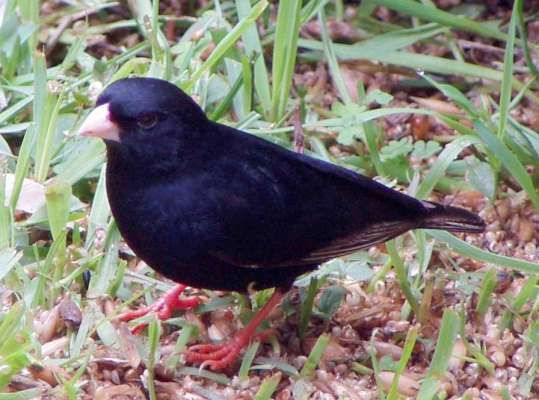 Dusky IndigobirdVidua funerea
-
 Broad-tailed Paradise WhydahVidua obtusa
-
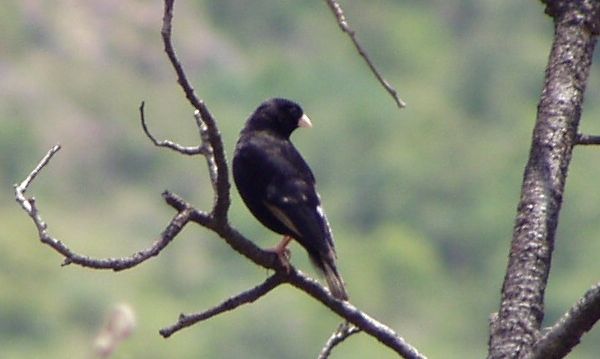 Purple IndigobirdVidua purpurascens
Compare
Questions and answers
What is the scientific name of the Cameroon Indigobird?
The scientific name of the Cameroon Indigobird is Vidua camerunensis. Written with its author, the full name is Vidua camerunensis (Grote, 1922).
Which family does the Cameroon Indigobird belong to?
Vidua camerunensis belongs to the family Viduidae, in the order Passeriformes and the class Aves.
Where is the Cameroon Indigobird found?
Checklists and occurrence records place Vidua camerunensis in 10 countries, including Cameroon, Nigeria, Gambia, Sierra Leone, Ghana and Guinea.
What is the conservation status of the Cameroon Indigobird?
The IUCN Red List category recorded for Vidua camerunensis is Least Concern (LC).
What other names does the Cameroon Indigobird have?
Vidua camerunensis is also known in English as CAIN and Fonio Indigobird.
Which bird songs does the Cameroon Indigobird mimic?
It commonly mimics the songs of black-bellied firefinches and African firefinches.[3]
Where does the Cameroon Indigobird occur?
It is reported from Sierra Leone, east Cameroon, north-east Zaire and South Sudan.[17]
How does the Cameroon Indigobird reproduce?
It is an obligate brood parasite that lays its eggs in the nests of other birds, including African firefinches and black-bellied firefinches.[10][11]
Is the Cameroon Indigobird difficult to identify?
Yes. The species can be difficult to identify to species in the field.[16]
Sources
Passages the profile rests on
- The Cameroon indigobird has blue plumage with underlying brown feathers and a small white beak. Source passage: “The birds have a distinct blue color with underlying brown feathers and a small white beak to crack nuts and seeds.” — English Wikipedia
- Male Cameroon indigobirds select songs to imitate, while other males imitate songs from different host species. Source passage: “The males pick which songs to mimic; however, when one male chooses a song from a host bird, the other males mimic other songs from a different host species.” — English Wikipedia
- The species commonly mimics the songs of black-bellied firefinches and African firefinches. Source passage: “the most common are the black-bellied firefinch (Lagonosticta rara) and African firefinch (L. rubricata).” — English Wikipedia
- Male indigobirds show their strongest territorial aggression when they hear their own song or the host song they imitate. Source passage: “Male indigobirds are most territorial and aggressive when they hear their own song or the host song that they mimic.” — English Wikipedia
- The species' song mimicry contributes to recognition among territorial males. Source passage: “DaCosta et al. found evidence that host mimicry is an important cue for species recognition among the territorial male birds.” — English Wikipedia
- Male indigobirds that successfully mimic songs are attractive to females. Source passage: “females are attracted to males that master the art of mimicry.” — English Wikipedia
- Young indigobirds learn to imitate songs during a sensitive developmental period. Source passage: “They learn to sing and mimic songs in their sensitive period.” — English Wikipedia
- The species' vocal repertoire includes mimicry, calling and mating vocalizations. Source passage: “The male have impressive vocal repertoires that can be used to mimic, calling, or mating.” — English Wikipedia
- Cameroon indigobirds in Sierra Leone mimic the songs of their apparent foster species. Source passage: “A population of brood-parasitic Cameroon Indigobirds (Vidua camerunensis) in. Sierra Leone mimics the songs of its apparent foster species,” — digitalcommons.usf.edu
- The Cameroon indigobird is an obligate brood parasite that lays its eggs in the nests of other birds. Source passage: “These birds are obligate brooding parasites, meaning they lay eggs in other birds' nests.” — English Wikipedia
- The species lays its eggs in nests of African firefinches and black-bellied firefinches, among other hosts. Source passage: “A nest parasite that lays its eggs in the nests of African and Black-bellied Firefinches and Brown and ...” — ebird.org
- Females prefer males whose songs most closely match those of their foster parents. Source passage: “They found that females choose males that have the closest song that matched the foster parent's songs.” — English Wikipedia
- Male indigobirds have been observed courting females of other species. Source passage: “The males of these indigobirds courted heterospecific females to increase genetic diversity.” — English Wikipedia
- The species was most recently assessed for the IUCN Red List in 2018. Source passage: “Cameroon Indigobird Vidua camerunensis has most recently been assessed for The IUCN Red List of Threatened Species in 2018.” — iucnredlist.org
- Some authors treat the Cameroon indigobird as a subspecies of the variable indigobird (Vidua funerea). Source passage: “It is considered by some authors to be a subspecies of the variable indigobird (Vidua funerea).” — English Wikipedia
- The Cameroon indigobird can be difficult to identify to species in the field. Source passage: “Indigobirds can be very difficult to identify to species in the field despite morphological differences among ...” — bu.edu
- The species is reported from Sierra Leone, east Cameroon, north-east Zaire and South Sudan. Source passage: “They range from Sierra Leone to east Cameroon, north east Zaire and South Sudan.” — English Wikipedia
Data
- Catalogue of Life, 2026-10-16 XR cc by
- Global Biodiversity Information Facility CC BY 4.0
- Wikidata CC0
- GeoNames CC BY 4.0
- Within the Catalogue of Life, this name comes from The Integrated Taxonomic Information System cc0
This species in other databases
Page built on 29 November 2026. See how the catalog is made and all sources and licences.
Cite this page
ScientificNames.org. (2026). Vidua camerunensis (Cameroon Indigobird). Retrieved November 29, 2026, from https://scientificnames.org/species/vidua-camerunensis
“Vidua camerunensis (Cameroon Indigobird).” ScientificNames.org, 2026, scientificnames.org/species/vidua-camerunensis. Accessed 29 Nov. 2026.
ScientificNames.org. “Vidua camerunensis (Cameroon Indigobird).” Accessed November 29, 2026. https://scientificnames.org/species/vidua-camerunensis.
@misc{scientificnames_vidua_camerunensis_cameroon_indigobird,
  author = {{ScientificNames.org}},
  title = {Vidua camerunensis (Cameroon Indigobird)},
  year = {2026},
  url = {https://scientificnames.org/species/vidua-camerunensis},
  note = {Accessed 2026-11-29}
}