Species · Birds
Jos Plateau Indigobird Vidua maryae
The scientific name of the Jos Plateau Indigobird is Vidua maryae. It is a species of bird in the family Viduidae (whydahs and indigobirds), order Passeriformes. The name dates from 1982.
- Scientific name
- Vidua maryae Payne, 1982
- Common name
- Jos Plateau Indigobird
- Genus
- Vidua
- Family
- Viduidae (Whydahs and Indigobirds)
- Order
- Passeriformes
- Class
- Aves
- Red List category
- LC Least Concern
- Recorded in
- 1 country
- Name status
- accepted in the Catalogue of Life

Overview
Vidua maryae inhabits dry woodland and shrubland in rocky areas within savanna. It lays its eggs in the nests of rock firefinches and exhibits dominance over their hatchlings after hatching.
Written 26 November 2026 from the sources listed below. Each statement was checked against the passage it cites; statements that could not be supported were removed.
Habitat
The Jos Plateau Indigobird inhabits dry woodland and shrubland in rocky areas. It occurs in rocky areas within savanna.[1][2]
Behaviour
The species exhibits dominance over rock firefinch hatchlings after hatching. It can be confidently identified only through its vocalizations.[3][4]
Reproduction and life cycle
The species lays its eggs in the nests of rock firefinches and removes from the host nest the same number of eggs that it lays there.[5][6]
It breeds throughout the year, with increased breeding activity during the Harmattan period from July to December.[7]
Conservation
Habitat loss is identified as a threat to the species. It was listed as Least Concern in its most recent assessment, conducted in 2016.[8][9][10]
Classification of the Jos Plateau Indigobird
| Kingdom | Animalia |
|---|---|
| Phylum | Chordata |
| Subphylum | Vertebrata |
| Infraphylum | Gnathostomata |
| Parvphylum | Osteichthyes |
| Megaclass | Tetrapoda |
| Class | Aves (Bird) |
| Order | Passeriformes (Passerine) |
| Family | Viduidae (Whydahs and Indigobirds) |
| Genus | Vidua (Whydahs) |
| Species | Vidua maryae Payne, 1982 |
Where the Jos Plateau Indigobird is found
Checklists and occurrence records place Vidua maryae in 1 country. GBIF holds 346 georeferenced records of it.
Countries
Regions and cities with the most records
- Plateau State, Nigeria 317
- Bukuru, Nigeria 276
- Jos, Nigeria 236
- Bauchi, Nigeria 14
- Pankshin, Nigeria 4
A number beside a place is its count of GBIF occurrence records. A place without a number comes from a checklist alone. Records show where a species has been observed or collected, which can include escapes and vagrants.
Common names
English
- Jos Plateau Indigobird
- JPIN
Names in 22 other languages
- Catalan
- vídua de l'altiplà de Jos
- Chinese
- 乔斯维达雀, 約斯高原維達雀
- Croatian
- nigerijska udovičica
- Czech
- atlásek nigerijský
- Danish
- Jos Atlaskfinke, Jos-atlaskfinke
- Dutch
- Jos-Plateaustaalvink
- Esperanto
- ĝosa viduo
- Finnish
- nigerianleski
- French
- Combassou du Jos
- German
- Jos-Plateau-Witwe, Josatlaswitwe
- Italian
- Vedova del Jos Plateau
- Japanese
- ジョスシコンチョウ
- Norwegian
- josenke
- Polish
- wdówka skalna
- Portuguese
- viúva-do-jos, viúva-do-planalto-jos, viúva-do-platô-jos
- Russian
- Вдовушка Жос-Плате, Горная вдовушка
- Serbian
- Atlas udovica sa Džos visoravni
- Slovak
- vdovka amarantia
- Spanish
- Viuda del Jos
- Swedish
- klippamarantsänka
- Turkish
- Jos Platosu Çivitkuşu
- Ukrainian
- вдовичка йосійська
Synonyms
2 other scientific names have been used for this species and are now treated as synonyms of Vidua maryae.
- Hypochera maryae Payne, RB, 1982
- Vidua funerea maryae Payne, RB, 1982
Related species
-
 Pin-tailed WhydahVidua macroura
-
 Long-tailed Paradise WhydahVidua paradisaea
-
 Village IndigobirdVidua chalybeata
-
 Shaft-tailed WhydahVidua regia
-
 Exclamatory Paradise WhydahVidua interjecta
-
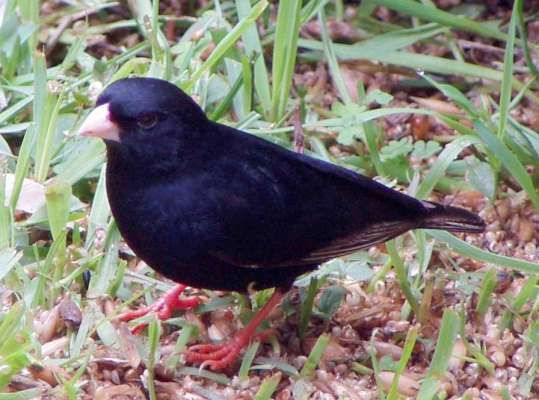 Dusky IndigobirdVidua funerea
-
 Broad-tailed Paradise WhydahVidua obtusa
-
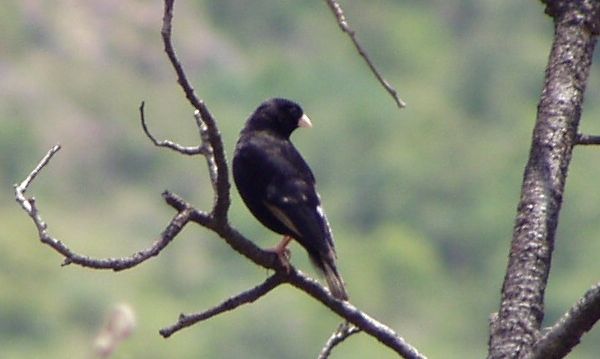 Purple IndigobirdVidua purpurascens
Compare
Questions and answers
What is the scientific name of the Jos Plateau Indigobird?
The scientific name of the Jos Plateau Indigobird is Vidua maryae. Written with its author, the full name is Vidua maryae Payne, 1982.
Which family does the Jos Plateau Indigobird belong to?
Vidua maryae belongs to the family Viduidae, in the order Passeriformes and the class Aves.
Where is the Jos Plateau Indigobird found?
Checklists and occurrence records place Vidua maryae in 1 country: Nigeria.
What is the conservation status of the Jos Plateau Indigobird?
The IUCN Red List category recorded for Vidua maryae is Least Concern (LC).
What other names does the Jos Plateau Indigobird have?
Vidua maryae is also known in English as JPIN.
Where does the Jos Plateau Indigobird occur?
It is described as endemic to Nigeria but has also been reported from northern Cameroon.[11][12]
What is the breeding period of the Jos Plateau Indigobird?
It breeds throughout the year, with increased breeding activity during the Harmattan period from July to December.[7]
Which species' nests does the Jos Plateau Indigobird use?
It lays its eggs in the nests of rock firefinches and removes the same number of eggs that it lays there.[5][6]
What is the conservation status of the Jos Plateau Indigobird?
It was listed as Least Concern in the 2016 IUCN Red List assessment.[9][10]
What threatens the Jos Plateau Indigobird?
Habitat loss is identified as a threat.[8]
How can the Jos Plateau Indigobird be identified?
It can be confidently identified only through its vocalizations.[4]
How is the Jos Plateau Indigobird described in terms of occurrence and knowledge?
It is described as scarce, locally occurring, and poorly known.[13]
Sources
Passages the profile rests on
- The species inhabits dry woodland and shrubland in rocky areas. Source passage: “Its natural habitats are dry woodland and shrubland in rocky areas.” — English Wikipedia
- The species occurs in rocky areas within savanna. Source passage: “Found in rocky areas within savanna.” — ebird.org
- The species exhibits dominance over rock firefinch hatchlings after hatching. Source passage: “After hatching they exhibit dominance against the hatchlings of the rock firefinches.” — English Wikipedia
- The species can be confidently identified only through its vocalizations, according to the available knowledge. Source passage: “Given current knowledge, can only be confidently identified by vocalizations.” — ebird.org
- The species lays its eggs in the nests of rock firefinches. Source passage: “It lays its eggs in the nest of the rock firefinch” — English Wikipedia
- The species removes from the host nest the same number of eggs that it lays there. Source passage: “they lay their eggs in the nest of the rock firefinch and then take away the exact number of laid eggs from the host bird” — English Wikipedia
- The species breeds throughout the year, with increased breeding activity during the Harmattan period from July to December. Source passage: “Their breeding seasons are all round the year but more pronounced during the cold Harmattan period between July and December.” — English Wikipedia
- Habitat loss is identified as a threat to the species. Source passage: “It is threatened by habitat loss.” — English Wikipedia
- The species was listed as Least Concern in its most recent assessment mentioned by the document. Source passage: “Vidua maryae is listed as Least Concern” — iucnredlist.org
- The most recent IUCN Red List assessment identified in the document was conducted in 2016. Source passage: “has most recently been assessed for The IUCN Red List of Threatened Species in 2016.” — iucnredlist.org
- The Jos Plateau indigobird was previously considered endemic to Nigeria but has also been reported from northern Cameroon. Source passage: “It was thought to be endemic to Nigeria, but has been recently reported from northern Cameroon.” — English Wikipedia
- The species is described as endemic to Nigeria. Source passage: “It is endemic to Nigeria.” — inaturalist.org
- The species is described as scarce, locally occurring, and poorly known. Source passage: “A scarce, local, and poorly known species.” — ebird.org
Data
- Catalogue of Life, 2026-10-16 XR cc by
- Global Biodiversity Information Facility CC BY 4.0
- Wikidata CC0
- GeoNames CC BY 4.0
- Wikimedia Commons per image; credit shown with each image
- Within the Catalogue of Life, this name comes from The Integrated Taxonomic Information System cc0
This species in other databases
Page built on 28 November 2026. See how the catalog is made and all sources and licences.
Cite this page
ScientificNames.org. (2026). Vidua maryae (Jos Plateau Indigobird). Retrieved November 28, 2026, from https://scientificnames.org/species/vidua-maryae
“Vidua maryae (Jos Plateau Indigobird).” ScientificNames.org, 2026, scientificnames.org/species/vidua-maryae. Accessed 28 Nov. 2026.
ScientificNames.org. “Vidua maryae (Jos Plateau Indigobird).” Accessed November 28, 2026. https://scientificnames.org/species/vidua-maryae.
@misc{scientificnames_vidua_maryae_jos_plateau_indigobird,
  author = {{ScientificNames.org}},
  title = {Vidua maryae (Jos Plateau Indigobird)},
  year = {2026},
  url = {https://scientificnames.org/species/vidua-maryae},
  note = {Accessed 2026-11-28}
}