Species · Flowering plants
Moth Bean Vigna aconitifolia
The scientific name of the Moth Bean is Vigna aconitifolia. It is a species of flowering plant in the family Fabaceae (bean), order Fabales.
- Scientific name
- Vigna aconitifolia (Jacq.) Maréchal
- Common name
- Moth Bean
- Genus
- Vigna
- Family
- Fabaceae (Bean)
- Order
- Fabales
- Class
- Magnoliopsida
- Red List category
- DD Data Deficient
- Recorded in
- 10 countries
- Name status
- accepted in the Catalogue of Life

Overview
Moth Bean is a creeping, annual herbaceous plant. It is native to India and grows in warm and dry habitats, particularly semi-arid and arid regions of the Indian subcontinent. Its seeds contain approximately 22–24% protein.
Written 26 November 2026 from the sources listed below. Each statement was checked against the passage it cites; statements that could not be supported were removed.
Appearance
Moth Bean is a creeping, annual herbaceous plant with hairy, densely packed branches. It produces yellow flowers.[1][2][3]
Its pods are brown and measure 2.5–5 cm long, with each pod containing between four and nine seeds.[4][5]
The seeds are rectangular and may be yellow-brown, whitish-green, or mottled with black.[6]
The stem can reach approximately 40 cm in height, while the branches can extend to a span of 150 cm.[7][8]
Habitat
Moth Bean grows in warm and dry habitats, particularly semi-arid and arid regions of the Indian subcontinent. It can grow at elevations up to 1,300 metres above sea level.[9][10]
Dry sandy soil is the most suitable soil type for cultivation. The species tolerates soil pH values ranging from 3.5 to 10 and can tolerate slight soil salinity.[11][12][13]
Its optimal annual rainfall for production is 500–750 mm, although it can grow with annual rainfall as low as 200–300 mm. It can tolerate daytime temperatures reaching 45 °C.[14][15][16]
Uses
Moth Bean is cultivated for human food and animal forage. It is also used as a cover crop and for green manuring.[17][18]
In India, its pods, sprouts, and seeds are consumed as food. The pods can be boiled and eaten, while the seeds can be consumed whole or split after cooking or frying.[19][20][21]
In Maharashtra, the sprouts are used to prepare a spicy stew called matki usal. Matki usal is used as the base of the Indian street food dish misal pav.[22][23]
Fried seeds are used to prepare a savoury snack called dalmoth. The flour is used to make a savoury snack called bhujia.[24][25]
Diet
Moth Bean seeds contain approximately 22–24% protein. The species is recognized for its amino acid, mineral, and vitamin profile.[26][27]
Behaviour
When fully grown, Moth Bean forms a low-lying soil cover. This growth helps prevent soil erosion by reducing moisture loss.[28][29]
Reproduction and life cycle
Moth Bean is propagated by seed and is a short-day crop. It generally takes 75–90 days to mature.[30][31][32]
Conservation
Moth Bean is considered an underutilized minor grain legume.[33]
Classification of the Moth Bean
| Kingdom | Plantae |
|---|---|
| Subkingdom | Pteridobiotina |
| Phylum | Tracheophyta |
| Class | Magnoliopsida |
| Order | Fabales |
| Family | Fabaceae (Bean) |
| Genus | Vigna (Cowpea) |
| Species | Vigna aconitifolia (Jacq.) Maréchal |
Where the Moth Bean is found
Checklists and occurrence records place Vigna aconitifolia in 10 countries across Africa and Asia. GBIF holds 551 georeferenced records of it.
Countries where it is native or its origin is not stated
Countries where it has been introduced
Regions and cities with the most records
- Punjab, Pakistan 15
- Yunnan, China 13
- Maharashtra, India 11
- Rajasthan, India 11
- Balochistan, Pakistan 10
- Gujarat, India 5
- Khyber Pakhtunkhwa, Pakistan 5
- Jalgaon, India 4
- Yousuo, China 4
- Zibihu, China 4
- Andhra Pradesh, India 3
- Charsadda, Pakistan 3
- Pabbi, Pakistan 3
- Rawalpindi, Pakistan 3
- Utmanzai, Pakistan 3
- Uttar Pradesh, India 3
- Assam, India
6 more countries have a few records outside this range
These countries hold a few records of Vigna aconitifolia but lie outside the range the checklists give for it. Such records are often zoo or garden specimens, museum material or vagrants, so the species is not counted as occurring there.
A number beside a place is its count of GBIF occurrence records. A place without a number comes from a checklist alone. Records show where a species has been observed or collected, which can include escapes and vagrants.
Common names
English
- Moth Bean
- Dew Bean
- Mat Bean
- Mat-bean
- Moth-bean
Names in 13 other languages
- Bengali
- Kheri
- Chinese
- 乌头叶豇豆, 烏頭葉豇豆
- Danish
- måttebønne
- French
- Haricot Papillon, haricot mat
- German
- Mattenbohne
- Gujarati
- Math, Mut
- Hindi
- Bhringga, Mooth, Moth, मोठ दाल
- Malay
- Mittikelu
- Nepali
- Kulthi
- Slovak
- vigna prilbicolistá
- Tamil
- Kallupayaru, Kollu, Nari Payaru, Pani Payaru, Tulkapavir
- Telugu
- Kuncuma Pesalu
- Thai
- Matpe
Synonyms
5 other scientific names have been used for this species and are now treated as synonyms of Vigna aconitifolia.
- Dolichos dissectus Lam.
- Dolichos palmatus Forssk. ex DC.
- Glycine triloba Burm.f.
- Phaseolus palmatus Forssk.
- Phaseolus aconitifolius Jacq. ambiguous synonym
Related species
-
 Mung BeanVigna radiata
-
 Adzuki BeanVigna angularis
-
 Black GramVigna mungo
-
 CowpeaVigna unguiculata
-
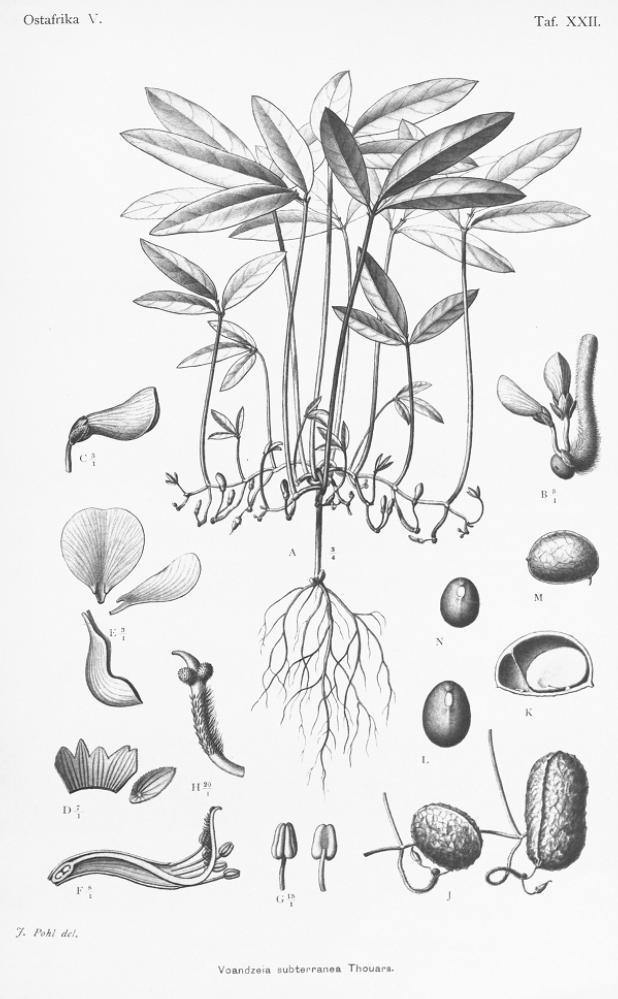 Bambara GroundnutVigna subterranea
-
 Rice BeanVigna umbellata
-
 Hairypod CowpeaVigna luteola
-
 Dune BeanVigna marina
Compare
Questions and answers
What is the scientific name of the Moth Bean?
The scientific name of the Moth Bean is Vigna aconitifolia. Written with its author, the full name is Vigna aconitifolia (Jacq.) Maréchal.
Which family does the Moth Bean belong to?
Vigna aconitifolia belongs to the family Fabaceae, in the order Fabales and the class Magnoliopsida.
Where is the Moth Bean found?
Checklists and occurrence records place Vigna aconitifolia in 10 countries, including India, Pakistan, Afghanistan, China, Sri Lanka and Saudi Arabia.
What is the conservation status of the Moth Bean?
The IUCN Red List category recorded for Vigna aconitifolia is Data Deficient (DD).
What other names does the Moth Bean have?
Vigna aconitifolia is also known in English as Dew Bean, Mat Bean, Mat-bean and Moth-bean.
What are moth beans good for?
Moth Bean is cultivated for human food and animal forage. It is also used as a cover crop and for green manuring.[17][18]
What are the nutritional facts for raw moth beans?
Moth Bean seeds contain approximately 22–24% protein. The species is recognized for its amino acid, mineral, and vitamin profile.[26][27]
Where does moth bean originate from?
Moth Bean is native to India.[34]
Sources
Passages the profile rests on
- The species is a creeping, annual herbaceous plant. Source passage: “Moth bean is a creeping annual herbaceous plant” — English Wikipedia
- The plant has hairy, densely packed branches. Source passage: “its hairy and dense-packed branches reaching a span of up to 150 cm (59 in).” — English Wikipedia
- The plant produces yellow flowers. Source passage: “Yellow flowers develop into a brown pod 2.5 to 5 cm in length” — English Wikipedia
- Its pods are brown and measure 2.5–5 cm long. Source passage: “Yellow flowers develop into a brown pod 2.5 to 5 cm in length” — English Wikipedia
- Each pod contains between four and nine seeds. Source passage: “which holds 4 to 9 seeds inside.” — English Wikipedia
- The seeds are rectangular and may be yellow-brown, whitish-green, or mottled with black. Source passage: “The rectangular seeds exist in a variety of colours including yellow-brown, whitish-green, and mottled with black.” — English Wikipedia
- The plant's stem can reach approximately 40 cm in height. Source passage: “Its stem can grow up to 40 centimetres (16 in) in height” — English Wikipedia
- The branches can extend to a span of 150 cm. Source passage: “branches reaching a span of up to 150 cm (59 in).” — English Wikipedia
- The species grows in warm and dry habitats, particularly semi-arid and arid regions of the Indian subcontinent. Source passage: “an annual herbaceous trailing legume of warm and dry habitats, particularly the semi-arid and arid regions of Indian subcontinent.” — pmc.ncbi.nlm.nih.gov
- The species can grow at elevations up to 1,300 metres above sea level. Source passage: “Grown at altitudes up to 1300 m above sea level” — English Wikipedia
- Dry sandy soil is the most suitable soil type for cultivating the species. Source passage: “While dry sandy soil is most suitable for production” — English Wikipedia
- The species tolerates soil pH values ranging from 3.5 to 10. Source passage: “it has a wide pH range (3.5–10)” — English Wikipedia
- The species can tolerate slight soil salinity. Source passage: “can tolerate slight salinity.” — English Wikipedia
- Its optimal annual rainfall for production is 500–750 mm. Source passage: “While optimal annual rainfall for production is 500–750 mm” — English Wikipedia
- The species can grow with annual rainfall as low as 200–300 mm. Source passage: “it is able to grow with 200–300 mm annually” — English Wikipedia
- The species can tolerate daytime temperatures reaching 45 °C. Source passage: “but has been shown to tolerate up to 45 °C during the day.” — English Wikipedia
- The species is cultivated for human food and animal forage. Source passage: “Moth bean is grown for both human consumption and as a forage crop.” — English Wikipedia
- The species is used as a cover crop and for green manuring. Source passage: “as a cover crop as well as green manuring” — pmc.ncbi.nlm.nih.gov
- The pods, sprouts, and seeds are consumed as food in India. Source passage: “The pods, sprouts, and protein-rich seeds of this crop are commonly consumed in India.” — English Wikipedia
- The seeds can be consumed whole or split after cooking or frying. Source passage: “Whole or split moth bean seeds can be cooked or fried.” — English Wikipedia
- The pods can be boiled and eaten. Source passage: “The moth bean pods can be boiled and eaten.” — English Wikipedia
- In Maharashtra, the sprouts are used to prepare a spicy stew called matki usal. Source passage: “In India, particularly in the state of Maharashtra, moth beans are sprouted before cooking and used for making a spicy stew called matki usal.” — English Wikipedia
- Matki usal is used as the base of the Indian street food dish misal pav. Source passage: “Matki usal forms the base of the Indian street food dish called misal pav.” — English Wikipedia
- Fried seeds are used to prepare a savoury snack called dalmoth. Source passage: “Fried dal of the bean is used to make a dry savory snack, known in India as dalmoth.” — English Wikipedia
- The flour is used to make a savoury snack called bhujia. Source passage: “The flour of the bean is used for making another savoury snack called bhujia.” — English Wikipedia
- The seeds of the species contain approximately 22–24% protein. Source passage: “The beans of these pods contain approximately 22–24% protein.” — English Wikipedia
- The species is recognized for its high protein content and amino acid, mineral, and vitamin profile. Source passage: “owing to its high protein content as well as amino acid, mineral and vitamin profile” — pmc.ncbi.nlm.nih.gov
- The species forms a low-lying soil cover when fully grown. Source passage: “It is an herbaceous creeping annual that creates a low-lying soil cover when fully grown.” — English Wikipedia
- The low-lying growth of the species helps prevent soil erosion by reducing moisture loss. Source passage: “The low-lying soil cover the crop creates helps prevent soil erosion by preventing moisture loss.” — English Wikipedia
- The species is propagated by seed. Source passage: “Propagation of moth bean is done by seed” — English Wikipedia
- The species is a short-day crop. Source passage: “Moth bean, a short-day crop” — English Wikipedia
- The species generally takes 75–90 days to mature. Source passage: “It takes 75–90 days for moth bean to mature” — English Wikipedia
- The species is considered an underutilized minor grain legume. Source passage: “Moth bean [Vigna aconitifolia (Jacq.) Maréchal syn. Phaseolus aconitifolius Jacq. (2n= 2x=22)] is an underutilized, minor grain legume.” — pmc.ncbi.nlm.nih.gov
- The species is native to India. Source passage: “Moth bean is native to India” — English Wikipedia
Data
- Catalogue of Life, 2026-10-16 XR cc by
- Global Biodiversity Information Facility CC BY 4.0
- Wikidata CC0
- GeoNames CC BY 4.0
- Wikimedia Commons per image; credit shown with each image
- Within the Catalogue of Life, this name comes from The World Checklist of Vascular Plants (WCVP): Fabaceae cc by
References
- Bull. Jard. Bot. Natl. Belg. 39: 160 (1969) where the name was published
This species in other databases
- Catalogue of Life 5BDLP
- Wikidata Q511249
- iNaturalist 311355
- World Flora Online wfo-0000187831
- GRIN 41595
Page built on 27 November 2026. See how the catalog is made and all sources and licences.
Cite this page
ScientificNames.org. (2026). Vigna aconitifolia (Moth Bean). Retrieved November 27, 2026, from https://scientificnames.org/species/vigna-aconitifolia
“Vigna aconitifolia (Moth Bean).” ScientificNames.org, 2026, scientificnames.org/species/vigna-aconitifolia. Accessed 27 Nov. 2026.
ScientificNames.org. “Vigna aconitifolia (Moth Bean).” Accessed November 27, 2026. https://scientificnames.org/species/vigna-aconitifolia.
@misc{scientificnames_vigna_aconitifolia_moth_bean,
  author = {{ScientificNames.org}},
  title = {Vigna aconitifolia (Moth Bean)},
  year = {2026},
  url = {https://scientificnames.org/species/vigna-aconitifolia},
  note = {Accessed 2026-11-27}
}