Species · Flowering plants
Hairypod Cowpea Vigna luteola
The scientific name of the Hairypod Cowpea is Vigna luteola. It is a species of flowering plant in the family Fabaceae (bean), order Fabales.
- Scientific name
- Vigna luteola (Jacq.) Benth.
- Common name
- Hairypod Cowpea
- Genus
- Vigna
- Family
- Fabaceae (Bean)
- Order
- Fabales
- Class
- Magnoliopsida
- Red List category
- LC Least Concern
- Recorded in
- 108 countries
- Name status
- accepted in the Catalogue of Life

Overview
Hairypod Cowpea is a short-lived perennial flowering plant in the family Fabaceae, order Fabales, and class Magnoliopsida. It grows in tropical and subtropical regions across multiple continents, including the Americas, Africa, the Middle East, Australia, and Asia.
Written 26 November 2026 from the sources listed below. Each statement was checked against the passage it cites; statements that could not be supported were removed.
Appearance
Its seed pods are thin and hairy, ranging in color from green to brown or black. They grow up to 5 cm long and 5–6 mm wide and contain numerous large black seeds.[1][2][3]
Habitat
The species prefers moist to wet clay soils and tolerates salinity levels from 0 to 10 ppt.[4]
The species occurs across tropical and subtropical regions on multiple continents. In the Americas, its coastal distribution extends from tropical South and Central America to the Gulf Coast states and North Carolina.[5][6]
In Africa, the species is most common in Zimbabwe and also occurs from Senegal through Ethiopia to Egypt. It also occurs in the Middle East, Australia, and across Asia.[7][8]
The species was formerly native to the New World and was introduced into cultivation in Ethiopia.[9]
Diet
Ground-feeding birds consume the seeds of Hairypod Cowpea.[10]
Behaviour
The seed pods twist spirally when seeds are dispersed.[11]
White-tailed deer browse on the species.[12]
Uses
The flowers are eaten as a boiled vegetable in Ethiopia and Malawi. The roots are chewed to obtain their sweet juice.[13][14]
In Ethiopia, the leaves and flowers are combined with Hagenia abyssinica to treat ulcers and syphilis.[15]
In Argentina, the plant is used to control cholesterol levels and is reported to have antimicrobial properties.[16][17]
The species is used to treat ghost sickness in Polynesia.[18]
Hairypod Cowpea is used as livestock pasture and ground cover in countries including Ghana, Zambia, and Australia. It is palatable to livestock and grows well in friable and slightly saline soils.[19][20]
Similar species
Cassius blue, grey hairstreak, long-tailed skipper, and dorantes skipper butterflies use Hairypod Cowpea as a larval host. The fungus Oomyces langloisii grows from dead stems of this plant in North America.[21][22]
Conservation
Hairypod Cowpea is frequently considered a weed in crops because of its abundance.[23]
Classification of the Hairypod Cowpea
| Kingdom | Plantae |
|---|---|
| Subkingdom | Pteridobiotina |
| Phylum | Tracheophyta |
| Class | Magnoliopsida |
| Order | Fabales |
| Family | Fabaceae (Bean) |
| Genus | Vigna (Cowpea) |
| Species | Vigna luteola (Jacq.) Benth. |
Where the Hairypod Cowpea is found
Checklists and occurrence records place Vigna luteola in 108 countries across Africa, Asia, Europe, North America, Oceania and South America. GBIF holds 13,299 georeferenced records of it.
Countries where it is native or its origin is not stated
- Afghanistan 28
- Algeria 3
- Angola 9
- Antigua and Barbuda 6
- Argentina 276
- Australia 353
- Bahamas 8
- Bangladesh 6
- Barbados 7
- Belize 70
- Benin 168
- Bolivia 44
- Bonaire, Saint Eustatius and Saba 16
- Botswana 114
- Brazil 1,279
- British Virgin Islands 3
- Burkina Faso 6
- Burundi 79
- Cameroon 92
- Cayman Islands 18
- Central African Republic 11
- Chad 24
- China 6
- Colombia 148
- Costa Rica 84
- Cuba 44
- Democratic Republic of the Congo 148
- Dominica 27
- Dominican Republic 48
- Ecuador 188
- Egypt 55
- El Salvador 14
- Equatorial Guinea 17
- Ethiopia 39
- Fiji 4
- French Guiana 72
- Gabon 94
- Ghana 28
- Guadeloupe 18
- Guatemala 33
- Guinea 10
- Guinea-Bissau 10
- Guyana 64
- Haiti 7
- Honduras 17
- India 20
- Indonesia 38
- Israel 438
- Ivory Coast 27
- Jamaica 31
- Japan 75
- Kenya 147
- Kiribati 4
- Laos 1
- Lebanon 12
- Liberia 12
- Madagascar 103
- Malawi 102
- Maldives 4
- Martinique 30
- Mexico 599
- Montserrat 7
- Mozambique 40
- Myanmar 4
- Namibia 11
- New Caledonia 3
- Nicaragua 69
- Niger 7
- Nigeria 13
- Palestinian Territory 3
- Panama 41
- Papua New Guinea 25
- Paraguay 38
- Peru 136
- Philippines 11
- Puerto Rico 268
- Republic of the Congo 4
- Reunion 3
- Rwanda 55
- Saint Kitts and Nevis 5
- Saint Lucia 4
- Saint Vincent and the Grenadines 11
- Senegal 15
- Sierra Leone 16
- South Africa 257
- South Sudan 13
- Sri Lanka 1
- Sudan 14
- Suriname 74
- Syria 13
- Taiwan 309
- Tanzania 300
- Thailand 21
- Togo 17
- Trinidad and Tobago 21
- U.S. Virgin Islands 25
- Uganda 168
- Uruguay 39
- Vanuatu
- Venezuela 26
- Vietnam 2
- Zambia 119
- Zimbabwe 29
Countries where it has been introduced
Regions and cities with the most records
- Florida, United States 2,945
- Texas, United States 759
- Louisiana, United States 335
- Queensland, Australia 232
- Northern District, Israel 193
- Jupiter, United States 180
- Titusville, United States 178
- Palm Beach Gardens, United States 175
- Plantation, United States 174
- Lauderdale Lakes, United States 172
- Cooper City, United States 170
- Lauderhill, United States 170
- Davie, United States 165
- Tamarac, United States 164
- Iona, United States 162
- North Lauderdale, United States 161
- Bayshore Gardens, United States 153
- Safed, Israel 153
- Tiberias, Israel 153
- Weston, United States 143
- Galveston, United States 141
- Ramat Gan, Israel 140
- Sarasota, United States 140
- Bnei Brak, Israel 139
- Giv'at Shmuel, Israel 139
- Tel Aviv, Israel 139
- Givatayim, Israel 138
- Or Yehuda, Israel 138
- Bat Yam, Israel 137
- H̱olon, Israel 137
- Yehud-Monosson, Israel 137
- Coral Terrace, United States 136
- Ganei Tikva, Israel 136
- Kiryat Ono, Israel 136
- Yehud Monosson, Israel 136
- Flagami, United States 135
3 more countries have a few records outside this range
These countries hold a few records of Vigna luteola but lie outside the range the checklists give for it. Such records are often zoo or garden specimens, museum material or vagrants, so the species is not counted as occurring there.
A number beside a place is its count of GBIF occurrence records. A place without a number comes from a checklist alone. Records show where a species has been observed or collected, which can include escapes and vagrants.
Common names
English
- Hairypod Cowpea
- Akwari
- Dalrymple Vigna
- Kashilka
- Lubiya Tajyib
- Mare
- Wild Cowpea
Names in 8 other languages
- Chinese
- Chang Ye Jiang Dou, 長葉豇豆, 长叶豇豆
- French
- Antaka, Famehifary, Gilibande, Goko, Indola a kwakwa, Ka vuhivahi, Kavuhivuhi, Masheke
- Hebrew
- לוביה מצרית
- Japanese
- Nagaba-hama-sasage, ナガバハマアズキ, ナガバハマササゲ
- Marathi
- बुरंबुळा
- Russian
- Вигна желтоватая
- Spanish
- Frijol Cimarrón, Porotillo
- Swahili
- Kisukuna
Synonyms
50 other scientific names have been used for this species and are now treated as synonyms of Vigna luteola.
- Callicysthus volubilis Endl.
- Calopogonium pedunculatum Standl.
- Calopogonium pendunculatum Standl.
- Dolichos abyssinicus Steud.
- Dolichos gangeticus Roxb.
- Dolichos glycinoides Kunth
- Dolichos helicopus (E.Mey.) Steud.
- Dolichos luteolus Jacq.
- Dolichos mexicanus Schltdl.
- Dolichos niloticus Delile
- Dolichos repens L.
- Lablab javanicus Miq.
- Lathyrus mexicanus Schlect
- Phasellus violaceus Moench
- Phaseolus luteolus (Jacq.) Gagnep.
- Phaseolus maritimus Hassk.
- Scytalis helicopus E.Mey.
- Scytalis helicopus var. major E.Mey.
- Scytalis helicopus var. minor E.Mey.
- Vigna acuminata Hayata
- Vigna brachystachys Benth.
- Vigna brasiliensis Mart. ex Benth.
- Vigna bukobensis Harms
- Vigna fischeri Harms
- Vigna gangetica Kurz
- Vigna glabra Savi
- Vigna glabra var. angustifolia Engelm. & A.Gray
- Vigna helicopus (E.Mey.) Walp.
- Vigna hirsuta Feay ex Alph.Wood
- Vigna holstii Harms
- Vigna jaegeri Harms
- Vigna longepedunculata Taub.
- Vigna luteola var. angustifolia (Engelm. & A.Gray) S.Watson
- Vigna luteola var. angustifolia B.L.Rob.
- Vigna luteola var. luteola
- Vigna luteola var. villosa (Savi) Baker
- Vigna nigerica A.Chev.
- Vigna nilotica (Delile) Hook.f.
- Vigna repens var. angustifolia (Engelm. & A.Gray) Kuntze
- Vigna repens var. glabra Kuntze
Showing 40 of 50.
Related species
-
 Mung BeanVigna radiata
-
 Adzuki BeanVigna angularis
-
 Black GramVigna mungo
-
 CowpeaVigna unguiculata
-
 Moth BeanVigna aconitifolia
-
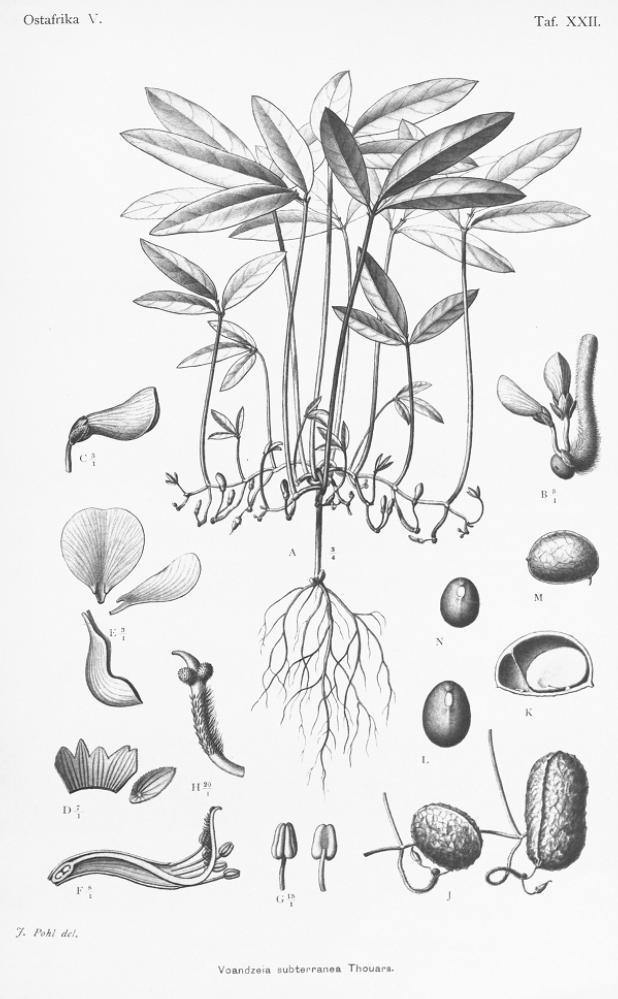 Bambara GroundnutVigna subterranea
-
 Rice BeanVigna umbellata
-
 Dune BeanVigna marina
Compare
Questions and answers
What is the scientific name of the Hairypod Cowpea?
The scientific name of the Hairypod Cowpea is Vigna luteola. Written with its author, the full name is Vigna luteola (Jacq.) Benth..
Which family does the Hairypod Cowpea belong to?
Vigna luteola belongs to the family Fabaceae, in the order Fabales and the class Magnoliopsida.
Where is the Hairypod Cowpea found?
Checklists and occurrence records place Vigna luteola in 108 countries, including Brazil, Mexico, Israel, Australia, Taiwan and Tanzania.
What is the conservation status of the Hairypod Cowpea?
The IUCN Red List category recorded for Vigna luteola is Least Concern (LC).
What other names does the Hairypod Cowpea have?
Vigna luteola is also known in English as Akwari, Dalrymple Vigna, Kashilka, Lubiya Tajyib, Mare and Wild Cowpea.
Sources
Passages the profile rests on
- Its seed pods are thin, hairy, and range in color from green to brown or black. Source passage: “It has thin, pubescent pods that are up to 5 cm (2.0 in) long and 5–6 mm (0.20–0.24 in) wide. The pods are range from green to brown or black.” — English Wikipedia
- Its seed pods grow up to 5 cm long and 5–6 mm wide. Source passage: “pods that are up to 5 cm (2.0 in) long and 5–6 mm (0.20–0.24 in) wide.” — English Wikipedia
- Its pods contain numerous large black seeds. Source passage: “The pods contain numerous large black seeds” — English Wikipedia
- The species prefers moist to wet clay soils and tolerates salinity levels from 0 to 10 ppt. Source passage: “It prefers moist to wet clay soils, and will tolerate a wide range of salinities, from 0-10 ppt.” — English Wikipedia
- The species occurs across tropical and subtropical regions on multiple continents. Source passage: “Vigna luteola can be found in tropical areas on many continents.” — English Wikipedia
- In the Americas, its coastal distribution extends from tropical South and Central America to the Gulf Coast states and North Carolina. Source passage: “ranging from tropical regions of South and Central America to the Gulf Coast states, as far north as North Carolina.” — English Wikipedia
- In Africa, the species is most common in Zimbabwe and also occurs from Senegal through Ethiopia to Egypt. Source passage: “In Africa, the plant is most common in Zimbabwe, but ranges from Senegal to Ethiopia to Egypt” — English Wikipedia
- The species also occurs in the Middle East, Australia, and across Asia. Source passage: “can be found in the Middle East, in Australia, and is widespread across Asia.” — English Wikipedia
- The species was formerly native to the New World and was introduced into cultivation in Ethiopia. Source passage: “Formerly native to the New World, the plant was brought into cultivation in Ethiopia” — English Wikipedia
- Ground-feeding birds consume the seeds of this species. Source passage: “ground-feeding birds often consume the seeds.” — English Wikipedia
- Its seed pods twist spirally when seeds are dispersed. Source passage: “the pod twists spirally when the seeds are dispersed.” — English Wikipedia
- White-tailed deer browse on this species. Source passage: “white-tailed deer often use it as a source of browsing” — English Wikipedia
- The flowers are eaten as a boiled vegetable in Ethiopia and Malawi. Source passage: “The flowers of Vigna luteola are eaten as a boiled vegetable in Ethiopia and Malawi” — English Wikipedia
- The roots are chewed to obtain their sweet juice. Source passage: “the roots are chewed for the sweet juice.” — English Wikipedia
- In Ethiopia, the leaves and flowers are combined with Hagenia abyssinica to treat ulcers and syphilis. Source passage: “In Ethiopia, the leaves and flowers are mixed with Hagenia abyssinica to treat ulcers and syphilis.” — English Wikipedia
- In Argentina, the plant is used to control cholesterol levels. Source passage: “In Argentina, it is used to control cholesterol levels” — English Wikipedia
- The plant is reported to have antimicrobial properties in Argentina. Source passage: “is reported to have antimicrobial properties as well.” — English Wikipedia
- The species is used to treat ghost sickness in Polynesia. Source passage: “It is also used to treat "ghost sickness", a supernatural ailment, in Polynesia.” — English Wikipedia
- The species is used as livestock pasture and ground cover in countries including Ghana, Zambia, and Australia. Source passage: “it is used as a pasture plant and as a ground cover in many countries, such as Ghana, Zambia, and Australia.” — English Wikipedia
- The plant is palatable to livestock and grows well in friable and slightly saline soils. Source passage: “the plant is palatable for livestock and grows well in friable and slightly saline soils” — English Wikipedia
- Cassius blue, grey hairstreak, long-tailed skipper, and dorantes skipper butterflies use the plant as a larval host. Source passage: “Cassius blue, grey hairstreak, long-tailed skipper, and dorantes skipper butterflies use it as a larval host plant” — English Wikipedia
- The fungus Oomyces langloisii grows from dead stems of this plant in North America. Source passage: “Oomyces langloisii grows from dead stems of the plant in North America.” — English Wikipedia
- The species is frequently considered a weed in crops because of its abundance. Source passage: “Vigna luteola is most often considered a weed for crops due to its abundance.” — English Wikipedia
Data
- Catalogue of Life, 2026-10-16 XR cc by
- Global Biodiversity Information Facility CC BY 4.0
- Wikidata CC0
- GeoNames CC BY 4.0
- Wikimedia Commons per image; credit shown with each image
- Within the Catalogue of Life, this name comes from The World Checklist of Vascular Plants (WCVP): Fabaceae cc by
References
- C.F.P.von Martius & auct. suc. (eds.), Fl. Bras. 15(1): 194 (1859) where the name was published
This species in other databases
- Catalogue of Life 5BDQR
- Wikidata Q15228192
- iNaturalist 131583
- World Flora Online wfo-0000188562
- GRIN 41616
Page built on 27 November 2026. See how the catalog is made and all sources and licences.
Cite this page
ScientificNames.org. (2026). Vigna luteola (Hairypod Cowpea). Retrieved November 27, 2026, from https://scientificnames.org/species/vigna-luteola
“Vigna luteola (Hairypod Cowpea).” ScientificNames.org, 2026, scientificnames.org/species/vigna-luteola. Accessed 27 Nov. 2026.
ScientificNames.org. “Vigna luteola (Hairypod Cowpea).” Accessed November 27, 2026. https://scientificnames.org/species/vigna-luteola.
@misc{scientificnames_vigna_luteola_hairypod_cowpea,
  author = {{ScientificNames.org}},
  title = {Vigna luteola (Hairypod Cowpea)},
  year = {2026},
  url = {https://scientificnames.org/species/vigna-luteola},
  note = {Accessed 2026-11-27}
}