Species · Flowering plants
Adzuki Bean Vigna angularis
The scientific name of the Adzuki Bean is Vigna angularis. It is a species of flowering plant in the family Fabaceae (bean), order Fabales.
- Scientific name
- Vigna angularis (Willd.) Ohwi & H.Ohashi
- Common name
- Adzuki Bean
- Genus
- Vigna
- Family
- Fabaceae (Bean)
- Order
- Fabales
- Class
- Magnoliopsida
- Red List category
- LC Least Concern
- Recorded in
- 22 countries
- Name status
- accepted in the Catalogue of Life

Overview
Vigna angularis, also known as the adzuki bean (Japanese: 小豆, Hepburn: azuki), azuki bean, aduki bean, red bean, or red mung bean, is an annual vine widely cultivated throughout East Asia for its small (approximately 5 mm or 1⁄4 in long) bean. The cultivars most familiar in East Asia have a uniform red color, but there are white, black, gray, and variously mottled varieties.
Classification of the Adzuki Bean
| Kingdom | Plantae |
|---|---|
| Subkingdom | Pteridobiotina |
| Phylum | Tracheophyta |
| Class | Magnoliopsida |
| Order | Fabales |
| Family | Fabaceae (Bean) |
| Genus | Vigna (Cowpea) |
| Species | Vigna angularis (Willd.) Ohwi & H.Ohashi |
Where the Adzuki Bean is found
Checklists and occurrence records place Vigna angularis in 22 countries across Africa, Asia, Europe and North America. GBIF holds 9,852 georeferenced records of it.
Countries where it is native or its origin is not stated
- Afghanistan 892
- Bangladesh
- Bhutan 6
- Georgia 12
- Hong Kong 29
- Japan 3,737
- Malaysia 3
- Myanmar 5
- Nepal 92
- North Korea 134
- Philippines 123
- South Korea 2,646
- Taiwan 611
- United States 476
- Vietnam 8
Countries where it has been introduced
Regions and cities with the most records
- Gyeonggi-do, South Korea 260
- Seongnam-si, South Korea 163
- Gwangju, South Korea 156
- Hanam, South Korea 154
- Gunpo, South Korea 144
- Uiwang, South Korea 144
- Suwon, South Korea 142
- Chungcheongnam-do, South Korea 141
- Gangwon-do, South Korea 135
- Anyang-si, South Korea 107
- Gyeongsangnam-do, South Korea 105
- Gyeongsangbuk-do, South Korea 98
- Kanagawa, Japan 98
- Kochi, Japan 93
- Zama, Japan 85
- Machida, Japan 84
- Minamirinkan, Japan 82
- Aihara, Japan 77
- Yamato, Japan 77
- Hachiōji, Japan 73
- Tama, Japan 69
- Hino, Japan 66
- Seoul, South Korea 66
- Inagi, Japan 65
- Jeollabuk-do, South Korea 60
- Atsugi, Japan 59
- Kunitachi, Japan 58
- Toyama, Japan 58
- Gwangmyeong, South Korea 57
- Ayase, Japan 54
- Fuchū, Japan 54
- Komae, Japan 54
- Sagamihara, Japan 54
- Chōfu, Japan 53
- Guri-si, South Korea 53
- Tachikawa, Japan 53
14 more countries have a few records outside this range
These countries hold a few records of Vigna angularis but lie outside the range the checklists give for it. Such records are often zoo or garden specimens, museum material or vagrants, so the species is not counted as occurring there.
A number beside a place is its count of GBIF occurrence records. A place without a number comes from a checklist alone. Records show where a species has been observed or collected, which can include escapes and vagrants.
Common names
English
- Adzuki Bean
- Azuki Bean
- Red Bean
- Small Red (Adzuki) Beans
Names in 12 other languages
- Chinese
- 歪头菜, 紅豆, 赤小豆, 赤小豆叶, 赤小豆花, 赤小豆芽, 赤豆, 野紅豆
- Czech
- vigna hranatá
- Dutch
- Adukiboon, adzukibonen
- Finnish
- adsukipapu
- Japanese
- Yabu Tsuru Azuki, アズキ
- Korean
- 팥
- Polish
- Fasola azuki
- Portuguese
- Feijão-azuqui e afins
- Russian
- Вигна угловатая
- Slovenian
- azuki fižol
- aka
- Ɛdua
- bnn
- bainukalitang
Synonyms
11 other scientific names have been used for this species and are now treated as synonyms of Vigna angularis.
- Azukia angularis (Willd.) Ohwi
- Azukia angularis var. nipponensis (Ohwi) Ohwi
- Dolichos angularis Willd.
- Dolichos angulatus Willd.
- Phaseolus angularis (Willd.) W.Wight
- Phaseolus angularis var. angularis
- Phaseolus angularis var. nipponensis (Ohwi) Ohwi
- Phaseolus atsuki Siebold
- Phaseolus nipponensis Ohwi
- Vigna angularis var. angularis
- Vigna angularis var. nipponensis (Ohwi) Ohwi & H.Ohashi
Related species
-
 Mung BeanVigna radiata
-
 Urad DalVigna mungo
-
 CowpeaVigna unguiculata
-
 Moth BeanVigna aconitifolia
-
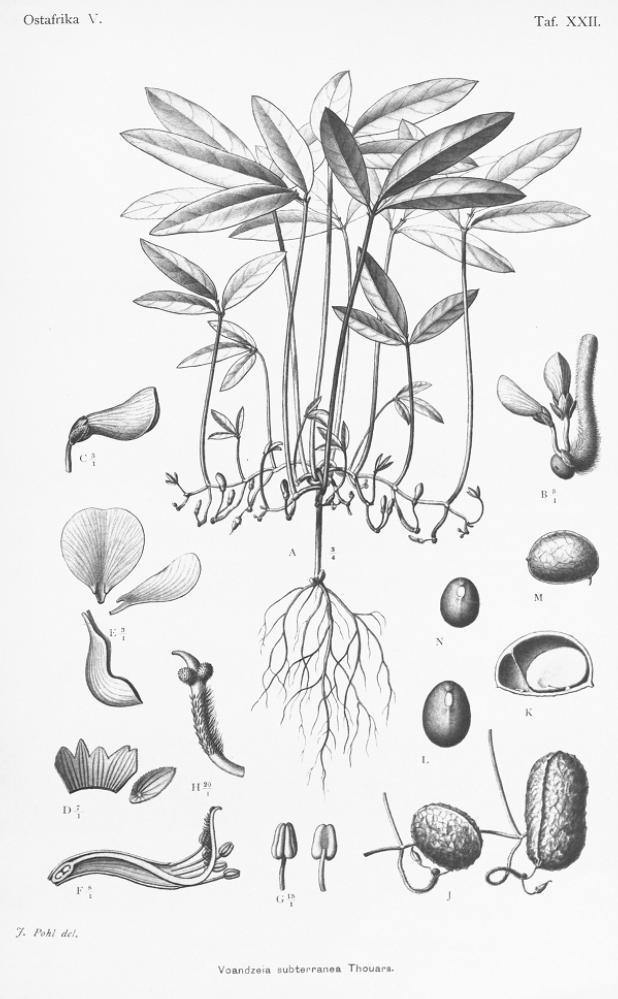 Bambara GroundnutVigna subterranea
-
 Rice BeanVigna umbellata
-
 MareVigna luteola
-
 Sea-beanVigna marina
Compare
Questions and answers
What is the scientific name of the Adzuki Bean?
The scientific name of the Adzuki Bean is Vigna angularis. Written with its author, the full name is Vigna angularis (Willd.) Ohwi & H.Ohashi.
Which family does the Adzuki Bean belong to?
Vigna angularis belongs to the family Fabaceae, in the order Fabales and the class Magnoliopsida.
Where is the Adzuki Bean found?
Checklists and occurrence records place Vigna angularis in 22 countries, including Japan, South Korea, Afghanistan, Taiwan, United States and North Korea.
What is the conservation status of the Adzuki Bean?
The IUCN Red List category recorded for Vigna angularis is Least Concern (LC).
What other names does the Adzuki Bean have?
Vigna angularis is also known in English as Azuki Bean, Red Bean and Small Red (Adzuki) Beans.
Sources
Data
- Catalogue of Life, 2026-10-16 XR cc by
- Global Biodiversity Information Facility CC BY 4.0
- Wikidata CC0
- English Wikipedia CC BY-SA 4.0
- GeoNames CC BY 4.0
- Wikimedia Commons per image; credit shown with each image
- Within the Catalogue of Life, this name comes from The World Checklist of Vascular Plants (WCVP): Fabaceae cc by
References
- J. Jap. Bot. 44: 29 (1969) where the name was published
This species in other databases
- Catalogue of Life 5BDLX
- Wikidata Q380279
- iNaturalist 122889
- World Flora Online wfo-0000187878
- GRIN 41598
Page built on 24 November 2026. See how the catalog is made and all sources and licences.
Cite this page
ScientificNames.org. (2026). Vigna angularis (Adzuki Bean). Retrieved November 24, 2026, from https://scientificnames.org/species/vigna-angularis
“Vigna angularis (Adzuki Bean).” ScientificNames.org, 2026, scientificnames.org/species/vigna-angularis. Accessed 24 Nov. 2026.
ScientificNames.org. “Vigna angularis (Adzuki Bean).” Accessed November 24, 2026. https://scientificnames.org/species/vigna-angularis.
@misc{scientificnames_vigna_angularis_adzuki_bean,
  author = {{ScientificNames.org}},
  title = {Vigna angularis (Adzuki Bean)},
  year = {2026},
  url = {https://scientificnames.org/species/vigna-angularis},
  note = {Accessed 2026-11-24}
}