Species · Flowering plants
Cowpea Vigna unguiculata
The scientific name of the Cowpea is Vigna unguiculata. It is a species of flowering plant in the family Fabaceae (bean), order Fabales.
- Scientific name
- Vigna unguiculata (L.) Walp.
- Common name
- Cowpea
- Genus
- Vigna
- Family
- Fabaceae (Bean)
- Order
- Fabales
- Class
- Magnoliopsida
- Recorded in
- 104 countries
- Name status
- accepted in the Catalogue of Life

Overview
Vigna unguiculata grows in diverse agroecosystems, including arid and semidesert regions, and grows best in sandy soils. It is capable of fixing atmospheric nitrogen through its root nodules.
Written 26 November 2026 from the sources listed below. Each statement was checked against the passage it cites; statements that could not be supported were removed.
Appearance
Bushy varieties can grow to approximately 20 cm tall, while climbing or trailing varieties can reach approximately 2 m in height. The taproot can penetrate approximately 2.4 m into the soil after eight weeks of growth.[1][2][3]
The leaves vary considerably in size and shape. Flower and seed-pod stalks measure approximately 20–50 cm long, and individual flower stalks can support four or more seed pods.[4][5][6]
The flowers can be purple, pink, yellow, white, or blue. Cultivated varieties produce seed pods approximately 10–110 cm long, each containing six to thirteen seeds.[7][8][9]
The seeds are usually kidney-shaped, although restricted space within the pod can make them more spherical. Their coats can be smooth or rough, and their surfaces may be speckled, mottled, or blotchy.[10][11]
Seed colours include white, cream, green, red, brown, and black, as well as combinations of these colours.[12]
Habitat
Cowpea grows well in sandy soils containing up to 85% sand. It tolerates infertile and acidic soils better than most other crops.[13][14]
It is cultivated in arid and semidesert regions where few other crops grow successfully. It grows best in regions receiving approximately 400–700 mm of annual rainfall, with an optimum growth temperature of approximately 30 °C.[15][16][17]
Cowpea was domesticated in Africa. West Africa has been proposed as the likely centre of origin and early domestication of cultivated cowpea, while molecular-marker research has also suggested East Africa as a possible domestication region.[18][19][20]
Cowpea remains discovered in rock shelters in Central Ghana have been dated to the second millennium BC. The species is believed to have reached Southeast Asia around 2300 BC and subsequently spread north to the Mediterranean region, where Greek and Roman populations used it.[21][22][23]
Cowpea probably reached Central and North America during the transatlantic slave trade between the seventeenth and early nineteenth centuries.[24]
The largest production areas are in Africa, particularly Nigeria and Niger, which together account for approximately 66% of worldwide production. Other major cowpea-producing countries in the Sahel include Burkina Faso, Ghana, Senegal, and Mali.[25][26][27]
Outside Africa, major production regions include Asia, Central America, and South America. Brazil is the world's second-leading cowpea seed producer and accounts for approximately 17% of annual production.[28][29]
Uses
Cowpea is primarily cultivated for its edible seeds. The seeds are commonly cooked and prepared as stews and curries or processed into flour and paste.[30][31]
Cowpea leaves and immature seed pods can also be consumed as food. Leaves can be harvested starting four weeks after planting, and seeds can be harvested approximately 100 days after planting.[32][33][34]
The whole plant is used as animal forage. It can be harvested for forage approximately 120 days after planting.[35][36]
Cowpea can be intercropped with sorghum, millet, maize, cassava, and cotton. It is cultivated as a food, feed, and soil-fertility management crop.[37][38]
Diet
Cowpea seeds are rich in protein and provide food energy, minerals, and vitamins. They contain approximately 25% protein.[39][40]
Cowpea seed starch is digested more slowly than cereal starch.[41]
Behaviour
Cowpea fixes atmospheric nitrogen through its root nodules. This contributes to soil fertility, including under suboptimal growing conditions.[42][43]
Cowpea exhibits resilience to environmental challenges associated with climate variability.[44]
Reproduction and life cycle
Cowpea is primarily self-pollinating. Genetic diversity within cowpea varieties is relatively low.[45][46]
Classification of the Cowpea
| Kingdom | Plantae |
|---|---|
| Subkingdom | Pteridobiotina |
| Phylum | Tracheophyta |
| Class | Magnoliopsida |
| Order | Fabales |
| Family | Fabaceae (Bean) |
| Genus | Vigna (Cowpea) |
| Species | Vigna unguiculata (L.) Walp. |
Where the Cowpea is found
Checklists and occurrence records place Vigna unguiculata in 104 countries across Africa, Asia, Europe, North America, Oceania and South America. GBIF holds 55,000 georeferenced records of it.
Countries where it is native or its origin is not stated
- Afghanistan 2,343
- Angola 302
- Benin 952
- Botswana 1,697
- Burundi 119
- Cabo Verde 3
- Cameroon 2,546
- Central African Republic 320
- China 869
- Democratic Republic of the Congo 506
- Equatorial Guinea 18
- Eritrea 16
- Eswatini 254
- Ethiopia 386
- Gabon 38
- Gambia 20
- Ghana 1,613
- Guinea 295
- Guinea-Bissau 49
- Italy 532
- Ivory Coast 494
- Kenya 807
- Lesotho 75
- Liberia 52
- Malawi 1,074
- Mali 1,351
- Mayotte 36
- Morocco 16
- Mozambique 337
- Namibia 311
- Nigeria 10,052
- Portugal 443
- Republic of the Congo 318
- Reunion 14
- Romania 413
- Rwanda 33
- Sao Tome and Principe 24
- Senegal 740
- Seychelles 12
- Sierra Leone 76
- South Africa 1,667
- South Sudan 15
- Sudan 254
- Tanzania 1,407
- Tunisia 19
- Zambia 1,085
- Zimbabwe 624
Countries where it has been introduced
- Algeria 11
- Australia 176
- Bangladesh 290
- Brazil 685
- Burkina Faso 692
- Cambodia 86
- Chad 337
- Colombia 174
- Comoros 8
- Cuba 68
- Dominican Republic 11
- Ecuador 37
- Egypt 873
- El Salvador 20
- Fiji 6
- French Guiana 13
- Guatemala 81
- Guyana 12
- Haiti 11
- Honduras 23
- India 5,719
- Indonesia 430
- Iraq 49
- Jamaica 28
- Kazakhstan 38
- Kiribati
- Kyrgyzstan 12
- Laos 127
- Libya 44
- Madagascar 334
- Mauritania 4
- Mexico 622
- Myanmar 16
- Nepal 194
- New Caledonia 17
- Niger 3,190
- Pakistan 169
- Papua New Guinea 21
- Philippines 777
- Puerto Rico 105
- Russia 68
- Somalia 307
- Sri Lanka 58
- Suriname 57
- Taiwan 181
- Tajikistan 40
- Thailand 498
- Togo 382
- Trinidad and Tobago 10
- Turkmenistan 92
- Uganda 293
- Ukraine 26
- United States 2,276
- Uzbekistan 176
- Vanuatu 2
- Vietnam 275
- Yemen 122
Regions and cities with the most records
- Plateau State, Nigeria 483
- North, Cameroon 422
- KwaZulu-Natal, South Africa 411
- Dolj, Romania 398
- Niger State, Nigeria 396
- Adamawa, Nigeria 380
- Taraba State, Nigeria 215
- Koulikoro, Mali 208
- Volta, Ghana 206
- Mokolo, Cameroon 205
- Limpopo, South Africa 196
- Pitoa, Cameroon 191
- Kebbi, Nigeria 183
- Oyo State, Nigeria 183
- Mpumalanga, South Africa 182
- Zinder Region, Niger 179
- Centre, Cameroon 176
- Garoua, Cameroon 176
- Kwara State, Nigeria 170
- North-West, Botswana 159
- Maradi Region, Niger 157
- West, Cameroon 156
- Hhohho Region, Eswatini 153
- Kaduna State, Nigeria 151
- Central, Ghana 146
- Tillabéri Region, Niger 133
- Veracruz, Mexico 131
- Benue State, Nigeria 129
- Haryana, India 129
- Ogun State, Nigeria 127
- Borno State, Nigeria 126
- Sikasso, Mali 125
- Cape Coast, Ghana 123
- Upper East, Ghana 123
- Tahoua Region, Niger 122
- Elmina, Ghana 121
58 more countries have a few records outside this range
These countries hold a few records of Vigna unguiculata but lie outside the range the checklists give for it. Such records are often zoo or garden specimens, museum material or vagrants, so the species is not counted as occurring there.
- Albania 15
- Argentina 58
- Armenia 72
- Austria 5
- Azerbaijan 138
- Belgium 15
- Bolivia 46
- Bonaire, Saint Eustatius and Saba 10
- Bulgaria 97
- Canada 12
- Chile 3
- Costa Rica 92
- Curacao 10
- Cyprus 26
- Czechia 4
- Denmark 12
- Dominica 6
- France 39
- French Polynesia 24
- Georgia 95
- Germany 7
- Greece 90
- Guadeloupe 8
- Guam 5
- Hong Kong 15
- Hungary 264
- Iran 286
- Israel 48
- Japan 150
- Jordan 12
- Lebanon 6
- Malaysia 258
- Maldives 3
- Malta 3
- Martinique 4
- Nicaragua 11
- North Korea 47
- Northern Mariana Islands 4
- Oman 122
- Panama 44
- Paraguay 26
- Peru 68
- Poland 4
- Saint Barthelemy 4
- Saudi Arabia 57
- Solomon Islands 3
- South Korea 90
- Spain 247
- Sweden 7
- Syria 37
- The Netherlands 4
- Timor Leste 10
- Tonga 4
- Turkey 285
- United Arab Emirates 4
- United Kingdom 136
- Uruguay 4
- Venezuela 60
A number beside a place is its count of GBIF occurrence records. A place without a number comes from a checklist alone. Records show where a species has been observed or collected, which can include escapes and vagrants.
Common names
English
- Cowpea
- Black-eyed Pea
- Cuckold's-Increase
- Reeve's-pea
- Southern Pea
- Twin Flower
- Snake-bean
Names in 24 other languages
- Arabic
- دجر, لوبياء, لوبياء ظفرية
- Chinese
- 短豇豆, 豇豆, 豇豆叶, 豇豆壳, 豇豆根, 赤小豆叶
- Czech
- vigna čínská
- Dutch
- Vignaboon
- Finnish
- lehmänpapu
- French
- Haricot kilomètre, Niébé, dolique de Chine
- German
- Augenbohne, Kuhbohne
- Italian
- Dolico dall'occhio nero, Fagiolo con l'occhio, Fagiolo dall'occhio
- Japanese
- ササゲ, 大角豆
- Korean
- dongbu, 동부
- Polish
- Wspięga wężowata
- Portuguese
- Boca-preta, Ervilha-de-vaca, Favalinha, Feijão-Congo, Feijão-Gurutuba, Feijão-Macassar, Feijão-Macáçar, Feijão-alfanje
- Russian
- Вигна початковая, Коровий горох
- Sinhala
- කව්පි
- Slovak
- vigna nechtíkatá
- Spanish
- Limoncillo, chiclayo
- Swahili
- Kunde
- Swedish
- ögonböna
- Tagalog
- Sitaw
- Thai
- ถั่วพุ่ม ถั่วฝักยาว และอื่น ๆ
- Turkish
- Börülce
- aka
- Edua
- bnn
- bainulaitaz
- mwl
- Chícharo
Synonyms
7 other scientific names have been used for this species and are now treated as synonyms of Vigna unguiculata.
- Dolichos unguiculatus L.
- Vigna brachycalyx Baker f.
- Vigna catjang Savi
- Vigna sinensis subsp. sinensis
- Vigna unguiculata subvar. typica Bertoni
- Vigna unguiculata var. unguiculata
- Phaseolus unguiculatus (L.) Piper ambiguous synonym
Subspecies and varieties
- Vigna unguiculata subsp. aduensis subspecies
- Vigna unguiculata subsp. alba subspecies
- Vigna unguiculata subsp. baoulensis subspecies
- Vigna unguiculata subsp. burundiensis subspecies
- Vigna unguiculata subsp. dekindtiana subspecies
- Vigna unguiculata subsp. letouzeyi subspecies
- Vigna unguiculata subsp. mensensis subspecies
- Vigna unguiculata subsp. pawekiae subspecies
- Vigna unguiculata subsp. pubescens subspecies
- Vigna unguiculata subsp. sesquipedalis (Long Beans) subspecies
- Vigna unguiculata subsp. stenophylla subspecies
- Vigna unguiculata subsp. tenuis subspecies
- Vigna unguiculata subsp. unguiculata (Southern Pea) subspecies
Related species
-
 Mung BeanVigna radiata
-
 Adzuki BeanVigna angularis
-
 Black GramVigna mungo
-
 Moth BeanVigna aconitifolia
-
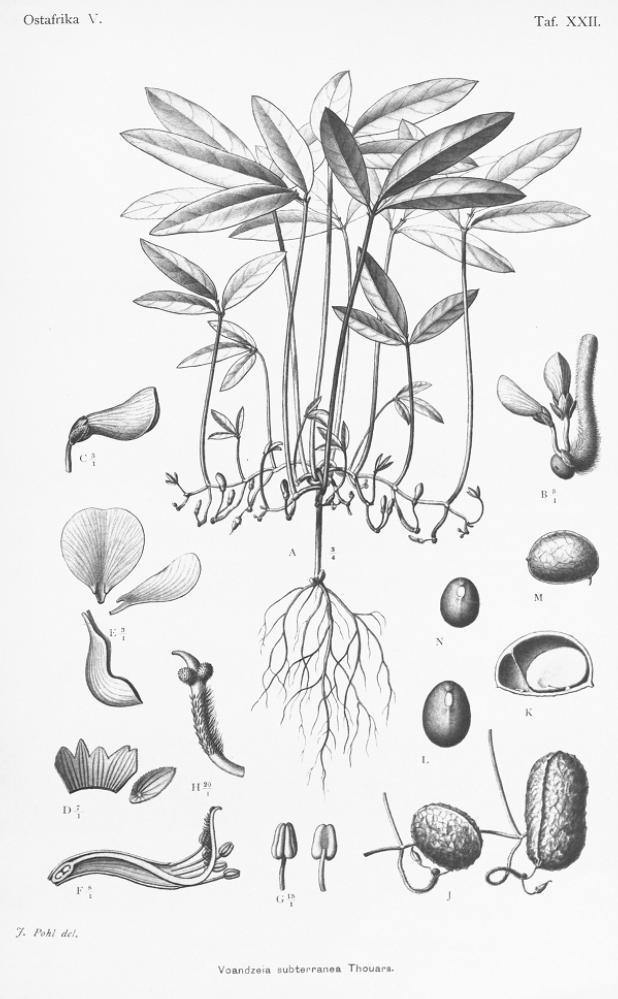 Bambara GroundnutVigna subterranea
-
 Rice BeanVigna umbellata
-
 Hairypod CowpeaVigna luteola
-
 Dune BeanVigna marina
Compare
Questions and answers
What is the scientific name of the Cowpea?
The scientific name of the Cowpea is Vigna unguiculata. Written with its author, the full name is Vigna unguiculata (L.) Walp..
Which family does the Cowpea belong to?
Vigna unguiculata belongs to the family Fabaceae, in the order Fabales and the class Magnoliopsida.
Where is the Cowpea found?
Checklists and occurrence records place Vigna unguiculata in 104 countries, including Nigeria, Cameroon, Afghanistan, Botswana, South Africa and Ghana.
What other names does the Cowpea have?
Vigna unguiculata is also known in English as Black-eyed Pea, Cuckold's-Increase, Reeve's-pea, Southern Pea, Twin Flower and Snake-bean.
Where are cowpeas native to?
Cowpea was domesticated in Africa. West Africa has been proposed as the likely centre of origin and early domestication, while East Africa has also been suggested as a possible domestication region.[18][19][20]
Sources
Passages the profile rests on
- Some bushy varieties grow to approximately 20 cm tall. Source passage: “Cowpeas can either be short and bushy (as short as 20 cm or 8 in)” — English Wikipedia
- Climbing or trailing varieties can reach approximately 2 m in height. Source passage: “by climbing supports or trailing along the ground (to a height of 2 m or 6 ft 7 in).” — English Wikipedia
- The taproot can penetrate approximately 2.4 m into the soil after eight weeks of growth. Source passage: “The taproot can penetrate to a depth of 2.4 m (7 ft 10 in) after eight weeks.” — English Wikipedia
- The leaves vary considerably in size and shape. Source passage: “The size and shape of the leaves vary greatly” — English Wikipedia
- The flower and seed-pod stalks measure approximately 20–50 cm long. Source passage: “the long 20–50 cm (8–20 in) peduncles” — English Wikipedia
- Individual flower stalks can support four or more seed pods. Source passage: “One peduncle can support four or more seed pods.” — English Wikipedia
- The flowers can be purple, pink, yellow, white, or blue. Source passage: “Flower colour varies through different shades of purple, pink, yellow, and white and blue.” — English Wikipedia
- Cultivated varieties produce seed pods measuring approximately 10–110 cm long. Source passage: “cultivated varieties can have pods between 10 and 110 cm (4 and 43 in) long.” — English Wikipedia
- A cultivated seed pod can contain six to thirteen seeds. Source passage: “A pod can contain six to 13 seeds” — English Wikipedia
- The seeds are usually kidney-shaped, although restricted space within the pod can make them more spherical. Source passage: “that are usually kidney-shaped, although the seeds become more spherical the more restricted they are within the pod.” — English Wikipedia
- The seeds can have smooth or rough coats and may be speckled, mottled, or blotchy. Source passage: “They can have a smooth or rough coat and be speckled, mottled, or blotchy.” — English Wikipedia
- Seed colours include white, cream, green, red, brown, and black, as well as combinations of these colours. Source passage: “Colours include white, cream, green, red, brown, and black, or various combinations.” — English Wikipedia
- The species grows well in sandy soils containing up to 85% sand. Source passage: “growing well in soils up to 85% sand.” — English Wikipedia
- The species grows best in sandy soils and tolerates infertile and acidic soils better than most other crops. Source passage: “The ideal soils are sandy and it has better tolerance for infertile and acid soil than most other crops.” — English Wikipedia
- Cowpea is cultivated in arid and semidesert regions where few other crops grow successfully. Source passage: “This makes them a particularly important crop in arid, semidesert regions where not many other crops will grow.” — English Wikipedia
- The species grows best in regions receiving approximately 400–700 mm of annual rainfall. Source passage: “It grows best in regions with an annual rainfall between 400 and 700 mm (16 and 28 in).” — English Wikipedia
- The optimum temperature for cowpea growth is approximately 30 °C. Source passage: “The optimum temperature for cowpea growth is 30 °C (86 °F)” — English Wikipedia
- The species was domesticated in Africa. Source passage: “It was domesticated in Africa” — English Wikipedia
- West Africa has been proposed as the likely centre of origin and early domestication of cultivated cowpea. Source passage: “the centre of diversity of the cultivated cowpea is West Africa, leading an early consensus that this is the likely centre of origin and place of early domestication.” — English Wikipedia
- Molecular-marker research has also suggested East Africa as a possible domestication region. Source passage: “New research using molecular markers has suggested that domestication may have instead occurred in East Africa” — English Wikipedia
- Cowpea remains were discovered in rock shelters in Central Ghana and dated to the second millennium BC. Source passage: “Remains of charred cowpeas from rock shelters in Central Ghana have been dated to the 2nd millennium BC.” — English Wikipedia
- Cowpea is believed to have reached Southeast Asia around 2300 BC. Source passage: “In 2300 BC, the cowpea is believed to have made its way into Southeast Asia” — English Wikipedia
- Cowpea subsequently spread north to the Mediterranean region, where it was used by Greek and Roman populations. Source passage: “From there they traveled north to the Mediterranean, where they were used by the Greeks and Romans.” — English Wikipedia
- Cowpea probably reached Central and North America during the transatlantic slave trade between the seventeenth and early nineteenth centuries. Source passage: “they probably reached Central and North America during the slave trade through the 17th to early 19th centuries.” — English Wikipedia
- The largest cowpea production areas are in Africa, particularly Nigeria and Niger. Source passage: “Most cowpeas are grown on the African continent, particularly in Nigeria and Niger” — English Wikipedia
- Nigeria and Niger together account for approximately 66% of worldwide cowpea production. Source passage: “which account for 66% of world production.” — English Wikipedia
- Other major cowpea-producing countries in the Sahel include Burkina Faso, Ghana, Senegal, and Mali. Source passage: “The Sahel region also contains other major producers such as Burkina Faso, Ghana, Senegal, and Mali.” — English Wikipedia
- Outside Africa, major cowpea production regions include Asia, Central America, and South America. Source passage: “Outside Africa, the major production areas are Asia, Central America, and South America.” — English Wikipedia
- Brazil is the world's second-leading cowpea seed producer and accounts for approximately 17% of annual production. Source passage: “Brazil is the world's second-leading producer of cowpea seed, accounting for 17% of annual cowpea production” — English Wikipedia
- Cowpea is primarily cultivated for its edible seeds. Source passage: “The crop is mainly grown for its seeds” — English Wikipedia
- Cowpea seeds are commonly cooked and prepared as stews and curries or processed into flour and paste. Source passage: “The seeds are usually cooked and made into stews and curries, or ground into flour or paste.” — English Wikipedia
- Leaves can be harvested starting four weeks after planting. Source passage: “Leaves can be picked from 4 weeks after planting.” — English Wikipedia
- Seeds can be harvested approximately 100 days after planting. Source passage: “The seeds can be harvested after about 100 days” — English Wikipedia
- Cowpea leaves and immature seed pods can also be consumed as food. Source passage: “although the leaves and immature seed pods can also be consumed.” — English Wikipedia
- The entire plant can be harvested for forage approximately 120 days after planting. Source passage: “the whole plant used as forage after about 120 days.” — English Wikipedia
- The whole cowpea plant is used as animal forage. Source passage: “The whole plant is also used as forage for animals” — English Wikipedia
- Cowpea can be intercropped with sorghum, millet, maize, cassava, and cotton. Source passage: “the cowpea can be effectively intercropped with sorghum, millet, maize, cassava, or cotton.” — English Wikipedia
- Cowpea is cultivated as a food, feed, and soil-fertility management crop. Source passage: “The crop has a multifaceted use, including food, feed, and soil fertility management.” — pmc.ncbi.nlm.nih.gov
- Cowpea seeds are rich in protein and provide food energy, minerals, and vitamins. Source passage: “Cowpea seeds provide a rich source of proteins and food energy, as well as minerals and vitamins.” — English Wikipedia
- Cowpea seeds contain approximately 25% protein. Source passage: “A seed can consist of 25% protein” — English Wikipedia
- Cowpea seed starch is digested more slowly than cereal starch. Source passage: “Cowpea starch is digested more slowly than the starch from cereals” — English Wikipedia
- Cowpea is capable of fixing atmospheric nitrogen through its root nodules. Source passage: “the plant's root nodules are able to fix atmospheric nitrogen” — English Wikipedia
- Cowpea contributes to soil fertility by fixing atmospheric nitrogen, including under suboptimal growing conditions. Source passage: “As a legume, cowpea possesses the ability to fix atmospheric nitrogen, enriching soil fertility, even under suboptimal conditions” — pmc.ncbi.nlm.nih.gov
- Cowpea exhibits resilience to environmental challenges associated with climate variability. Source passage: “However, cowpea exhibits a notable resilience to environmental challenges” — pmc.ncbi.nlm.nih.gov
- The species is primarily self-pollinating. Source passage: “the plant is primarily self-pollinating” — English Wikipedia
- The genetic diversity within cowpea varieties is relatively low. Source passage: “its genetic diversity within varieties is relatively low.” — English Wikipedia
Data
- Catalogue of Life, 2026-10-16 XR cc by
- Global Biodiversity Information Facility CC BY 4.0
- Wikidata CC0
- GeoNames CC BY 4.0
- Wikimedia Commons per image; credit shown with each image
- Within the Catalogue of Life, this name comes from The World Checklist of Vascular Plants (WCVP): Fabaceae cc by
References
- Repert. Bot. Syst. 1: 779 (1843) where the name was published
This species in other databases
- Catalogue of Life 7FSHX
- Wikidata Q498940
- iNaturalist 122898
- World Flora Online wfo-0000189386
- GRIN 41647
Page built on 28 November 2026. See how the catalog is made and all sources and licences.
Cite this page
ScientificNames.org. (2026). Vigna unguiculata (Cowpea). Retrieved November 28, 2026, from https://scientificnames.org/species/vigna-unguiculata
“Vigna unguiculata (Cowpea).” ScientificNames.org, 2026, scientificnames.org/species/vigna-unguiculata. Accessed 28 Nov. 2026.
ScientificNames.org. “Vigna unguiculata (Cowpea).” Accessed November 28, 2026. https://scientificnames.org/species/vigna-unguiculata.
@misc{scientificnames_vigna_unguiculata_cowpea,
  author = {{ScientificNames.org}},
  title = {Vigna unguiculata (Cowpea)},
  year = {2026},
  url = {https://scientificnames.org/species/vigna-unguiculata},
  note = {Accessed 2026-11-28}
}