Species · Birds
Kuhl's Lorikeet Vini kuhlii
The scientific name of the Kuhl's Lorikeet is Vini kuhlii. It is a species of bird in the family Psittaculidae (lories), order Psittaciformes. The name dates from 1824.
- Scientific name
- Vini kuhlii (Vigors, 1824)
- Common name
- Kuhl's Lorikeet
- Genus
- Vini
- Family
- Psittaculidae (Lories)
- Order
- Psittaciformes
- Class
- Aves
- Red List category
- EN Endangered
- Recorded in
- 3 countries
- Name status
- accepted in the Catalogue of Life

Overview
Kuhl's Lorikeet is a bird belonging to the genus Vini, family Psittaculidae, and order Psittaciformes. It is currently restricted to Rimatara in French Polynesia. It has green upperparts, a blue nape, bright red undersides and cheeks, and a finely hooked orange bill.
Written 26 November 2026 from the sources listed below. Each statement was checked against the passage it cites; statements that could not be supported were removed.
Appearance
Kuhl's Lorikeet has a green back, wings and crown, a blue nape and legs, and bright red undersides and cheeks. Its short tail, cherry-red throat and breast, green upperparts, and finely hooked orange bill distinguish its appearance.[1][2]
The species has vibrant plumage and flies quickly.[3]
Habitat
Kuhl's Lorikeet inhabits natural tropical moist lowland forests and plantations. On islands where native forests have been cleared and extensive coconut plantations established, it occurs exclusively in those plantations.[4][5]
Diet
Kuhl's Lorikeet feeds on nectar, which it obtains using a brush-like tongue.[6][7]
Reproduction and life cycle
The reintroduced population on Atiu in the Cook Islands was confirmed to be reproducing in 2008. Successful reproduction resulted in an estimated population exceeding 400 individuals in 2019.[8][9][10]
Conservation
Kuhl's Lorikeet's natural distribution contracted substantially following human arrival. Introduced black rats threaten the species, and black rats introduced by Europeans became predators of it.[11][12][13]
The species faces competition and nest disturbances from the common myna. It has also been trapped for the international bird trade and hunted for its colourful feathers.[14][15][16]
The species' last native population was protected by a traditional taboo established by Queen Tamaeva V of Rimatara around 1900.[17]
The reintroduced population on Atiu was established on an island without black rats.[18]
Classification of the Kuhl's Lorikeet
| Kingdom | Animalia |
|---|---|
| Phylum | Chordata |
| Subphylum | Vertebrata |
| Infraphylum | Gnathostomata |
| Parvphylum | Osteichthyes |
| Megaclass | Tetrapoda |
| Class | Aves (Bird) |
| Order | Psittaciformes (Parrot) |
| Family | Psittaculidae (Lories) |
| Genus | Vini (Vini Lories) |
| Species | Vini kuhlii (Vigors, 1824) |
Where the Kuhl's Lorikeet is found
Checklists and occurrence records place Vini kuhlii in 3 countries across Oceania. GBIF holds 195 georeferenced records of it.
Countries
Regions and cities with the most records
1 more country has a few records outside this range
These countries hold a few records of Vini kuhlii but lie outside the range the checklists give for it. Such records are often zoo or garden specimens, museum material or vagrants, so the species is not counted as occurring there.
Range as the checklists state it
Oceania
A number beside a place is its count of GBIF occurrence records. A place without a number comes from a checklist alone. Records show where a species has been observed or collected, which can include escapes and vagrants.
Common names
English
- Kuhl's Lorikeet
- Rimatara Lorikeet
- Rimitara Lorikeet
Names in 24 other languages
- Chinese
- 库氏鹦鹉, 庫氏吸蜜鸚鵡
- Croatian
- zelenokapi lori
- Czech
- charmozin rubínový, vini rubínový
- Dutch
- Kuhls Lori
- Esperanto
- rubena lorio
- Estonian
- rubiin-nestepapagoi
- Finnish
- tubuainlurikki
- French
- Lori de Kuhl, Vini de Kuhl
- Hungarian
- piroshasú pálmalóri, rubinlóri
- Italian
- Lorichetto di Kuhl
- Japanese
- ムスメインコ
- Lithuanian
- polinezinis loris atsiskyrėlis
- Norwegian
- tubuailori
- Polish
- loreczka rubinowa
- Portuguese
- loriquito-de-rimatara, lóri-de-rimatara, lóris-de-kuhl
- Russian
- Рубиновый лори-отшельник
- Serbian
- Rubin lori
- Slovak
- lori karmínový
- Spanish
- Lori de Rimatara, Lori de Rimitara
- Swedish
- rimataralorikit
- Turkish
- Kuhl Loriketi
- Ukrainian
- лорі-віні рубіновий
- Welsh
- lori Kühl
- mrj
- Рубин ӹдӹр лори
Synonyms
3 other scientific names have been used for this species and are now treated as synonyms of Vini kuhlii.
- Coriphilus kuhlii Vigors, NA, 1824
- Psittacula kuhlii Vigors, 1824
- Vini coccinea Lesson, RP, 1833
Related species
-
 Collared LoryVini solitaria
-
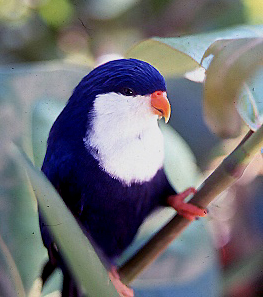 Blue LorikeetVini peruviana
-
 Ultramarine LorikeetVini ultramarina
-
 Blue-crowned LorikeetVini australis
-
 Stephen's LorikeetVini stepheni
-
 Conquered LorikeetVini vidivici
- Sinoto's LorikeetVini sinotoi
- Meek's LorikeetVini meeki
Compare
Questions and answers
What is the scientific name of the Kuhl's Lorikeet?
The scientific name of the Kuhl's Lorikeet is Vini kuhlii. Written with its author, the full name is Vini kuhlii (Vigors, 1824).
Which family does the Kuhl's Lorikeet belong to?
Vini kuhlii belongs to the family Psittaculidae, in the order Psittaciformes and the class Aves.
Where is the Kuhl's Lorikeet found?
Checklists and occurrence records place Vini kuhlii in 3 countries: Cook Islands, French Polynesia and Kiribati.
What is the conservation status of the Kuhl's Lorikeet?
The IUCN Red List category recorded for Vini kuhlii is Endangered (EN).
What other names does the Kuhl's Lorikeet have?
Vini kuhlii is also known in English as Rimatara Lorikeet and Rimitara Lorikeet.
Sources
Passages the profile rests on
- The species has a green back, wings and crown, a blue nape and legs, and bright red undersides and cheeks. Source passage: “a green back, wings and crown, a blue nape and legs and bright red undersides and cheeks.” — English Wikipedia
- The species has a short tail, a cherry-red throat and breast, green upperparts, and a finely hooked orange bill. Source passage: “Luminous, short-tailed parrot with a cherry-red throat and breast, green upperparts, and finely hooked orange bill.” — ebird.org
- The species has vibrant plumage and flies quickly. Source passage: “It is a fast flying lorikeet with vibrant plumage;” — English Wikipedia
- The species inhabits natural tropical moist lowland forests and plantations. Source passage: “The Kuhl's lorikeet's habitat is natural tropical moist lowland forests and plantations.” — English Wikipedia
- On islands where native forests have been cleared and extensive coconut plantations established, the species occurs exclusively in those plantations. Source passage: “In islands denuded of native forests and covered with extensive coconut plantations it is found exclusively in those areas.” — English Wikipedia
- The species feeds on nectar. Source passage: “Like all Vini lorikeets it is a nectarivore” — English Wikipedia
- The species uses a brush-like tongue to obtain nectar. Source passage: “has a brushy tongue to acquire the nectar.” — English Wikipedia
- A population of the species was reintroduced to Atiu in the Cook Islands in 2007. Source passage: “In 2007 a population was reintroduced to the black-rat-free island of Atiu in the Cook Islands” — English Wikipedia
- The reintroduced population on Atiu was confirmed to be reproducing in 2008. Source passage: “In 2008, the introduced population was found to be reproducing.” — English Wikipedia
- Successful reproduction on Atiu resulted in an estimated population exceeding 400 individuals in 2019. Source passage: “In 2019, successful reproduction resulted in an estimated population of over 400 individuals on the island of Atiu.” — English Wikipedia
- The species' natural distribution contracted substantially following human arrival. Source passage: “Its range contracted greatly after the arrival of humans” — English Wikipedia
- Introduced black rats threaten the species. Source passage: “Like many island species, Kuhl's lorikeet is threatened by introduced black rats.” — English Wikipedia
- Black rats introduced by Europeans became predators of the species. Source passage: “Black rats were introduced to their native range by Europeans and are now predators of the lorikeet.” — English Wikipedia
- The species faces competition and nest disturbances from the common myna. Source passage: “The bird also faces competition and the disturbances of nests from the common myna.” — English Wikipedia
- The species has been trapped for the international bird trade. Source passage: “They are also trapped for the international bird trade.” — English Wikipedia
- The species has been hunted for its colourful feathers. Source passage: “Its colourful feathers have also meant that the species was regularly hunted.” — English Wikipedia
- The species' last native population was protected by a traditional taboo established by Queen Tamaeva V of Rimatara around 1900. Source passage: “The last native population was protected by a tapu or taboo by Queen Tamaeva V of Rimatara around 1900.” — English Wikipedia
- The reintroduced population on Atiu was established on an island without black rats. Source passage: “the black-rat-free island of Atiu in the Cook Islands” — English Wikipedia
Data
- Catalogue of Life, 2026-10-16 XR cc by
- Global Biodiversity Information Facility CC BY 4.0
- Wikidata CC0
- GeoNames CC BY 4.0
- Wikimedia Commons per image; credit shown with each image
- Within the Catalogue of Life, this name comes from The Integrated Taxonomic Information System cc0
References
- Gill, Frank, & and Minturn Wright. (2006). Birds of the World: Recommended English Names.
- Dickinson, E. C., and L. Christidis, eds. (2014). The Howard and Moore Complete Checklist of the Birds of the World, 4th Edition, Vol. 2 Passerines.
This species in other databases
Page built on 29 November 2026. See how the catalog is made and all sources and licences.
Cite this page
ScientificNames.org. (2026). Vini kuhlii (Kuhl's Lorikeet). Retrieved November 29, 2026, from https://scientificnames.org/species/vini-kuhlii
“Vini kuhlii (Kuhl's Lorikeet).” ScientificNames.org, 2026, scientificnames.org/species/vini-kuhlii. Accessed 29 Nov. 2026.
ScientificNames.org. “Vini kuhlii (Kuhl's Lorikeet).” Accessed November 29, 2026. https://scientificnames.org/species/vini-kuhlii.
@misc{scientificnames_vini_kuhlii_kuhls_lorikeet,
  author = {{ScientificNames.org}},
  title = {Vini kuhlii (Kuhl's Lorikeet)},
  year = {2026},
  url = {https://scientificnames.org/species/vini-kuhlii},
  note = {Accessed 2026-11-29}
}