Species · Birds
Ultramarine Lorikeet Vini ultramarina
The scientific name of the Ultramarine Lorikeet is Vini ultramarina. It is a species of bird in the family Psittaculidae (lories), order Psittaciformes. The name dates from 1820.
- Scientific name
- Vini ultramarina (Kuhl, 1820)
- Common name
- Ultramarine Lorikeet
- Genus
- Vini
- Family
- Psittaculidae (Lories)
- Order
- Psittaciformes
- Class
- Aves
- Red List category
- CR Critically Endangered
- Recorded in
- 1 country
- Name status
- accepted in the Catalogue of Life

Overview
Vini ultramarina is endemic to the Marquesas Islands. It has predominantly blue and white plumage and is classified as Critically Endangered.
Written 26 November 2026 from the sources listed below. Each statement was checked against the passage it cites; statements that could not be supported were removed.
Appearance
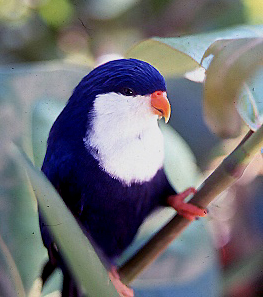
The Ultramarine Lorikeet has predominantly blue and white plumage.[1]
Habitat
The species inhabits subtropical or tropical moist lowland forests and subtropical or tropical moist montane forests.[2][3]
Diet
The Ultramarine Lorikeet feeds on nectar, pollen and flowers from various flowering trees. It appears to prefer flowers of coconut palms and Hibiscus tiliaceus.[4][5][6]
Its diet also includes multiple types of fruit and insects.[7]
Reproduction and life cycle
The species nests in tree cavities, particularly in Artocarpus altilis and Hibiscus tiliaceus trees.[8][9][10]
Conservation
The Ultramarine Lorikeet is endemic to the Marquesas Islands. During the 1970s, it occurred on Fatu Hiva, Ua Pou, Nuku Hiva and Ua Huka. By 2008, it had become extinct on Fatu Hiva, Ua Pou and Nuku Hiva, leaving Ua Huka as the only island where it remains.[11][12][13][14]
The species is classified as Critically Endangered and is listed in the IUCN Red List category Critically Endangered. Its estimated population on Ua Huka is approximately 1,000–2,499 individual birds, while BirdLife DataZone reports 1,000–2,499 mature individuals and a stable population trend.[15][16][17][18][19]
The introduction of black rats is a major threat to the species. Predation by introduced black rats has greatly reduced its population, and black rats were introduced to Nuku Hiva in 1915. Predation by cats has also contributed to its decline.[20][21][22][23]
Deforestation is a major threat to the species. Forest clearing for farms, logging and tourism has contributed to population decline, while grazing and fires have severely affected the islands occupied by the species.[24][25][26]
Much of the original dry forest has been converted into grassland, and upland forests have also suffered substantial damage.[27][28]
Classification of the Ultramarine Lorikeet
| Kingdom | Animalia |
|---|---|
| Phylum | Chordata |
| Subphylum | Vertebrata |
| Infraphylum | Gnathostomata |
| Parvphylum | Osteichthyes |
| Megaclass | Tetrapoda |
| Class | Aves (Bird) |
| Order | Psittaciformes (Parrot) |
| Family | Psittaculidae (Lories) |
| Genus | Vini (Vini Lories) |
| Species | Vini ultramarina (Kuhl, 1820) |
Where the Ultramarine Lorikeet is found
Checklists and occurrence records place Vini ultramarina in 1 country across Oceania. GBIF holds 142 georeferenced records of it.
Countries
Regions and cities with the most records
Range as the checklists state it
Oceania
A number beside a place is its count of GBIF occurrence records. A place without a number comes from a checklist alone. Records show where a species has been observed or collected, which can include escapes and vagrants.
Common names
English
- Ultramarine Lorikeet
- Ultramarine Lory
Names in 27 other languages
- Catalan
- lori ultramarí
- Chinese
- 深藍吸蜜鸚鵡, 翠蓝鹦鹉
- Croatian
- tirkizni lori
- Czech
- charmozin modrý, vini modrý
- Danish
- Smaragdlori
- Dutch
- Hemelsblauwe Lori
- Esperanto
- ultramara lorio
- Estonian
- safiir-nestepapagoi
- Finnish
- sinilurikki
- French
- Lori ultramarin
- German
- Ultramarin-Lori, Ultramarinlori
- Hungarian
- smaragdlóri, tengerkék pálmalóri
- Italian
- Lorichetto oltremarino
- Japanese
- コンセイインコ
- Lithuanian
- mėlynasis loris atsiskyrėlis
- Norwegian
- blålori
- Polish
- loreczka błękitna
- Portuguese
- loriquito-ultramarino, lóri-ultramarino
- Russian
- Маркизский лори-отшельник, Ультрамариновый лори-отшельник
- Serbian
- Smaragdni lori
- Slovak
- lori belasý
- Spanish
- Lori ultramar
- Swedish
- ultramarinlorikit
- Turkish
- Çok Mavili Loriket
- Ukrainian
- лорі-віні бірюзовий
- Welsh
- lori ddulas
- pnb
- الٹرامیرین طوطا
Synonyms
3 other scientific names have been used for this species and are now treated as synonyms of Vini ultramarina.
- Coriphilus ultramarinus Kuhl, H, 1820
- Psittacus ultramarinus Kuhl, 1820
- Vini yncas
Related species
-
 Collared LoryVini solitaria
-
 Blue LorikeetVini peruviana
-
 Blue-crowned LorikeetVini australis
-
 Kuhl's LorikeetVini kuhlii
-
 Stephen's LorikeetVini stepheni
-
 Conquered LorikeetVini vidivici
- Sinoto's LorikeetVini sinotoi
- Meek's LorikeetVini meeki
Compare
Questions and answers
What is the scientific name of the Ultramarine Lorikeet?
The scientific name of the Ultramarine Lorikeet is Vini ultramarina. Written with its author, the full name is Vini ultramarina (Kuhl, 1820).
Which family does the Ultramarine Lorikeet belong to?
Vini ultramarina belongs to the family Psittaculidae, in the order Psittaciformes and the class Aves.
Where is the Ultramarine Lorikeet found?
Checklists and occurrence records place Vini ultramarina in 1 country: French Polynesia.
What is the conservation status of the Ultramarine Lorikeet?
The IUCN Red List category recorded for Vini ultramarina is Critically Endangered (CR).
What other names does the Ultramarine Lorikeet have?
Vini ultramarina is also known in English as Ultramarine Lory.
Sources
Passages the profile rests on
- The Ultramarine Lorikeet has predominantly blue and white plumage. Source passage: “A mostly blue-and-white lorikeet.” — ebird.org
- The species inhabits subtropical or tropical moist lowland forests. Source passage: “Its natural habitats are subtropical or tropical moist lowland forest” — English Wikipedia
- The species inhabits subtropical or tropical moist montane forests. Source passage: “subtropical or tropical moist montane forest” — English Wikipedia
- The species feeds on nectar from various flowering trees. Source passage: “feeds on a large variety of nectar, pollen, and flowers from various flowering trees.” — English Wikipedia
- The species consumes pollen and flowers from flowering trees. Source passage: “nectar, pollen, and flowers from various flowering trees.” — English Wikipedia
- The species appears to prefer flowers of coconut palms and Hibiscus tiliaceus. Source passage: “It seems to prefer flowers of the coconut palm and Hibiscus tiliaceus.” — English Wikipedia
- The species also eats multiple types of fruit and insects. Source passage: “The bird's diet also includes multiple fruits and insects.” — English Wikipedia
- The species nests in tree cavities. Source passage: “The ultramarine lorikeet nests in tree cavities,” — English Wikipedia
- The species particularly uses Artocarpus altilis trees for nesting. Source passage: “especially in Artocarpus altilis,” — English Wikipedia
- The species particularly uses Hibiscus tiliaceus trees for nesting. Source passage: “and Hibiscus tiliaceus.” — English Wikipedia
- The species is endemic to the Marquesas Islands. Source passage: “endemic to the Marquesas Islands.” — English Wikipedia
- During the 1970s, the species occurred on Fatu Hiva, Ua Pou, Nuku Hiva, and Ua Huka in the Marquesas Islands. Source passage: “During the 1970s, the bird was still prevalent on its natural range of Fatu Hiva, Ua Pou, Nuku Hiva, and Ua Huka in the Marquesas Islands.” — English Wikipedia
- By 2008, the species had become extinct on Fatu Hiva, Ua Pou, and Nuku Hiva. Source passage: “the ultramarine lorikeet became extinct on Fatu Hiva, Ua Pu, and Nuku Hiva by 2008.” — English Wikipedia
- Ua Huka is the only island where the species remains according to the document. Source passage: “Nowadays, the rare bird only remains on Ua Huka.” — English Wikipedia
- The species is classified as Critically Endangered. Source passage: “It is critically endangered,” — English Wikipedia
- The estimated population on Ua Huka is approximately 1,000–2,499 individual birds. Source passage: “On Ua Huka, the population is estimated to be at about 1,000-2,499 individual birds.” — English Wikipedia
- BirdLife DataZone reports 1,000–2,499 mature individuals. Source passage: “Number of mature individuals 1,000 - 2,499” — datazone.birdlife.org
- BirdLife DataZone reports the population trend as stable. Source passage: “Population trend Stable” — datazone.birdlife.org
- The species is listed in the IUCN Red List category Critically Endangered. Source passage: “CR IUCN Red List category” — datazone.birdlife.org
- The introduction of black rats is identified as a major threat to the species. Source passage: “threatened mainly by introduction of the black rat” — English Wikipedia
- Predation by introduced black rats has greatly reduced the species' population. Source passage: “The ultramarine lorikeet is greatly threatened by the predation from the black rat which has greatly decreased its population” — English Wikipedia
- Black rats were introduced to Nuku Hiva in 1915. Source passage: “since its introduction to Nuku Hiva in 1915.” — English Wikipedia
- Predation by cats is also identified as a factor in the species' decline. Source passage: “predation by the invasive black rat and cat” — English Wikipedia
- Deforestation is identified as a major threat to the species. Source passage: “threatened mainly by introduction of the black rat and by deforestation.” — English Wikipedia
- Forest clearing for farms, logging, and tourism has contributed to the species' population decline. Source passage: “Deforestation to make way for farms, logging, and tourism has also had large impact in the decline of its population.” — English Wikipedia
- Grazing and fires have severely affected the islands occupied by the species. Source passage: “All islands have been devastated by extremely high levels of grazing and fire.” — English Wikipedia
- Much of the original dry forest has been converted into grassland. Source passage: “Most of the original dry forest has been reduced to grassland,” — English Wikipedia
- Upland forests have also suffered substantial damage. Source passage: “and terrible damage has been caused to upland forests as well.” — English Wikipedia
Data
- Catalogue of Life, 2026-10-16 XR cc by
- Global Biodiversity Information Facility CC BY 4.0
- Wikidata CC0
- GeoNames CC BY 4.0
- Wikimedia Commons per image; credit shown with each image
- Within the Catalogue of Life, this name comes from The Integrated Taxonomic Information System cc0
References
- Gill, Frank, & and Minturn Wright. (2006). Birds of the World: Recommended English Names.
- Dickinson, E. C., and L. Christidis, eds. (2014). The Howard and Moore Complete Checklist of the Birds of the World, 4th Edition, Vol. 2 Passerines.
This species in other databases
Page built on 29 November 2026. See how the catalog is made and all sources and licences.
Cite this page
ScientificNames.org. (2026). Vini ultramarina (Ultramarine Lorikeet). Retrieved November 29, 2026, from https://scientificnames.org/species/vini-ultramarina
“Vini ultramarina (Ultramarine Lorikeet).” ScientificNames.org, 2026, scientificnames.org/species/vini-ultramarina. Accessed 29 Nov. 2026.
ScientificNames.org. “Vini ultramarina (Ultramarine Lorikeet).” Accessed November 29, 2026. https://scientificnames.org/species/vini-ultramarina.
@misc{scientificnames_vini_ultramarina_ultramarine_lorikeet,
  author = {{ScientificNames.org}},
  title = {Vini ultramarina (Ultramarine Lorikeet)},
  year = {2026},
  url = {https://scientificnames.org/species/vini-ultramarina},
  note = {Accessed 2026-11-29}
}