Species · Birds
Collared Lory Vini solitaria
The scientific name of the Collared Lory is Vini solitaria. It is a species of bird in the family Psittaculidae (lories), order Psittaciformes. The name dates from 1800.
- Scientific name
- Vini solitaria (Suckow, 1800)
- Common name
- Collared Lory
- Genus
- Vini
- Family
- Psittaculidae (Lories)
- Order
- Psittaciformes
- Class
- Aves
- Red List category
- LC Least Concern
- Recorded in
- 1 country
- Name status
- accepted in the Catalogue of Life

Overview
The Collared Lory is endemic to the islands of Fiji. The Collared Lory has bright red underparts and faces, purple crowns, and greenish upperparts.
Written 26 November 2026 from the sources listed below. Each statement was checked against the passage it cites; statements that could not be supported were removed.
Uses
The Collared Lory was prized in western Polynesia for its colorful plumage. Kula feather trading networks connected Fiji, Samoa, and Tonga until colonial times.[1][2]
Appearance
Adult Collared Lories measure approximately 20 cm in length. Their underparts and faces are bright red, their crowns are purple, and their upperparts are greenish.[3][4]
Males have scarlet cheeks, throats, breasts, and upper abdomens, with a dark purple crown. Their napes are lime-green and red, with some elongated feathers.[5][6][7]
The wings, back, and tail are greenish, while the lower abdomen is purple. The bill is yellow-orange, the feet are pink-orange, and the irises are orange-red.[8][9][10]
Females have a paler crown than males, with a greenish hue toward the rear.[11]
Juveniles have duller plumage, with faint purple transverse markings on the upper abdomen and breast. Their bills are brown and their irises are pale brown.[12][13]
Habitat
The Collared Lory naturally inhabits subtropical or tropical moist lowland forests. It has adapted to human habitation and occurs in urban Suva.[14][15]
Diet
The Collared Lory feeds on fruit, seeds, nectar, and blossoms.[16]
Trees favored for feeding include drala (Erythrina variegata), the coconut palm (Cocos nucifera), and the introduced African tulip tree (Spathodea campanulata).[17][18][19]
Behaviour
The Collared Lory flies rapidly and straight with quick, shallow wingbeats. It can be observed in pairs or small groups.[20][21]
The Collared Lory produces a high-pitched single or double shriek. It readily becomes tame in captivity.[22][23]
The Collared Lory is not solitary despite the alternative common name solitary lory.[24]
Reproduction and life cycle
The Collared Lory nests in tree hollows and sometimes in holes in rotting coconuts that remain attached to trees.[25][26]
The clutch size in captivity is two eggs. The clutch size of wild Collared Lories is unknown but is presumed to match the captive clutch size.[27][28]
Incubation lasts approximately 30 days, and the nestling stage lasts approximately nine weeks.[29][30]
Classification of the Collared Lory
| Kingdom | Animalia |
|---|---|
| Phylum | Chordata |
| Subphylum | Vertebrata |
| Infraphylum | Gnathostomata |
| Parvphylum | Osteichthyes |
| Megaclass | Tetrapoda |
| Class | Aves (Bird) |
| Order | Psittaciformes (Parrot) |
| Family | Psittaculidae (Lories) |
| Genus | Vini (Vini Lories) |
| Species | Vini solitaria (Suckow, 1800) |
Where the Collared Lory is found
Checklists and occurrence records place Vini solitaria in 1 country across Oceania. GBIF holds 3,060 georeferenced records of it.
Countries
Regions and cities with the most records
- Central, Fiji 1,457
- Lami, Fiji 1,080
- Suva, Fiji 1,023
- Nasinu, Fiji 1,013
- Northern, Fiji 724
- Western, Fiji 484
- Eastern, Fiji 251
- Lautoka, Fiji 193
- Nadi, Fiji 147
- Sigatoka, Fiji 123
- Labasa, Fiji 7
1 more country has a few records outside this range
These countries hold a few records of Vini solitaria but lie outside the range the checklists give for it. Such records are often zoo or garden specimens, museum material or vagrants, so the species is not counted as occurring there.
Range as the checklists state it
Oceania
A number beside a place is its count of GBIF occurrence records. A place without a number comes from a checklist alone. Records show where a species has been observed or collected, which can include escapes and vagrants.
Common names
English
- Collared Lory
Names in 25 other languages
- Catalan
- lori solitari
- Chinese
- 紅領吸蜜鸚鵡, 绿领鹦鹉
- Croatian
- fidžijski lori
- Czech
- charmozin límcový, lori límcový
- Danish
- Eremitlori
- Dutch
- Gekraagde Lori
- Esperanto
- fiĝia lorio
- Estonian
- fidţi nestepapagoi
- Finnish
- Fidžinlurikki, fidžinluri
- French
- Lori des Fidji
- German
- Einsiedlerlori
- Hungarian
- galléros pálmalóri, remetelóri
- Italian
- Lori dal collare
- Japanese
- ハナレインコ
- Lithuanian
- fidžinis loris
- Norwegian
- grønnakkelori
- Polish
- loreczka pustelnicza
- Portuguese
- lóri-das-fiji, lóris-das-fiji
- Russian
- Лори-отшельник
- Serbian
- Kragnasti lori
- Slovak
- lori golierikatý
- Spanish
- Lori solitario
- Swedish
- kraglorikit
- Turkish
- Yakalı Lori
- Ukrainian
- лорі-самітник
Synonyms
7 other scientific names have been used for this species and are now treated as synonyms of Vini solitaria.
- Phigys solitarius (Suckow, 1800)
- Phigys soltarius Suckow, GA, 1800
- Psittacus coccineus Shaw, G, 1812
- Psittacus phigy Bechstein, JM, 1811
- Psittacus solitarius Suckow, 1800
- Psittacus vaillanti Shaw, G, 1810
- Vini solitarius (Suckow, 1800)
Related species
-
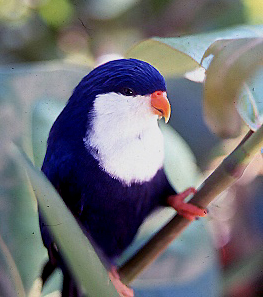 Blue LorikeetVini peruviana
-
 Ultramarine LorikeetVini ultramarina
-
 Blue-crowned LorikeetVini australis
-
 Kuhl's LorikeetVini kuhlii
-
 Stephen's LorikeetVini stepheni
-
 Conquered LorikeetVini vidivici
- Sinoto's LorikeetVini sinotoi
- Meek's LorikeetVini meeki
Compare
Questions and answers
What is the scientific name of the Collared Lory?
The scientific name of the Collared Lory is Vini solitaria. Written with its author, the full name is Vini solitaria (Suckow, 1800).
Which family does the Collared Lory belong to?
Vini solitaria belongs to the family Psittaculidae, in the order Psittaciformes and the class Aves.
Where is the Collared Lory found?
Checklists and occurrence records place Vini solitaria in 1 country: Fiji.
What is the conservation status of the Collared Lory?
The IUCN Red List category recorded for Vini solitaria is Least Concern (LC).
Sources
Passages the profile rests on
- The Collared Lory was prized in western Polynesia for its colorful plumage. Source passage: “The bird was prized throughout western Polynesia for its vibrant plumage” — English Wikipedia
- Kula feather trading networks connected Fiji, Samoa, and Tonga until colonial times. Source passage: “The maritime trading networks based on "kula" feathers existed between Fiji, Samoa, and Tonga up until colonial times.” — English Wikipedia
- Adult Collared Lories have bright red underparts and faces, purple crowns, and greenish upperparts. Source passage: “it has bright red underparts and face with a purple crown and greenish upperparts.” — English Wikipedia
- Adult Collared Lories measure approximately 20 cm in length. Source passage: “Adult birds are around 20 cm (8 in) long” — English Wikipedia
- Male Collared Lories have scarlet cheeks, throats, breasts, and upper abdomens. Source passage: “The male has bright scarlet cheeks, throat, breast, and upper abdomen.” — English Wikipedia
- The male has a dark purple crown. Source passage: “The crown is dark purple.” — English Wikipedia
- The male has a lime-green and red nape with some elongated feathers. Source passage: “The nape is lime green and red and some of the feathers on the nape are elongated.” — English Wikipedia
- The wings, back, and tail of the Collared Lory are greenish. Source passage: “The wings, back, and tail are greenish.” — English Wikipedia
- The lower abdomen of the Collared Lory is purple. Source passage: “The lower abdomen is purple.” — English Wikipedia
- The Collared Lory has a yellow-orange bill, pink-orange feet, and orange-red irises. Source passage: “The bill is yellow-orange, the feet pink-orange, and the irises are orange-red.” — English Wikipedia
- Females have a paler crown than males, with a greenish hue toward the rear. Source passage: “The female is similar but with a paler crown that has a greenish hue posteriorly.” — English Wikipedia
- Juveniles have duller plumage with faint purple transverse markings on the upper abdomen and breast. Source passage: “Juveniles are duller with vague purple transverse striations on the upper abdomen and breast” — English Wikipedia
- Juvenile Collared Lories have brown bills and pale brown irises. Source passage: “they have a brown beak and pale brown irises.” — English Wikipedia
- The Collared Lory naturally inhabits subtropical or tropical moist lowland forests. Source passage: “Its natural habitat is subtropical or tropical moist lowland forests.” — English Wikipedia
- The Collared Lory has adapted to human habitation and occurs in urban Suva. Source passage: “It has adapted to human habitation and can be found in Suva.” — English Wikipedia
- The Collared Lory feeds on fruit, seeds, nectar, and blossoms. Source passage: “The diet of the collared lory consists fruit, seeds, nectar and blossoms.” — English Wikipedia
- Trees favored by the Collared Lory for feeding include drala (Erythrina variegata). Source passage: “Trees favoured include the drala (Erythrina variegata)” — English Wikipedia
- The coconut palm (Cocos nucifera) is among the trees favored by the Collared Lory. Source passage: “the coconut palm (Cocos nucifera)” — English Wikipedia
- The Collared Lory also favors the introduced African tulip tree (Spathodea campanulata) for feeding. Source passage: “the introduced and invasive African tulip tree (Spathodea campanulata).” — English Wikipedia
- The Collared Lory flies rapidly and straight with quick, shallow wingbeats. Source passage: “The collared lory is a fast and straight flyer with quick shallow wingbeats” — English Wikipedia
- The Collared Lory can be observed in pairs or small groups. Source passage: “can be found in pairs or small groups.” — English Wikipedia
- The Collared Lory produces a high-pitched single or double shriek. Source passage: “The call is a high pitched single or double shriek.” — English Wikipedia
- The Collared Lory readily becomes tame in captivity. Source passage: “The species became tame readily in captivity” — English Wikipedia
- The Collared Lory is not solitary despite the alternative common name solitary lory. Source passage: “The latter is a misnomer; the species is not solitary.” — English Wikipedia
- The Collared Lory nests in tree hollows. Source passage: “The nest is a hollow in a tree” — English Wikipedia
- The Collared Lory sometimes nests in holes in rotting coconuts that remain attached to trees. Source passage: “or sometimes in a hole in a rotting coconut still attached to the tree.” — English Wikipedia
- The clutch size of the Collared Lory in captivity is two eggs. Source passage: “The clutch size is two eggs in captivity” — English Wikipedia
- The clutch size of wild Collared Lories is unknown but is presumed to match the captive clutch size. Source passage: “the size in the wild is unknown but presumed to be the same.” — English Wikipedia
- Incubation in the Collared Lory lasts approximately 30 days. Source passage: “Incubation is around 30 days” — English Wikipedia
- The nestling stage of the Collared Lory lasts approximately nine weeks. Source passage: “the nestling stage lasts about 9 weeks.” — English Wikipedia
Data
- Catalogue of Life, 2026-10-16 XR cc by
- Global Biodiversity Information Facility CC BY 4.0
- Wikidata CC0
- GeoNames CC BY 4.0
- Wikimedia Commons per image; credit shown with each image
- iNaturalist per image; credit shown with each image
- Within the Catalogue of Life, this name comes from The Integrated Taxonomic Information System cc0
This species in other databases
Page built on 29 November 2026. See how the catalog is made and all sources and licences.
Cite this page
ScientificNames.org. (2026). Vini solitaria (Collared Lory). Retrieved November 29, 2026, from https://scientificnames.org/species/vini-solitaria
“Vini solitaria (Collared Lory).” ScientificNames.org, 2026, scientificnames.org/species/vini-solitaria. Accessed 29 Nov. 2026.
ScientificNames.org. “Vini solitaria (Collared Lory).” Accessed November 29, 2026. https://scientificnames.org/species/vini-solitaria.
@misc{scientificnames_vini_solitaria_collared_lory,
  author = {{ScientificNames.org}},
  title = {Vini solitaria (Collared Lory)},
  year = {2026},
  url = {https://scientificnames.org/species/vini-solitaria},
  note = {Accessed 2026-11-29}
}