Species · Flowering plants
Native Violet Viola banksii
The scientific name of the Native Violet is Viola banksii. It is a species of flowering plant in the family Violaceae (violet family), order Malpighiales.
- Scientific name
- Viola banksii K.R.Thiele & Prober
- Common name
- Native Violet
- Genus
- Viola
- Family
- Violaceae (Violet Family)
- Order
- Malpighiales
- Class
- Magnoliopsida
- Recorded in
- 3 countries
- Name status
- accepted in the Catalogue of Life

Overview
Viola banksii is native to Australia's east coast, from near Brisbane to Batemans Bay. It has distinctive purple and white flowers and almost circular, usually bright green leaves with a deep, narrow, V-shaped notch at the base.
Written 26 November 2026 from the sources listed below. Each statement was checked against the passage it cites; statements that could not be supported were removed.
Similar species
Native Violet was formerly identified under the name Viola hederacea. The original type specimen of Viola hederacea collected by Labillardière was determined not to represent the hardier and more showy plant subsequently cultivated and sold.[1][2]
Appearance
Native Violet has distinctive purple and white flowers. Its fully developed leaves are almost circular, with a deep, narrow, V-shaped notch at the base, and are usually bright, fresh green.[3][4][5]
The cultivar Viola banksii 'White Glory' has entirely white flowers with a slight fragrance.[6]
Habitat
Native Violet is native to Australia's east coast, from near Brisbane to Batemans Bay. An introduced or naturalised population has been recorded at Mount Donna Buang near Melbourne.[7][8]
In garden cultivation, Native Violet grows in different soil types when provided with sufficient moisture and at least partial shade.[9]
Behaviour
Native Violet can grow vigorously in heavier soils that retain moisture. It spreads to form a naturally low-growing groundcover.[10][11]
Conservation
Widespread cultivation of Native Violet creates some risk that it will become naturalised in certain areas.[12]
Uses
Native Violet is sold and cultivated in garden nurseries and gardens throughout Australia, particularly in eastern regions.[13]
Classification of the Native Violet
| Kingdom | Plantae |
|---|---|
| Subkingdom | Pteridobiotina |
| Phylum | Tracheophyta |
| Class | Magnoliopsida |
| Order | Malpighiales |
| Family | Violaceae (Violet Family) |
| Subfamily | Violoideae |
| Genus | Viola (Violets) |
| Species | Viola banksii K.R.Thiele & Prober |
Where the Native Violet is found
Checklists and occurrence records place Viola banksii in 3 countries across Oceania. GBIF holds 2,477 georeferenced records of it.
Countries where it is native or its origin is not stated
Countries where it has been introduced
Regions and cities with the most records
- New South Wales, Australia 1,927
- Sydney, Australia 295
- Hornsby, Australia 241
- Queensland, Australia 227
- Parramatta, Australia 192
- Coffs Harbour, Australia 177
- Victoria, Australia 153
- Batemans Bay, Australia 82
- Burwood, Australia 74
- Port Macquarie, Australia 69
- Balwyn North, Australia 59
- Melbourne, Australia 57
- Auckland, New Zealand 46
- Liverpool, Australia 45
- Wollongong, Australia 45
- Auckland, New Zealand 41
- Central Coast, Australia 41
- Avondale, New Zealand 39
- Mount Eden, New Zealand 39
- Remuera, New Zealand 39
- New Lynn, New Zealand 38
- Logan City, Australia 37
- Otahuhu, New Zealand 33
- Capalaba, Australia 31
- Mangere, New Zealand 30
- Newcastle, Australia 30
- Gold Coast, Australia 29
- Papatoetoe, New Zealand 29
- Otara, New Zealand 27
- Frankston East, Australia 22
- Manukau City, New Zealand 22
- Brisbane, Australia 21
- Grafton, Australia 21
- Northland, New Zealand 21
- Sunshine Coast, Australia 20
- Taree, Australia 19
6 more countries have a few records outside this range
These countries hold a few records of Viola banksii but lie outside the range the checklists give for it. Such records are often zoo or garden specimens, museum material or vagrants, so the species is not counted as occurring there.
Range as the checklists state it
Australia (New South Wales, Queensland); New Zealand [I]
A number beside a place is its count of GBIF occurrence records. A place without a number comes from a checklist alone. Records show where a species has been observed or collected, which can include escapes and vagrants.
Common names
English
- Native Violet
- Australian Native Violet
- Banks Violet
- Banks' Violet
Names in 3 other languages
- Chinese
- 澳洲堇菜
- Japanese
- シンヨウキンサイ
- Swedish
- murgrönsviol
Synonyms
4 other scientific names have been used for this species and are now treated as synonyms of Viola banksii.
- Erpetion reniforme Sweet
- Viola hederacea f. reniformis (Sweet) Voss
- Viola hederacea var. elatines DC.
- Viola reniformis (Sweet) R.Br. ex Ging. ambiguous synonym
Related species
-
 Sweet VioletViola odorata
-
 Wild PansyViola tricolor
-
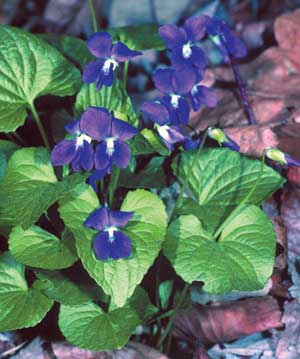 North American Common Blue VioletViola sororia
-
 Australian VioletViola hederacea
-
 Common Dog-VioletViola riviniana
-
 Horned PansyViola cornuta
-
 Manchurian VioletViola mandshurica
-
 American Dog VioletViola labradorica
Compare
Questions and answers
What is the scientific name of the Native Violet?
The scientific name of the Native Violet is Viola banksii. Written with its author, the full name is Viola banksii K.R.Thiele & Prober.
Which family does the Native Violet belong to?
Viola banksii belongs to the family Violaceae, in the order Malpighiales and the class Magnoliopsida.
Where is the Native Violet found?
Checklists and occurrence records place Viola banksii in 3 countries, including Australia and Norfolk Island.
What other names does the Native Violet have?
Viola banksii is also known in English as Australian Native Violet, Banks Violet and Banks' Violet.
What is the difference between viola hederacea and viola banksii?
Native Violet was formerly identified under the name Viola hederacea. The original type specimen of Viola hederacea collected by Labillardière was determined not to represent the hardier and more showy plant subsequently cultivated and sold.[1][2]
Do Viola plants like sun or shade?
In garden cultivation, Native Violet grows in different soil types when provided with sufficient moisture and at least partial shade.[9]
Sources
Passages the profile rests on
- Viola banksii was formerly identified under the name Viola hederacea. Source passage: “For many years it was known as Viola hederacea” — English Wikipedia
- The original type specimen of Viola hederacea collected by Labillardière was determined not to represent the hardier and more showy plant subsequently cultivated and sold. Source passage: “the original type specimen of V. hederacea collected by Labillardière was not the same as the hardier and showier plant later collected, cultivated and widely sold.” — English Wikipedia
- Viola banksii has distinctive purple and white flowers. Source passage: “This species is distinguished by its striking purple and white flowers.” — English Wikipedia
- Its fully developed leaves are almost circular, with a deep, narrow, V-shaped notch at the base. Source passage: “the fully developed leaves are almost circular in outline with a deep, narrow, v-shaped sinus at the base” — English Wikipedia
- Its leaves are usually bright, fresh green. Source passage: “are usually rather bright, fresh green.” — English Wikipedia
- The cultivar Viola banksii 'White Glory' has entirely white flowers with a slight fragrance. Source passage: “V. "White Glory" has all-white flowers with a slight fragrance.” — English Wikipedia
- Viola banksii is native to Australia's east coast, from near Brisbane to Batemans Bay. Source passage: “native to the east coast from near Brisbane to Batemans Bay” — English Wikipedia
- An introduced or naturalised population of Viola banksii has been recorded at Mount Donna Buang near Melbourne. Source passage: “One such population has been recorded at Mount Donna Buang near Melbourne.” — English Wikipedia
- In garden cultivation, Viola banksii grows in different soil types when provided with sufficient moisture and at least partial shade. Source passage: “adaptable to different soil types as long as it gets sufficient moisture and at least half shade or more in a garden situation” — English Wikipedia
- Viola banksii can grow vigorously in heavier soils that retain moisture. Source passage: “It can be quite vigorous in heavier, moisture-retentive soils” — English Wikipedia
- Viola banksii spreads to form a naturally low-growing groundcover. Source passage: “spreads forming a natural low groundcover.” — English Wikipedia
- Widespread cultivation of Viola banksii creates some risk that it will become naturalised in certain areas. Source passage: “Cultivated widely, Viola banksii is at some risk of becoming naturalised in some areas.” — English Wikipedia
- Viola banksii is sold and cultivated in garden nurseries and gardens throughout Australia, particularly in eastern regions. Source passage: “is sold and grown throughout garden nurseries and grown and loved in gardens around Australia, especially in the east.” — English Wikipedia
Data
- Catalogue of Life, 2026-10-16 XR cc by
- Global Biodiversity Information Facility CC BY 4.0
- Wikidata CC0
- GeoNames CC BY 4.0
- Wikimedia Commons per image; credit shown with each image
- Within the Catalogue of Life, this name comes from Synonymic Checklists of the Vascular Plants of the World cc by
References
- Thiele, K. R., & Prober. (2003). Muelleria 18: 15 (2003). where the name was published
This species in other databases
- Catalogue of Life 7FRQ4
- Wikidata Q7933053
- iNaturalist 410980
- World Flora Online wfo-0000430574
- GRIN 468329
Page built on 28 November 2026. See how the catalog is made and all sources and licences.
Cite this page
ScientificNames.org. (2026). Viola banksii (Native Violet). Retrieved November 28, 2026, from https://scientificnames.org/species/viola-banksii
“Viola banksii (Native Violet).” ScientificNames.org, 2026, scientificnames.org/species/viola-banksii. Accessed 28 Nov. 2026.
ScientificNames.org. “Viola banksii (Native Violet).” Accessed November 28, 2026. https://scientificnames.org/species/viola-banksii.
@misc{scientificnames_viola_banksii_native_violet,
  author = {{ScientificNames.org}},
  title = {Viola banksii (Native Violet)},
  year = {2026},
  url = {https://scientificnames.org/species/viola-banksii},
  note = {Accessed 2026-11-28}
}