Species · Flowering plants
Manchurian Violet Viola mandshurica
The scientific name of the Manchurian Violet is Viola mandshurica. It is a species of flowering plant in the family Violaceae (violet family), order Malpighiales.
- Scientific name
- Viola mandshurica W.Becker
- Common name
- Manchurian Violet
- Genus
- Viola
- Family
- Violaceae (Violet Family)
- Order
- Malpighiales
- Class
- Magnoliopsida
- Recorded in
- 7 countries
- Name status
- accepted in the Catalogue of Life

Overview
The species is native to eastern Asia and occurs as far west as eastern Siberia. The plant lacks a true stem, and its rich purple, trumpet-shaped flowers have five petals with bilateral symmetry.
Written 26 November 2026 from the sources listed below. Each statement was checked against the passage it cites; statements that could not be supported were removed.
Appearance
Manchurian violet reaches a height of 6–18 centimeters. It has short, thick rhizomatous roots, and its leaves and flowers emerge directly from the ground.[1][2][3]
The leaves are typically oval-lanceolate to lanceolate and are normally medium green on both surfaces. Their surfaces are either hairless or sparsely covered with short, soft hairs.[4][5][6]
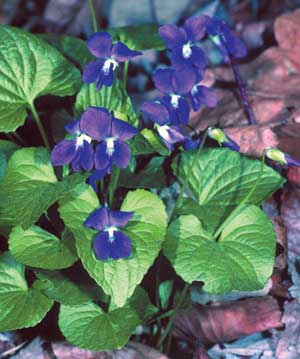
The flowers are trumpet-shaped, with five petals arranged in bilateral symmetry. The petals are typically rich purple, and the lowest petal is often the smallest.[7][8][9]
Habitat
Manchurian violet inhabits both undisturbed woodlands and urban areas. It occurs in low-lying plains and mountainous regions.[10][11]
The wild form generally prefers semi-shaded locations and humus-enriched soil that is not excessively moist.[12][13]
Reproduction and life cycle
Manchurian violet flowers from April through May. Its fruiting period extends from May through September.[14][15]
Uses
The flowers of Manchurian violet can be used to make flower pancakes for Korea's Samjinnal spring festival.[16]
Horticultural varieties of the species are popular as garden plants.[17]
Similar species
In Japan, Manchurian violet is regarded as the basic violet species, while other violet species receive additional descriptive names.[18]
Classification of the Manchurian Violet
| Kingdom | Plantae |
|---|---|
| Subkingdom | Pteridobiotina |
| Phylum | Tracheophyta |
| Class | Magnoliopsida |
| Order | Malpighiales |
| Family | Violaceae (Violet Family) |
| Subfamily | Violoideae |
| Genus | Viola (Violets) |
| Species | Viola mandshurica W.Becker |
Where the Manchurian Violet is found
Checklists and occurrence records place Viola mandshurica in 7 countries across Asia. GBIF holds 8,260 georeferenced records of it.
Countries where it is native or its origin is not stated
Countries where it has been introduced
Regions and cities with the most records
- Gyeonggi-do, South Korea 460
- Gangwon-do, South Korea 309
- Gyeongsangbuk-do, South Korea 305
- Gyeongsangnam-do, South Korea 293
- Jeollanam-do, South Korea 266
- Primorye, Russia 228
- Chungcheongnam-do, South Korea 224
- Seongnam-si, South Korea 213
- Uiwang, South Korea 208
- Gunpo, South Korea 207
- Nagano, Japan 204
- Anyang-si, South Korea 197
- Gwangju, South Korea 196
- Suwon, South Korea 186
- Jeollabuk-do, South Korea 182
- Hanam, South Korea 168
- Kochi, Japan 147
- Seoul, South Korea 130
- Kanagawa, Japan 120
- Tokyo, Japan 113
- Guri-si, South Korea 98
- Taiwan, Taiwan 96
- Minamirinkan, Japan 94
- Machida, Japan 92
- Yamato, Japan 91
- Azamino, Japan 90
- Iwate, Japan 89
- Gwangmyeong, South Korea 87
- Hokkaido, Japan 85
- Liaoning, China 83
- Noborito, Japan 83
- Inagi, Japan 81
- Komae, Japan 81
- Tama, Japan 80
- Wabu, South Korea 79
- Chōfu, Japan 76
1 more country has a few records outside this range
These countries hold a few records of Viola mandshurica but lie outside the range the checklists give for it. Such records are often zoo or garden specimens, museum material or vagrants, so the species is not counted as occurring there.
Range as the checklists state it
Russian Far East (Upper Amur, Khabarovsk, Kuril Isl., Primorye); Georgia [Caucasus] [I]; China (Anhui, Hebei, Heilongjiang, ?Henan, Jilin, Liaoning, Nei Mongol, ?Shaanxi, Shandong, ?Shanxi); North Korea; South Korea; Japan (Hokkaido, Honshu, Shikoku, Kyushu); Taiwan
A number beside a place is its count of GBIF occurrence records. A place without a number comes from a checklist alone. Records show where a species has been observed or collected, which can include escapes and vagrants.
Common names
English
- Manchurian Violet
- Manchuria Violet
Names in 7 other languages
- Chinese
- 紫花地丁
- Estonian
- mandžuuria kannike
- Japanese
- sumire, スミレ, スミレ(広義)
- Korean
- 제비꽃
- Polish
- Fiołek mandżurski
- Russian
- Фиалка маньчжурская
- Turkish
- Mançurya Menekşesi
Synonyms
28 other scientific names have been used for this species and are now treated as synonyms of Viola mandshurica.
- Viola albida subsp. marginata W.Becker
- Viola chinensis var. ciliata Nakai
- Viola chinensis var. media Nakai
- Viola chinensis var. transitica Nakai
- Viola hsinganensis Taken.
- Viola mandshurica f. albiflora P.Y.Fu & Y.C.Teng
- Viola mandshurica f. albiflora S.S.Ying
- Viola mandshurica f. aureoreticulata M.Nagas.
- Viola mandshurica f. ciliata (Nakai) F.Maek.
- Viola mandshurica f. crassa (Tatew.) F.Maek.
- Viola mandshurica f. dispar Honda
- Viola mandshurica f. glabra (Nakai) Hiyama ex F.Maek.
- Viola mandshurica f. hasegawae Hiyama
- Viola mandshurica f. macrantha (Maxim.) Nakai ex Kitag.
- Viola mandshurica f. plena F.Maek.
- Viola mandshurica f. villosa Sugim.
- Viola mandshurica var. ciliata Nakai
- Viola mandshurica var. crassa Tatew.
- Viola mandshurica var. glabra Nakai
- Viola mandshurica var. glabripetala Hiyama
- Viola mandshurica var. media (Nakai) Hiyama
- Viola oblongosagittata f. ishizakii Yamam.
- Viola oldhamiana Nakai
- Viola patrinii var. gmeliniana Miq.
- Viola patrinii var. macrantha Maxim.
- Viola philippica f. intermedia (Kitag.) Kitag.
- Viola rhodosepala Kitag.
- Viola yedoensis f. intermedia Kitag.
Subspecies and varieties
Related species
-
 Sweet VioletViola odorata
-
 Wild PansyViola tricolor
-
 North American Common Blue VioletViola sororia
-
 Australian VioletViola hederacea
-
 Common Dog-VioletViola riviniana
-
 Horned PansyViola cornuta
-
 Native VioletViola banksii
-
 American Dog VioletViola labradorica
Compare
Questions and answers
What is the scientific name of the Manchurian Violet?
The scientific name of the Manchurian Violet is Viola mandshurica. Written with its author, the full name is Viola mandshurica W.Becker.
Which family does the Manchurian Violet belong to?
Viola mandshurica belongs to the family Violaceae, in the order Malpighiales and the class Magnoliopsida.
Where is the Manchurian Violet found?
Checklists and occurrence records place Viola mandshurica in 7 countries, including South Korea, Japan, Russia, Taiwan, China and North Korea.
What other names does the Manchurian Violet have?
Viola mandshurica is also known in English as Manchuria Violet.
Sources
Passages the profile rests on
- The species lacks a true stem, with its leaves and flowers emerging directly from the ground. Source passage: “does not have a true stem, with leaves and flowers each emerging directly from the ground” — English Wikipedia
- The plant reaches a height of 6–18 centimeters. Source passage: “reaching a height of 6–18 centimeters (2–7 in).” — English Wikipedia
- The plant has short, thick rhizomatous roots. Source passage: “Its rhizomatous roots are short and thick.” — English Wikipedia
- The leaves are typically oval-lanceolate to lanceolate in shape. Source passage: “The leaves are typically oval-lanceolate to lanceolate” — English Wikipedia
- The leaf surfaces are either hairless or sparsely covered with short, soft hairs. Source passage: “with both surfaces either glabrous or sparsely puberulous” — English Wikipedia
- The leaves are normally medium green on both their upper and lower surfaces. Source passage: “the color of the leaves is normally a medium green above and below” — English Wikipedia
- The flowers are trumpet-shaped and have five petals with bilateral symmetry. Source passage: “its trumpet-shaped flowers have five petals and bilateral symmetry.” — English Wikipedia
- The lowest petal is often the smallest of the five petals. Source passage: “The lowermost petal is often the smallest” — English Wikipedia
- The petals are typically rich purple in color. Source passage: “all petals are typically a rich purple hue” — English Wikipedia
- The species inhabits both undisturbed woodlands and urban areas. Source passage: “from undisturbed woodlands to urban areas” — English Wikipedia
- The species occurs in both low-lying plains and mountainous regions. Source passage: “from low-lying plains to mountainous regions.” — English Wikipedia
- The wild form generally prefers semi-shaded locations. Source passage: “The wild form, and most named varieties and hybrids, prefer a semi-shaded location” — English Wikipedia
- The wild form generally prefers humus-enriched soil that is not excessively moist. Source passage: “humus-enriched soil that is not overly moist.” — English Wikipedia
- The species flowers from April through May. Source passage: “It blooms from April to May” — English Wikipedia
- The fruiting period extends from May through September. Source passage: “the fruiting period is from May to September.” — English Wikipedia
- The flowers of Viola mandshurica can be used to make flower pancakes for Korea's Samjinnal spring festival. Source passage: “Flower pancakes, which may be made with the flowers of V. mandshurica among other species, are an essential part of the Korean Samjinnal festival” — English Wikipedia
- Horticultural varieties of the species are popular as garden plants. Source passage: “A number of varieties have been developed by horticulturalists and are popular as garden plants.” — English Wikipedia
- In Japan, Viola mandshurica is regarded as the basic violet species, while other violet species receive additional descriptive names. Source passage: “In Japan, V. mandshurica is considered to be the basic species and other violet species have additional descriptors” — English Wikipedia
Data
- Catalogue of Life, 2026-10-16 XR cc by
- Global Biodiversity Information Facility CC BY 4.0
- Wikidata CC0
- GeoNames CC BY 4.0
- Wikimedia Commons per image; credit shown with each image
- Within the Catalogue of Life, this name comes from Synonymic Checklists of the Vascular Plants of the World cc by
References
- Becker, W. (1917). Bot. Jahrb. Syst. 54(5, Beibl. 120): 179-180 (1917). where the name was published
This species in other databases
- Catalogue of Life 5BH4P
- Wikidata Q5369958
- iNaturalist 424920
- World Flora Online wfo-0001144437
- GRIN 41728
Page built on 28 November 2026. See how the catalog is made and all sources and licences.
Cite this page
ScientificNames.org. (2026). Viola mandshurica (Manchurian Violet). Retrieved November 28, 2026, from https://scientificnames.org/species/viola-mandshurica
“Viola mandshurica (Manchurian Violet).” ScientificNames.org, 2026, scientificnames.org/species/viola-mandshurica. Accessed 28 Nov. 2026.
ScientificNames.org. “Viola mandshurica (Manchurian Violet).” Accessed November 28, 2026. https://scientificnames.org/species/viola-mandshurica.
@misc{scientificnames_viola_mandshurica_manchurian_violet,
  author = {{ScientificNames.org}},
  title = {Viola mandshurica (Manchurian Violet)},
  year = {2026},
  url = {https://scientificnames.org/species/viola-mandshurica},
  note = {Accessed 2026-11-28}
}