Species · Flowering plants
Common Dog-Violet Viola riviniana
The scientific name of the Common Dog-Violet is Viola riviniana. It is a species of flowering plant in the family Violaceae (violet family), order Malpighiales.
- Scientific name
- Viola riviniana Rchb.
- Common name
- Common Dog-Violet
- Genus
- Viola
- Family
- Violaceae (Violet Family)
- Order
- Malpighiales
- Class
- Magnoliopsida
- Recorded in
- 56 countries
- Name status
- accepted in the Catalogue of Life

Overview
Common Dog-Violet (Viola riviniana Rchb.) is a perennial flowering plant in the family Violaceae, order Malpighiales and class Magnoliopsida, with a prostrate growth habit. It inhabits woodland edges, grassland and shady hedge banks. It has dark green, heart-shaped leaves and produces violet-coloured flowers.
Written 26 November 2026 from the sources listed below. Each statement was checked against the passage it cites; statements that could not be supported were removed.
Appearance
Common Dog-Violet has dark green, heart-shaped leaves and produces violet-coloured flowers. It can reach 10 cm in height and 50 cm in breadth.[1][2][3]
Habitat
Common Dog-Violet inhabits woodland edges, grassland and shady hedge banks. It occurs in all soil types except acidic and very wet soils.[4][5]
Diet
Common Dog-Violet serves as a food plant for the pearl-bordered fritillary butterfly and the small pearl-bordered fritillary butterfly. It also serves as a food plant for the silver-washed fritillary butterfly and the high brown fritillary butterfly.[6][7][8][9]
Reproduction and life cycle
Common Dog-Violet flowers in May and June. It can hybridise with early dog-violet to produce Viola × bavarica.[10][11]
Similar species
Viola canina has clear blue flowers and narrower leaves. Viola palustris occurs in wet places and has kidney-shaped leaves.[12][13]
Nurseries sometimes sell Common Dog-Violet under the name Viola labradorica.[14]
Uses
Common Dog-Violet was voted the county flower of Lincolnshire in 2002.[15]
Behaviour
Common Dog-Violet is a perennial plant with a prostrate growth habit.[16]
Classification of the Common Dog-Violet
| Kingdom | Plantae |
|---|---|
| Subkingdom | Pteridobiotina |
| Phylum | Tracheophyta |
| Class | Magnoliopsida |
| Order | Malpighiales |
| Family | Violaceae (Violet Family) |
| Subfamily | Violoideae |
| Genus | Viola (Violets) |
| Species | Viola riviniana Rchb. |
Where the Common Dog-Violet is found
Checklists and occurrence records place Viola riviniana in 56 countries across Africa, Europe, North America and Oceania. GBIF holds 551,361 georeferenced records of it.
Countries where it is native or its origin is not stated
- Aland Islands 1,272
- Albania 7
- Algeria 9
- Andorra 40
- Austria 5,267
- Belarus 218
- Belgium 12,701
- Bosnia and Herzegovina 8
- Bulgaria 32
- Croatia 62
- Czechia 3,700
- Denmark 6,315
- Estonia 2,098
- Faroe Islands 180
- Finland 18,282
- France 86,000
- Germany 25,865
- Greece 72
- Guernsey 16
- Hungary 57
- Iceland 65
- Ireland 4,184
- Isle of Man 3,686
- Italy 910
- Jersey 2
- Kosovo
- Latvia 251
- Liechtenstein 9
- Lithuania 64
- Luxembourg 1,331
- Malta
- Moldova 2
- Montenegro 22
- Morocco 23
- North Macedonia 5
- Norway 28,321
- Poland 21,728
- Portugal 2,149
- Romania 18
- Russia 2,079
- San Marino
- Serbia 11
- Slovakia 1,081
- Slovenia 194
- Spain 5,030
- Svalbard and Jan Mayen
- Sweden 39,823
- Switzerland 6,608
- The Netherlands 20,739
- Tunisia 10
- Ukraine 264
- United Kingdom 249,380
Countries where it has been introduced
Regions and cities with the most records
- England, United Kingdom 146,901
- Scotland, United Kingdom 64,805
- Wales, United Kingdom 18,180
- Bavaria, Germany 14,806
- Auvergne-Rhône-Alpes, France 14,262
- Bourgogne-Franche-Comté, France 9,714
- Centre-Val de Loire, France 8,670
- Île-de-France, France 8,647
- Västra Götaland, Sweden 6,810
- Södermanland, Sweden 5,682
- Gelderland, The Netherlands 5,591
- Falmouth, United Kingdom 5,561
- Redruth, United Kingdom 5,541
- Truro, United Kingdom 5,531
- Northern Ireland, United Kingdom 5,511
- Camborne, United Kingdom 5,405
- Occitanie, France 4,791
- Bodmin, United Kingdom 4,663
- Pays de la Loire, France 4,581
- St Austell, United Kingdom 4,581
- Grand Est, France 4,564
- Hauts-de-France, France 4,493
- Newquay, United Kingdom 3,831
- Gävleborg, Sweden 3,773
- Penzance, United Kingdom 3,587
- Buxton, United Kingdom 3,456
- Hoensbroek, The Netherlands 3,234
- Fulwood, United Kingdom 3,210
- Maastricht, The Netherlands 3,197
- Skåne, Sweden 3,189
- High Peak, United Kingdom 3,066
- Douglas, Isle of Man 2,991
- Dronfield, United Kingdom 2,969
- Chester-le-Street, United Kingdom 2,967
- Chesterfield, United Kingdom 2,967
- Stanley, United Kingdom 2,911
4 more countries have a few records outside this range
These countries hold a few records of Viola riviniana but lie outside the range the checklists give for it. Such records are often zoo or garden specimens, museum material or vagrants, so the species is not counted as occurring there.
Range as the checklists state it
Iceland; Svalbard; Faeroe Isl.; England (England, Wales, Isle of Man, Scotland, Outer Hebrides, St. Kilda Isl., Orkney Isl., Shetland Isl., Isles of Scilly); Ireland (Ireland, Northern Ireland); Denmark; Norway; Sweden; Finland; Netherlands; Belgium; Luxembourg; Germany (Brandenburg, Berlin, Baden-Württemberg, Bayern, Hessen, Hamburg, Mecklenburg-Vorpommern, Niedersachsen, Nordrhein-Westfalen, Rheinland-Pfalz, Schleswig-Holstein, Saarland, Sachsen, Sachsen-Anhalt, Thüringen); Switzerland; Liechtenstein; Austria; Poland; Czech Republic; Slovakia; Hungary; Portugal; Spain; Andorra; France; Channel Isl. (Alderney, Guernsey, Jersey, Sark); Corsica; Sardinia; Italy; Sicily; Malta; ?San Marino; Slovenia; Croatia; Bosnia & Hercegovina; Montenegro; Serbia; Kosovo; North Macedonia; Albania; Romania; Bulgaria; Greece (mountains of mainland, Thasos, Samothraki); Estonia; Latvia; Lithuania; Belarus; C-European Russia; N-European Russia; Moldova; Morocco; Algeria; Tunisia; Madeira (Madeira Isl.); Canary Isl. (Tenerife, La Gomera, Hierro, La Palma); East Aegaean Isl. (Lesvos, Chios); Australia [I] (Victoria [I]); New Zealand [I]; Chatham Isl. [I]; Canada [I] (British California [I]); USA [I] (California [I], Oregon [I], Washington State [I])
A number beside a place is its count of GBIF occurrence records. A place without a number comes from a checklist alone. Records show where a species has been observed or collected, which can include escapes and vagrants.
Common names
English
- Common Dog-Violet
- Rivinus' Violet
- Blunt-spurred Violet
- Common Dog Violet
- Dog Violet
- European Dog Violet
- Wood Violet
Names in 28 other languages
- Belarusian
- Фіялка Рывініуса
- Chinese
- 犬堇菜
- Croatian
- Rivinijeva ljubica
- Czech
- violka Rivinova
- Danish
- Krat-viol
- Dutch
- Bleeksporig bosviooltje
- Estonian
- võsakannike
- Faroese
- dimm blákolla
- Finnish
- metsäorvokki
- French
- violette de Rivinius, violette de Rivinus
- German
- Hain-Veilchen
- Hungarian
- nagyvirágú ibolya
- Icelandic
- Skógfjóla
- Irish
- Sailchuach chon
- Italian
- Viola di Rivinus
- Latvian
- Rivina vijolīte
- Lithuanian
- Rivino našlaitė
- Northern Sami
- vuovdeviola
- Norwegian Bokmål
- skogfiol
- Polish
- Fiołek Rivina
- Portuguese
- Violeta-brava, Violeta-de-Rivinius
- Russian
- Фиалка Ривинуса
- Slovak
- fialka Rivinova
- Slovenian
- Rivinova vijolica
- Spanish
- Violeta de monte
- Swedish
- skogsviol
- Ukrainian
- Фіалка Рівінієва
- Welsh
- Esgidiau a Sanau y Gog, Fioled Gyffredin, Fioledau Cyffredin, Gwiolydd Gyffredin, Millyn Glasog y Gelltydd, Pen y Neidr, Sanau'r Gog, Sanau'r Gwcw
Synonyms
56 other scientific names have been used for this species and are now treated as synonyms of Viola riviniana.
- Viola arenaria subsp. puberula (Lange) Nyman
- Viola broussonetiana Schult.
- Viola canina subsp. riviniana (Rchb.) Schübl. & G.Martens
- Viola canina var. pubescens Merino
- Viola canina var. riviniana (Rchb.) Mert. & W.D.J.Koch
- Viola canina var. riviniana (Rchb.) C.C.Gmel.
- Viola guffroyi Rouy
- Viola nemorosa (Neuman, Wahlst. & Murb.) G.H.Loos
- Viola reichenbachiana var. pubescens Pau
- Viola riviniana f. minor Murb. ex E.S.Gregory
- Viola riviniana f. prolifera Valentine
- Viola riviniana f. sobolifera Valentine
- Viola riviniana subsp. minor (Murb. ex E.S.Gregory) Valentine
- Viola riviniana subsp. nemorosa (L. Neumann, Wahlst. & Murb.) Valentine
- Viola riviniana subsp. riviniana Reichb.
- Viola riviniana var. leucocentra Pinkw.
- Viola riviniana var. minor (Murb. ex E.S.Gregory) Valentine
- Viola riviniana var. nemorosa Neuman, Wahlst. & Murb.
- Viola rupestris subsp. puberula (Lange) W.Becker
- Viola sequeirae Capelo, R.Jardim, J.C.Costa, Lousã & Rivas Mart.
- Viola silvatica f. pygmaea (Lange) Samp.
- Viola silvatica subsp. insularis (Gren.) Nyman
- Viola silvatica subsp. riviniana (Rchb.) Syme
- Viola silvatica var. adunca Kurtz
- Viola silvatica var. ascoplectron Svent. ex Marcet
- Viola silvatica var. grandiflora Gren.
- Viola silvatica var. macrantha Fr.
- Viola silvatica var. pygmaea Lange
- Viola silvatica var. riviniana (Rchb.) Boiss.
- Viola silvatica var. riviniana (Rchb.) Asch.
- Viola silvatica var. rostrata Cout.
- Viola silvestris subsp. insularis (Gren.) Rouy & Foucaud
- Viola subsessilifolia Lázaro Ibiza
- Viola sylvatica var. grandiflora Gren.
- Viola sylvatica var. sylvatica
- Viola sylvestris f. albidotomentosa W.Becker
- Viola sylvestris subsp. nemorum Döll
- Viola sylvestris subsp. riviniana (Rchb.) Tourlet
- Viola sylvestris subsp. riviniana (Rchb.) W.D.J.Koch
- Viola sylvestris subsp. riviniana (Rchb.) Čelak.
Showing 40 of 56.
Subspecies and varieties
- Viola riviniana var. riviniana variety
Related species
-
 Sweet VioletViola odorata
-
 Wild PansyViola tricolor
-
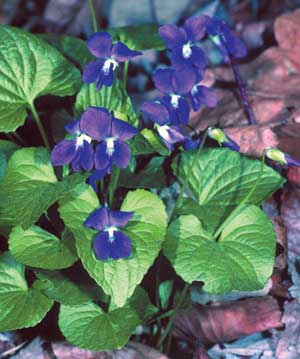 North American Common Blue VioletViola sororia
-
 Australian VioletViola hederacea
-
 Horned PansyViola cornuta
-
 Native VioletViola banksii
-
 Manchurian VioletViola mandshurica
-
 American Dog VioletViola labradorica
Compare
Questions and answers
What is the scientific name of the Common Dog-Violet?
The scientific name of the Common Dog-Violet is Viola riviniana. Written with its author, the full name is Viola riviniana Rchb..
Which family does the Common Dog-Violet belong to?
Viola riviniana belongs to the family Violaceae, in the order Malpighiales and the class Magnoliopsida.
Where is the Common Dog-Violet found?
Checklists and occurrence records place Viola riviniana in 56 countries, including United Kingdom, France, Sweden, Norway, Germany and Poland.
What other names does the Common Dog-Violet have?
Viola riviniana is also known in English as Rivinus' Violet, Blunt-spurred Violet, Common Dog Violet, Dog Violet, European Dog Violet and Wood Violet.
Sources
Passages the profile rests on
- The plant has dark green, heart-shaped leaves. Source passage: “has dark green, heart-shaped leaves” — English Wikipedia
- The plant produces violet-coloured flowers. Source passage: “produces multiple violet coloured flowers in May and June.” — English Wikipedia
- The plant can reach 10 cm in height and 50 cm in breadth. Source passage: “Growing to 10 cm (3.9 in) tall and 50 cm (20 in) broad” — English Wikipedia
- The species inhabits woodland edges, grassland and shady hedge banks. Source passage: “It inhabits woodland edges, grassland and shady hedge banks.” — English Wikipedia
- The species occurs in all soil types except acidic and very wet soils. Source passage: “It is found in all soils except those which are acid or very wet.” — English Wikipedia
- The species serves as a food plant for the pearl-bordered fritillary butterfly. Source passage: “It is the food plant of the pearl bordered fritillary” — English Wikipedia
- The species serves as a food plant for the small pearl-bordered fritillary butterfly. Source passage: “small pearl-bordered fritillary” — English Wikipedia
- The species serves as a food plant for the silver-washed fritillary butterfly. Source passage: “silver-washed fritillary” — English Wikipedia
- The species serves as a food plant for the high brown fritillary butterfly. Source passage: “high brown fritillary butterflies.” — English Wikipedia
- The species flowers in May and June. Source passage: “produces multiple violet coloured flowers in May and June.” — English Wikipedia
- The species can hybridise with early dog-violet to produce Viola × bavarica. Source passage: “This species hybridises with early dog-violet (V. reichenbachiana) to produce Viola × bavarica.” — English Wikipedia
- Viola canina has clear blue flowers and narrower leaves. Source passage: “Viola canina (heath dog violet) – clear blue flowers; narrower leaves;” — English Wikipedia
- Viola palustris occurs in wet places and has kidney-shaped leaves. Source passage: “Viola palustris (marsh violet) – found in wet places; leaves are kidney-shaped;” — English Wikipedia
- Nurseries sometimes sell Viola riviniana under the name Viola labradorica. Source passage: “V. riviniana is sometimes sold by nurseries as V. labradorica” — English Wikipedia
- The species was voted the county flower of Lincolnshire in 2002. Source passage: “Viola riviniana was voted the county flower of Lincolnshire in 2002” — English Wikipedia
- The species is a perennial plant with a prostrate growth habit. Source passage: “this prostrate perennial has dark green, heart-shaped leaves” — English Wikipedia
Data
- Catalogue of Life, 2026-10-16 XR cc by
- Global Biodiversity Information Facility CC BY 4.0
- Wikidata CC0
- GeoNames CC BY 4.0
- Wikimedia Commons per image; credit shown with each image
- Within the Catalogue of Life, this name comes from Synonymic Checklists of the Vascular Plants of the World cc by
References
- Rchb. (1823). Iconogr. Bot. Pl. Crit. 1: 81 (1823). where the name was published
This species in other databases
Page built on 29 November 2026. See how the catalog is made and all sources and licences.
Cite this page
ScientificNames.org. (2026). Viola riviniana (Common Dog-Violet). Retrieved November 29, 2026, from https://scientificnames.org/species/viola-riviniana
“Viola riviniana (Common Dog-Violet).” ScientificNames.org, 2026, scientificnames.org/species/viola-riviniana. Accessed 29 Nov. 2026.
ScientificNames.org. “Viola riviniana (Common Dog-Violet).” Accessed November 29, 2026. https://scientificnames.org/species/viola-riviniana.
@misc{scientificnames_viola_riviniana_common_dog_violet,
  author = {{ScientificNames.org}},
  title = {Viola riviniana (Common Dog-Violet)},
  year = {2026},
  url = {https://scientificnames.org/species/viola-riviniana},
  note = {Accessed 2026-11-29}
}