Species · Flowering plants
Green Alder Alnus alnobetula
The scientific name of the Green Alder is Alnus alnobetula. It is a species of flowering plant in the family Betulaceae (birch family), order Fagales.
- Scientific name
- Alnus alnobetula (Ehrh.) K.Koch
- Common name
- Green Alder
- Genus
- Alnus
- Family
- Betulaceae (Birch Family)
- Order
- Fagales
- Class
- Magnoliopsida
- Red List category
- LC Least Concern
- Recorded in
- 42 countries
- Name status
- accepted in the Catalogue of Life

Overview
The species is widespread across Europe, Asia, and North America, and grows in mountain avalanche chutes and on subarctic river gravels in northern Siberia, Alaska, and Canada. The green alder has shallow roots containing nitrogen-fixing nodules.
Written 26 November 2026 from the sources listed below. Each statement was checked against the passage it cites; statements that could not be supported were removed.
Appearance
The green alder is a deciduous shrub or small tree with smooth grey bark. It reaches a height of 3–12 metres.[1][2]
Its ovoid leaves are shiny green above and light green underneath. They measure 3–8 centimetres long and 2–6 centimetres wide.[3][4]
The species has a shallow root system.[5]
Habitat
The green alder commonly colonizes mountain avalanche chutes. It also commonly grows on subarctic river gravels in northern Siberia, Alaska, and Canada, alongside shrubby willows.[6][7][8]
The species grows well in relatively poor soils but requires moist soil.[9][10]
Alnus alnobetula subsp. crispa occurs in northeastern North America and Greenland.[11]
Alnus alnobetula subsp. fruticosa occurs in northeastern Europe, northern Asia, and northwestern North America.[12]
Alnus alnobetula subsp. sinuata occurs in western North America and far northeastern Siberia.[13]
Behaviour
The green alder is light-demanding and grows rapidly. It can regenerate from roots and broken stumps after avalanche damage.[14][15]
The species produces both stump suckers and root suckers.[16]
Reproduction and life cycle
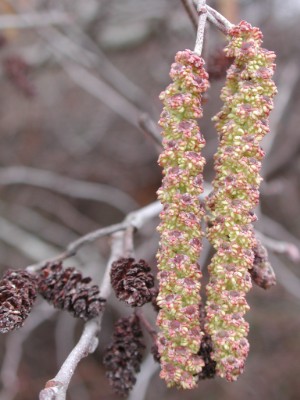
The flowers grow in catkins that appear in late spring after the leaves emerge. The male catkins hang down and measure 4–8 centimetres long.[17][18]
Mature female catkins measure approximately 1 centimetre long and 0.7 centimetres wide. They occur in clusters of three to ten on branched stems.[19][20]
The seeds are light brown, measure 1–2 millimetres long, and have a narrow encircling wing.[21]
Uses
Green alder is used in afforestation projects on infertile soils. Its nitrogen-fixing root nodules can enrich soil, contributing approximately 50 kilograms of nitrogen per hectare annually.[22][23][24][25]
The species has been used for revegetation and strip-mine reclamation.[26]
The leaves have been used in traditional Austrian medicine as external treatments or internal tea for infections and fever.[27]
Conservation
The green alder is classified as an environmental weed in New Zealand.[28]
Classification of the Green Alder
| Kingdom | Plantae |
|---|---|
| Subkingdom | Pteridobiotina |
| Phylum | Tracheophyta |
| Class | Magnoliopsida |
| Order | Fagales |
| Family | Betulaceae (Birch Family) |
| Subfamily | Betuloideae |
| Genus | Alnus (Alder) |
| Species | Alnus alnobetula (Ehrh.) K.Koch |
Where the Green Alder is found
Checklists and occurrence records place Alnus alnobetula in 42 countries across Asia, Europe, North America and Oceania. GBIF holds 78,268 georeferenced records of it.
Countries where it is native or its origin is not stated
- Austria 6,253
- Belgium 3
- Bosnia and Herzegovina 5
- Bulgaria 25
- Canada 9,937
- China 14
- Croatia
- Czechia 123
- Denmark 202
- Estonia 14
- France 26,579
- Greenland 207
- Hungary 14
- Iceland 32
- Italy 1,986
- Japan 637
- Kosovo
- Latvia 16
- Liechtenstein 17
- Mongolia 15
- Montenegro 2
- North Korea 46
- North Macedonia
- Norway 223
- Poland 157
- Portugal 43
- Romania 47
- Russia 6,734
- Saint Pierre and Miquelon 28
- Serbia
- Slovakia 30
- Slovenia 58
- South Korea 120
- Spain 53
- Sweden 115
- Switzerland 12,040
- The Netherlands 11
- Ukraine 134
- United States 8,859
Countries where it has been introduced
Regions and cities with the most records
- Auvergne-Rhône-Alpes, France 16,220
- Provence-Alpes-Côte d'Azur, France 8,509
- Valais, Switzerland 2,284
- Bavaria, Germany 2,265
- Buryatiya Republic, Russia 2,235
- Salzburg, Austria 1,974
- Bern, Switzerland 1,939
- British Columbia, Canada 1,530
- Upper Austria, Austria 1,519
- Quebec, Canada 1,464
- Alaska, United States 1,409
- Sallanches, France 1,367
- Vaud, Switzerland 1,308
- Monthey, Switzerland 1,295
- Saint-Martin-d'Hères, France 1,258
- Meylan, France 1,212
- Martigny-Ville, Switzerland 1,203
- Corsica, France 1,179
- Tyrol, Austria 1,159
- Newfoundland and Labrador, Canada 1,083
- Ontario, Canada 969
- Échirolles, France 956
- Ticino, Switzerland 940
- Cluses, France 919
- Sitten, Switzerland 912
- Grenoble, France 873
- Montreux, Switzerland 871
- Nova Scotia, Canada 870
- Albertville, France 817
- Washington, United States 747
- Fontaine, France 742
- Gap, France 727
- Sierre, Switzerland 717
- Uri, Switzerland 670
- Sonthofen, Germany 651
- Kamchatka, Russia 636
1 more country has a few records outside this range
These countries hold a few records of Alnus alnobetula but lie outside the range the checklists give for it. Such records are often zoo or garden specimens, museum material or vagrants, so the species is not counted as occurring there.
A number beside a place is its count of GBIF occurrence records. A place without a number comes from a checklist alone. Records show where a species has been observed or collected, which can include escapes and vagrants.
Common names
English
- Green Alder
- European Green Alder
- Mountain Alder
Names in 34 other languages
- Arabic
- نغت أخضر
- Azerbaijani
- Yaşıl qızılağac
- Basque
- Haltz berde
- Chinese
- 榿樹, 綠赤楊
- Czech
- olše zelená
- Danish
- Grøn el, Grøn-el
- Dutch
- Alpenels
- Estonian
- roheline lepp
- Finnish
- pensasleppä
- French
- Aulne des Alpes, Aune des Alpes, Aune vert, aulne vert
- German
- Alpen-Erle, Alpenerle, Bergerle, Grün-Erle, Laublatsche
- Hungarian
- Havasi éger
- Icelandic
- Kjarrölur
- Italian
- Ontano Alpino, Ontano Verde
- Lithuanian
- Žaliasis alksnis
- Macedonian
- Зелена евла
- Norwegian
- Groene Els
- Norwegian Bokmål
- grønnor
- Norwegian Nynorsk
- grønor
- Persian
- توسکای سبز
- Polish
- Olsza zielona
- Russian
- Ольха зелёная
- Slovak
- jelša zelená
- Slovenian
- zelena jelša
- Spanish
- Aliso verde
- Swedish
- björkal, grönal
- Turkish
- Yeşil kızılağaç
- Ukrainian
- Вільха зелена
- azb
- یاشیل قیزیل آغاج
- hsb
- Zelena wólša
- mic
- Tupsi
- oji
- Wadoop
- roh
- Ogn verd
- udm
- Вож лулпу
Synonyms
2 other scientific names have been used for this species and are now treated as synonyms of Alnus alnobetula.
- Alnus alnobetula var. genuina Regel
- Betula viridis Vill.
Subspecies and varieties
- Alnus alnobetula subsp. alnobetula (European Green Alder) subspecies
- Alnus alnobetula subsp. crispa (Green Alder) subspecies
- Alnus alnobetula subsp. fruticosa (Siberian Alder) subspecies
- Alnus alnobetula subsp. sinuata (Sitka Alder) subspecies
- Alnus alnobetula subsp. suaveolens (Corsican Green Alder) subspecies
Related species
-
 Common AlderAlnus glutinosa
-
 Gray AlderAlnus incana
-
 Red AlderAlnus rubra
-
 Italian AlderAlnus cordata
-
 California AlderAlnus rhombifolia
-
 Common AlderAlnus serrulata
-
 Nepalese AlderAlnus nepalensis
-
 Andean AlderAlnus acuminata
Compare
Questions and answers
What is the scientific name of the Green Alder?
The scientific name of the Green Alder is Alnus alnobetula. Written with its author, the full name is Alnus alnobetula (Ehrh.) K.Koch.
Which family does the Green Alder belong to?
Alnus alnobetula belongs to the family Betulaceae, in the order Fagales and the class Magnoliopsida.
Where is the Green Alder found?
Checklists and occurrence records place Alnus alnobetula in 42 countries, including France, Switzerland, Canada, United States, Russia and Austria.
What is the conservation status of the Green Alder?
The IUCN Red List category recorded for Alnus alnobetula is Least Concern (LC).
What other names does the Green Alder have?
Alnus alnobetula is also known in English as European Green Alder and Mountain Alder.
Where do alder trees grow in the USA?
The species occurs in North America. Alnus alnobetula subsp. crispa occurs in northeastern North America, while Alnus alnobetula subsp. sinuata occurs in western North America.[29][11][13]
What is special about alder trees?
The green alder has nitrogen-fixing root nodules that can enrich soil. It can contribute approximately 50 kilograms of nitrogen per hectare annually.[22][24][25]
Sources
Passages the profile rests on
- The green alder is a deciduous shrub or small tree with smooth grey bark. Source passage: “It is a deciduous large shrub or small tree 3–12 metres (10–39 ft) tall with smooth grey bark even in old age.” — English Wikipedia
- The green alder reaches a height of 3–12 metres. Source passage: “3–12 metres (10–39 ft) tall” — English Wikipedia
- Its leaves are shiny green above, light green underneath, and ovoid in shape. Source passage: “The leaves are shiny green with light green undersurfaces, ovoid” — English Wikipedia
- Its leaves measure 3–8 centimetres long and 2–6 centimetres wide. Source passage: “3–8 centimetres (1.2–3.1 in) long and 2–6 cm (0.79–2.36 in) broad.” — English Wikipedia
- The species has a shallow root system. Source passage: “Alnus alnobetula has a shallow root system” — English Wikipedia
- The species commonly colonizes mountain avalanche chutes. Source passage: “In many areas, it is a highly characteristic colonist of avalanche chutes in mountains” — English Wikipedia
- The species commonly grows on subarctic river gravels in northern Siberia, Alaska, and Canada. Source passage: “It also commonly grows on subarctic river gravels, particularly in northern Siberia, Alaska and Canada” — English Wikipedia
- On subarctic river gravels, the species commonly occurs alongside shrubby willows. Source passage: “in this habitat it commonly occurs mixed with shrubby willows.” — English Wikipedia
- The species grows well in relatively poor soils. Source passage: “grows well on poorer soils.” — English Wikipedia
- Unlike some other alder species, it requires moist soil. Source passage: “Unlike some other alders, it does require moist soil” — English Wikipedia
- The subspecies Alnus alnobetula subsp. crispa occurs in northeastern North America and Greenland. Source passage: “northeastern North America, Greenland (mountain alder; syn. A. crispa)” — English Wikipedia
- The subspecies Alnus alnobetula subsp. fruticosa occurs in northeastern Europe, northern Asia, and northwestern North America. Source passage: “Northeast Europe, northern Asia, northwestern North America” — English Wikipedia
- The subspecies Alnus alnobetula subsp. sinuata occurs in western North America and far northeastern Siberia. Source passage: “western North America, far northeastern Siberia (Sitka alder; syn. A. sinuata)” — English Wikipedia
- The species is light-demanding and grows rapidly. Source passage: “It is a light-demanding, fast-growing shrub” — English Wikipedia
- The species can regenerate from roots and broken stumps after avalanche damage. Source passage: “survives the avalanches through its ability to re-grow from the roots and broken stumps.” — English Wikipedia
- The species produces both stump suckers and root suckers. Source passage: “marked not only by vigorous production of stump suckers, but also by root suckers.” — English Wikipedia
- Its flowers grow in catkins that appear in late spring after the leaves emerge. Source passage: “The flowers are catkins, appearing late in spring after the leaves emerge” — English Wikipedia
- Its male catkins hang down and measure 4–8 centimetres long. Source passage: “the male catkins are pendulous, 4–8 cm long” — English Wikipedia
- Its mature female catkins measure approximately 1 centimetre long and 0.7 centimetres wide. Source passage: “the female catkins 1 cm long and 0.7 cm broad when mature in late autumn” — English Wikipedia
- Its female catkins occur in clusters of three to ten on branched stems. Source passage: “in clusters of 3–10 on a branched stem.” — English Wikipedia
- Its seeds are light brown, measure 1–2 millimetres long, and have a narrow encircling wing. Source passage: “The seeds are small, 1–2 mm long, light brown with a narrow encircling wing.” — English Wikipedia
- The roots of the species contain nitrogen-fixing nodules. Source passage: “The roots of green alder have nitrogen-fixing nodules.” — English Wikipedia
- Green alder is used in afforestation projects on infertile soils. Source passage: “Green alder is sometimes used for afforestation on infertile soils” — English Wikipedia
- The species can enrich soil through its nitrogen-fixing root nodules. Source passage: “which it enriches by means of its nitrogen-fixing nodules” — English Wikipedia
- Green alder can contribute approximately 50 kilograms of nitrogen per hectare annually to soil. Source passage: “It can add 50kg of nitrogen per hectare (20 kg per acre) per year to the soil.” — English Wikipedia
- The species has been used for revegetation and strip-mine reclamation. Source passage: “can be used for revegetation and stripmine reclamation.” — English Wikipedia
- The leaves have been used in traditional Austrian medicine as external treatments or internal tea for infections and fever. Source passage: “The leaves have been used in the traditional Austrian medicine externally or internally as tea for treatment of infections and fever.” — English Wikipedia
- The species is classified as an environmental weed in New Zealand. Source passage: “The species is classed as an environmental weed in New Zealand.” — English Wikipedia
- The species is widespread across Europe, Asia, and North America. Source passage: “widespread across much of Europe, Asia, and North America.” — English Wikipedia
- The document lists mountain alder and green alder among the common names associated with Alnus alnobetula subsp. sinuata. Source passage: “COMMON NAMES : Sitka alder mountain alder wavyleaf alder green alder” — fs.usda.gov
Data
- Catalogue of Life, 2026-10-16 XR cc by
- Global Biodiversity Information Facility CC BY 4.0
- Wikidata CC0
- GeoNames CC BY 4.0
- Wikimedia Commons per image; credit shown with each image
- Within the Catalogue of Life, this name comes from Synonymic Checklists of the Vascular Plants of the World cc by
References
- (Ehrh.) K.Koch. where the name was published
This species in other databases
- Catalogue of Life C2NF
- Wikidata Q20720096
- iNaturalist 868167
- World Flora Online wfo-0000944137
- GRIN 2435
Page built on 28 November 2026. See how the catalog is made and all sources and licences.
Cite this page
ScientificNames.org. (2026). Alnus alnobetula (Green Alder). Retrieved November 28, 2026, from https://scientificnames.org/species/alnus-alnobetula
“Alnus alnobetula (Green Alder).” ScientificNames.org, 2026, scientificnames.org/species/alnus-alnobetula. Accessed 28 Nov. 2026.
ScientificNames.org. “Alnus alnobetula (Green Alder).” Accessed November 28, 2026. https://scientificnames.org/species/alnus-alnobetula.
@misc{scientificnames_alnus_alnobetula_green_alder,
  author = {{ScientificNames.org}},
  title = {Alnus alnobetula (Green Alder)},
  year = {2026},
  url = {https://scientificnames.org/species/alnus-alnobetula},
  note = {Accessed 2026-11-28}
}