Species · Flowering plants
Nepalese Alder Alnus nepalensis
The scientific name of the Nepalese Alder is Alnus nepalensis. It is a species of flowering plant in the family Betulaceae (birch family), order Fagales.
- Scientific name
- Alnus nepalensis D.Don
- Common name
- Nepalese Alder
- Genus
- Alnus
- Family
- Betulaceae (Birch Family)
- Order
- Fagales
- Class
- Magnoliopsida
- Red List category
- LC Least Concern
- Recorded in
- 10 countries
- Name status
- accepted in the Catalogue of Life

Overview
Nepalese alder (Alnus nepalensis D.Don) is a large deciduous flowering tree in the family Betulaceae, order Fagales, and class Magnoliopsida. It grows in the subtropical highlands of the Himalayas at elevations between 500 and 3,000 m. It is distinguished by its silver-gray bark, separate male and female catkins, and nitrogen-fixing root nodules.
Written 26 November 2026 from the sources listed below. Each statement was checked against the passage it cites; statements that could not be supported were removed.
Appearance
Nepalese alder is a large deciduous tree with silver-gray bark. It reaches up to 30 m in height and 60 cm in diameter.[1][2]
The leaves are alternate, simple, and shallowly toothed, with prominent parallel veins. They measure 7–16 cm in length and 5–10 cm in width.[3][4]
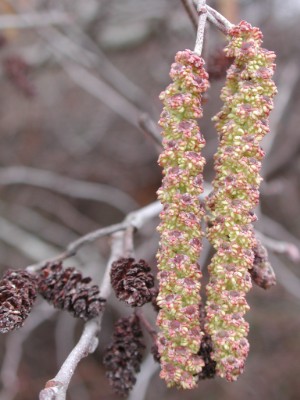
The tree produces separate male and female flowers in the form of catkins. Male flowers are pendulous and measure 10–25 cm in length, while female flowers are erect and measure 1–2 cm in length.[5][6][7]
Female flowers occur in axillary racemes containing up to eight flowers together.[8]
Habitat
Nepalese alder grows in the subtropical highlands of the Himalayas at elevations between 500 and 3,000 m.[9][10]
It grows best in deep volcanic loamy soils but also grows in clay, sand, and gravel soils. It tolerates a wide variety of soil types and grows well in very wet areas.[11][12][13]
The species requires abundant soil moisture and prefers locations beside streams. It also grows on slopes.[14][15]
It occurs throughout the Himalayas, from Pakistan through India, Nepal, and Bhutan to Yunnan in southwest China.[16]
Diet
The fruit of Nepalese alder is fed to cattle and goats. Local people eat its embryo.[17][18]
Behaviour
Nepalese alder grows quickly.[19]
Reproduction and life cycle
Nepalese alder produces its flowers in autumn, with seeds maturing the following year.[20]
Uses
Nepalese alder is used for land reclamation. It is planted to control erosion on hillsides and to recover land in areas affected by shifting cultivation.[21][22][23]
The roots have nodules that fix nitrogen.[24]
The wood is moderately soft and is occasionally used to make boxes and for light construction. Its main uses are as firewood and for making charcoal.[25][26][27]
Indigenous H'mong, Nung, and Thu Lao communities in Simacai district, Lao Cai province, northern Vietnam, use Nepalese alder to regreen and enrich forests.[28]
The species is called Utis in Nepali.[29]
Classification of the Nepalese Alder
| Kingdom | Plantae |
|---|---|
| Subkingdom | Pteridobiotina |
| Phylum | Tracheophyta |
| Class | Magnoliopsida |
| Order | Fagales |
| Family | Betulaceae (Birch Family) |
| Subfamily | Betuloideae |
| Genus | Alnus (Alder) |
| Species | Alnus nepalensis D.Don |
Where the Nepalese Alder is found
Checklists and occurrence records place Alnus nepalensis in 10 countries across Asia. GBIF holds 1,795 georeferenced records of it.
Countries
- Bangladesh
- Bhutan 24
- China 1,411
- India 143
- Indonesia 3
- Laos
- Myanmar 32
- Nepal 154
- Thailand 1
- Vietnam 27
Regions and cities with the most records
- Yunnan, China 634
- Sichuan, China 206
- Guizhou, China 170
- Kunming, China 98
- Majie, China 97
- Tibet, China 75
- Anlong, China 63
- Guangxi, China 55
- Dali Old Town, China 33
- Dali, China 30
- Haidong Zhen, China 29
- Shangpa, China 25
- Yinqiao Zhen, China 24
- Fengyi, China 20
- Xichang, China 20
- Beihai, China 19
- Pu'er, China 19
- Tengyue, China 19
- Yongjian, China 19
- Xingyi, China 18
- Uttarakhand, India 17
- Zhonghe, China 15
- Hehua, China 14
- Mangbang, China 14
- Wanqiao Zhen, China 14
- Jinding, China 13
- Ki̇̄rtipur, Nepal 13
- Pātan, Nepal 13
- Wuhe, China 13
- Kathmandu, Nepal 11
- Madhyapur Thimi, Nepal 11
- Huangshan, China 10
- Lijiang, China 10
- Zhelou, China 10
- Banepā, Nepal 9
- Dhulikhel, Nepal 9
2 more countries have a few records outside this range
These countries hold a few records of Alnus nepalensis but lie outside the range the checklists give for it. Such records are often zoo or garden specimens, museum material or vagrants, so the species is not counted as occurring there.
Range as the checklists state it
China (Sichuan, Yunnan); Tibet; Nepal; Bhutan; N-India (Arunachal Pradesh, Assam, Himachal Pradesh, Manipur, Meghalaya, Mizoram, Nagaland, Sikkim, Tripura, Uttarakhand, West Bengal); Bangladesh; Myanmar; Thailand; Laos; Vietnam
A number beside a place is its count of GBIF occurrence records. A place without a number comes from a checklist alone. Records show where a species has been observed or collected, which can include escapes and vagrants.
Common names
English
- Nepalese Alder
- Himalayan Alder
- Indian Alder
- Nepal Black Cedar
- Nepal Alder
- Nepali Alder
Names in 7 other languages
- Chinese
- ni po er qi mu, 尼泊爾赤楊
- Estonian
- nepaali lepp
- Hindi
- Lal-amiri, Otish, Ust, Utees
- Japanese
- ネパールハンノキ
- Nepali
- उतिस, उतिस Utis
- Thai
- สร้อยสมเด็จ
- asm
- Utis
Synonyms
4 other scientific names have been used for this species and are now treated as synonyms of Alnus nepalensis.
- Alnus boshia Buch.-Ham. ex D.Don
- Betula leptophylla Regel
- Betula leptostachya Wall.
- Clethropsis nepalensis (D.Don) Spach
Related species
-
 Common AlderAlnus glutinosa
-
 Gray AlderAlnus incana
-
 Red AlderAlnus rubra
-
 Green AlderAlnus alnobetula
-
 Italian AlderAlnus cordata
-
 California AlderAlnus rhombifolia
-
 Common AlderAlnus serrulata
-
 Andean AlderAlnus acuminata
Compare
Questions and answers
What is the scientific name of the Nepalese Alder?
The scientific name of the Nepalese Alder is Alnus nepalensis. Written with its author, the full name is Alnus nepalensis D.Don.
Which family does the Nepalese Alder belong to?
Alnus nepalensis belongs to the family Betulaceae, in the order Fagales and the class Magnoliopsida.
Where is the Nepalese Alder found?
Checklists and occurrence records place Alnus nepalensis in 10 countries, including China, Nepal, India, Myanmar, Vietnam and Bhutan.
What is the conservation status of the Nepalese Alder?
The IUCN Red List category recorded for Alnus nepalensis is Least Concern (LC).
What other names does the Nepalese Alder have?
Alnus nepalensis is also known in English as Himalayan Alder, Indian Alder, Nepal Black Cedar, Nepal Alder and Nepali Alder.
How tall does black cedar grow?
Nepalese alder reaches up to 30 m in height.[2]
Sources
Passages the profile rests on
- Alnus nepalensis is a large deciduous tree with silver-gray bark. Source passage: “Alnus nepalensis is a large deciduous alder with silver-gray bark” — English Wikipedia
- The tree reaches up to 30 m in height and 60 cm in diameter. Source passage: “reaches up to 30 m in height and 60 cm in diameter.” — English Wikipedia
- The leaves are alternate, simple, and shallowly toothed, with prominent parallel veins. Source passage: “The leaves are alternate, simple, shallowly toothed, with prominent veins parallel to each other” — English Wikipedia
- The leaves measure 7–16 cm in length and 5–10 cm in width. Source passage: “7–16 cm long and 5–10 cm broad.” — English Wikipedia
- The species produces separate male and female flowers on the same tree in the form of catkins. Source passage: “The flowers are catkins, with the male and female flowers separate but produced on the same tree.” — English Wikipedia
- Male flowers are pendulous and measure 10–25 cm in length. Source passage: “The male flowers are 10 to 25 cm (4 to 10 in) long and pendulous” — English Wikipedia
- Female flowers are erect and measure 1–2 cm in length. Source passage: “the female flowers are erect, 1 to 2 cm (0.4 to 0.8 in)” — English Wikipedia
- Female flowers occur in axillary racemes containing up to eight flowers together. Source passage: “with up to eight together in axillary racemes.” — English Wikipedia
- The species grows in subtropical highlands of the Himalayas. Source passage: “found in the subtropical highlands of the Himalayas.” — English Wikipedia
- The species grows at elevations between 500 and 3,000 m. Source passage: “at 500–3000 m of elevation” — English Wikipedia
- The species grows best in deep volcanic loamy soils. Source passage: “It grows best on deep volcanic loamy soils” — English Wikipedia
- The species also grows in clay, sand, and gravel soils. Source passage: “but also grows on clay, sand and gravel.” — English Wikipedia
- The species tolerates a wide variety of soil types and grows well in very wet areas. Source passage: “It tolerates a wide variety of soil types and grows well in very wet areas.” — English Wikipedia
- The species requires abundant soil moisture and prefers locations beside streams. Source passage: “It needs plenty of moisture in the soil and prefers streamside locations” — English Wikipedia
- The species also grows on slopes. Source passage: “but also grows on slopes.” — English Wikipedia
- The species occurs throughout the Himalayas, from Pakistan through India, Nepal, and Bhutan to Yunnan in southwest China. Source passage: “It occurs throughout the Himalaya at 500–3000 m of elevation from Pakistan through India, Nepal and Bhutan to Yunnan in southwest China.” — English Wikipedia
- The fruit of the species is fed to cattle and goats. Source passage: “The fruit is fed to cattle and goats” — academia.edu
- Local people eat the embryo of the species. Source passage: “local people eat embryo.” — academia.edu
- The species grows quickly. Source passage: “The tree grows quickly” — English Wikipedia
- The species produces its flowers in autumn, with seeds maturing the following year. Source passage: “Unusually for an alder, they are produced in the autumn, with the seeds maturing the following year.” — English Wikipedia
- The species is used for land reclamation. Source passage: “It is used in land reclamation” — English Wikipedia
- The species is planted to control erosion on hillsides. Source passage: “sometimes planted as erosion control on hillsides” — English Wikipedia
- The species is planted to recover land in areas affected by shifting cultivation. Source passage: “for land recovery in shifting cultivation.” — English Wikipedia
- The roots of the species have nodules that fix nitrogen. Source passage: “It has nodules on the roots which fix nitrogen.” — English Wikipedia
- The wood is moderately soft. Source passage: “The wood is moderately soft.” — English Wikipedia
- The wood is occasionally used to make boxes and for light construction. Source passage: “It is occasionally used for making boxes and in light construction” — English Wikipedia
- The wood is mainly used as firewood and for making charcoal. Source passage: “but is mainly used as firewood, when it burns evenly but rather rapidly, and for making charcoal.” — English Wikipedia
- Indigenous H'mong, Nung, and Thu Lao communities in Simacai district, Lao Cai province, northern Vietnam, use the species to regreen and enrich forests. Source passage: “Currently, this tree species is preferred by different indigenous ethnic groups such as H'mong, Nung and Thu Lao in Simacai district, Lao Cai province, Northern Vietnam to regreen and enrich the forest by local knowledge (SPERI, CENDI).” — English Wikipedia
- The species is called Utis in Nepali. Source passage: “The tree is called Utis in Nepali” — English Wikipedia
Data
- Catalogue of Life, 2026-10-16 XR cc by
- Global Biodiversity Information Facility CC BY 4.0
- Wikidata CC0
- GeoNames CC BY 4.0
- Wikimedia Commons per image; credit shown with each image
- Within the Catalogue of Life, this name comes from Synonymic Checklists of the Vascular Plants of the World cc by
References
- Don, D. Prodr. Fl. Nepal. 58 (1825). where the name was published
This species in other databases
Page built on 27 November 2026. See how the catalog is made and all sources and licences.
Cite this page
ScientificNames.org. (2026). Alnus nepalensis (Nepalese Alder). Retrieved November 27, 2026, from https://scientificnames.org/species/alnus-nepalensis
“Alnus nepalensis (Nepalese Alder).” ScientificNames.org, 2026, scientificnames.org/species/alnus-nepalensis. Accessed 27 Nov. 2026.
ScientificNames.org. “Alnus nepalensis (Nepalese Alder).” Accessed November 27, 2026. https://scientificnames.org/species/alnus-nepalensis.
@misc{scientificnames_alnus_nepalensis_nepalese_alder,
  author = {{ScientificNames.org}},
  title = {Alnus nepalensis (Nepalese Alder)},
  year = {2026},
  url = {https://scientificnames.org/species/alnus-nepalensis},
  note = {Accessed 2026-11-27}
}