Species · Flowering plants
Italian Alder Alnus cordata
The scientific name of the Italian Alder is Alnus cordata. It is a species of flowering plant in the family Betulaceae (birch family), order Fagales.
- Scientific name
- Alnus cordata (Loisel.) Duby
- Common name
- Italian Alder
- Genus
- Alnus
- Family
- Betulaceae (Birch Family)
- Order
- Fagales
- Class
- Magnoliopsida
- Red List category
- LC Least Concern
- Recorded in
- 21 countries
- Name status
- accepted in the Catalogue of Life

Overview
Italian Alder (Alnus cordata (Loisel.) Duby) is a flowering plant in the Betulaceae family, order Fagales and class Magnoliopsida. It is native to the southern Apennine Mountains in Campania, Basilicata and Calabria, and the north-eastern mountains of Corsica. It can improve soil fertility through symbiotic nitrogen fixation involving Frankia alni bacteria.
Written 26 November 2026 from the sources listed below. Each statement was checked against the passage it cites; statements that could not be supported were removed.
Appearance
Italian Alder is a tree or shrub that typically grows up to 25 metres tall, with exceptional individuals reaching 28 metres. Its trunk can reach 70–100 centimetres in diameter.[1][2][3]
Its deciduous leaves are alternate, ovate or circular-ovate, heart-shaped at the base, glossy green and finely serrated. They measure 5–12 centimetres in length.[4][5]
Its bark is smooth and greyish brown. The leaves generally remain on the tree from April through December in the Northern Hemisphere and retain their green colour during autumn.[6][7][8]
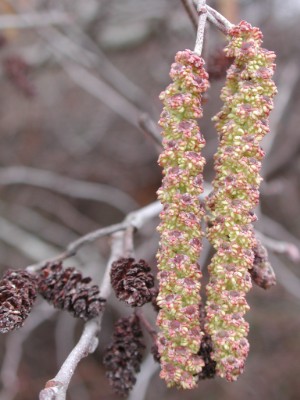
Male flowers occur in pendulous, reddish cylindrical catkins measuring up to 10 centimetres long. Male inflorescences contain five to six catkins.[9][10]
Female catkins are ovoid and develop into woody pseudo-cones when mature. Mature female catkins measure 2–3 centimetres long and 1.5–2 centimetres wide, with a dark green to brown colour and hard, woody texture.[11][12][13]
The species produces reddish-orange wood.[14]
Habitat
Italian Alder grows in open meadows near rivers, including marshy and flood-prone ground. Along rivers with sufficient growing space and water, individual bases can produce four to six stems.[15][16]
The species can thrive on drier soils than most other alder species.[17]
Trees growing in groves tend to develop thinner and straighter trunks than those growing individually.[18]
Reproduction and life cycle
Pollination takes place in early spring before the leaves emerge.[19]
Seeds ripen during winter, changing from green to dark brown, and the pseudo-cones open the following spring. The small winged seeds are dispersed by wind.[20][21]
Behaviour
Italian Alder can improve soil fertility through symbiotic nitrogen fixation involving Frankia alni bacteria.[22]
The species grows rapidly even under unfavourable growing conditions.[23]
Uses
Italian Alder is used for landscape planting on difficult sites, including mining spoil heaps and heavily compacted urban areas. It is commonly planted as a windbreak to help protect soil.[24][25]
Its wood is highly durable when kept either wet or dry. Its timber is used for turning, carving, moulding, furniture, panelling and plywood.[26][27]
Italian Alder can be cultivated as a medium-to-large bonsai and responds well to pruning. It has received the Royal Horticultural Society's Award of Garden Merit.[28][29]
Its stem bark contains phenolic components reported to have properties similar to skin-whitening and antioxidant compounds.[30]
Classification of the Italian Alder
| Kingdom | Plantae |
|---|---|
| Subkingdom | Pteridobiotina |
| Phylum | Tracheophyta |
| Class | Magnoliopsida |
| Order | Fagales |
| Family | Betulaceae (Birch Family) |
| Subfamily | Betuloideae |
| Genus | Alnus (Alder) |
| Species | Alnus cordata (Loisel.) Duby |
Where the Italian Alder is found
Checklists and occurrence records place Alnus cordata in 21 countries across Europe, North America and Oceania. GBIF holds 21,545 georeferenced records of it.
Countries where it is native or its origin is not stated
- Austria 30
- Belgium 1,435
- Denmark 25
- France 2,626
- Isle of Man 35
- Italy 1,816
- Luxembourg 6
- Norway 3
- Poland 5
- Sweden 90
- Switzerland 18
- The Netherlands 1,839
Countries where it has been introduced
- Australia 5
- Germany 81
- Guernsey
- Ireland 87
- Jersey 1
- Portugal 47
- Spain 555
- United Kingdom 12,794
- United States 47
Regions and cities with the most records
- England, United Kingdom 11,088
- Corsica, France 907
- Prescot, United Kingdom 860
- Kirkby, United Kingdom 842
- St Helens, United Kingdom 828
- Huyton, United Kingdom 825
- Fazakerley, United Kingdom 822
- Old Swan, United Kingdom 811
- Scotland, United Kingdom 774
- Chorley, United Kingdom 759
- Halewood, United Kingdom 748
- Maghull, United Kingdom 744
- Allerton, United Kingdom 743
- Speke, United Kingdom 734
- Litherland, United Kingdom 719
- Garston, United Kingdom 718
- Leyland, United Kingdom 717
- Haydock, United Kingdom 714
- Skelmersdale, United Kingdom 712
- Blackburn, United Kingdom 693
- Liverpool, United Kingdom 692
- Widnes, United Kingdom 682
- Bootle, United Kingdom 680
- Runcorn, United Kingdom 675
- Darwen, United Kingdom 664
- Ashton in Makerfield, United Kingdom 656
- Preston, United Kingdom 647
- Shepherds Bush, United Kingdom 638
- Harlesden, United Kingdom 636
- Willesden, United Kingdom 627
- Barnes, United Kingdom 626
- Fulham, United Kingdom 621
- City of Westminster, United Kingdom 620
- London, United Kingdom 620
- Acton, United Kingdom 619
- Cricklewood, United Kingdom 618
3 more countries have a few records outside this range
These countries hold a few records of Alnus cordata but lie outside the range the checklists give for it. Such records are often zoo or garden specimens, museum material or vagrants, so the species is not counted as occurring there.
Range as the checklists state it
England [I] (England [I], Wales [I], Isle of Man [I], Scotland [I]); Ireland [I] (Ireland [I], Northern Ireland [I]); Germany [I]; Spain [I]; Channel Isl. [I] (Guernsey [I], Jersey [I]); Corsica; S-Italy; Azores [I] (Sao Miguel Isl. [I]); Australia [I] (Tasmania [I]); USA [I] (California [I])
A number beside a place is its count of GBIF occurrence records. A place without a number comes from a checklist alone. Records show where a species has been observed or collected, which can include escapes and vagrants.
Common names
English
- Italian Alder
- Alder of Corsica
Names in 6 other languages
- Dutch
- Hartbladige els
- Italian
- Ontano napoletano
- Norwegian Bokmål
- italiaor
- Spanish
- Aliso
- Swedish
- italiensk al
- Welsh
- Gwern yr Eidal, Gwernen yr Eidal
Synonyms
13 other scientific names have been used for this species and are now treated as synonyms of Alnus cordata.
- Alnus cordata Desf.
- Alnus cordata f. parvifolia Callier
- Alnus cordata f. parvifolia (Loisel.) Duby
- Alnus cordata subsp. neapolitana (Savi) J.-M.Tison
- Alnus cordata var. rotundifolia Dippel
- Alnus cordifolia Ten.
- Alnus cordifolia var. rotundifolia Regel
- Alnus neapolitana Savi
- Alnus nervosus Dippel
- Alnus obcordata C.A.Mey. ex Steud.
- Betula cordata Loisel.
- Alnus macrocarpa Req. ex Nyman ambiguous synonym
- Alnus rotundifolia Bertol. ambiguous synonym
Related species
-
 Common AlderAlnus glutinosa
-
 Gray AlderAlnus incana
-
 Red AlderAlnus rubra
-
 Green AlderAlnus alnobetula
-
 California AlderAlnus rhombifolia
-
 Common AlderAlnus serrulata
-
 Nepalese AlderAlnus nepalensis
-
 Andean AlderAlnus acuminata
Compare
Questions and answers
What is the scientific name of the Italian Alder?
The scientific name of the Italian Alder is Alnus cordata. Written with its author, the full name is Alnus cordata (Loisel.) Duby.
Which family does the Italian Alder belong to?
Alnus cordata belongs to the family Betulaceae, in the order Fagales and the class Magnoliopsida.
Where is the Italian Alder found?
Checklists and occurrence records place Alnus cordata in 21 countries, including France, The Netherlands, Italy, Belgium, Sweden and Isle of Man.
What is the conservation status of the Italian Alder?
The IUCN Red List category recorded for Alnus cordata is Least Concern (LC).
What other names does the Italian Alder have?
Alnus cordata is also known in English as Alder of Corsica.
What is the Latin name for alder?
The Latin name of Italian Alder is Alnus cordata (Loisel.) Duby.[1]
Is alder a type of birch?
Italian Alder belongs to the Betulaceae family.[1]
Is alder a high quality wood?
Italian Alder wood is highly durable when kept either wet or dry. Its timber is used for turning, carving, moulding, furniture, panelling and plywood.[26][27]
Sources
Passages the profile rests on
- Alnus cordata is a tree or shrub belonging to the Betulaceae family. Source passage: “Alnus cordata, the Italian alder, is a tree or shrub species belonging to the family Betulaceae” — English Wikipedia
- The species typically grows up to 25 metres tall, with exceptional individuals reaching 28 metres. Source passage: “growing up to 25 m (80 feet) tall (exceptionally to 28 m or 90 feet)” — English Wikipedia
- Its trunk can reach 70–100 centimetres in diameter. Source passage: “with a trunk up to 70–100 centimetres (30–40 in) in diameter.” — English Wikipedia
- Its deciduous leaves are alternate, ovate or circular-ovate, heart-shaped at the base, glossy green and finely serrated. Source passage: “they are alternate, ovate or circular-ovate shaped, cordate at base, rich glossy green” — English Wikipedia
- Its leaves measure 5–12 centimetres in length. Source passage: “5–12 cm (2–4+3⁄4 inches) long, with a finely serrated margin.” — English Wikipedia
- Its bark is smooth and greyish brown. Source passage: “The bark is smooth with greyish brown colour.” — English Wikipedia
- Its leaves generally remain on the tree from April through December in the Northern Hemisphere. Source passage: “from April to December in the Northern Hemisphere” — English Wikipedia
- Its leaves generally retain their green colour during autumn rather than changing colour. Source passage: “the leaves don't change from their original green color.” — English Wikipedia
- Its male flowers occur in pendulous, reddish cylindrical catkins measuring up to 10 centimetres long. Source passage: “pendulous, reddish and up to 10 cm (4 inches) long” — English Wikipedia
- Its male inflorescences contain five to six catkins. Source passage: “The slender cylindrical male contain 5 - 6 catkins” — English Wikipedia
- Its female catkins are ovoid and develop into woody pseudo-cones when mature. Source passage: “The female catkins are ovoid, when mature in autumn 2–3 cm” — English Wikipedia
- Mature female catkins measure 2–3 centimetres long and 1.5–2 centimetres wide. Source passage: “2–3 cm (3⁄4–1+1⁄8 inches) long and 1.5–2 cm (5⁄8–3⁄4 inch) broad” — English Wikipedia
- Mature female catkins are dark green to brown and have a hard, woody texture. Source passage: “dark green to brown, hard, woody” — English Wikipedia
- The species produces reddish-orange wood. Source passage: “The tree also produces valuable reddish-orange wood.” — English Wikipedia
- Along rivers with sufficient growing space and water, individual bases can produce four to six stems. Source passage: “Along rivers with room to grow and plenty of water one base will often give rise to four to six stems” — English Wikipedia
- The species grows in open meadows near rivers, including marshy and flood-prone ground. Source passage: “In open meadows near rivers, marshy ground and flooding can cause trees to angle or tilt over” — English Wikipedia
- The species can thrive on drier soils than most other alder species. Source passage: “It thrives on much drier soils than most other alders” — English Wikipedia
- Trees growing in groves tend to develop thinner and straighter trunks than those growing individually. Source passage: “In groves of multiple trees they grow thinner and straighter” — English Wikipedia
- Pollination takes place in early spring before the leaves emerge. Source passage: “pollination is in early spring, before the leaves emerge.” — English Wikipedia
- Its small winged seeds are dispersed by wind. Source passage: “The small winged seeds disperse by wind” — English Wikipedia
- Its seeds ripen during winter, changing from green to dark brown, and the pseudo-cones open the following spring. Source passage: “through the winter they ripen, turning from green to dark brown colour, and they open the following spring.” — English Wikipedia
- The species can improve soil fertility through symbiotic nitrogen fixation involving Frankia alni bacteria. Source passage: “Like other alders, it is able to improve soil fertility through symbiotic nitrogen fixation with the bacteria Actinomyces alni (Frankia alni).” — English Wikipedia
- The species grows rapidly even under unfavourable growing conditions. Source passage: “and grows rapidly even under very unfavourable circumstances” — English Wikipedia
- The species is used for landscape planting on difficult sites, including mining spoil heaps and heavily compacted urban areas. Source passage: “valuable for landscape planting on difficult sites such as mining spoil heaps and heavily compacted urban sites.” — English Wikipedia
- The species is commonly planted as a windbreak to help protect soil. Source passage: “It is commonly grown as a windbreak which helps with soil protection.” — English Wikipedia
- Its wood is highly durable when kept either wet or dry. Source passage: “but is highly durable when kept wet or dry.” — English Wikipedia
- Its timber is used for turning, carving, moulding, furniture, panelling and plywood. Source passage: “The timber is liked by carpenters and used for turning and carving, for moulding, furniture, panelling and plywood.” — English Wikipedia
- Alnus cordata has received the Royal Horticultural Society's Award of Garden Merit. Source passage: “Alnus cordata has gained The Royal Horticultural Society's Award of Garden Merit.” — English Wikipedia
- The species can be cultivated as a medium-to-large bonsai and responds well to pruning. Source passage: “The Italian Alder makes a medium to large bonsai, a quick grower it responds well to pruning” — English Wikipedia
- Its stem bark contains phenolic components reported to have properties similar to skin-whitening and antioxidant compounds. Source passage: “they were able to determine that its components were similar to those of skin-whitening and antioxidant properties.” — English Wikipedia
- Introduced populations occur in France, Belgium, Spain, Portugal and the United Kingdom. Source passage: “other European countries (France, Belgium, Spain, Portugal, United Kingdom)” — English Wikipedia
- The species has also been introduced to Chile and New Zealand. Source passage: “and extra-European countries (Chile, New Zealand)” — English Wikipedia
- The species has become naturalised in some regions where it was introduced. Source passage: “where it has become naturalised.” — English Wikipedia
Data
- Catalogue of Life, 2026-10-16 XR cc by
- Global Biodiversity Information Facility CC BY 4.0
- Wikidata CC0
- GeoNames CC BY 4.0
- Wikimedia Commons per image; credit shown with each image
- Within the Catalogue of Life, this name comes from Synonymic Checklists of the Vascular Plants of the World cc by
References
- Duby. (1828). Fl. Gall. [Loiseleur], ed. 2, 2: 317 (1828). where the name was published
This species in other databases
Page built on 27 November 2026. See how the catalog is made and all sources and licences.
Cite this page
ScientificNames.org. (2026). Alnus cordata (Italian Alder). Retrieved November 27, 2026, from https://scientificnames.org/species/alnus-cordata
“Alnus cordata (Italian Alder).” ScientificNames.org, 2026, scientificnames.org/species/alnus-cordata. Accessed 27 Nov. 2026.
ScientificNames.org. “Alnus cordata (Italian Alder).” Accessed November 27, 2026. https://scientificnames.org/species/alnus-cordata.
@misc{scientificnames_alnus_cordata_italian_alder,
  author = {{ScientificNames.org}},
  title = {Alnus cordata (Italian Alder)},
  year = {2026},
  url = {https://scientificnames.org/species/alnus-cordata},
  note = {Accessed 2026-11-27}
}