Species · Flowering plants
California Alder Alnus rhombifolia
The scientific name of the California Alder is Alnus rhombifolia. It is a species of flowering plant in the family Betulaceae (birch family), order Fagales.
- Scientific name
- Alnus rhombifolia Nutt.
- Common name
- California Alder
- Genus
- Alnus
- Family
- Betulaceae (Birch Family)
- Order
- Fagales
- Class
- Magnoliopsida
- Red List category
- LC Least Concern
- Recorded in
- 3 countries
- Name status
- accepted in the Catalogue of Life

Overview
Alnus rhombifolia grows in riparian habitats from San Diego County, California, north to Chelan County, Washington, and east to Idaho County, Idaho. It has pale gray bark, rhombic to narrowly elliptic leaves, and winged seeds that disperse throughout winter.
Written 26 November 2026 from the sources listed below. Each statement was checked against the passage it cites; statements that could not be supported were removed.
Appearance
California alder is a deciduous tree with pale gray bark that is smooth when young and becomes scaly with age. Its thin bark may have mottled whitish-gray patches, and its trunk bears dark, drooping scars resembling eyebrows where lower lateral branches have fallen.[1][2][3]
The alternate leaves are rhombic to narrowly elliptic, measuring 4–10 centimetres long and 2–5 centimetres wide. Their margins are finely serrated, their undersides are thinly hairy, and their upper surfaces are green while their lower surfaces are yellowish green.[4][5][6]
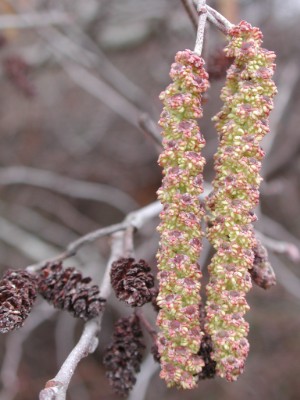
The male flowers grow in slender, pendulous, yellowish catkins measuring 3–10 centimetres long. Mature female catkins are ovoid and measure 10–22 millimetres long and 7–10 millimetres wide.[7][8]
The leaves drop in late autumn while still green. Old woody seed-bearing structures remain on the tree for up to a year after seed dispersal.[9][10]
Habitat
California alder occurs along watercourses, particularly in mountain canyons within riparian forests and woodlands. It is most common along rivers and third-order streams and often grows in thickets of small trees beside permanent streams.[11][12][13]
The species grows in sandy, gravelly, and other alluvial soils, generally occupying low positions in riparian zones, particularly banks just above floodplains. It grows along small streams in the Coast Ranges and Sierra Nevada.[14][15][16]
It occurs primarily in riparian conifer forests and riparian oak woodlands, as well as in riparian zones within bunchgrass, sagebrush-grass, and chaparral communities. It is commonly found in low-elevation montane zones.[17][18][19]
The species occurs in riparian habitats at elevations of 100–2,400 metres. Its habitats include chaparral, woodland, montane forest, and temperate forest ecoregions.[20][21]
Reproduction and life cycle
Male catkins occur in clusters of two to seven. Flowering occurs in early spring before the leaves emerge, from January through March.[22][23][24]
The cone-like fruits appear in autumn. Each female cone scale bears a small round winged nutlet that is dispersed by floods and wind.[25][26]
The species produces small winged seeds that disperse throughout winter. Its old woody seed-bearing structures can remain on the tree for up to a year after seed dispersal.[27][9]
White alder hybridizes with thinleaf alder in southwestern Idaho.[28]
Diet
Pine siskins frequently feed on the maturing cone-like fruits. Sapsuckers feed on boring beetles and other insects found on the trees and consume sap from holes in the trunk.[29][30]
Behaviour
Mature California alder trees tolerate flooding and the species also tolerates coastal fog. Floods can wash away large stands, which are rapidly replaced by dense groups of seedlings.[31][32][33]
Uses
Chumash people used California alder wood to make bowls, trays, and spoons. The wood is also used for firewood, lumber, and ornamental planting.[34][35][36]
The bark was used to produce dye for basket materials. The Ohlone used the bark as a dye, and Native Americans extracted red dye from it for use in baskets.[37][38][39]
Some California Indigenous people reportedly consumed the inner bark. Alder-bark tea was reportedly used medicinally by some Indigenous people in California, and the bark was used to make a perspiration-inducing tea for use in sweat houses.[40][41][42]
Some Plateau Indian tribes used white alder for female health treatments.[43]
Classification of the California Alder
| Kingdom | Plantae |
|---|---|
| Subkingdom | Pteridobiotina |
| Phylum | Tracheophyta |
| Class | Magnoliopsida |
| Order | Fagales |
| Family | Betulaceae (Birch Family) |
| Subfamily | Betuloideae |
| Genus | Alnus (Alder) |
| Species | Alnus rhombifolia Nutt. |
Where the California Alder is found
Checklists and occurrence records place Alnus rhombifolia in 3 countries across North America. GBIF holds 5,838 georeferenced records of it.
Countries
Regions and cities with the most records
- California, United States 3,950
- Altadena, United States 838
- La Cañada Flintridge, United States 831
- Pasadena, United States 812
- Arcadia, United States 804
- La Crescenta-Montrose, United States 801
- Monrovia, United States 800
- South Pasadena, United States 799
- Glendale, United States 778
- Temple City, United States 775
- San Gabriel, United States 770
- Alhambra, United States 767
- Burbank, United States 728
- Duarte, United States 682
- Rosemead, United States 679
- Monterey Park, United States 662
- El Monte, United States 566
- Los Angeles, United States 388
- Azusa, United States 356
- Baldwin Park, United States 342
- South El Monte, United States 336
- Vincent, United States 324
- East Los Angeles, United States 300
- Oregon, United States 291
- Glendora, United States 197
- West Covina, United States 196
- San Jose, United States 186
- West Puente Valley, United States 183
- Avocado Heights, United States 179
- Lake Forest, United States 176
- Covina, United States 172
- San Dimas, United States 170
- Rancho Santa Margarita, United States 166
- Milpitas, United States 162
- Santa Clara, United States 161
- Campbell, United States 159
1 more country has a few records outside this range
These countries hold a few records of Alnus rhombifolia but lie outside the range the checklists give for it. Such records are often zoo or garden specimens, museum material or vagrants, so the species is not counted as occurring there.
Range as the checklists state it
USA (California, Idaho, Montana, Nevada, Oregon, Washington State); Mexico (Baja California Norte)
A number beside a place is its count of GBIF occurrence records. A place without a number comes from a checklist alone. Records show where a species has been observed or collected, which can include escapes and vagrants.
Common names
English
- California Alder
- Mountain Alder
Names in 12 other languages
- Chinese
- 白榿木, 白赤楊
- Estonian
- kalifornia lepp
- French
- aulne de la sierra
- German
- Weiß-Erle
- Polish
- Olsza biała
- Russian
- Ольха ромболистная
- Slovak
- jelša kosoštvorcolistá
- Spanish
- Aile blanco, Aliso blanco
- Turkish
- Ak kızılağaç
- Ukrainian
- Вільха біла
- nsz
- Su Tumync’a
- xgf
- tukunet
Synonyms
6 other scientific names have been used for this species and are now treated as synonyms of Alnus rhombifolia.
- Alnus californica (Regel) H.J.P.Winkl.
- Alnus glutinosa lusus californica Regel
- Alnus rhombifolia var. bernardiana Munz & I.M.Johnston
- Alnus rhombifolia var. bernardina Munz & I.M.Johnst.
- Alnus rhombifolia var. ovalis H.J.P.Winkl.
- Alnus rhombifolia var. typica Callier
Related species
-
 Common AlderAlnus glutinosa
-
 Gray AlderAlnus incana
-
 Red AlderAlnus rubra
-
 Green AlderAlnus alnobetula
-
 Italian AlderAlnus cordata
-
 Common AlderAlnus serrulata
-
 Nepalese AlderAlnus nepalensis
-
 Andean AlderAlnus acuminata
Compare
Questions and answers
What is the scientific name of the California Alder?
The scientific name of the California Alder is Alnus rhombifolia. Written with its author, the full name is Alnus rhombifolia Nutt..
Which family does the California Alder belong to?
Alnus rhombifolia belongs to the family Betulaceae, in the order Fagales and the class Magnoliopsida.
Where is the California Alder found?
Checklists and occurrence records place Alnus rhombifolia in 3 countries: United States, Canada and Mexico.
What is the conservation status of the California Alder?
The IUCN Red List category recorded for Alnus rhombifolia is Least Concern (LC).
What other names does the California Alder have?
Alnus rhombifolia is also known in English as Mountain Alder.
What is special about alder trees?
California alder can fix nitrogen and tolerates flooding when mature. It helps protect watersheds and provides wildlife habitat.[44][31][45]
Where do alder trees grow in the USA?
California alder occurs from San Diego County, California, north to Chelan County, Washington, and east to Idaho County, Idaho. Its core distribution is in the foothills of northern California and southwestern Oregon, with isolated populations in extreme western Nevada and western Montana.[46][47][48]
Can you eat alder?
Some California Indigenous people reportedly consumed the inner bark of California alder.[40]
Sources
Passages the profile rests on
- The species is a deciduous tree with pale gray bark that is smooth when young and becomes scaly with age. Source passage: “with pale gray bark, smooth on young trees, becoming scaly on old trees.” — English Wikipedia
- The thin bark is ashy gray with mottled whitish-gray patches. Source passage: “The thin bark is ashy gray with mottled whitish-gray patches.” — nathistoc.bio.uci.edu
- The trunk bears dark, drooping scars resembling eyebrows where lower lateral branches have fallen. Source passage: “The trunk is marked by dark, drooping, eyebrow-like scars formed where the lower lateral branches have fallen off” — nathistoc.bio.uci.edu
- Its alternate leaves are rhombic to narrowly elliptic and measure 4–10 centimetres long and 2–5 centimetres wide. Source passage: “The leaves are alternate, rhombic to narrow elliptic, 4–10 centimetres (1.6–3.9 in) long and 2–5 centimetres (0.79–1.97 in) broad” — English Wikipedia
- The leaf margins are finely serrated and the leaf undersides are thinly hairy. Source passage: “with a finely serrated margin and a rounded to acute apex; they are thinly hairy below.” — English Wikipedia
- The upper leaf surfaces are green and the lower surfaces are yellowish green. Source passage: “Upper surfaces are green and lower surfaces are yellowish green.” — nathistoc.bio.uci.edu
- The male flowers grow in slender, pendulous, yellowish catkins measuring 3–10 centimetres long. Source passage: “The male catkins are pendulous, slender, 3–10 centimetres (1.2–3.9 in) long, yellowish” — English Wikipedia
- Mature female catkins are ovoid and measure 10–22 millimetres long and 7–10 millimetres wide. Source passage: “The female catkins are ovoid, when mature in autumn 10–22 millimetres (0.39–0.87 in) long and 7–10 millimetres (0.28–0.39 in) broad” — English Wikipedia
- Its old woody seed-bearing structures remain on the tree for up to a year after seed dispersal. Source passage: “leaving the old woody, blackish 'cones' on the tree for up to a year after.” — English Wikipedia
- The leaves drop in late autumn while still green. Source passage: “They drop in the late fall while still green.” — nathistoc.bio.uci.edu
- The species is most common along rivers and third-order streams. Source passage: “White alder is most common along rivers and third-order streams” — fs.usda.gov
- The species occurs along watercourses, particularly in mountain canyons within riparian forests and woodlands. Source passage: “scattered to locally frequent along water courses, especially in mountain canyons in riparian forest and woodland” — nathistoc.bio.uci.edu
- The species is often found growing as thickets of small trees beside permanent streams. Source passage: “They are often found as a thicket of small trees along a permanent stream.” — nathistoc.bio.uci.edu
- The species grows along small streams in the Coast Ranges and Sierra Nevada. Source passage: “It grows along small streams in the Coast Ranges and the Sierra Nevada” — fs.usda.gov
- The species grows in sandy, gravelly, and other alluvial soils. Source passage: “White alder grows in sands [57], gravels [57,134], and other alluvial soils” — fs.usda.gov
- The species generally occupies low positions in riparian zones, particularly banks just above floodplains. Source passage: “It is more common on banks just above floodplains than on floodplains or upper terraces” — fs.usda.gov
- The species is commonly found in low-elevation montane zones. Source passage: “White alder is most common in low-elevation montane zones” — fs.usda.gov
- The species grows primarily in riparian conifer forests and riparian oak woodlands. Source passage: “White alder grows primarily in riparian conifer forests [48,63] and riparian oak woodlands along major streams and rivers” — fs.usda.gov
- The species also occurs in riparian zones within bunchgrass, sagebrush-grass, and chaparral communities. Source passage: “It also grows in riparian zones of bunchgrass, sagebrush-grass [63], and chaparral communities” — fs.usda.gov
- The species occurs in riparian habitats at elevations of 100–2,400 metres. Source passage: “It occurs in riparian zone habitats at an elevational range of 100–2,400 metres” — English Wikipedia
- The species occurs primarily in chaparral, woodland, montane forest, and temperate forest ecoregions. Source passage: “Alnus rhombifolia is primarily found in the chaparral and woodlands, montane, and temperate forests ecoregions.” — English Wikipedia
- Male catkins occur in clusters of two to seven. Source passage: “and produced in clusters of two to seven” — English Wikipedia
- Pollination occurs in early spring before the leaves emerge. Source passage: “pollination is in early spring, before the leaves emerge.” — English Wikipedia
- The species flowers from January through March. Source passage: “Flowering: January-March.” — nathistoc.bio.uci.edu
- The cone-like fruits appear in autumn, while flowering occurs in early spring before the leaves emerge. Source passage: “Fruits occur in cone-like catkins which appear in the fall and flower in early spring before the leaves appear.” — nathistoc.bio.uci.edu
- Each female cone scale bears a small round winged nutlet that is dispersed by floods and wind. Source passage: “Each cone scale has a tiny round winged nutlet, dispersed by flood and wind.” — nathistoc.bio.uci.edu
- The species produces small winged seeds that disperse throughout winter. Source passage: “The small winged seeds disperse through the winter” — English Wikipedia
- White alder hybridizes with thinleaf alder in southwestern Idaho. Source passage: “White alder hybridizes with thinleaf alder in southwestern Idaho” — fs.usda.gov
- Pine siskins frequently feed on the maturing cone-like fruits. Source passage: “Flocks of pine siskins frequently feed on the maturing 'cones'.” — nathistoc.bio.uci.edu
- Sapsuckers feed on boring beetles and other insects found on the trees and consume sap from holes in the trunk. Source passage: “Sapsuckers feed on boring beetles and other insects on these trees, and enjoy the oozing sap from the holes they make in the trunk” — nathistoc.bio.uci.edu
- The species tolerates flooding when mature. Source passage: “Mature white alders are classified as very tolerant of flooding” — fs.usda.gov
- The species tolerates coastal fog. Source passage: “White alder also tolerates coastal fog” — fs.usda.gov
- Floods can wash away large stands of the species, which are rapidly replaced by dense groups of seedlings. Source passage: “During floods, great stands of these trees may be washed away and are rapidly replaced by dense masses of seedlings.” — nathistoc.bio.uci.edu
- Chumash people used the wood of this species. Source passage: “Chumash people used white alder for its wood” — English Wikipedia
- Chumash people used alder wood to make bowls, trays, and spoons. Source passage: “alder wood was used to make bowls, trays and spoons.” — English Wikipedia
- The species is used for firewood, lumber, and ornamental planting. Source passage: “White alder is used for firewood, as lumber, and as an ornamental.” — nathistoc.bio.uci.edu
- The bark was used to produce dye for basket materials. Source passage: “alder bark dye was used as a colorant for woodwardia ferns used in baskets” — English Wikipedia
- The Ohlone used the bark of this species as a dye. Source passage: “The Ohlone also used the bark as a dye” — English Wikipedia
- Native Americans extracted red dye from its bark for use in baskets. Source passage: “Native Americans extracted red dye from the bark and used it for their baskets” — nathistoc.bio.uci.edu
- Some California Indigenous people reportedly consumed the inner bark. Source passage: “and are also reported to have consumed the inner bark.” — English Wikipedia
- Alder-bark tea was reportedly used medicinally by some Indigenous people in California. Source passage: “Alder-bark tea was reportedly used by some California indigenous people for medicinal purposes.” — English Wikipedia
- The bark was used to make a perspiration-inducing tea for use in sweat houses. Source passage: “made a perspiration-inducing tea from it, used in their sweat houses.” — nathistoc.bio.uci.edu
- Some Plateau Indian tribes used white alder for female health treatments. Source passage: “Some Plateau Indian tribes use white alder for female health treatment needs.” — English Wikipedia
- The species can fix nitrogen. Source passage: “Like other alders, it is able to fix nitrogen” — English Wikipedia
- The species helps protect watersheds and provides wildlife habitat. Source passage: “Its greatest value lies in the ability to protect watersheds and provide wildlife habitat.” — nathistoc.bio.uci.edu
- The species occurs from San Diego County, California, north to Chelan County, Washington, and east to Idaho County, Idaho. Source passage: “It is distributed from San Diego County, California, north to Chelan County, Washington, and east to Idaho County, Idaho” — fs.usda.gov
- Its core distribution is in the foothills of northern California and southwestern Oregon. Source passage: “Its core distribution lies in the foothills of northern California and southwestern Oregon” — fs.usda.gov
- Isolated populations occur in extreme western Nevada and western Montana. Source passage: “Isolated populations occur in extreme western Nevada [65,73] and western Montana” — fs.usda.gov
- The tree typically grows 15–25 metres tall, although individuals can rarely reach 35 metres. Source passage: “growing to 15–25 metres (49–82 ft) (rarely to 35 metres (115 ft)) tall” — English Wikipedia
Data
- Catalogue of Life, 2026-10-16 XR cc by
- Global Biodiversity Information Facility CC BY 4.0
- Wikidata CC0
- GeoNames CC BY 4.0
- Wikimedia Commons per image; credit shown with each image
- Within the Catalogue of Life, this name comes from Synonymic Checklists of the Vascular Plants of the World cc by
References
- Nutt. (1842). N. Amer. Sylv. [Nuttall] 1: 33 (1842). where the name was published
This species in other databases
- Catalogue of Life C2SM
- Wikidata Q2666303
- iNaturalist 53351
- World Flora Online wfo-0000947401
- GRIN 316543
Page built on 29 November 2026. See how the catalog is made and all sources and licences.
Cite this page
ScientificNames.org. (2026). Alnus rhombifolia (California Alder). Retrieved November 29, 2026, from https://scientificnames.org/species/alnus-rhombifolia
“Alnus rhombifolia (California Alder).” ScientificNames.org, 2026, scientificnames.org/species/alnus-rhombifolia. Accessed 29 Nov. 2026.
ScientificNames.org. “Alnus rhombifolia (California Alder).” Accessed November 29, 2026. https://scientificnames.org/species/alnus-rhombifolia.
@misc{scientificnames_alnus_rhombifolia_california_alder,
  author = {{ScientificNames.org}},
  title = {Alnus rhombifolia (California Alder)},
  year = {2026},
  url = {https://scientificnames.org/species/alnus-rhombifolia},
  note = {Accessed 2026-11-29}
}