Species · Flowering plants
Common Alder Alnus serrulata
The scientific name of the Common Alder is Alnus serrulata. It is a species of flowering plant in the family Betulaceae (birch family), order Fagales.
- Scientific name
- Alnus serrulata (Aiton) Willd.
- Common name
- Common Alder
- Genus
- Alnus
- Family
- Betulaceae (Birch Family)
- Order
- Fagales
- Class
- Magnoliopsida
- Red List category
- LC Least Concern
- Recorded in
- 2 countries
- Name status
- accepted in the Catalogue of Life
Overview
Common alder (Alnus serrulata) is a thicket-forming shrub that can grow as a large shrub or small tree. It is native to eastern North America, with a range extending from Maine to northern Florida and westward to southeastern Oklahoma, Missouri, and Illinois. It typically produces multiple stems from its base and has broad, dark green leaves with conspicuous pinnate veins.
Written 26 November 2026 from the sources listed below. Each statement was checked against the passage it cites; statements that could not be supported were removed.
Appearance
Common alder commonly reaches 8–12 feet (2.4–3.7 metres) in height. Exceptional individuals can reach 30 feet (9.1 metres) in height and 15 centimetres in diameter.[1][2][3]
Its simple leaves are round and obovate, with blades wider in the middle, an obtuse tip, and a V-shaped base. The leaves have conspicuous pinnate veins, smooth upper surfaces, and hairy undersides.[4][5][6][7]
The upper leaf surfaces are dark green, while the undersides are pale green. Its leaves measure 3–5 inches (7.6–12.7 centimetres) long.[8][9]
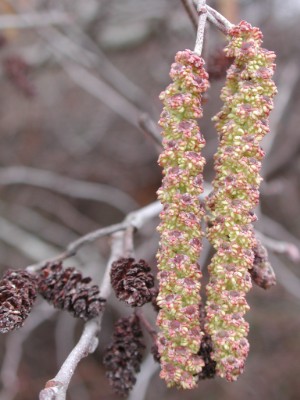
Its fruits are ovate, dark brown, hard, and cone-like, with winged scales. Its twigs are reddish-brown with a three-angled pith, and young twigs are covered with hairs.[10][11][12]
Its bark is brownish-gray and smooth.[13]
Reproduction and life cycle
Common alder is monoecious, with male and female flowers occurring on the same plant. Its reddish-green flowers open between March and April.[14][15]
Its male catkins measure 1.6–2.4 inches long, while its female catkins measure approximately half an inch long.[16][17]
Its seeds are produced in small cones and lack wings. The fruits generally mature in autumn and persist on the plant.[18][19]
Habitat
Common alder grows in moist soils near streams, pond margins, and riversides. Its habitats include streambanks, riversides, and swamps, and it also grows on hills.[20][21][22]
It can establish roots below the water line. It requires moist soil with a pH between 6.8 and 7.2 and full sun or partial sun.[23][24][25]
Conservation
Common alder is classified as facultative wetland vegetation in the Atlantic and Gulf Coastal Plains. It is classified as an obligate wetland species in the North and Midwest.[26][27]
Uses
Common alder is used to stabilize and restore riverside and streambank habitats.[28]
Its bark has been used medicinally for its astringent, diuretic, emetic, ophthalmic, and purgative properties. Native Americans used bark tea to treat diarrhea, coughs, toothaches, sore mouth, and childbirth pain.[29][30]
The species has been used in the form of a skin wash to treat acne. An extract of its bark has been used to produce orange dye.[31][32]
Classification of the Common Alder
| Kingdom | Plantae |
|---|---|
| Subkingdom | Pteridobiotina |
| Phylum | Tracheophyta |
| Class | Magnoliopsida |
| Order | Fagales |
| Family | Betulaceae (Birch Family) |
| Subfamily | Betuloideae |
| Genus | Alnus (Alder) |
| Species | Alnus serrulata (Aiton) Willd. |
Where the Common Alder is found
Checklists and occurrence records place Alnus serrulata in 2 countries across North America. GBIF holds 13,835 georeferenced records of it.
Countries
Regions and cities with the most records
- Georgia, United States 803
- Pennsylvania, United States 681
- Alabama, United States 668
- North Carolina, United States 666
- Virginia, United States 641
- Arkansas, United States 431
- Maryland, United States 315
- New Jersey, United States 266
- Mississippi, United States 249
- New York, United States 219
- Texas, United States 187
- Tennessee, United States 186
- Chamblee, United States 159
- Brookhaven, United States 157
- North Druid Hills, United States 151
- Massachusetts, United States 147
- Connecticut, United States 144
- Norcross, United States 143
- South Carolina, United States 142
- Missouri, United States 141
- Sandy Springs, United States 140
- Dunwoody, United States 132
- Adams Morgan, United States 131
- Foggy Bottom, United States 130
- Arlington, United States 129
- Golden Triangle, United States 129
- Mount Pleasant, United States 129
- Shaw, United States 129
- Washington, United States 129
- Central 14th Street / Spring Road, United States 128
- Downtown DC, United States 128
- Florida, United States 127
- Mount Vernon Triangle, United States 127
- Northwest One, United States 127
- Baileys Crossroads, United States 126
- NoMa, United States 126
7 more countries have a few records outside this range
These countries hold a few records of Alnus serrulata but lie outside the range the checklists give for it. Such records are often zoo or garden specimens, museum material or vagrants, so the species is not counted as occurring there.
Range as the checklists state it
Canada (New Brunswick, Nova Scotia, Québec); USA (Alabama, Arkansas, Connecticut, District of Columbia, Delaware, Florida, Georgia, Illinois, Indiana, Kansas, Kentucky, Louisiana, Massachusetts, Maryland, Maine, Missouri, Mississippi, North Carolina, New Hampshire, New Jersey, New York, Ohio, Oklahoma, Pennsylvania, Rhode Island, South Carolina, Tennessee, Texas, Virginia, Vermont, West Virginia)
A number beside a place is its count of GBIF occurrence records. A place without a number comes from a checklist alone. Records show where a species has been observed or collected, which can include escapes and vagrants.
Common names
English
- Common Alder
- Tag Alder
- Brookside Alder
- Hazel Alder
- Smooth Alder
Names in 1 other language
- French
- Aulne serrute, aulne blanc, aulne serrulé, aulne tendre
Synonyms
33 other scientific names have been used for this species and are now treated as synonyms of Alnus serrulata.
- Alnus autumnalis Hartig ex Garcke
- Alnus glutinosa lusus obtusifolia Regel
- Alnus glutinosa prol. oblongata (Aiton) Rouy
- Alnus glutinosa var. autumnalis Kuntze
- Alnus glutinosa var. oblongata (Aiton) Pers.
- Alnus glutinosa var. serrulata (Aiton) Regel
- Alnus incana var. serrulata (Aiton) B.Boivin
- Alnus latifolia Desf.
- Alnus macrophylla Desf. ex Steud.
- Alnus macrophylla Desf. ex Corrie
- Alnus noveboracensis Britton
- Alnus oblongata var. elliptica Corrie
- Alnus rugosa var. obtusifolia (Regel) H.J.P.Winkl.
- Alnus rugosa var. serrulata (Aiton) H.J.P.Winkl.
- Alnus serrulata f. emarginata Fernald
- Alnus serrulata f. mollescens Fernald
- Alnus serrulata f. nanella Fernald
- Alnus serrulata f. noveboracensis (Britton) Fernald
- Alnus serrulata f. serrulata
- Alnus serrulata var. macrophylla Spach
- Alnus serrulata var. obtusifolia (Regel) Regel
- Alnus serrulata var. serrulata
- Alnus serrulata var. subelliptica Fernald
- Alnus serrulata var. vulgaris Fernald
- Alnus undulata hort. ex H. J. P. Winkl.
- Betula alnus var. serrulata (Aiton) Michx.
- Betula oblongata Aiton
- Betula serrulata Aiton
- Alnus americana K.Koch ambiguous synonym
- Alnus oblongata (Aiton) Willd. ambiguous synonym
- Alnus rubra Desf. ex Corrie ambiguous synonym
- Alnus rubra Desf. ex Steud. ambiguous synonym
- Alnus rugosa Regel ambiguous synonym
Related species
-
 Common AlderAlnus glutinosa
-
 Gray AlderAlnus incana
-
 Red AlderAlnus rubra
-
 Green AlderAlnus alnobetula
-
 Italian AlderAlnus cordata
-
 California AlderAlnus rhombifolia
-
 Nepalese AlderAlnus nepalensis
-
 Andean AlderAlnus acuminata
Compare
Questions and answers
What is the scientific name of the Common Alder?
The scientific name of the Common Alder is Alnus serrulata. Written with its author, the full name is Alnus serrulata (Aiton) Willd..
Which family does the Common Alder belong to?
Alnus serrulata belongs to the family Betulaceae, in the order Fagales and the class Magnoliopsida.
Where is the Common Alder found?
Checklists and occurrence records place Alnus serrulata in 2 countries: United States and Canada.
What is the conservation status of the Common Alder?
The IUCN Red List category recorded for Alnus serrulata is Least Concern (LC).
What other names does the Common Alder have?
Alnus serrulata is also known in English as Tag Alder, Brookside Alder, Hazel Alder and Smooth Alder.
What is the scientific name for tag alder?
The scientific name for tag alder is Alnus serrulata (Aiton) Willd.[33]
What is the scientific name of alder?
The scientific name given for Common alder is Alnus serrulata (Aiton) Willd.[34]
Is speckled alder a tree or a shrub?
Common alder can grow as either a large shrub or a small tree.[35]
Sources
Passages the profile rests on
- The species commonly reaches a height of 8–12 feet (2.4–3.7 metres). Source passage: “commonly grows up to 8–12 feet (2.4–3.7 m) high” — English Wikipedia
- Exceptional individuals can reach 30 feet (9.1 metres) in height. Source passage: “exceptionally 30 ft (9.1 m)” — English Wikipedia
- Exceptional individuals can reach 15 centimetres in diameter. Source passage: “and 15 centimetres (5.9 in) in diameter.” — English Wikipedia
- Its simple leaves are round and obovate. Source passage: “The simple, round leaves are obovate” — English Wikipedia
- Its leaf blades are wider in the middle and have an obtuse tip and a V-shaped base. Source passage: “obtuse, wider at middle, and V-shaped base.” — English Wikipedia
- Its leaves have conspicuous pinnate veins. Source passage: “Veins are pinnate and conspicuous.” — English Wikipedia
- The upper leaf surfaces are smooth, while the undersides are hairy. Source passage: “Leaves have a smooth texture above and hairy texture below.” — English Wikipedia
- Its leaves measure 3–5 inches (7.6–12.7 centimetres) long. Source passage: “3 to 5 in (7.6 to 12.7 cm) long” — English Wikipedia
- The upper surfaces of its leaves are dark green and the undersides are pale green. Source passage: “The upper side of the leaves are dark green and the undersides are pale green.” — English Wikipedia
- Its fruits are ovate, dark brown, hard, and cone-like, with winged scales. Source passage: “The ovate, dark brown, cone-like fruit is hard with winged scales.” — English Wikipedia
- Its twigs are reddish-brown and have a three-angled pith. Source passage: “The twigs are reddish-brown and have a three-angled-pith” — English Wikipedia
- Young twigs are covered with hairs. Source passage: “young twigs are covered with hairs.” — English Wikipedia
- Its bark is brownish-gray and smooth. Source passage: “The bark is brownish gray, smooth” — English Wikipedia
- The species is monoecious, with male and female flowers occurring on the same plant. Source passage: “The flowers are monoecious, meaning that both sexes are found on a single plant.” — English Wikipedia
- Its reddish-green flowers open between March and April. Source passage: “Reddish-green flowers open in March to April.” — English Wikipedia
- Its male catkins measure 1.6–2.4 inches long. Source passage: “Male (Staminate) catkins are 1.6-2.4 in long” — English Wikipedia
- Its female catkins measure approximately half an inch long. Source passage: “female (Pistillate) catkins are 1/2 in long.” — English Wikipedia
- Its seeds are produced in small cones and lack wings. Source passage: “Seeds are produced in small cones and do not have wings.” — English Wikipedia
- Its fruits generally mature in autumn and persist on the plant. Source passage: “Fruit usually matures during fall and is quite persistent.” — English Wikipedia
- The species prefers moist soils near streams, pond margins, and riversides. Source passage: “The plant prefers moist soil near streams, pond margins, and riversides” — English Wikipedia
- The species also grows on hills. Source passage: “It can also be found growing on hills.” — English Wikipedia
- Its habitats include streambanks, riversides, and swamps. Source passage: “Alnus serrulata can be found in habitats such as streambanks, riversides, and swamps.” — English Wikipedia
- The species can establish roots below the water line. Source passage: “can be rooted under the water line.” — English Wikipedia
- The species requires moist soil with a pH between 6.8 and 7.2. Source passage: “It also requires moist soil that has a pH of 6.8–7.2.” — English Wikipedia
- The species requires full sun or partial sun. Source passage: “Water use is high and it requires sun or part-sun.” — English Wikipedia
- The species is classified as facultative wetland vegetation in the Atlantic and Gulf Coastal Plains. Source passage: “classified as an facultative wetland species in the Atlantic and Gulf Coastal Plains” — English Wikipedia
- The species is classified as an obligate wetland species in the North and Midwest. Source passage: “an obligate wetland species in the North and Midwest.” — English Wikipedia
- The species is used to stabilize and restore riverside and streambank habitats. Source passage: “it usually functions as a stabilizer and restorer for those habitats.” — English Wikipedia
- The bark has been used medicinally for its astringent, diuretic, emetic, ophthalmic, and purgative properties. Source passage: “It is also used to treat astringent, diuretic, emetic, ophthalmic, and purgative symptoms.” — English Wikipedia
- Native Americans used bark tea to treat diarrhea, coughs, toothaches, sore mouth, and childbirth pain. Source passage: “A tea made from the bark was used by Native Americans as a treatment for diarrhea, coughs, toothaches, sore mouth, and the pain of birth.” — English Wikipedia
- The species has been used in the form of a skin wash to treat acne. Source passage: “It has also been used as a treatment for acne in the form of a skin wash.” — English Wikipedia
- An extract of the bark has been used to produce orange dye. Source passage: “An extract from the bark was used as an orange dye.” — English Wikipedia
- The species is also known by the common names hazel alder, smooth alder, tag alder, and brookside alder. Source passage: “common names including common alder, tag alder, hazel alder, brookside alder and smooth alder.” — English Wikipedia
- Alnus serrulata is a thicket-forming shrub. Source passage: “is a thicket-forming shrub in the family Betulaceae.” — English Wikipedia
- The species can grow as either a large shrub or a small tree. Source passage: “Alnus serrulata is a large shrub or small tree” — English Wikipedia
- The species is native to eastern North America. Source passage: “It is native to eastern North America” — English Wikipedia
- Its range extends from Maine to northern Florida and westward to southeastern Oklahoma, Missouri, and Illinois. Source passage: “It ranges from Maine to Northern Florida, west to southeastern Oklahoma, Missouri, and Illinois.” — English Wikipedia
- The species also grows along the Mississippi River. Source passage: “It also grows along the Mississippi River.” — English Wikipedia
Data
- Catalogue of Life, 2026-10-16 XR cc by
- Global Biodiversity Information Facility CC BY 4.0
- Wikidata CC0
- GeoNames CC BY 4.0
- Wikimedia Commons per image; credit shown with each image
- Within the Catalogue of Life, this name comes from Synonymic Checklists of the Vascular Plants of the World cc by
References
- Willd. (1805). Sp. Pl., ed. 4 [Willdenow] 3(1): 336 (1805). where the name was published
This species in other databases
Page built on 27 November 2026. See how the catalog is made and all sources and licences.
Cite this page
ScientificNames.org. (2026). Alnus serrulata (Common Alder). Retrieved November 27, 2026, from https://scientificnames.org/species/alnus-serrulata
“Alnus serrulata (Common Alder).” ScientificNames.org, 2026, scientificnames.org/species/alnus-serrulata. Accessed 27 Nov. 2026.
ScientificNames.org. “Alnus serrulata (Common Alder).” Accessed November 27, 2026. https://scientificnames.org/species/alnus-serrulata.
@misc{scientificnames_alnus_serrulata_common_alder,
  author = {{ScientificNames.org}},
  title = {Alnus serrulata (Common Alder)},
  year = {2026},
  url = {https://scientificnames.org/species/alnus-serrulata},
  note = {Accessed 2026-11-27}
}