Species · Fishes
Orange-fin Anemonefish Amphiprion chrysopterus
The scientific name of the Orange-fin Anemonefish is Amphiprion chrysopterus. It is a species of fish in the family Pomacentridae (damselfishes), order Perciformes. The name dates from 1830.
- Scientific name
- Amphiprion chrysopterus Cuvier, 1830
- Common name
- Orange-fin Anemonefish
- Genus
- Amphiprion
- Family
- Pomacentridae (Damselfishes)
- Order
- Perciformes
- Class
- Teleostei
- Red List category
- LC Least Concern
- Environment
- marine
- Recorded in
- 20 countries
- Name status
- accepted in the Catalogue of Life

Overview
Amphiprion chrysopterus occurs in the Western Pacific north of the Great Barrier Reef, from Queensland, Australia, and New Guinea to the Marshall Islands and Tuamotu Islands. It has two white vertical stripes, yellow to orange fins and a body with generally yellow edges and middle sides ranging from yellow-brown to dark brown.
Written 26 November 2026 from the sources listed below. Each statement was checked against the passage it cites; statements that could not be supported were removed.
Appearance
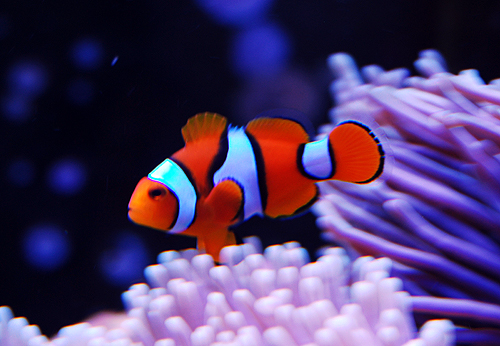
The Orange-fin Anemonefish has a short, deep body and a small head. Its body edges are generally yellow, while the middle sides range from yellow-brown to dark brown.[1][2]
It has two white vertical stripes, one behind the eye and another before the anus. Its fins range in colour from yellow to orange.[3][4]
Juveniles have a dull orange coloration. The tail fins are generally white or yellow, with coloration varying according to geographic origin.[5][6]
Individuals around Fiji and Tonga generally have yellow tails, while individuals from the Marshall and Solomon Islands generally have white tails.[7][8]
The species has 10–11 dorsal spines, 15–17 dorsal soft rays and 13–14 anal soft rays.[9][10][11]
It can reach 17 cm in length.[12]
Habitat
The Orange-fin Anemonefish occurs at depths ranging from the surface to 20 metres. Adults generally inhabit reef passages and slopes.[13][14]
It is associated with the bubble-tip sea anemone Entacmaea quadricolor, the beaded sea anemone Heteractis aurora, the sebae sea anemone Heteractis crispa and the magnificent sea anemone Heteractis magnifica.[15][16][17][18]
It is also associated with the corkscrew tentacle sea anemone Macrodactyla doreensis, Haddon's anemone Stichodactyla haddoni and Mertens' carpet sea anemone Stichodactyla mertensii.[19][20][21]
Diet
The Orange-fin Anemonefish feeds mainly on zooplankton and algae.[22]
Behaviour
Individuals with generally blackish coloration are associated with Mertens' carpet sea anemone. Brown males and juveniles are associated with Heteractis crispa.[23][24]
Only orange or brown juveniles are associated with Heteractis aurora.[25]
Similar species
The Orange-fin Anemonefish tends to be darker in coloration than Amphiprion akindynos. Black pelvic and anal fins distinguish it from Amphiprion akindynos.[26][27]
A wider middle or tail bar is indicative of Amphiprion clarkii rather than the Orange-fin Anemonefish. Amphiprion tricinctus generally has a tail bar unless its coloration is entirely black.[28][29]
Classification of the Orange-fin Anemonefish
| Kingdom | Animalia |
|---|---|
| Phylum | Chordata |
| Subphylum | Vertebrata |
| Infraphylum | Gnathostomata |
| Parvphylum | Osteichthyes |
| Gigaclass | Actinopterygii |
| Superclass | Actinopteri |
| Class | Teleostei (Teleost) |
| Order | Perciformes |
| Family | Pomacentridae (Damselfishes) |
| Subfamily | Amphiprioninae |
| Genus | Amphiprion (Clownfish) |
| Species | Amphiprion chrysopterus Cuvier, 1830 |
Where the Orange-fin Anemonefish is found
Checklists and occurrence records place Amphiprion chrysopterus in 20 countries. GBIF holds 2,109 georeferenced records of it.
Countries
- American Samoa 217
- Australia 170
- Fiji 443
- French Polynesia 131
- Guam 84
- Kiribati 17
- Marshall Islands 136
- Micronesia 27
- New Caledonia 19
- Niue 5
- Northern Mariana Islands 177
- Palau 121
- Papua New Guinea 134
- Samoa 8
- Solomon Islands 110
- Tonga 156
- Tuvalu 5
- United States Minor Outlying Islands 80
- Vanuatu 29
- Wallis and Futuna 40
Regions and cities with the most records
- Pago Pago, American Samoa 134
- Hagåtña, Guam 46
- Dededo Village, Guam 45
- Saipan, Northern Mariana Islands 44
- Mangilao Village, Guam 43
- Tamuning-Tumon-Harmon Village, Guam 43
- Yigo Village, Guam 42
- Nuku‘alofa, Tonga 33
- Faaa, French Polynesia 17
- Western, Fiji 17
- Port-Vila, Vanuatu 16
- Western District, American Samoa 13
- Papeete, French Polynesia 12
- Punaauia, French Polynesia 12
- Western Province, Solomon Islands 11
- Alo, Wallis and Futuna 10
- Northern, Fiji 10
- Sigave, Wallis and Futuna 10
- Vavau, Tonga 10
- Koror, Palau 8
- Lami, Fiji 8
- Lautoka, Fiji 8
- Nasinu, Fiji 8
- Northern Islands, Northern Mariana Islands 8
- Suva, Fiji 8
- Central, Fiji 7
- Central Province, Solomon Islands 6
- Milne Bay Province, Papua New Guinea 6
- Nadi, Fiji 6
- Oro Province, Papua New Guinea 6
- Alofi, Niue 5
- Malaita Province, Solomon Islands 5
- Sigatoka, Fiji 5
- Îles du Vent, French Polynesia 5
- Ngerulmud, Palau 4
- Palikir, Micronesia 4
4 more countries have a few records outside this range
These countries hold a few records of Amphiprion chrysopterus but lie outside the range the checklists give for it. Such records are often zoo or garden specimens, museum material or vagrants, so the species is not counted as occurring there.
A number beside a place is its count of GBIF occurrence records. A place without a number comes from a checklist alone. Records show where a species has been observed or collected, which can include escapes and vagrants.
Common names
English
- Orange-fin Anemonefish
- Orange-finned Anemonefish
- Two-banded Anemonefish
- Orangefin Anemonefish
Names in 11 other languages
- Catalan
- Peix pallasso polinesi
- Czech
- klaun oranžovoploutvý
- Danish
- Orangefinnet klovnfisk
- French
- Poisson-Clown à nageoires jaunes, Poisson-clown
- German
- Orangeflossen-Anemonenfisch
- Italian
- Pesce pagliaccio pinna arancione
- Mandarin Chinese
- 橙鰭雙鋸魚
- Portuguese
- Peixe-palhaço-polinésio
- Russian
- Тропический амфиприон
- Spanish
- Pez payaso de aletas doradas
- tah
- 'atoti
Related species
-
 Ocellaris ClownfishAmphiprion ocellaris
-
 Orange ClownfishAmphiprion percula
-
 Clark's AnemonefishAmphiprion clarkii
-
 Tomato ClownfishAmphiprion frenatus
-
 Pink Skunk ClownfishAmphiprion perideraion
-
 Barrier Reef AnemonefishAmphiprion akindynos
-
 Red Sea ClownfishAmphiprion bicinctus
-
 Saddleback ClownfishAmphiprion polymnus
Compare
Questions and answers
What is the scientific name of the Orange-fin Anemonefish?
The scientific name of the Orange-fin Anemonefish is Amphiprion chrysopterus. Written with its author, the full name is Amphiprion chrysopterus Cuvier, 1830.
Which family does the Orange-fin Anemonefish belong to?
Amphiprion chrysopterus belongs to the family Pomacentridae, in the order Perciformes and the class Teleostei.
Where is the Orange-fin Anemonefish found?
Checklists and occurrence records place Amphiprion chrysopterus in 20 countries, including Fiji, American Samoa, Northern Mariana Islands, Australia, Tonga and Marshall Islands.
What is the conservation status of the Orange-fin Anemonefish?
The IUCN Red List category recorded for Amphiprion chrysopterus is Least Concern (LC).
What other names does the Orange-fin Anemonefish have?
Amphiprion chrysopterus is also known in English as Orange-finned Anemonefish, Two-banded Anemonefish and Orangefin Anemonefish.
What is the diet of a clownfish?
The Orange-fin Anemonefish feeds mainly on zooplankton and algae.[22]
Where do clownfish and anemones live?
The Orange-fin Anemonefish occurs in the Western Pacific north of the Great Barrier Reef, from Queensland, Australia, and New Guinea to the Marshall Islands and Tuamotu Islands. It occurs at depths from the surface to 20 metres, and adults generally inhabit reef passages and slopes.[13][14][30][31]
Sources
Passages the profile rests on
- The species has a short, deep body and a small head. Source passage: “The fish's body is short and deep; the head is small.” — English Wikipedia
- Its body edges are generally yellow, while the middle sides range from yellow-brown to dark brown. Source passage: “Generally yellow in the body edges, it is yellow-brown to dark brown in the middle sides” — English Wikipedia
- The species has two white vertical stripes, one behind the eye and another before the anus. Source passage: “with two white vertical stripes, the first behind the eye and the second before the anus.” — English Wikipedia
- Its fins range in colour from yellow to orange. Source passage: “The fins are yellow to orange.” — English Wikipedia
- Juveniles have a dull orange coloration. Source passage: “Juveniles are a dull orange.” — English Wikipedia
- The tail fins are generally white or yellow, with coloration varying according to geographic origin. Source passage: “The tail fins are generally white or yellow and vary depending on the area of origin” — English Wikipedia
- Individuals around Fiji and Tonga generally have yellow tails. Source passage: “fish in the area surrounding Fiji and Tonga have yellow tails” — English Wikipedia
- Individuals from the Marshall and Solomon Islands generally have white tails. Source passage: “fish from the Marshall and Solomon Islands have white tails” — English Wikipedia
- The species has 10–11 dorsal spines. Source passage: “Dorsal spines (total) number 10 - 11;” — English Wikipedia
- The species has 15–17 dorsal soft rays. Source passage: “dorsal soft rays (total) are 15–17 in number.” — English Wikipedia
- The species has 13–14 anal soft rays. Source passage: “13-14 anal soft rays are present.” — English Wikipedia
- The species can reach 17 cm in length. Source passage: “It can grow to 17 cm in length.” — English Wikipedia
- The species occurs at depths ranging from the surface to 20 metres. Source passage: “from the surface to 20 m” — English Wikipedia
- Adults generally inhabit reef passages and slopes. Source passage: “Adults generally inhabit reef passages and slopes.” — English Wikipedia
- The species is associated with the bubble-tip sea anemone Entacmaea quadricolor. Source passage: “Entacmaea quadricolor bubble-tip anemone” — English Wikipedia
- The species is associated with the beaded sea anemone Heteractis aurora. Source passage: “Heteractis aurora beaded sea anemone” — English Wikipedia
- The species is associated with the sebae sea anemone Heteractis crispa. Source passage: “Heteractis crispa sebae anemone” — English Wikipedia
- The species is associated with the magnificent sea anemone Heteractis magnifica. Source passage: “Heteractis magnifica magnificent sea anemone” — English Wikipedia
- The species is associated with the corkscrew tentacle sea anemone Macrodactyla doreensis. Source passage: “Macrodactyla doreensis corkscrew tentacle sea anemone” — English Wikipedia
- The species is associated with Haddon's anemone Stichodactyla haddoni. Source passage: “Stichodactyla haddoni Haddon's anemone” — English Wikipedia
- The species is associated with Mertens' carpet sea anemone Stichodactyla mertensii. Source passage: “Stichodactyla mertensii Mertens' carpet sea anemone” — English Wikipedia
- The species feeds mainly on zooplankton and algae. Source passage: “The species feeds mainly on zooplankton and algae” — australian.museum
- Individuals with generally blackish coloration are associated with Mertens' carpet sea anemone. Source passage: “Fish that are generally blackish are associated with the host anemone Stichodactyla mertensii” — English Wikipedia
- Brown males and juveniles are associated with Heteractis crispa. Source passage: “Heteractis crispa is associated with brown males and juveniles.” — English Wikipedia
- Only orange or brown juveniles are associated with Heteractis aurora. Source passage: “Only orange or brown juveniles are associated with Heteractis aurora” — English Wikipedia
- The species tends to be darker in coloration than Amphiprion akindynos. Source passage: “A. chrysopterus tends to be darker than A. akindynos” — English Wikipedia
- Black pelvic and anal fins distinguish the species from Amphiprion akindynos. Source passage: “the presence of black pelvic and anal fins eliminates A. akindynos.” — English Wikipedia
- A wider middle or tail bar is indicative of Amphiprion clarkii rather than this species. Source passage: “A wider midbar or tail bar is indicative of A. clarkii.” — English Wikipedia
- Amphiprion tricinctus generally has a tail bar unless its coloration is entirely black. Source passage: “A. tricinctus also has a tail bar unless it is solid black.” — English Wikipedia
- The species occurs in the Western Pacific north of the Great Barrier Reef. Source passage: “found in the Western Pacific north of the Great Barrier Reef” — English Wikipedia
- Its documented geographic range extends through Pacific waters between Queensland, Australia, and New Guinea to the Marshall Islands and Tuamotu Islands. Source passage: “between Queensland, Australia, and New Guinea to the Marshall and Tuamotus Islands.” — English Wikipedia
Data
- Catalogue of Life, 2026-10-16 XR cc by
- Global Biodiversity Information Facility CC BY 4.0
- Wikidata CC0
- GeoNames CC BY 4.0
- Wikimedia Commons per image; credit shown with each image
- Within the Catalogue of Life, this name comes from World Register of Marine Species cc by
References
- Cuvier, G., & Valenciennes, A. (1830). Histoire naturelle des poissons. Tome cinquième. Livre cinquième. Des Sciénoïdes. Livre cinquième. Des Sciénoïdes. v. 5: i–xxviii + 1–499 + 4 pp., Pls. 100–140. [Cuvier authored volume. i–xx + 1–374 in Strasbourg edition.]. where the name was published
This species in other databases
- Catalogue of Life D558
- Wikidata Q1437711
- iNaturalist 180381
- WoRMS urn:lsid:marinespecies.org:taxname:278393
- ITIS 615181
Page built on 29 November 2026. See how the catalog is made and all sources and licences.
Cite this page
ScientificNames.org. (2026). Amphiprion chrysopterus (Orange-fin Anemonefish). Retrieved November 29, 2026, from https://scientificnames.org/species/amphiprion-chrysopterus
“Amphiprion chrysopterus (Orange-fin Anemonefish).” ScientificNames.org, 2026, scientificnames.org/species/amphiprion-chrysopterus. Accessed 29 Nov. 2026.
ScientificNames.org. “Amphiprion chrysopterus (Orange-fin Anemonefish).” Accessed November 29, 2026. https://scientificnames.org/species/amphiprion-chrysopterus.
@misc{scientificnames_amphiprion_chrysopterus_orange_fin_anemonefish,
  author = {{ScientificNames.org}},
  title = {Amphiprion chrysopterus (Orange-fin Anemonefish)},
  year = {2026},
  url = {https://scientificnames.org/species/amphiprion-chrysopterus},
  note = {Accessed 2026-11-29}
}