Species · Fishes
Red Saddleback Anemonefish Amphiprion ephippium
The scientific name of the Red Saddleback Anemonefish is Amphiprion ephippium. It is a species of fish in the family Pomacentridae (damselfishes), order Perciformes. The name dates from 1790.
- Scientific name
- Amphiprion ephippium (Bloch, 1790)
- Common name
- Red Saddleback Anemonefish
- Genus
- Amphiprion
- Family
- Pomacentridae (Damselfishes)
- Order
- Perciformes
- Class
- Teleostei
- Red List category
- LC Least Concern
- Environment
- marine
- Recorded in
- 8 countries
- Name status
- accepted in the Catalogue of Life

Overview
The Red Saddleback Anemonefish is a marine fish belonging to the family Pomacentridae. The species occurs in the Andaman and Nicobar Islands, Thailand, Malaysia, Sumatra, and Java. Adults have a reddish-orange body with a black saddle or spot on their sides and lack a white head bar.
Written 26 November 2026 from the sources listed below. Each statement was checked against the passage it cites; statements that could not be supported were removed.
Appearance
Adult individuals have a reddish-orange body with a black saddle or spot on their sides. Small juveniles may display two or three white bars that disappear in mature individuals.[1][2]
The species reaches a maximum length of 12 cm. It has 10–11 dorsal spines, two anal spines, 16–18 dorsal soft rays, and 13–14 anal soft rays.[3][4][5]
Habitat
The species is associated with bubble-tip anemones (Entacmaea quadricolor) and Sebae anemones (Heteractis crispa).[6][7]
Behaviour
Anemonefish form symbiotic mutualistic relationships with sea anemones in the wild. The host anemone protects them from predators and provides food through meal scraps and occasional dead tentacles.[8][9]
Anemonefish defend their host anemones against predators and parasites. Groups of clownfish have a dominance hierarchy in which the largest and most aggressive individual is the female.[10][11]
Reproduction and life cycle
Only one male and one female reproduce within a clownfish group through external fertilization. Clownfish develop initially as males and become females when mature.[12][13]
Conservation
The species has a low to moderate vulnerability score of 25 out of 100 in FishBase. FishBase reports a high preliminary population doubling potential, with a minimum doubling time of less than 15 months.[14][15]
Similar species
Adult Amphiprion ephippium can be distinguished from Amphiprion frenatus, Amphiprion melanopus, and Amphiprion rubrocinctus by its lack of a white head bar.[16]
Classification of the Red Saddleback Anemonefish
| Kingdom | Animalia |
|---|---|
| Phylum | Chordata |
| Subphylum | Vertebrata |
| Infraphylum | Gnathostomata |
| Parvphylum | Osteichthyes |
| Gigaclass | Actinopterygii |
| Superclass | Actinopteri |
| Class | Teleostei (Teleost) |
| Order | Perciformes |
| Family | Pomacentridae (Damselfishes) |
| Subfamily | Amphiprioninae |
| Genus | Amphiprion (Clownfish) |
| Species | Amphiprion ephippium (Bloch, 1790) |
Where the Red Saddleback Anemonefish is found
Checklists and occurrence records place Amphiprion ephippium in 8 countries. GBIF holds 138 georeferenced records of it.
Countries
Regions and cities with the most records
- Andaman and Nicobar, India 3
- Ban Chalong, Thailand 3
- Ban Ratsada, Thailand 3
- Ban Talat Nua, Thailand 3
- Sabang, Indonesia 3
- Satun, Thailand 3
- Tanintharyi Region, Myanmar 3
- Wichit, Thailand 3
A number beside a place is its count of GBIF occurrence records. A place without a number comes from a checklist alone. Records show where a species has been observed or collected, which can include escapes and vagrants.
Common names
English
- Red Saddleback Anemonefish
- Saddle Anemone
- Saddle Clownfish
- Tomato Clownfish
- Saddle Anemonefish
Names in 11 other languages
- Catalan
- Peix pallasso de punt negre
- Czech
- klaun sedlatý
- Danish
- Kulglødsfisk
- French
- Poisson-clown rouge à selle
- German
- Glühkohlen-Anemonenfisch
- Italian
- Pesce pagliaccio rosso
- Malay
- Gombing, Inggu
- Portuguese
- Peixe-palhaço-de-sela-preta
- Russian
- Огненный амфиприон
- Spanish
- Pez payaso naranja ensillado
- Thai
- ปลาการ์ตูนแดงดำ, ปลาสลิดหินส้ม
Synonyms
3 other scientific names have been used for this species and are now treated as synonyms of Amphiprion ephippium.
- Amphiprion calliops Schultz, 1966
- Lutianus ephippium Bloch, 1790
- Lutjanus ephippium Bloch, 1790
Related species
-
 Ocellaris ClownfishAmphiprion ocellaris
-
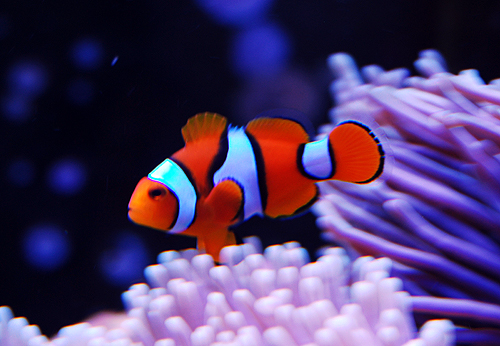 Orange ClownfishAmphiprion percula
-
 Clark's AnemonefishAmphiprion clarkii
-
 Tomato ClownfishAmphiprion frenatus
-
 Pink Skunk ClownfishAmphiprion perideraion
-
 Barrier Reef AnemonefishAmphiprion akindynos
-
 Red Sea ClownfishAmphiprion bicinctus
-
 Saddleback ClownfishAmphiprion polymnus
Compare
Questions and answers
What is the scientific name of the Red Saddleback Anemonefish?
The scientific name of the Red Saddleback Anemonefish is Amphiprion ephippium. Written with its author, the full name is Amphiprion ephippium (Bloch, 1790).
Which family does the Red Saddleback Anemonefish belong to?
Amphiprion ephippium belongs to the family Pomacentridae, in the order Perciformes and the class Teleostei.
Where is the Red Saddleback Anemonefish found?
Checklists and occurrence records place Amphiprion ephippium in 8 countries, including Thailand, Indonesia, India, Myanmar, Philippines and China.
What is the conservation status of the Red Saddleback Anemonefish?
The IUCN Red List category recorded for Amphiprion ephippium is Least Concern (LC).
What other names does the Red Saddleback Anemonefish have?
Amphiprion ephippium is also known in English as Saddle Anemone, Saddle Clownfish, Tomato Clownfish and Saddle Anemonefish.
Sources
Passages the profile rests on
- Adult individuals have a reddish-orange body with a black saddle or spot on their sides. Source passage: “Adults, as the common name suggests, have a reddish-orange body and a black saddle or spot on the sides.” — English Wikipedia
- Small juveniles may display two or three white bars that disappear in mature individuals. Source passage: “While small juveniles may have 2 or 3 white bars, these are not present in mature fish.” — English Wikipedia
- The species reaches a maximum length of 12 cm. Source passage: “They reach a maximum length of 12 cm (4+3⁄4 in).” — English Wikipedia
- The species has 10–11 dorsal spines and two anal spines. Source passage: “They have 10-11 dorsal spines, 2 anal spines,” — English Wikipedia
- The species has 16–18 dorsal soft rays and 13–14 anal soft rays. Source passage: “16-18 dorsal soft rays and 13-14 anal soft rays.” — English Wikipedia
- The species is associated with bubble-tip anemones (Entacmaea quadricolor). Source passage: “Entacmaea quadricolor Bubble-tip anemone” — English Wikipedia
- The species is associated with Sebae anemones (Heteractis crispa). Source passage: “Heteractis crispa Sebae anemone” — English Wikipedia
- Anemonefish form symbiotic mutualistic relationships with sea anemones in the wild. Source passage: “Clownfish or anemonefish are fishes that, in the wild, form symbiotic mutualisms with sea anemones” — English Wikipedia
- The host anemone protects anemonefish from predators and provides food through meal scraps and occasional dead tentacles. Source passage: “The sea anemone protects the clownfish from predators, as well as providing food through the scraps left from the anemone's meals and occasional dead anemone tentacles.” — English Wikipedia
- Anemonefish defend their host anemones against predators and parasites. Source passage: “In return, the clownfish defends the anemone from its predators, and parasites.” — English Wikipedia
- Groups of clownfish have a dominance hierarchy in which the largest and most aggressive individual is the female. Source passage: “In a group of clownfish, there is a strict dominance hierarchy. The largest and most aggressive fish is female and is found at the top.” — English Wikipedia
- Only one male and one female reproduce within a clownfish group through external fertilization. Source passage: “Only two clownfish, a male and a female, in a group reproduce through external fertilization.” — English Wikipedia
- Clownfish develop initially as males and become females when mature. Source passage: “Clownfish are sequential hermaphrodites, meaning that they develop into males first, and when they mature, they become females.” — English Wikipedia
- The species has a low to moderate vulnerability score of 25 out of 100 in FishBase. Source passage: “Low to moderate vulnerability (25 of 100).” — fishbase.se
- FishBase reports a high preliminary population doubling potential, with a minimum doubling time of less than 15 months. Source passage: “High, minimum population doubling time less than 15 months (Preliminary K or Fecundity.).” — fishbase.se
- Adult Amphiprion ephippium can be distinguished from Amphiprion frenatus, Amphiprion melanopus, and Amphiprion rubrocinctus by its lack of a white head bar. Source passage: “The lack of a white head bar on adults distinguishes A. ephippium from the somewhat similar A. frenatus, A. melanopus, and A. rubrocinctus.” — English Wikipedia
Data
- Catalogue of Life, 2026-10-16 XR cc by
- Global Biodiversity Information Facility CC BY 4.0
- Wikidata CC0
- GeoNames CC BY 4.0
- Wikimedia Commons per image; credit shown with each image
- Within the Catalogue of Life, this name comes from World Register of Marine Species cc by
References
- Bloch, Marcus E. 1790. D. Marcus Elieser Bloch’s, ausübenden Arztes zu Berlin; der Utrechter, Frankfurter, Göttinger, Harlemmer, Vlieffiager, Mainzischen, Böhmischen und Coppenhagner Gesellschaften der Wissenschaften; der Berliner, Römisch - Kaiserlichen, Danziger, Hallischen und Zürcher Naturforschenden Gesellschaften; der St. Petersburger, Leipziger, Baierschen und Zelüschen ökonomischen Gesellschaften; der Ackerbau-Gesellschaft, und des Mufée zu Paris, Mitglieds oder Correspondenten, Naturgeschichte der ausländischen Fische. Schlesinger, Berlin. Vol. 4, (Naturgeschichte der ausländischen Fische) Edition: i-xii, 1-128, pls. 217-252. where the name was published
This species in other databases
- Catalogue of Life D55D
- Wikidata Q1532838
- iNaturalist 57754
- WoRMS urn:lsid:marinespecies.org:taxname:212782
- ITIS 170143
Page built on 27 November 2026. See how the catalog is made and all sources and licences.
Cite this page
ScientificNames.org. (2026). Amphiprion ephippium (Red Saddleback Anemonefish). Retrieved November 27, 2026, from https://scientificnames.org/species/amphiprion-ephippium
“Amphiprion ephippium (Red Saddleback Anemonefish).” ScientificNames.org, 2026, scientificnames.org/species/amphiprion-ephippium. Accessed 27 Nov. 2026.
ScientificNames.org. “Amphiprion ephippium (Red Saddleback Anemonefish).” Accessed November 27, 2026. https://scientificnames.org/species/amphiprion-ephippium.
@misc{scientificnames_amphiprion_ephippium_red_saddleback_anemonefish,
  author = {{ScientificNames.org}},
  title = {Amphiprion ephippium (Red Saddleback Anemonefish)},
  year = {2026},
  url = {https://scientificnames.org/species/amphiprion-ephippium},
  note = {Accessed 2026-11-27}
}