Species · Fishes
Seychelles Anemonefish Amphiprion fuscocaudatus
The scientific name of the Seychelles Anemonefish is Amphiprion fuscocaudatus. It is a species of fish in the family Pomacentridae (damselfishes), order Perciformes. The name dates from 1972.
- Scientific name
- Amphiprion fuscocaudatus Allen, 1972
- Common name
- Seychelles Anemonefish
- Genus
- Amphiprion
- Family
- Pomacentridae (Damselfishes)
- Order
- Perciformes
- Class
- Teleostei
- Red List category
- LC Least Concern
- Environment
- marine
- Recorded in
- 1 country
- Name status
- accepted in the Catalogue of Life

Overview
Amphiprion fuscocaudatus occurs exclusively in the Seychelles Islands and Aldabra in the western Indian Ocean. It has a dark brown to blackish body with white bars, yellow or orange lower body features and a dark, streaked caudal fin.
Written 26 November 2026 from the sources listed below. Each statement was checked against the passage it cites; statements that could not be supported were removed.
Appearance
The body is dark brown to blackish and has white bars. The snout, breast, belly, pelvic fins and anal fins are yellow or orange.[1]
The caudal fin has a dark central region with longitudinal streaks separated by lighter areas. The species has 11 dorsal spines, 15–16 dorsal soft rays, 2 anal spines and 14 anal soft rays.[2][3][4]
The species reaches a maximum length of 14 cm.[5]
Similar species
Amphiprion chrysogaster is a similar species. Its caudal fin is uniformly dark with a narrow white margin.[6]
Classification of the Seychelles Anemonefish
| Kingdom | Animalia |
|---|---|
| Phylum | Chordata |
| Subphylum | Vertebrata |
| Infraphylum | Gnathostomata |
| Parvphylum | Osteichthyes |
| Gigaclass | Actinopterygii |
| Superclass | Actinopteri |
| Class | Teleostei (Teleost) |
| Order | Perciformes |
| Family | Pomacentridae (Damselfishes) |
| Subfamily | Amphiprioninae |
| Genus | Amphiprion (Clownfish) |
| Species | Amphiprion fuscocaudatus Allen, 1972 |
Where the Seychelles Anemonefish is found
Checklists and occurrence records place Amphiprion fuscocaudatus in 1 country. GBIF holds 52 georeferenced records of it.
Countries
Regions and cities with the most records
A number beside a place is its count of GBIF occurrence records. A place without a number comes from a checklist alone. Records show where a species has been observed or collected, which can include escapes and vagrants.
Common names
English
- Seychelles Anemonefish
Names in 11 other languages
- Arabic
- سمكة المهرج سيشيل
- Catalan
- Peix pallasso crioll
- Chinese
- 棕尾雙鋸魚
- Danish
- Seychellisk klovnfisk
- French
- Poisson-clown des Seychelles
- German
- Seychellen-Anemonenfisch
- Italian
- Pesce pagliaccio delle Seychelles
- Mandarin Chinese
- 棕尾双锯鱼
- Portuguese
- Peixe-palhaço-de-Seychelles
- Russian
- Двухцветный амфиприон
- Spanish
- Pez payaso de aletas oscuras
Related species
-
 Ocellaris ClownfishAmphiprion ocellaris
-
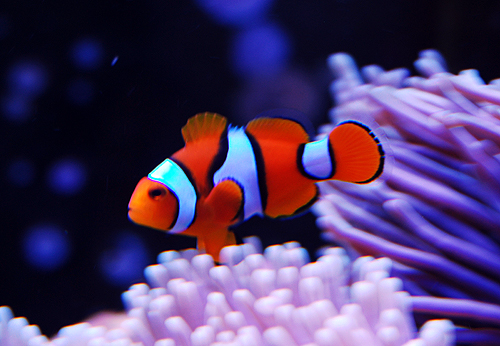 Orange ClownfishAmphiprion percula
-
 Clark's AnemonefishAmphiprion clarkii
-
 Tomato ClownfishAmphiprion frenatus
-
 Pink Skunk ClownfishAmphiprion perideraion
-
 Barrier Reef AnemonefishAmphiprion akindynos
-
 Red Sea ClownfishAmphiprion bicinctus
-
 Saddleback ClownfishAmphiprion polymnus
Compare
Questions and answers
What is the scientific name of the Seychelles Anemonefish?
The scientific name of the Seychelles Anemonefish is Amphiprion fuscocaudatus. Written with its author, the full name is Amphiprion fuscocaudatus Allen, 1972.
Which family does the Seychelles Anemonefish belong to?
Amphiprion fuscocaudatus belongs to the family Pomacentridae, in the order Perciformes and the class Teleostei.
Where is the Seychelles Anemonefish found?
Checklists and occurrence records place Amphiprion fuscocaudatus in 1 country: Seychelles.
What is the conservation status of the Seychelles Anemonefish?
The IUCN Red List category recorded for Amphiprion fuscocaudatus is Least Concern (LC).
Sources
Passages the profile rests on
- The body is dark brown to blackish and has white bars, with a yellow or orange snout, breast, belly, pelvic fins and anal fins. Source passage: “The body of A. fuscocaudatus is dark brown to blackish, with the white bars and yellow or orange snout, breast, belly, pelvic and anal fins.” — English Wikipedia
- The caudal fin has a dark central region with longitudinal streaks separated by lighter areas. Source passage: “The caudal fin has a dark central area and longitudinal streaks separated by lighter areas.” — English Wikipedia
- The species has 11 dorsal spines and 2 anal spines. Source passage: “They have 11 dorsal spines, 2 anal spines, 15-16 dorsal soft rays and 14 anal soft rays.” — English Wikipedia
- The species has 15–16 dorsal soft rays and 14 anal soft rays. Source passage: “They have 11 dorsal spines, 2 anal spines, 15-16 dorsal soft rays and 14 anal soft rays.” — English Wikipedia
- The species reaches a maximum length of 14 cm. Source passage: “They reach a maximum length of 14 cm (5+1⁄2 in).” — English Wikipedia
- Amphiprion chrysogaster is a similar species, but its caudal fin is uniformly dark with a narrow white margin. Source passage: “A. chrysogaster is very similar however, its caudal fin is uniformly dark with just a narrow white margin.” — English Wikipedia
Data
- Catalogue of Life, 2026-10-16 XR cc by
- Global Biodiversity Information Facility CC BY 4.0
- Wikidata CC0
- GeoNames CC BY 4.0
- Wikimedia Commons per image; credit shown with each image
- Within the Catalogue of Life, this name comes from World Register of Marine Species cc by
References
- Allen, G. R. (1972). The Anemonefishes: Their Classification and Biology. T. F. H. Publications, Inc. Ltd. Neptune City, New Jersey., pp. 288. where the name was published
This species in other databases
- Catalogue of Life D55G
- Wikidata Q1851739
- iNaturalist 619608
- WoRMS urn:lsid:marinespecies.org:taxname:212774
- ITIS 615185
Page built on 28 November 2026. See how the catalog is made and all sources and licences.
Cite this page
ScientificNames.org. (2026). Amphiprion fuscocaudatus (Seychelles Anemonefish). Retrieved November 28, 2026, from https://scientificnames.org/species/amphiprion-fuscocaudatus
“Amphiprion fuscocaudatus (Seychelles Anemonefish).” ScientificNames.org, 2026, scientificnames.org/species/amphiprion-fuscocaudatus. Accessed 28 Nov. 2026.
ScientificNames.org. “Amphiprion fuscocaudatus (Seychelles Anemonefish).” Accessed November 28, 2026. https://scientificnames.org/species/amphiprion-fuscocaudatus.
@misc{scientificnames_amphiprion_fuscocaudatus_seychelles_anemonefish,
  author = {{ScientificNames.org}},
  title = {Amphiprion fuscocaudatus (Seychelles Anemonefish)},
  year = {2026},
  url = {https://scientificnames.org/species/amphiprion-fuscocaudatus},
  note = {Accessed 2026-11-28}
}