Species · Fishes
Maldive Anemonefish Amphiprion nigripes
The scientific name of the Maldive Anemonefish is Amphiprion nigripes. It is a species of fish in the family Pomacentridae (damselfishes), order Perciformes. The name dates from 1908.
- Scientific name
- Amphiprion nigripes Regan, 1908
- Common name
- Maldive Anemonefish
- Genus
- Amphiprion
- Family
- Pomacentridae (Damselfishes)
- Order
- Perciformes
- Class
- Teleostei
- Red List category
- LC Least Concern
- Environment
- marine
- Recorded in
- 5 countries
- Name status
- accepted in the Catalogue of Life

Overview
Amphiprion nigripes inhabits outer reef slopes at depths of 2–25 m in the western Indian Ocean, including the Maldive Islands and Laccadive Islands. It is typically rusty orange with a single white stripe behind the eye and black pelvic and anal fins, and is particularly associated with the magnificent sea anemone.
Written 26 November 2026 from the sources listed below. Each statement was checked against the passage it cites; statements that could not be supported were removed.
Appearance
The Maldive anemonefish has an oval-shaped body that is compressed laterally. Its typical coloration is rusty orange with a single vertical white stripe immediately behind the eye.[1][2]
Its pelvic and anal fins are typically black, while the amount of black coloration on its belly varies among individuals. Some individuals have orange-yellow coloration and an anal fin matching their body color.[3][4][5]
Females can grow to a maximum length of 11 cm.[6]
Habitat
The species inhabits outer reef slopes at depths of 2–25 m and typically occupies these slopes in small groups. It is particularly associated with the magnificent sea anemone.[7][8][9]
Diet
The Maldive anemonefish is omnivorous. Its natural diet includes zooplankton, small benthic crustaceans and algae.[10][11]
In captivity, it can consume brine shrimp, mysis shrimp and chopped shellfish. Tank-raised individuals have accepted high-protein flakes and granular foods.[12][13]
Behaviour
The species is active during daylight hours and aggressively defends its territory. Males live in harems organized by a dominance hierarchy that maintains individual social ranks.[14][15][16]
The species depends on its host sea anemone for shelter and protection of its group and nest. It shelters among the anemone's tentacles, and a thin mucus layer protects it against their stinging tentacles.[17][18][19]
The relationship between the Maldive anemonefish and its host sea anemone is mutualistic. The fish can defend its host against reef fishes that consume anemone tentacles, including butterflyfish.[20][21]
Reproduction and life cycle
The Maldive anemonefish is a protandrous hermaphrodite. Individuals initially develop as males and later are capable of changing into females.[22]
The species has been successfully raised in captivity.[23]
Conservation
The FishBase record reports a high preliminary minimum population doubling rate of less than 15 months.[24]
Uses
The FishBase record gives an estimated protein content of 18.6% by wet weight and an estimated omega-3 content of 0.147 g per 100 g of wet weight.[25][26]
Classification of the Maldive Anemonefish
| Kingdom | Animalia |
|---|---|
| Phylum | Chordata |
| Subphylum | Vertebrata |
| Infraphylum | Gnathostomata |
| Parvphylum | Osteichthyes |
| Gigaclass | Actinopterygii |
| Superclass | Actinopteri |
| Class | Teleostei (Teleost) |
| Order | Perciformes |
| Family | Pomacentridae (Damselfishes) |
| Subfamily | Amphiprioninae |
| Genus | Amphiprion (Clownfish) |
| Species | Amphiprion nigripes Regan, 1908 |
Where the Maldive Anemonefish is found
Checklists and occurrence records place Amphiprion nigripes in 5 countries. GBIF holds 517 georeferenced records of it.
Countries
Regions and cities with the most records
- Male, Maldives 59
- Hendala, Sri Lanka 26
- Ja Ela, Sri Lanka 26
- Kandana, Sri Lanka 26
- Peliyagoda, Sri Lanka 26
- Wattala, Sri Lanka 26
- Welisara, Sri Lanka 26
- Katunayaka, Sri Lanka 25
- Negombo, Sri Lanka 25
- Trincomalee, Sri Lanka 3
A number beside a place is its count of GBIF occurrence records. A place without a number comes from a checklist alone. Records show where a species has been observed or collected, which can include escapes and vagrants.
Common names
English
- Maldive Anemonefish
- Black-footed Clownfish
- Blackfin Anemonefish
- Blackfinned Anemonefish
- Maldives Clown
- Maldivian Anemonefish
Names in 10 other languages
- Catalan
- Peix pallasso aleta negra
- Czech
- klaun černoploutvý
- Danish
- Maldivisk klovnfisk
- Dutch
- Zwartvinanemoonvis
- French
- Poisson-clown cardinal, Poisson-clown des Maldives
- German
- Malediven-Anemonenfisch
- Italian
- Pesce pagliaccio delle Maldive
- Portuguese
- Peixe-palhaço-das-Maldivas
- Russian
- Кардинал Амфиприон, Клоун мальдивский
- Spanish
- Pez Payaso de Aleta Negra
Related species
-
 Ocellaris ClownfishAmphiprion ocellaris
-
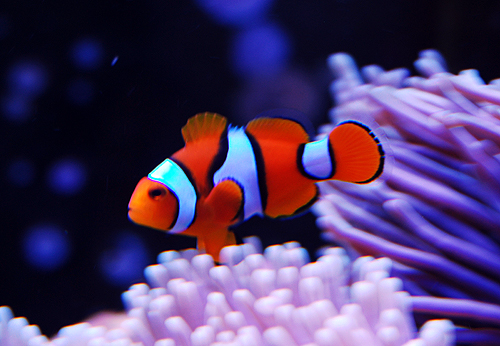 Orange ClownfishAmphiprion percula
-
 Clark's AnemonefishAmphiprion clarkii
-
 Tomato ClownfishAmphiprion frenatus
-
 Pink Skunk ClownfishAmphiprion perideraion
-
 Barrier Reef AnemonefishAmphiprion akindynos
-
 Red Sea ClownfishAmphiprion bicinctus
-
 Saddleback ClownfishAmphiprion polymnus
Compare
Questions and answers
What is the scientific name of the Maldive Anemonefish?
The scientific name of the Maldive Anemonefish is Amphiprion nigripes. Written with its author, the full name is Amphiprion nigripes Regan, 1908.
Which family does the Maldive Anemonefish belong to?
Amphiprion nigripes belongs to the family Pomacentridae, in the order Perciformes and the class Teleostei.
Where is the Maldive Anemonefish found?
Checklists and occurrence records place Amphiprion nigripes in 5 countries: Maldives, Sri Lanka, India, Iran and Vietnam.
What is the conservation status of the Maldive Anemonefish?
The IUCN Red List category recorded for Amphiprion nigripes is Least Concern (LC).
What other names does the Maldive Anemonefish have?
Amphiprion nigripes is also known in English as Black-footed Clownfish, Blackfin Anemonefish, Blackfinned Anemonefish, Maldives Clown and Maldivian Anemonefish.
Are there clownfish in the Maldives?
Yes. The Maldive anemonefish occurs in the Maldive Islands.[27]
Sources
Passages the profile rests on
- The species has an oval-shaped body that is compressed laterally. Source passage: “It is oval-bodied and laterally compressed.” — English Wikipedia
- Its typical coloration is rusty orange with a single vertical white stripe immediately behind the eye. Source passage: “This clownfish is characterized by its rusty orange color with a single white stripe running vertically just behind the eye.” — English Wikipedia
- Its pelvic and anal fins are typically black. Source passage: “It has black pelvic and anal fins (hence the common name)” — English Wikipedia
- The amount of black coloration on its belly varies among individuals. Source passage: “a variable area on its belly can be more or less black.” — English Wikipedia
- Some individuals have orange-yellow coloration and an anal fin matching their body color. Source passage: “some fishes can be orangeish-yellow with an anal fin which is not black but the same color as the body.” — English Wikipedia
- Females can grow to a maximum length of 11 cm. Source passage: “grows up to 11 cm as a female” — English Wikipedia
- The species inhabits outer reef slopes at depths of 2–25 m. Source passage: “on outer reef slopes at depths of 2–25 m (6 ft 7 in – 82 ft 0 in).” — English Wikipedia
- The species is particularly associated with the magnificent sea anemone. Source passage: “It is particularly associated with the magnificent sea anemone.” — English Wikipedia
- The species typically occupies outer reef slopes in small groups. Source passage: “This species typically lives in small groups on outer reef slopes” — English Wikipedia
- The species is omnivorous. Source passage: “This anemonefish is omnivorous” — English Wikipedia
- Its natural diet includes zooplankton, small benthic crustaceans, and algae. Source passage: “its diet is based on zooplankton, small benthic crustaceans, and algae.” — English Wikipedia
- In captivity, the species can consume brine shrimp, mysis shrimp, and chopped shellfish. Source passage: “the species can eat brine shrimp, mysis shrimp, and chopped shellfish provided by a hobbyist.” — English Wikipedia
- Tank-raised individuals have accepted high-protein flakes and granular foods. Source passage: “Individuals that are tank-raised have accepted high-protein flakes as well as granular foods.” — English Wikipedia
- The species is active during daylight hours. Source passage: “Amphiprion nigripes is active during the day.” — English Wikipedia
- Males live in harems organized by a dominance hierarchy that maintains individual social ranks. Source passage: “The males live in harems in which an established dominance hierarchy manages the group and keeps individuals at a specific social rank.” — English Wikipedia
- The species aggressively defends its territory. Source passage: “It also aggressively defends its territory” — English Wikipedia
- The species depends on its host sea anemone for shelter and protection of its group and nest. Source passage: “which represents its "life insurance" as a safe shelter for the group and for the nest.” — English Wikipedia
- The fish shelters among its host anemone's tentacles. Source passage: “The fish lives within the sea anemone's tentacles and can use it as a shelter” — English Wikipedia
- A thin mucus layer protects the fish against the stinging tentacles of its host anemone. Source passage: “it has developed a thin layer of mucus which covers its body as a protection against the anemone's stinging tentacles” — English Wikipedia
- The relationship between the species and its host sea anemone is mutualistic. Source passage: “The associative relationship that binds the clownfish and the sea anemone is called mutualism.” — English Wikipedia
- The fish can defend its host anemone against reef fishes that consume anemone tentacles, including butterflyfish. Source passage: “the clownfish can also defend the anemone against some reef fishes which could eat the tentacles, such as butterflyfish.” — English Wikipedia
- The species is a protandrous hermaphrodite, with individuals initially developing as males and later being capable of changing into females. Source passage: “all fish are hatched as males and later can change sex to female.” — English Wikipedia
- The species has been successfully raised in captivity. Source passage: “It has successfully been raised in captivity.” — English Wikipedia
- The FishBase record reports a high preliminary minimum population doubling rate of less than 15 months. Source passage: “High, minimum population doubling time less than 15 months (Preliminary K or Fecundity.).” — fishbase.se
- The FishBase record gives an estimated protein content of 18.6% by wet weight. Source passage: “Protein = 18.6 [17.6, 19.6] %;” — fishbase.se
- The FishBase record gives an estimated omega-3 content of 0.147 g per 100 g of wet weight. Source passage: “Omega3 = 0.147 [0.095, 0.224] g/100g;” — fishbase.se
- Its recorded distribution includes the Maldive Islands. Source passage: “in the Maldive Islands, Laccadive Islands.” — English Wikipedia
Data
- Catalogue of Life, 2026-10-16 XR cc by
- Global Biodiversity Information Facility CC BY 4.0
- Wikidata CC0
- GeoNames CC BY 4.0
- Wikimedia Commons per image; credit shown with each image
- Within the Catalogue of Life, this name comes from World Register of Marine Species cc by
References
- Regan, C. T. (1908). Report on the marine fishes collected by Mr. J. Stanley Gardiner in the Indian Ocean. The Transactions of the Linnean Society of London. Second Series. Zoology, v. 12 (pt 3): 217–255, Pls. 23–32. https://doi.org/10.1111/j.1096-3642.1908.tb00199.x Link where the name was published
This species in other databases
- Catalogue of Life D55X
- Wikidata Q969728
- iNaturalist 180380
- WoRMS urn:lsid:marinespecies.org:taxname:278399
- ITIS 615201
Page built on 29 November 2026. See how the catalog is made and all sources and licences.
Cite this page
ScientificNames.org. (2026). Amphiprion nigripes (Maldive Anemonefish). Retrieved November 29, 2026, from https://scientificnames.org/species/amphiprion-nigripes
“Amphiprion nigripes (Maldive Anemonefish).” ScientificNames.org, 2026, scientificnames.org/species/amphiprion-nigripes. Accessed 29 Nov. 2026.
ScientificNames.org. “Amphiprion nigripes (Maldive Anemonefish).” Accessed November 29, 2026. https://scientificnames.org/species/amphiprion-nigripes.
@misc{scientificnames_amphiprion_nigripes_maldive_anemonefish,
  author = {{ScientificNames.org}},
  title = {Amphiprion nigripes (Maldive Anemonefish)},
  year = {2026},
  url = {https://scientificnames.org/species/amphiprion-nigripes},
  note = {Accessed 2026-11-29}
}