Species · Fishes
Pacific Anemonefish Amphiprion pacificus
The scientific name of the Pacific Anemonefish is Amphiprion pacificus. It is a species of fish in the family Pomacentridae (damselfishes), order Perciformes. The name dates from 2010.
- Scientific name
- Amphiprion pacificus Allen, Drew & Fenner, 2010
- Common name
- Pacific Anemonefish
- Genus
- Amphiprion
- Family
- Pomacentridae (Damselfishes)
- Order
- Perciformes
- Class
- Teleostei
- Environment
- marine
- Recorded in
- 3 countries
- Name status
- accepted in the Catalogue of Life
Overview
Amphiprion pacificus occurs in the western Pacific Ocean, with recorded locations including Wallis Island, Tonga, Fiji and the Samoan Islands. It is distinguished by a white stripe running along the dorsal ridge from the middle of the snout to the base of the caudal fin.
Written 26 November 2026 from the sources listed below. Each statement was checked against the passage it cites; statements that could not be supported were removed.
Appearance
The body is pinkish brown to dark brown, generally becoming yellowish or orange on the lower sides and abdomen. The fins are whitish to semi-translucent.[1][2]
The species has nine dorsal spines, 18–20 dorsal soft rays, two anal spines and 12–13 anal soft rays.[3][4][5]
The species does not exhibit geographic, sex-related or host-anemone-related colour variations.[6]
The four specimens used as the basis for the species description measured between 3.09 and 4.83 cm.[7]
Habitat
The species generally occurs at depths of 4–10 metres. It is hosted by the magnificent sea anemone, Heteractis magnifica.[8][9]
Diet
The species' natural diet includes zooplankton.[10]
Behaviour
The Pacific Anemonefish forms a symbiotic mutualistic relationship with sea anemones. It is unaffected by the stinging tentacles of its host anemone.[11][12]
The species has a size-based dominance hierarchy in which the female is largest and the breeding male is second largest.[13]
Reproduction and life cycle
The species is a sequential hermaphrodite. If the sole breeding female dies, the breeding male changes into a female.[14][15]
When the breeding female dies, the largest non-breeding male becomes the breeding male.[16]
Conservation
The species is uncommon throughout its geographic range.[17]
Classification of the Pacific Anemonefish
| Kingdom | Animalia |
|---|---|
| Phylum | Chordata |
| Subphylum | Vertebrata |
| Infraphylum | Gnathostomata |
| Parvphylum | Osteichthyes |
| Gigaclass | Actinopterygii |
| Superclass | Actinopteri |
| Class | Teleostei (Teleost) |
| Order | Perciformes |
| Family | Pomacentridae (Damselfishes) |
| Subfamily | Amphiprioninae |
| Genus | Amphiprion (Clownfish) |
| Species | Amphiprion pacificus Allen, Drew & Fenner, 2010 |
Where the Pacific Anemonefish is found
Checklists and occurrence records place Amphiprion pacificus in 3 countries. GBIF holds 19 georeferenced records of it.
Countries
Regions and cities with the most records
A number beside a place is its count of GBIF occurrence records. A place without a number comes from a checklist alone. Records show where a species has been observed or collected, which can include escapes and vagrants.
Common names
English
- Pacific Anemonefish
Names in 7 other languages
- Catalan
- Peix pallasso del Pacífic
- French
- Poisson-clown énigmatique
- German
- Pazifischer Anemonenfisch
- Italian
- Pesce pagliaccio del Pacifico
- Portuguese
- Peixe-palhaço-do-Pacífico
- Russian
- Тихоокеанский амфиприон
- Spanish
- Pez Payaso del Pacífico
Related species
-
 Ocellaris ClownfishAmphiprion ocellaris
-
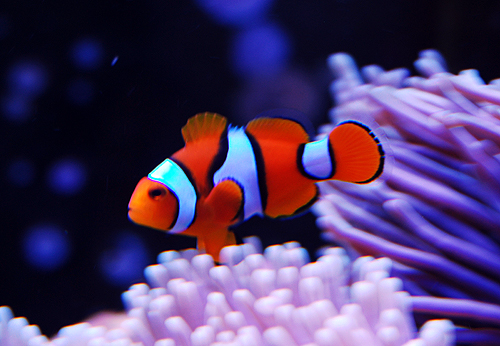 Orange ClownfishAmphiprion percula
-
 Clark's AnemonefishAmphiprion clarkii
-
 Tomato ClownfishAmphiprion frenatus
-
 Pink Skunk ClownfishAmphiprion perideraion
-
 Barrier Reef AnemonefishAmphiprion akindynos
-
 Red Sea ClownfishAmphiprion bicinctus
-
 Saddleback ClownfishAmphiprion polymnus
Compare
Questions and answers
What is the scientific name of the Pacific Anemonefish?
The scientific name of the Pacific Anemonefish is Amphiprion pacificus. Written with its author, the full name is Amphiprion pacificus Allen, Drew & Fenner, 2010.
Which family does the Pacific Anemonefish belong to?
Amphiprion pacificus belongs to the family Pomacentridae, in the order Perciformes and the class Teleostei.
Where is the Pacific Anemonefish found?
Checklists and occurrence records place Amphiprion pacificus in 3 countries: Tonga, Wallis and Futuna and American Samoa.
Sources
Passages the profile rests on
- The body is pinkish brown to dark brown, generally becoming yellowish or orange on the lower sides and abdomen. Source passage: “The body of A. pacificus is pinkish brown dark brown, usually grading to yellowish or orange on lower side of body including abdomen.” — English Wikipedia
- Its fins are whitish to semi-translucent. Source passage: “The fins are whitish to semi-translucent.” — English Wikipedia
- The species has nine dorsal spines and two anal spines. Source passage: “It has 9 dorsal spines, 2 anal spines,” — English Wikipedia
- The species has 18–20 dorsal soft rays. Source passage: “18-20 dorsal soft rays” — English Wikipedia
- The species has 12–13 anal soft rays. Source passage: “12-13 anal soft rays.” — English Wikipedia
- The species does not exhibit geographic, sex-related or host-anemone-related colour variations. Source passage: “A. pacificus, like other members of the skunk complex does not show any of these variations.” — English Wikipedia
- The four specimens used as the basis for the species description measured between 3.09 and 4.83 cm. Source passage: “The four specimens that were the basis of the description ranged from 3.09 to 4.83 cm (1+1⁄4 to 2 in).” — English Wikipedia
- The species generally occurs at depths of 4–10 metres. Source passage: “is generally found at depths of 4 to 10 metres (13 to 33 ft).” — English Wikipedia
- The species is hosted by the magnificent sea anemone, Heteractis magnifica. Source passage: “Heteractis magnifica magnificent sea anemone” — English Wikipedia
- The species' natural diet includes zooplankton. Source passage: “The fish's natural diet includes zooplankton.” — English Wikipedia
- The species forms a symbiotic mutualistic relationship with sea anemones. Source passage: “Like all anemonefishes it forms a symbiotic mutualism with sea anemones” — English Wikipedia
- The species is unaffected by the stinging tentacles of its host anemone. Source passage: “is unaffected by the stinging tentacles of the host anemone.” — English Wikipedia
- The species has a size-based dominance hierarchy in which the female is largest and the breeding male is second largest. Source passage: “the female is largest, the breeding male is second largest, and the male non-breeders get progressively smaller” — English Wikipedia
- The species is a sequential hermaphrodite. Source passage: “It is a sequential hermaphrodite” — English Wikipedia
- The breeding male changes into a female if the sole breeding female dies. Source passage: “the breeding male will change to female if the sole breeding female dies” — English Wikipedia
- When the breeding female dies, the largest non-breeding male becomes the breeding male. Source passage: “with the largest non-breeder becomes the breeding male.” — English Wikipedia
- The species is uncommon throughout its geographic range. Source passage: “It is not common within its range” — English Wikipedia
- The species occurs in the western Pacific Ocean. Source passage: “Amphiprion pacificus, is a species of anemonefish found in the western Pacific Ocean.” — English Wikipedia
- Recorded locations include Wallis Island, Tonga, Fiji and the Samoan Islands. Source passage: “A. pacificus is found the western Pacific at Wallis Island, Tonga, Fiji and Samoan Islands” — English Wikipedia
Data
- Catalogue of Life, 2026-10-16 XR cc by
- Global Biodiversity Information Facility CC BY 4.0
- Wikidata CC0
- GeoNames CC BY 4.0
- Within the Catalogue of Life, this name comes from World Register of Marine Species cc by
References
- Allen, G. R., Drew, J., & Fenner, D. (2010). Amphiprion pacificus, a new species of anemonefish (Pomacentridae) from Fiji, Tonga, Samoa, and Wallis Island. Aqua, Intl. J. Ichthyol. 16(3):129-138. where the name was published
This species in other databases
- Catalogue of Life D562
- Wikidata Q219440
- iNaturalist 619610
- WoRMS urn:lsid:marinespecies.org:taxname:712752
Page built on 29 November 2026. See how the catalog is made and all sources and licences.
Cite this page
ScientificNames.org. (2026). Amphiprion pacificus (Pacific Anemonefish). Retrieved November 29, 2026, from https://scientificnames.org/species/amphiprion-pacificus
“Amphiprion pacificus (Pacific Anemonefish).” ScientificNames.org, 2026, scientificnames.org/species/amphiprion-pacificus. Accessed 29 Nov. 2026.
ScientificNames.org. “Amphiprion pacificus (Pacific Anemonefish).” Accessed November 29, 2026. https://scientificnames.org/species/amphiprion-pacificus.
@misc{scientificnames_amphiprion_pacificus_pacific_anemonefish,
  author = {{ScientificNames.org}},
  title = {Amphiprion pacificus (Pacific Anemonefish)},
  year = {2026},
  url = {https://scientificnames.org/species/amphiprion-pacificus},
  note = {Accessed 2026-11-29}
}