Species · Fishes
Australian Clownfish Amphiprion rubrocinctus
The scientific name of the Australian Clownfish is Amphiprion rubrocinctus. It is a species of fish in the family Pomacentridae (damselfishes), order Perciformes. The name dates from 1842.
- Scientific name
- Amphiprion rubrocinctus Richardson, 1842
- Common name
- Australian Clownfish
- Genus
- Amphiprion
- Family
- Pomacentridae (Damselfishes)
- Order
- Perciformes
- Class
- Teleostei
- Red List category
- LC Least Concern
- Environment
- marine
- Recorded in
- 2 countries
- Name status
- accepted in the Catalogue of Life

Overview
Amphiprion rubrocinctus inhabits tropical seas in northwestern Australia, occurring from Ningaloo Reef in Western Australia to Groote Eylandt in the Gulf of Carpentaria in the Northern Territory. It is distinguished by its blackish or dark brown sides, red snout, breast, belly and fins, and a single white head bar.
Written 27 November 2026 from the sources listed below. Each statement was checked against the passage it cites; statements that could not be supported were removed.
Appearance
The sides are blackish or dark brown, while the snout, breast, belly and fins are red. A single white head bar is often poorly developed and lacks a pronounced black margin.[1][2]
Habitat
The Australian Clownfish inhabits tropical seas in northwestern Australia. Its distribution extends from Ningaloo Reef in Western Australia to Groote Eylandt in the Gulf of Carpentaria in the Northern Territory.[3][4]
Its usual host is the bubble-tip anemone (Entacmaea quadricolor). It is also hosted by the giant carpet anemone (Stichodactyla gigantea).[5][6]
Diet
The natural diet of the Australian Clownfish includes zooplankton.[7]
Behaviour
The Australian Clownfish forms a symbiotic mutualistic relationship with sea anemones and is unaffected by their host's stinging tentacles.[8]
It has a strict size-based dominance hierarchy. Females are largest, breeding males are second largest, and non-breeding males become progressively smaller.[9]
Reproduction and life cycle
If the breeding female dies, the breeding male changes sex to female and the largest non-breeding male becomes the breeding male.[10]
Similar species
The Australian Clownfish belongs to the tomato complex and shares similarities with other members of that group.[11]
Amphiprion frenatus resembles the Australian Clownfish, but males of A. frenatus are entirely bright red and females have a more vivid white head bar.[12]
Amphiprion barberi was initially considered a geographic color variation of the Australian Clownfish before being described as a separate species in 2008. It differs by lacking dark brown or black sides and having a geographically distinct distribution.[13][14]
Amphiprion perideraion and Amphiprion sandaracinos can be distinguished by their distinctive white dorsal-ridge stripes. Amphiprion clarkii and Amphiprion ocellaris differ by having three white bars each.[15][16]
Conservation
The Australian Clownfish has a relatively small geographic range, which is identified as an extinction-risk characteristic. Its ability to use two different anemone hosts may reduce the extinction risk associated with extreme habitat specialisation.[17][18]
The species was not evaluated in the 2012 release of the IUCN Red List. The Northern Territory Department of Land Resource Management listed it as being of least concern.[19][20]
Uses
The estimated protein content is 19.4% by wet weight. The estimated omega-3 content is 0.195 grams per 100 grams of wet weight.[21][22]
The estimated calcium content is 75.4 milligrams per 100 grams of wet weight, and the estimated iron content is 0.816 milligrams per 100 grams of wet weight.[23][24]
The estimated selenium content is 8.23 micrograms per 100 grams of wet weight, and the estimated vitamin A content is 78.7 micrograms per 100 grams of wet weight. The estimated zinc content is 1.44 milligrams per 100 grams of wet weight.[25][26][27]
Classification of the Australian Clownfish
| Kingdom | Animalia |
|---|---|
| Phylum | Chordata |
| Subphylum | Vertebrata |
| Infraphylum | Gnathostomata |
| Parvphylum | Osteichthyes |
| Gigaclass | Actinopterygii |
| Superclass | Actinopteri |
| Class | Teleostei (Teleost) |
| Order | Perciformes |
| Family | Pomacentridae (Damselfishes) |
| Subfamily | Amphiprioninae |
| Genus | Amphiprion (Clownfish) |
| Species | Amphiprion rubrocinctus Richardson, 1842 |
Where the Australian Clownfish is found
Checklists and occurrence records place Amphiprion rubrocinctus in 2 countries. GBIF holds 264 georeferenced records of it.
Countries
Regions and cities with the most records
- Darwin, Australia 58
- Palmerston, Australia 33
- Western Australia, Australia 18
- Northern Territory, Australia 12
- Karratha, Australia 7
A number beside a place is its count of GBIF occurrence records. A place without a number comes from a checklist alone. Records show where a species has been observed or collected, which can include escapes and vagrants.
Common names
English
- Australian Clownfish
- Australian Anemonefish
- Northwest Anemonefish
- Red Anemonefish
- Redgirdled Anemonefish
Names in 8 other languages
- Catalan
- Peix pallasso australià
- Czech
- klaun australský
- French
- Poisson-clown soldat
- German
- Australischer Anemonenfisch, Westaustralischer Anemonenfisch
- Italian
- Pesce pagliaccio dell'Australia nordoccidentale
- Portuguese
- Peixe-palhaço-australiano
- Russian
- Солдат Амфиприон
- Spanish
- Pez payaso rojo del Noroeste
Synonyms
2 other scientific names have been used for this species and are now treated as synonyms of Amphiprion rubrocinctus.
- Amphiprion ruppelii Castelnau, 1873
- Amphiprion tricolor Günther, 1862
Related species
-
 Ocellaris ClownfishAmphiprion ocellaris
-
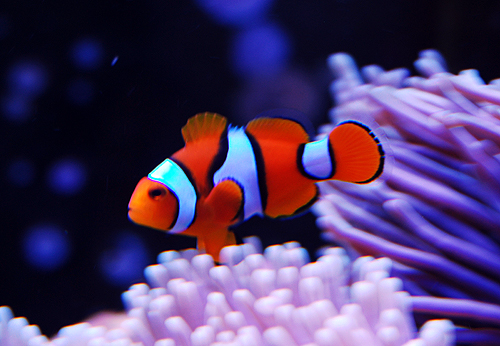 Orange ClownfishAmphiprion percula
-
 Clark's AnemonefishAmphiprion clarkii
-
 Tomato ClownfishAmphiprion frenatus
-
 Pink Skunk ClownfishAmphiprion perideraion
-
 Barrier Reef AnemonefishAmphiprion akindynos
-
 Red Sea ClownfishAmphiprion bicinctus
-
 Saddleback ClownfishAmphiprion polymnus
Compare
Questions and answers
What is the scientific name of the Australian Clownfish?
The scientific name of the Australian Clownfish is Amphiprion rubrocinctus. Written with its author, the full name is Amphiprion rubrocinctus Richardson, 1842.
Which family does the Australian Clownfish belong to?
Amphiprion rubrocinctus belongs to the family Pomacentridae, in the order Perciformes and the class Teleostei.
Where is the Australian Clownfish found?
Checklists and occurrence records place Amphiprion rubrocinctus in 2 countries: Australia and Fiji.
What is the conservation status of the Australian Clownfish?
The IUCN Red List category recorded for Amphiprion rubrocinctus is Least Concern (LC).
What other names does the Australian Clownfish have?
Amphiprion rubrocinctus is also known in English as Australian Anemonefish, Northwest Anemonefish, Red Anemonefish and Redgirdled Anemonefish.
What kind of habitat do clownfish live in?
The Australian Clownfish inhabits tropical seas in northwestern Australia and is hosted by sea anemones, usually the bubble-tip anemone and also the giant carpet anemone.[3][5][6]
What is the diet of a clownfish?
The natural diet of the Australian Clownfish includes zooplankton.[7]
Sources
Passages the profile rests on
- The sides of this species are blackish or dark brown, while its snout, breast, belly and fins are red. Source passage: “The side of A. rubrocinctus has blackish or dark brown sides with red snout, breast, belly and fins.” — English Wikipedia
- This species has a single white head bar that is often poorly developed and lacks a pronounced black margin. Source passage: “it has a single white head bar that is often poorly developed and lacking a pronounced black margin.” — English Wikipedia
- This species inhabits tropical seas in northwestern Australia. Source passage: “A. rubrocinctus is only found in the tropical seas of north west Australia” — English Wikipedia
- This species occurs from Ningaloo Reef in Western Australia to Groote Eylandt in the Gulf of Carpentaria in the Northern Territory. Source passage: “from Ningaloo Reef, Western Australia, to Groote Eylandt in the Gulf of Carpentaria, Northern Territory.” — English Wikipedia
- This species is hosted by the bubble-tip anemone (Entacmaea quadricolor), which is its usual host. Source passage: “Entacmaea quadricolor Bubble-tip anemone (usually)” — English Wikipedia
- This species is also hosted by the giant carpet anemone (Stichodactyla gigantea). Source passage: “Stichodactyla gigantea giant carpet anemone” — English Wikipedia
- The natural diet of this species includes zooplankton. Source passage: “The fish's natural diet includes zooplankton.” — English Wikipedia
- This species forms a symbiotic mutualistic relationship with sea anemones and is unaffected by their host's stinging tentacles. Source passage: “Like all anemonefishes it forms a symbiotic mutualism with sea anemones and is unaffected by the stinging tentacles of the host anemone.” — English Wikipedia
- This species has a strict size-based dominance hierarchy in which females are largest, breeding males are second largest, and non-breeding males become progressively smaller. Source passage: “the female is largest, the breeding male is second largest, and the male non-breeders get progressively smaller as the hierarchy descends.” — English Wikipedia
- If the breeding female dies, the breeding male changes sex to female and the largest non-breeding male becomes the breeding male. Source passage: “the breeding male will change to female if the sole breeding female dies, with the largest non-breeder becomes the breeding male.” — English Wikipedia
- This species belongs to the tomato complex and shares similarities with other members of that group. Source passage: “A. rubrocinctus is included in the tomato complex and so has similarities with other species in this complex.” — English Wikipedia
- Amphiprion frenatus resembles this species, but males of A. frenatus are entirely bright red and females have a more vivid white head bar. Source passage: “A. frenatus is similar however males are entirely bright red and the white head bar is more vivid on females.” — English Wikipedia
- Amphiprion barberi was initially considered a geographic color variation of this species before being described as a separate species in 2008. Source passage: “A. barberi was originally thought to be a geographic color variation of A. rubrocinctus but was described as a separate species in 2008.” — English Wikipedia
- Amphiprion barberi differs from this species by lacking dark brown or black sides and having a geographically distinct distribution. Source passage: “A. barberi lacks the dark brown or black sides and is geographically distinct.” — English Wikipedia
- Amphiprion perideraion and Amphiprion sandaracinos can be distinguished from this species by their distinctive white dorsal-ridge stripes. Source passage: “A. perideraion and A. sandaracinos have a distinctive white stripe along the dorsal ridge” — English Wikipedia
- Amphiprion clarkii and Amphiprion ocellaris differ from this species by having three white bars each. Source passage: “A. clarkii and A. ocellaris each have 3 white bars.” — English Wikipedia
- This species has a relatively small geographic range, which is identified as an extinction-risk characteristic. Source passage: “A. rubrocinctus has only one of these characteristics, being a small geographic range” — English Wikipedia
- Its ability to use two different anemone hosts may reduce the extinction risk associated with extreme habitat specialisation. Source passage: “its ability to use two different anemone hosts may reduce the risk of extinction associated with extreme specialisation.” — English Wikipedia
- This species was not evaluated in the 2012 release of the IUCN Red List. Source passage: “This species was not evaluated in the 2012 release of the IUCN Red List.” — English Wikipedia
- The Northern Territory Department of Land Resource Management listed this species as being of least concern. Source passage: “The Northern Territory Department of Land Resource Management has listed the species as being of least concern.” — English Wikipedia
- The estimated protein content of this species is 19.4% by wet weight. Source passage: “Protein = 19.4 [18.2, 20.5] %;” — fishbase.se
- The estimated omega-3 content of this species is 0.195 grams per 100 grams of wet weight. Source passage: “Omega3 = 0.195 [0.106, 0.352] g/100g;” — fishbase.se
- The estimated calcium content of this species is 75.4 milligrams per 100 grams of wet weight. Source passage: “Calcium = 75.4 [28.8, 146.2] mg/100g;” — fishbase.se
- The estimated iron content of this species is 0.816 milligrams per 100 grams of wet weight. Source passage: “Iron = 0.816 [0.454, 1.436] mg/100g;” — fishbase.se
- The estimated selenium content of this species is 8.23 micrograms per 100 grams of wet weight. Source passage: “Selenium = 8.23 [3.91, 18.08] μg/100g;” — fishbase.se
- The estimated vitamin A content of this species is 78.7 micrograms per 100 grams of wet weight. Source passage: “VitaminA = 78.7 [22.7, 270.1] μg/100g;” — fishbase.se
- The estimated zinc content of this species is 1.44 milligrams per 100 grams of wet weight. Source passage: “Zinc = 1.44 [0.90, 2.24] mg/100g (wet weight);” — fishbase.se
Data
- Catalogue of Life, 2026-10-16 XR cc by
- Global Biodiversity Information Facility CC BY 4.0
- Wikidata CC0
- GeoNames CC BY 4.0
- Wikimedia Commons per image; credit shown with each image
- Within the Catalogue of Life, this name comes from World Register of Marine Species cc by
References
- Richardson, J. (1842). Contributions to the ichthyology of Australia. [Continued from p. 218.]. Annals and Magazine of Natural History (New Series), v. 9 (no. 59) (art. 42): 384–393. where the name was published
This species in other databases
- Catalogue of Life D56D
- Wikidata Q783203
- iNaturalist 117751
- WoRMS urn:lsid:marinespecies.org:taxname:278404
- ITIS 615208
Page built on 27 November 2026. See how the catalog is made and all sources and licences.
Cite this page
ScientificNames.org. (2026). Amphiprion rubrocinctus (Australian Clownfish). Retrieved November 27, 2026, from https://scientificnames.org/species/amphiprion-rubrocinctus
“Amphiprion rubrocinctus (Australian Clownfish).” ScientificNames.org, 2026, scientificnames.org/species/amphiprion-rubrocinctus. Accessed 27 Nov. 2026.
ScientificNames.org. “Amphiprion rubrocinctus (Australian Clownfish).” Accessed November 27, 2026. https://scientificnames.org/species/amphiprion-rubrocinctus.
@misc{scientificnames_amphiprion_rubrocinctus_australian_clownfish,
  author = {{ScientificNames.org}},
  title = {Amphiprion rubrocinctus (Australian Clownfish)},
  year = {2026},
  url = {https://scientificnames.org/species/amphiprion-rubrocinctus},
  note = {Accessed 2026-11-27}
}