Species · Fishes
Sebae Clownfish Amphiprion sebae
The scientific name of the Sebae Clownfish is Amphiprion sebae. It is a species of fish in the family Pomacentridae (damselfishes), order Perciformes. The name dates from 1853.
- Scientific name
- Amphiprion sebae Bleeker, 1853
- Common name
- Sebae Clownfish
- Genus
- Amphiprion
- Family
- Pomacentridae (Damselfishes)
- Order
- Perciformes
- Class
- Teleostei
- Red List category
- LC Least Concern
- Environment
- marine
- Recorded in
- 8 countries
- Name status
- accepted in the Catalogue of Life

Overview
Amphiprion sebae occurs in the northern Indian Ocean, extending from Java to the Arabian Peninsula. It is characterized by two broad white body bars, a yellow or orange tail, and a blackish or dark brown body.
Written 26 November 2026 from the sources listed below. Each statement was checked against the passage it cites; statements that could not be supported were removed.
Appearance
The body is blackish or dark brown, with a yellow snout, breast, and belly. Two broad white bars cross the body, with the middle bar angled backwards, and the tail is yellow or orange.[1][2][3]
The species has 10–11 dorsal spines, 2 anal spines, 14–17 dorsal soft rays, and 13–14 anal soft rays. It can reach a maximum reported length of 14 centimetres.[4][5][6]
A melanistic variation occurs in which the fish lacks its yellow snout, breast, and belly.[7]
Habitat
The Sebae Clownfish typically lives in association with sea anemones and is normally associated with the saddle anemone, Stichodactyla haddoni. Stichodactyla haddoni is a documented host anemone of the species.[8][9][10]
Behaviour
The species has a symbiotic relationship with its host anemone and is unaffected by the anemone's stinging tentacles.[11]
Individuals participate in a strict dominance hierarchy in which the largest fish is female.[12]
Reproduction and life cycle
Reproduction involves external fertilization by a male and a female. The species exhibits sequential hermaphroditism, changing from male to female.[13][14]
In captive breeding observations, the male begins courting the female approximately one week before spawning and initiates maintenance of the selected nesting site. The female enters the nest to deposit her eggs.[15][16][17]
A spawning event produces approximately 300–600 eggs, which the male usually guards. The eggs hatch approximately six to eight days after being laid.[18][19][20]
Newly fertilized eggs are transparent and contain oil droplets, while mature eggs develop a bright yellow to orange coloration. The eggs measure approximately 1.7–2.6 mm in length and 0.8–1.3 mm in width.[21][22][23]
After hatching, the larvae have small yolk sacs. They begin feeding and undergo a change in body shape between the third and fourth day of development.[24][25]
Larvae enter metamorphosis between days fifteen and eighteen of their life cycle.[26]
Conservation
The species was assessed for the IUCN Red List in 2021.[27]
Similar species
Amphiprion polymnus is similar in appearance to the Sebae Clownfish but can be distinguished by a characteristic black or dark wedge-shaped marking on its tail.[28][29]
The Sebae Clownfish has sometimes been incorrectly labeled as Amphiprion clarkii in the aquarium trade. Amphiprion clarkii lacks the characteristic sloping middle body bar found in the Sebae Clownfish.[30][31]
Classification of the Sebae Clownfish
| Kingdom | Animalia |
|---|---|
| Phylum | Chordata |
| Subphylum | Vertebrata |
| Infraphylum | Gnathostomata |
| Parvphylum | Osteichthyes |
| Gigaclass | Actinopterygii |
| Superclass | Actinopteri |
| Class | Teleostei (Teleost) |
| Order | Perciformes |
| Family | Pomacentridae (Damselfishes) |
| Subfamily | Amphiprioninae |
| Genus | Amphiprion (Clownfish) |
| Species | Amphiprion sebae Bleeker, 1853 |
Where the Sebae Clownfish is found
Checklists and occurrence records place Amphiprion sebae in 8 countries. GBIF holds 138 georeferenced records of it.
Countries
Regions and cities with the most records
- Trincomalee, Sri Lanka 7
- Utan, Indonesia 7
- Jakarta, Indonesia 6
- Amlapura, Indonesia 5
- Amlapura city, Indonesia 5
- Bedugul, Indonesia 5
A number beside a place is its count of GBIF occurrence records. A place without a number comes from a checklist alone. Records show where a species has been observed or collected, which can include escapes and vagrants.
Common names
English
- Sebae Clownfish
- Sebae Anemonefish
- Brown Clownfish
- Sebae Clown
- Yellowtail Clownfish
- Yellowtailed Anemonefish
Names in 10 other languages
- Catalan
- Peix pallasso del golf
- Chinese
- 雙帶雙鋸魚
- Czech
- klaun zlatoploutvý
- French
- Poisson-clown javanais
- German
- Goldschwanz-Anemonenfisch
- Italian
- Pesce pagliaccio di Seba
- Portuguese
- Peixe-palhaço-de-Java
- Russian
- Яванский амфиприон
- Spanish
- Pez Payaso de Seba
- Thai
- ปลาการ์ตูนลายปล้องหางเหลือง, ปลาการ์ตูนสองบั้ง
Related species
-
 Ocellaris ClownfishAmphiprion ocellaris
-
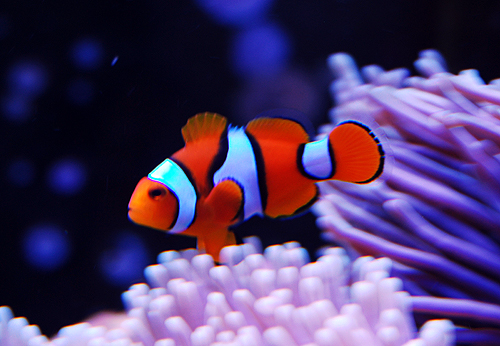 Orange ClownfishAmphiprion percula
-
 Clark's AnemonefishAmphiprion clarkii
-
 Tomato ClownfishAmphiprion frenatus
-
 Pink Skunk ClownfishAmphiprion perideraion
-
 Barrier Reef AnemonefishAmphiprion akindynos
-
 Red Sea ClownfishAmphiprion bicinctus
-
 Saddleback ClownfishAmphiprion polymnus
Compare
Questions and answers
What is the scientific name of the Sebae Clownfish?
The scientific name of the Sebae Clownfish is Amphiprion sebae. Written with its author, the full name is Amphiprion sebae Bleeker, 1853.
Which family does the Sebae Clownfish belong to?
Amphiprion sebae belongs to the family Pomacentridae, in the order Perciformes and the class Teleostei.
Where is the Sebae Clownfish found?
Checklists and occurrence records place Amphiprion sebae in 8 countries, including Indonesia, India, Thailand, Vietnam, Philippines and Sri Lanka.
What is the conservation status of the Sebae Clownfish?
The IUCN Red List category recorded for Amphiprion sebae is Least Concern (LC).
What other names does the Sebae Clownfish have?
Amphiprion sebae is also known in English as Sebae Anemonefish, Brown Clownfish, Sebae Clown, Yellowtail Clownfish and Yellowtailed Anemonefish.
What kind of habitat do clownfish live in?
The Sebae Clownfish typically lives in association with sea anemones and is normally associated with the saddle anemone, Stichodactyla haddoni.[8][9][10]
Why won't anemones eat clownfish?
The Sebae Clownfish has a symbiotic relationship with its host anemone and is unaffected by the anemone's stinging tentacles.[11]
Sources
Passages the profile rests on
- The body is blackish or dark brown, with a yellow snout, breast, and belly. Source passage: “The body of A. sebae is blackish or dark brown with a yellow snout, breast and belly.” — English Wikipedia
- The fish has two broad white body bars, with the middle bar angled backwards. Source passage: “It has two broad white bars., with the mid-body bar angled backwards.” — English Wikipedia
- Its tail is yellow or orange. Source passage: “The tail is yellow or orange.” — English Wikipedia
- The species has 10–11 dorsal spines and 2 anal spines. Source passage: “They have 10–11 dorsal spines, 2 anal spines,” — English Wikipedia
- The species has 14–17 dorsal soft rays and 13–14 anal soft rays. Source passage: “14–17 dorsal soft rays and 13–14 anal soft rays.” — English Wikipedia
- The species can reach a maximum reported length of 14 centimetres. Source passage: “They can grow to 14 centimetres (5.5 in).” — English Wikipedia
- A melanistic variation occurs in which the fish lacks its yellow snout, breast, and belly. Source passage: “There is a melantistic variation where the fish lacks the yellow snout, breast and belly.” — English Wikipedia
- The species typically lives in association with sea anemones. Source passage: “Like all anemonefish it is usually found living in association with sea anemones.” — English Wikipedia
- The species is normally associated with the saddle anemone, Stichodactyla haddoni. Source passage: “it is normally found with the Stichodactyla haddoni or saddle anemone.” — English Wikipedia
- Stichodactyla haddoni is a documented host anemone of this species. Source passage: “A. sebae is associated with the following species of anemone: Stichodactyla haddoni” — English Wikipedia
- The species has a symbiotic relationship with its host anemone and is unaffected by the anemone's stinging tentacles. Source passage: “A. sebae, like all anemonefish, lives in a symbiotic relationship with the host anemone where the fish is unaffected by the stinging tentacles of the anemone.” — English Wikipedia
- Individuals participate in a strict dominance hierarchy in which the largest fish is female. Source passage: “Clownfish are sequential hermaphrodites, changing from male to female, with a strict dominance hierarchy and only the largest fish being female.” — English Wikipedia
- Reproduction in the species involves external fertilization by a male and a female. Source passage: “Only two clownfish, a male and a female, in a group reproduce through external fertilization.” — English Wikipedia
- The species exhibits sequential hermaphroditism, changing from male to female. Source passage: “Clownfish are sequential hermaphrodites, changing from male to female,” — English Wikipedia
- In captive breeding observations, the male begins courting the female approximately one week before spawning. Source passage: “The male starts courting the female a week before they spawn.” — English Wikipedia
- The male initiates maintenance of the selected nesting site. Source passage: “The male initiates maintenance of the site chosen for habitation.” — English Wikipedia
- The female enters the nest to deposit her eggs. Source passage: “The female enters the nest to lay her eggs.” — English Wikipedia
- A spawning event produces approximately 300–600 eggs. Source passage: “About 300 to 600 eggs are laid.” — English Wikipedia
- The male usually guards the eggs. Source passage: “The males usually guard the eggs,” — English Wikipedia
- The eggs hatch approximately six to eight days after being laid. Source passage: “which hatch after six to eight days.” — English Wikipedia
- Newly fertilized eggs are transparent and contain oil droplets. Source passage: “When A. sebae eggs are recently fertilized, they are transparent (yellow/clear) with oil droplets.” — English Wikipedia
- Mature eggs develop a bright yellow to orange coloration. Source passage: “Amphiprion sebae eggs mature, they become bright yellow to orange color,” — English Wikipedia
- The eggs measure approximately 1.7–2.6 mm in length and 0.8–1.3 mm in width. Source passage: “the size of the eggs can range from length: 1.7- 2.6 mm and width: 0.8-1.3 mm.” — English Wikipedia
- The larvae have small yolk sacs after hatching. Source passage: “The yolk sacs of the larvae were small.” — English Wikipedia
- Larvae begin feeding and undergo a change in body shape between the third and fourth day of development. Source passage: “Between the third and fourth day they fed and their body shape changed.” — English Wikipedia
- Larvae enter metamorphosis between days fifteen and eighteen of their life cycle. Source passage: “On days fifteen to eighteen in their life cycle they enter metamorphosis.” — English Wikipedia
- The species was assessed for the IUCN Red List in 2021. Source passage: “Sebae Clownfish Amphiprion sebae has most recently been assessed for The IUCN Red List of Threatened Species in 2021.” — iucnredlist.org
- Amphiprion polymnus is similar in appearance to Amphiprion sebae. Source passage: “A. polymnus (Saddleback anemonefish) is similar,” — English Wikipedia
- Amphiprion polymnus can be distinguished by a characteristic black or dark wedge-shaped marking on its tail. Source passage: “but can be distinguished by its characteristic black or dark wedge shape on the tail.” — English Wikipedia
- Amphiprion sebae has sometimes been incorrectly labeled as Amphiprion clarkii in the aquarium trade. Source passage: “There are reports of A. sabae being incorrectly labeled in the aquarium trade as A. clarkii,” — English Wikipedia
- Amphiprion clarkii lacks the characteristic sloping middle body bar found in Amphiprion sebae. Source passage: “A. clarkii lacks the characteristic sloping mid-band.” — English Wikipedia
Data
- Catalogue of Life, 2026-10-16 XR cc by
- Global Biodiversity Information Facility CC BY 4.0
- Wikidata CC0
- GeoNames CC BY 4.0
- Wikimedia Commons per image; credit shown with each image
- Within the Catalogue of Life, this name comes from World Register of Marine Species cc by
References
- Bleeker, P. (1853). Diagnostische beschrijvingen van nieuwe of weinig bekende vischsoorten van Batavia. Tiental I-VI. Natuurkundig Tijdschrift Voor Nederlandsch Indië, v. 4 (no. 3): 451–516. where the name was published
This species in other databases
- Catalogue of Life D56J
- Wikidata Q1073281
- iNaturalist 180382
- WoRMS urn:lsid:marinespecies.org:taxname:212772
- ITIS 170147
Page built on 27 November 2026. See how the catalog is made and all sources and licences.
Cite this page
ScientificNames.org. (2026). Amphiprion sebae (Sebae Clownfish). Retrieved November 27, 2026, from https://scientificnames.org/species/amphiprion-sebae
“Amphiprion sebae (Sebae Clownfish).” ScientificNames.org, 2026, scientificnames.org/species/amphiprion-sebae. Accessed 27 Nov. 2026.
ScientificNames.org. “Amphiprion sebae (Sebae Clownfish).” Accessed November 27, 2026. https://scientificnames.org/species/amphiprion-sebae.
@misc{scientificnames_amphiprion_sebae_sebae_clownfish,
  author = {{ScientificNames.org}},
  title = {Amphiprion sebae (Sebae Clownfish)},
  year = {2026},
  url = {https://scientificnames.org/species/amphiprion-sebae},
  note = {Accessed 2026-11-27}
}