Species · Birds
White-cheeked Partridge Arborophila atrogularis
The scientific name of the White-cheeked Partridge is Arborophila atrogularis. It is a species of bird in the family Phasianidae (quail), order Galliformes. The name dates from 1849.
- Scientific name
- Arborophila atrogularis (Blyth, 1849)
- Common name
- White-cheeked Partridge
- Genus
- Arborophila
- Family
- Phasianidae (Quail)
- Order
- Galliformes
- Class
- Aves
- Red List category
- LC Least Concern
- Recorded in
- 5 countries
- Name status
- accepted in the Catalogue of Life

Overview
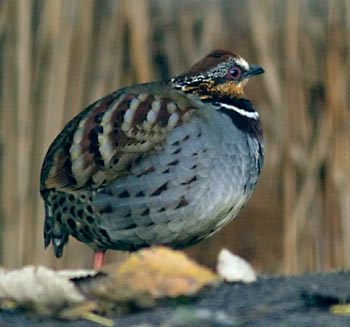
The White-cheeked Partridge (Arborophila atrogularis) is a bird in the Phasianidae family, order Galliformes and class Aves. It occurs mainly in Northeast India, northern Myanmar and northeast Bangladesh. It has gray-brown plumage and a bright white cheek patch.
Written 26 November 2026 from the sources listed below. Each statement was checked against the passage it cites; statements that could not be supported were removed.
Appearance
The White-cheeked Partridge has gray-brown plumage and a bright white cheek patch.[1]
Habitat
The species inhabits dense undergrowth in primary and secondary evergreen forests. Its habitat sometimes includes scrub, bamboo, grassland and cultivated land adjoining forests.[2][3]
In India, it generally occurs at elevations below 750 metres. In Southeast Asia, it may occur at elevations reaching 1,220 metres.[4][5]
Behaviour
The White-cheeked Partridge is shy and is seldom observed in open areas.[6]
Conservation
The White-cheeked Partridge is classified as Least Concern by the IUCN. It was most recently assessed for the IUCN Red List in 2023.[7][8]
Its population size is unknown and its population is believed to be decreasing. The species is threatened by habitat loss and hunting.[9][10][11]
Classification of the White-cheeked Partridge
| Kingdom | Animalia |
|---|---|
| Phylum | Chordata |
| Subphylum | Vertebrata |
| Infraphylum | Gnathostomata |
| Parvphylum | Osteichthyes |
| Megaclass | Tetrapoda |
| Class | Aves (Bird) |
| Order | Galliformes (Fowls) |
| Family | Phasianidae (Quail) |
| Genus | Arborophila (Hill-Partridges) |
| Species | Arborophila atrogularis (Blyth, 1849) |
Where the White-cheeked Partridge is found
Checklists and occurrence records place Arborophila atrogularis in 5 countries across Asia. GBIF holds 2,050 georeferenced records of it.
Countries
Regions and cities with the most records
- Assam, India 874
- Digboi, India 533
- Margherita, India 526
- Nahorkatiya, India 516
- Duliajan, India 514
- Duliajan Oil Town, India 513
- Mākum, India 274
- Arunachal Pradesh, India 230
- Meghalaya, India 182
- Nāmrup, India 144
- Yunnan, China 138
- Tura, India 132
- Mizoram, India 121
- Guwahati, India 119
- North Guwāhāti, India 119
- Kachin State, Myanmar 67
- Sylhet Division, Bangladesh 58
- Chittagong, Bangladesh 44
- Khowai, India 38
- Taranagar, India 36
- Bibir Hat, Bangladesh 27
- Tinsukia, India 21
- Sagaing Region, Myanmar 17
- Tripura, India 15
- Aizawl, India 14
- Shella, India 14
- Nagaland, India 12
- Dharmanagar, India 11
- Rangāpāra, India 11
- Belonia, India 9
- Nongpoh, India 9
- Chumukedima, India 8
- Dimāpur, India 8
- Dum Duma, India 8
- Kailāshahar, India 8
- Kuda, India 8
Range as the checklists state it
Southern Asia
A number beside a place is its count of GBIF occurrence records. A place without a number comes from a checklist alone. Records show where a species has been observed or collected, which can include escapes and vagrants.
Common names
English
- White-cheeked Partridge
- White-cheecked Hill Partridge
- White-cheeked Hill Partridge
Names in 32 other languages
- Arabic
- حجل أبيض الخدين, حجل التل أبيض الخدين
- Bengali
- সাদাচিবুক তিতির
- Burmese
- ပါးဖြူတောင်ခါ
- Catalan
- Perdiu boscana galtablanca, perdiu forestal emmascarada
- Chinese
- 白頰山鷓鴣, 白颊山鹧鸪
- Croatian
- crnogrla trčka
- Czech
- koroptev bělolící
- Danish
- Burma Skovhøne
- Dutch
- Witwangbospatrijs
- Esperanto
- Nigragorĝa perdriko, blankvanga perdriko
- Estonian
- mustkurk-künkakana
- Finnish
- valkoposkipyy
- French
- Torquéole à joues blanches
- German
- Weißwangen-Buschwachtel, Weißwangen-Waldrebhuhn, Weißwangenbuschwachtel, Weißwangenwaldrebhuhn
- Hindi
- सफ़ेद गाल वाला तीतर
- Italian
- Pernice guancebianche
- Japanese
- ノドグロミヤマテッケイ
- Lithuanian
- baltaskruostė krūmyninė kurapka
- Norwegian
- hvitskjegghøne
- Persian
- کبک گونهسفید
- Polish
- pstropiór czarnogardły
- Portuguese
- perdiz-de-faces-brancas, perdiz-montesa-de-bochechas-brancas
- Russian
- Белощёкая кустарниковая куропатка, Белощёкая лесная куропатка
- Serbian
- Jarebica belih obraza
- Slovak
- kurička bielolíca
- Spanish
- Arborófila cariblanca
- Swedish
- vitkindad sånghöna
- Turkish
- Ak Yanaklı Dağ Kekliği
- Ukrainian
- куріпка білощока
- Vietnamese
- Gà so má trắng
- Welsh
- petrisen fynydd fochwen
- pnb
- چٹے چیک آلا تتر
Synonyms
2 other scientific names have been used for this species and are now treated as synonyms of Arborophila atrogularis.
- Arboricola atrogularis Blyth, 1849
- Arborophila atrogularis atrogularis Blyth, E, 1849
Related species
-
 Hill PartridgeArborophila torqueola
-
 Red-billed PartridgeArborophila rubrirostris
-
 Rufous-throated PartridgeArborophila rufogularis
-
 Taiwan PartridgeArborophila crudigularis
-
 White-necklaced PartridgeArborophila gingica
-
 Bar-backed PartridgeArborophila brunneopectus
-
 Chestnut-breasted PartridgeArborophila mandellii
-
 Chestnut-bellied PartridgeArborophila javanica
Compare
Questions and answers
What is the scientific name of the White-cheeked Partridge?
The scientific name of the White-cheeked Partridge is Arborophila atrogularis. Written with its author, the full name is Arborophila atrogularis (Blyth, 1849).
Which family does the White-cheeked Partridge belong to?
Arborophila atrogularis belongs to the family Phasianidae, in the order Galliformes and the class Aves.
Where is the White-cheeked Partridge found?
Checklists and occurrence records place Arborophila atrogularis in 5 countries: India, China, Myanmar, Bangladesh and Bhutan.
What is the conservation status of the White-cheeked Partridge?
The IUCN Red List category recorded for Arborophila atrogularis is Least Concern (LC).
What other names does the White-cheeked Partridge have?
Arborophila atrogularis is also known in English as White-cheecked Hill Partridge and White-cheeked Hill Partridge.
How rare is it to see a partridge?
The White-cheeked Partridge is shy and is seldom observed in open areas.[6]
Sources
Passages the profile rests on
- The species has gray-brown plumage and a bright white cheek patch. Source passage: “a gray-brown partridge with a bright white cheek patch.” — ebird.org
- The species inhabits dense undergrowth in primary and secondary evergreen forests. Source passage: “inhabiting dense undergrowth in primary and secondary evergreen forest” — English Wikipedia
- Its habitat sometimes includes scrub, bamboo, grassland and cultivated land adjoining forests. Source passage: “this sometimes includes adjacent areas of scrub, bamboo, grassland and cultivated land.” — English Wikipedia
- In India, the species generally occurs at elevations below 750 metres. Source passage: “In India, the species occurs generally at altitudes below 750 m” — English Wikipedia
- In Southeast Asia, the species may occur at elevations reaching 1,220 metres. Source passage: “but may be found at up to 1,220 m in South-East Asia.” — English Wikipedia
- The species is shy and is seldom observed in open areas. Source passage: “shy and seldom seen out in the open” — ebird.org
- The species is classified as Least Concern by the IUCN. Source passage: “The white-cheeked partridge is currently classified as Least Concern by the IUCN.” — English Wikipedia
- The species was most recently assessed for the IUCN Red List in 2023. Source passage: “has most recently been assessed for The IUCN Red List of Threatened Species in 2023.” — iucnredlist.org
- The population size of the species is unknown. Source passage: “Population numbers are unknown” — English Wikipedia
- The species' population is believed to be decreasing. Source passage: “believed to be decreasing” — English Wikipedia
- The species is threatened by habitat loss and hunting. Source passage: “It is threatened habitat loss and hunting.” — English Wikipedia
Data
- Catalogue of Life, 2026-10-16 XR cc by
- Global Biodiversity Information Facility CC BY 4.0
- Wikidata CC0
- GeoNames CC BY 4.0
- Wikimedia Commons per image; credit shown with each image
- Within the Catalogue of Life, this name comes from The Integrated Taxonomic Information System cc0
References
- Dickinson, Edward C., ed. (2003). The Howard and Moore Complete Checklist of the Birds of the World, 3rd Edition.
- Gill, Frank, & and Minturn Wright. (2006). Birds of the World: Recommended English Names.
- Dickinson, E. C., and J. V. Remsen Jr., eds. (2013). The Howard and Moore Complete Checklist of the Birds of the World, 4th Edition, Vol. 1 Non-Passerines.
This species in other databases
Page built on 27 November 2026. See how the catalog is made and all sources and licences.
Cite this page
ScientificNames.org. (2026). Arborophila atrogularis (White-cheeked Partridge). Retrieved November 27, 2026, from https://scientificnames.org/species/arborophila-atrogularis
“Arborophila atrogularis (White-cheeked Partridge).” ScientificNames.org, 2026, scientificnames.org/species/arborophila-atrogularis. Accessed 27 Nov. 2026.
ScientificNames.org. “Arborophila atrogularis (White-cheeked Partridge).” Accessed November 27, 2026. https://scientificnames.org/species/arborophila-atrogularis.
@misc{scientificnames_arborophila_atrogularis_white_cheeked_partridge,
  author = {{ScientificNames.org}},
  title = {Arborophila atrogularis (White-cheeked Partridge)},
  year = {2026},
  url = {https://scientificnames.org/species/arborophila-atrogularis},
  note = {Accessed 2026-11-27}
}