Species · Birds
Orange-necked Partridge Arborophila davidi
The scientific name of the Orange-necked Partridge is Arborophila davidi. It is a species of bird in the family Phasianidae (quail), order Galliformes. The name dates from 1927.
- Scientific name
- Arborophila davidi Delacour, 1927
- Common name
- Orange-necked Partridge
- Genus
- Arborophila
- Family
- Phasianidae (Quail)
- Order
- Galliformes
- Class
- Aves
- Red List category
- NT Near Threatened
- Recorded in
- 2 countries
- Name status
- accepted in the Catalogue of Life

Overview
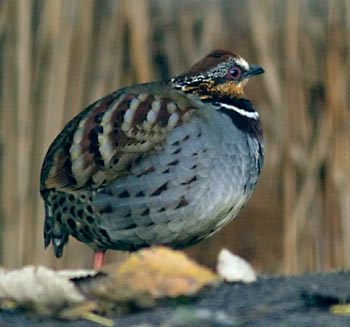
Arborophila davidi occurs in southern Vietnam and a small area of Mondulkiri in eastern Cambodia. It is a small, intricately patterned forest partridge with an orange throat, black breast band and black-and-white scalloped flank markings.
Written 26 November 2026 from the sources listed below. Each statement was checked against the passage it cites; statements that could not be supported were removed.
Appearance
The Orange-necked Partridge measures approximately 27 centimetres in length and weighs approximately 241 grams. It has brown eyes, a black beak and pinkish legs.[1][2][3]
The forehead and crown are dusky, while the nape is mottled brown. A black band extends from the beak to the sides of the neck, and a whitish band extends from the eye towards the neck before becoming orange.[4][5]
The chin is pale buff and the throat is rusty orange. The breast is olive-brown with a black band, while the belly is greyish and whitish and the flanks have black and white scalloped markings.[6][7][8][9]
The back and rump are olive-brown with dark brown bars. The wing coverts have black and grey bands.[10][11]
Habitat
The Orange-necked Partridge inhabits lowland forests, shrubland and plantations. It occupies hilly forests at elevations between 120 and 600 metres and prefers bamboo vegetation.[12][13]
The species also occurs in disturbed habitats, including scrubland, bamboo areas and logged plantations. All individuals recorded during a 2005 survey were located less than two kilometres from water.[14][15]
Behaviour
The species produces territorial calls consisting of repeated accelerating prruu notes that become higher-pitched pwi sounds, as well as rapid tu notes. During duets, one bird responds to the other with a series of tchew-tchew-tchew notes.[16][17]
Its alarm call consists of a pher or phu sound. Relatively little is known about the species' behaviour.[18][19]
Conservation
The IUCN assessed the Orange-necked Partridge as critically endangered before downlisting it to endangered in 2000 and near threatened in 2009. It was assessed as near threatened in the assessment described in the document.[20][21]
The species has an estimated population of nearly 10,000 individuals. Its population and geographical range are both small, and its population is declining, although the decline is considered probably not rapid.[22][23][24]
The species is threatened by logging, forest clearance and hunting. It appears to tolerate some degradation of its forest habitat.[25][26]
Uses
The Orange-necked Partridge appeared on a Vietnamese national stamp in 2000.[27]
Classification of the Orange-necked Partridge
| Kingdom | Animalia |
|---|---|
| Phylum | Chordata |
| Subphylum | Vertebrata |
| Infraphylum | Gnathostomata |
| Parvphylum | Osteichthyes |
| Megaclass | Tetrapoda |
| Class | Aves (Bird) |
| Order | Galliformes (Fowls) |
| Family | Phasianidae (Quail) |
| Genus | Arborophila (Hill-Partridges) |
| Species | Arborophila davidi Delacour, 1927 |
Where the Orange-necked Partridge is found
Checklists and occurrence records place Arborophila davidi in 2 countries across Asia. GBIF holds 497 georeferenced records of it.
Countries
Regions and cities with the most records
Range as the checklists state it
Southern Asia
A number beside a place is its count of GBIF occurrence records. A place without a number comes from a checklist alone. Records show where a species has been observed or collected, which can include escapes and vagrants.
Common names
English
- Orange-necked Partridge
- Orange-necked Hill Partridge
Names in 26 other languages
- Arabic
- حجل التل برتقالي العنق, حجل برتقالي العنق
- Catalan
- perdiu forestal de David
- Chinese
- 橙頸山鷓鴣, 橙颈山鹧鸪
- Croatian
- narančastogrla trčka
- Czech
- koroptev Davidova, koroptev vietnamská
- Danish
- Saigonskovhøne
- Dutch
- Davids Bospatrijs
- Esperanto
- oranĝkola perdriko
- Estonian
- valjas-künkakana
- Finnish
- oranssiniskapyy
- French
- Torquéole de David
- German
- David-Waldrebhuhn, Davidbuschwachtel, Davidwaldrebhuhn
- Italian
- Pernice colloarancio
- Japanese
- サイゴンミヤマテッケイ
- Lithuanian
- Davido krūmyninė kurapka
- Norwegian
- vietnamhøne
- Polish
- pstropiór wietnamski
- Portuguese
- perdiz-de-pescoço-laranja, perdiz-montesa-de-pescoço-laranja
- Russian
- Давидова кустарниковая куропатка, Оранжевогорлая лесная куропатка
- Serbian
- Jarebica narandžastog vrata
- Slovak
- kurička Davidova
- Spanish
- Arborófila de David
- Swedish
- davidsånghöna, vietnamsånghöna
- Turkish
- Kayısı Gerdanlı Dağ Kekliği
- Ukrainian
- куріпка в’єтнамська
- Welsh
- petrisen goed David
Related species
-
 Hill PartridgeArborophila torqueola
-
 Red-billed PartridgeArborophila rubrirostris
-
 Rufous-throated PartridgeArborophila rufogularis
-
 Taiwan PartridgeArborophila crudigularis
-
 White-necklaced PartridgeArborophila gingica
-
 Bar-backed PartridgeArborophila brunneopectus
-
 Chestnut-breasted PartridgeArborophila mandellii
-
 Chestnut-bellied PartridgeArborophila javanica
Compare
Questions and answers
What is the scientific name of the Orange-necked Partridge?
The scientific name of the Orange-necked Partridge is Arborophila davidi. Written with its author, the full name is Arborophila davidi Delacour, 1927.
Which family does the Orange-necked Partridge belong to?
Arborophila davidi belongs to the family Phasianidae, in the order Galliformes and the class Aves.
Where is the Orange-necked Partridge found?
Checklists and occurrence records place Arborophila davidi in 2 countries: Vietnam and Cambodia.
What is the conservation status of the Orange-necked Partridge?
The IUCN Red List category recorded for Arborophila davidi is Near Threatened (NT).
What other names does the Orange-necked Partridge have?
Arborophila davidi is also known in English as Orange-necked Hill Partridge.
How rare is it to see a partridge?
The Orange-necked Partridge has an estimated population of nearly 10,000 individuals. Its population and geographical range are both small, and its population is declining, although the decline is considered probably not rapid.[22][23][24]
What are the defining characteristics of a partridge bird?
The Orange-necked Partridge is a small, intricately patterned forest partridge. It has a rusty orange throat, a black breast band, olive-brown upperparts with dark brown bars, and black-and-white scalloped markings on its flanks.[6][7][9][10][28]
Sources
Passages the profile rests on
- The Orange-necked Partridge measures approximately 27 centimetres in length. Source passage: “The orange-necked partridge is about 27 cm (11 in) long” — English Wikipedia
- The species weighs approximately 241 grams. Source passage: “weighs about 241 g (8.5 oz).” — English Wikipedia
- The species has brown eyes, a black beak and pinkish legs. Source passage: “The eyes are brown, the beak is black, and the legs are pinkish.” — English Wikipedia
- The forehead and crown are dusky, while the nape is mottled brown. Source passage: “The forehead and crown are dusky, and the nape is mottled brown.” — English Wikipedia
- A black band extends from the beak to the sides of the neck, while a whitish band extends from the eye towards the neck and becomes orange. Source passage: “A black band extends from the beak to the sides of the neck, and a whitish band extends from the eye to the neck-sides, becoming orange.” — English Wikipedia
- The species has a black breast band. Source passage: “There is also a black breast-band.” — English Wikipedia
- Its chin is pale buff and its throat is rusty orange. Source passage: “The chin is pale buff, and the throat is rusty-orange.” — English Wikipedia
- The breast is olive-brown, while the belly is greyish and whitish. Source passage: “The breast is olive-brown, and the belly is greyish and whitish.” — English Wikipedia
- The flanks have black and white scalloped markings. Source passage: “The flanks have black and white scallops.” — English Wikipedia
- The back and rump are olive-brown with dark brown bars. Source passage: “The back and rump are olive-brown, with dark brown bars.” — English Wikipedia
- The wing coverts have black and grey bands. Source passage: “The wing coverts have black and grey bands.” — English Wikipedia
- The species inhabits lowland forests, shrubland and plantations. Source passage: “Its habitats are lowland forests, shrubland, and plantations.” — English Wikipedia
- The species occupies hilly forests at elevations between 120 and 600 metres and prefers bamboo vegetation. Source passage: “It lives in forest in hills at elevations of 120–600 m (390–1,970 ft), preferring bamboos.” — English Wikipedia
- The species also occurs in disturbed habitats such as scrubland, bamboo areas and logged plantations. Source passage: “It also occurs in some disturbed habitats, including scrubs, bamboos and logged plantations.” — English Wikipedia
- All individuals recorded during a 2005 survey were located less than two kilometres from water. Source passage: “All of the individuals recorded in a 2005 survey lived less than 2 km (1.2 mi) from water.” — English Wikipedia
- The species produces territorial calls consisting of repeated accelerating prruu notes that become higher-pitched pwi sounds, as well as rapid tu notes. Source passage: “The territorial calls are a repeated, accelerating prruu, becoming pwi at higher pitches, and also a series of fast tu notes.” — English Wikipedia
- During duets, one bird responds to the other with a series of tchew-tchew-tchew notes. Source passage: “In duets, the other bird responds with tchew-tchew-tchew.” — English Wikipedia
- The alarm call consists of a pher or phu sound. Source passage: “The alarm call is a pher or phu.” — English Wikipedia
- Relatively little is known about the species' behaviour. Source passage: “Little is known about this partridge's behaviour.” — English Wikipedia
- The IUCN assessed the species as critically endangered before downlisting it to endangered in 2000 and near threatened in 2009. Source passage: “The IUCN assessed it as a critically endangered species, downlisting to endangered in 2000 and to near threatened in 2009.” — English Wikipedia
- The species was assessed as near threatened in the assessment described in the document. Source passage: “so it is assessed as near threatened even though its population and range are both small.” — English Wikipedia
- The species has an estimated population of nearly 10,000 individuals. Source passage: “The population is estimated to be nearly 10,000.” — English Wikipedia
- The population is declining, although the decline is considered probably not rapid. Source passage: “The population is declining, but the decline is probably not rapid” — English Wikipedia
- The species' population and geographical range are both small. Source passage: “even though its population and range are both small.” — English Wikipedia
- The species is threatened by logging, forest clearance and hunting. Source passage: “It is threatened by logging, forest clearance and hunting.” — English Wikipedia
- The species appears to tolerate some degradation of its forest habitat. Source passage: “the bird seems to tolerate some forest degradation” — English Wikipedia
- The Orange-necked Partridge appeared on a Vietnamese national stamp in 2000. Source passage: “In 2000, the orange-necked partridge appeared on a national stamp of Vietnam.” — English Wikipedia
- The species is described as a small, intricately patterned forest partridge. Source passage: “Small, intricately patterned forest partridge” — ebird.org
Data
- Catalogue of Life, 2026-10-16 XR cc by
- Global Biodiversity Information Facility CC BY 4.0
- Wikidata CC0
- GeoNames CC BY 4.0
- Wikimedia Commons per image; credit shown with each image
- Within the Catalogue of Life, this name comes from The Integrated Taxonomic Information System cc0
References
- Dickinson, Edward C., ed. (2003). The Howard and Moore Complete Checklist of the Birds of the World, 3rd Edition.
- Gill, Frank, & and Minturn Wright. (2006). Birds of the World: Recommended English Names.
- Dickinson, E. C., and J. V. Remsen Jr., eds. (2013). The Howard and Moore Complete Checklist of the Birds of the World, 4th Edition, Vol. 1 Non-Passerines.
This species in other databases
Page built on 27 November 2026. See how the catalog is made and all sources and licences.
Cite this page
ScientificNames.org. (2026). Arborophila davidi (Orange-necked Partridge). Retrieved November 27, 2026, from https://scientificnames.org/species/arborophila-davidi
“Arborophila davidi (Orange-necked Partridge).” ScientificNames.org, 2026, scientificnames.org/species/arborophila-davidi. Accessed 27 Nov. 2026.
ScientificNames.org. “Arborophila davidi (Orange-necked Partridge).” Accessed November 27, 2026. https://scientificnames.org/species/arborophila-davidi.
@misc{scientificnames_arborophila_davidi_orange_necked_partridge,
  author = {{ScientificNames.org}},
  title = {Arborophila davidi (Orange-necked Partridge)},
  year = {2026},
  url = {https://scientificnames.org/species/arborophila-davidi},
  note = {Accessed 2026-11-27}
}