Species · Birds
Sichuan Partridge Arborophila rufipectus
The scientific name of the Sichuan Partridge is Arborophila rufipectus. It is a species of bird in the family Phasianidae (quail), order Galliformes. The name dates from 1932.
- Scientific name
- Arborophila rufipectus Boulton, 1932
- Common name
- Sichuan Partridge
- Genus
- Arborophila
- Family
- Phasianidae (Quail)
- Order
- Galliformes
- Class
- Aves
- Red List category
- VU Vulnerable
- Recorded in
- 1 country
- Name status
- accepted in the Catalogue of Life

Overview
Arborophila rufipectus is endemic to China and occurs mainly in southern Sichuan Province, with records from northern Yunnan, including Laojun Mountain. It is an omnivorous forest-dwelling species that makes seasonal movements between elevations.
Written 26 November 2026 from the sources listed below. Each statement was checked against the passage it cites; statements that could not be supported were removed.
Habitat
The Sichuan Partridge inhabits temperate forest and subtropical evergreen and deciduous broadleaf forests in southwestern China. It uses elevations ranging from 1,100 to 2,250 metres above sea level.[1][2][3]
It prefers primary broadleaf forest and older planted secondary broadleaf forest over forests close to human activity. Its principal habitats, in descending order, are primary broadleaf forest, old replanted broadleaf forest, degraded forest and scrub.[4][5]
The species prefers forests with dense canopies and relatively open understories. It uses thick shrubs as roosting sites.[6][7]
In Laojunshan Nature Reserve, the species occurs in secondary broadleaf forest but not in settlements, coniferous plantations or farmland. It typically occurs at elevations of 1,400–1,800 metres and is commonly found on gently sloping ground near water sources.[8][9][10]
Diet
The Sichuan Partridge is omnivorous and consumes invertebrates, fruits, seeds and grassroots. Flies and other dipterans are the predominant animal-derived foods, while lepidopterans and spiders are also important.[11][12][13]
Fruits and seeds from Symplocos species contribute substantially to its diet. It also consumes fruits and seeds from Rubus, Celastrus, Holboellia and Actinidia species.[14][15][16][17][18]
The species commonly forages among withered leaves on the understory surface. It adjusts its diet according to food availability and its own needs.[19][20]
Behaviour
Sichuan Partridges undergo seasonal movements between different elevations. During the breeding season, they occupy elevations between 1,400 and 2,250 metres, while in winter they generally move below 1,400 metres.[21][22][23]
During postbreeding wandering from August to October, chicks gradually move away from their birthplace with their parents. Young birds separate from their parents in mid or late autumn and begin independent lives.[24][25]
Males are territorial and monogamous and guard their mates continuously after pairing. They remain away from females before mating and during incubation, but outside these periods they roost alongside females.[26][27][28][29]
Male Sichuan Partridges produce three types of monosyllabic calls associated with crowing, courtship and territorial defence.[30]
Reproduction and life cycle
The breeding season begins in late March. Hatching occurs from mid-May through mid-July.[31][32]
Females brood on the ground. During the initial two weeks of ground brooding, males sit near the ground before moving to roost elsewhere.[33][34]
Conservation
The Sichuan Partridge is classified as Endangered on the IUCN Red List and is nationally protected in China. Its small population and severely fragmented habitat contribute to its endangered classification.[35][36][37]
Habitat loss and hunting threaten the species. Livestock browsing, bamboo shoot collection and medicinal plant collection negatively affect its habitat.[38][39][40]
The National Forest Protection Programme prohibited deforestation in the region, particularly in the upper Yangtze. Protected reserves established since 1998 are considered capable of supporting a stable population.[41][42]
Planted broadleaf forests can develop characteristics resembling primary forest within 15–20 years.[43]
Classification of the Sichuan Partridge
| Kingdom | Animalia |
|---|---|
| Phylum | Chordata |
| Subphylum | Vertebrata |
| Infraphylum | Gnathostomata |
| Parvphylum | Osteichthyes |
| Megaclass | Tetrapoda |
| Class | Aves (Bird) |
| Order | Galliformes (Fowls) |
| Family | Phasianidae (Quail) |
| Genus | Arborophila (Hill-Partridges) |
| Species | Arborophila rufipectus Boulton, 1932 |
Where the Sichuan Partridge is found
Checklists and occurrence records place Arborophila rufipectus in 1 country across Asia. GBIF holds 393 georeferenced records of it.
Countries
Regions and cities with the most records
Range as the checklists state it
Southern Asia
A number beside a place is its count of GBIF occurrence records. A place without a number comes from a checklist alone. Records show where a species has been observed or collected, which can include escapes and vagrants.
Common names
English
- Sichuan Partridge
- Sichuan Hill Partridge
Names in 29 other languages
- Arabic
- حجل التل سيتشوان, حجل سيتشوان
- Catalan
- Perdiu boscana de Sichuan, perdiu forestal de Sichuan
- Chinese
- 四川山鷓鴣, 四川山鹧鸪
- Croatian
- sečuanska trčka
- Czech
- koroptev hnědoprsá
- Danish
- Sichuanskovhøne
- Dutch
- Boultons Bospatrijs
- Esperanto
- Rufabrusta perdriko, siĉŭana perdriko
- Estonian
- sichuani künkakana
- Finnish
- sichuaninpyy
- French
- Torquéole de Boulton
- German
- Boultonbuschwachtel, Rostbrust-Waldrebhuhn, Sichuanbuschwachtel, Sichuanwaldrebhuhn
- Italian
- Pernice del Sichuan
- Japanese
- シセンミヤマテッケイ
- Latvian
- Sičuaņas irbīte
- Lithuanian
- sičuaninė krūmyninė kurapka
- Norwegian
- sichuanhøne
- Persian
- کبک سیچوان
- Polish
- pstropiór syczuański
- Portuguese
- perdiz-de-sujuão, perdiz-do-sujuão, perdiz-montesa-de-peito-ruivo
- Russian
- Сычуаньская кустарниковая куропатка, Сычуаньская лесная куропатка
- Serbian
- Sečuanska jarebica
- Slovak
- kurička hnedoprsá
- Spanish
- Arborófila de Sichuán
- Swedish
- sichuansånghöna
- Turkish
- Ak Boğazlı Dağ Kekliği
- Ukrainian
- куріпка сичуанська
- Vietnamese
- Gà so Tứ Xuyên
- Welsh
- petrisen fynydd Boulton
Related species
-
 Hill PartridgeArborophila torqueola
-
 Red-billed PartridgeArborophila rubrirostris
-
 Rufous-throated PartridgeArborophila rufogularis
-
 Taiwan PartridgeArborophila crudigularis
-
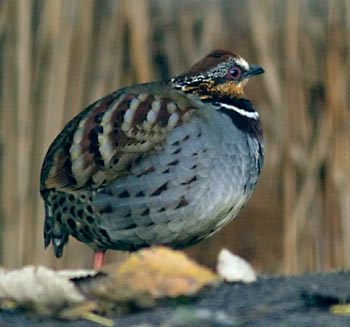 White-necklaced PartridgeArborophila gingica
-
 Bar-backed PartridgeArborophila brunneopectus
-
 Chestnut-breasted PartridgeArborophila mandellii
-
 Chestnut-bellied PartridgeArborophila javanica
Compare
Questions and answers
What is the scientific name of the Sichuan Partridge?
The scientific name of the Sichuan Partridge is Arborophila rufipectus. Written with its author, the full name is Arborophila rufipectus Boulton, 1932.
Which family does the Sichuan Partridge belong to?
Arborophila rufipectus belongs to the family Phasianidae, in the order Galliformes and the class Aves.
Where is the Sichuan Partridge found?
Checklists and occurrence records place Arborophila rufipectus in 1 country: China.
What is the conservation status of the Sichuan Partridge?
The IUCN Red List category recorded for Arborophila rufipectus is Vulnerable (VU).
What other names does the Sichuan Partridge have?
Arborophila rufipectus is also known in English as Sichuan Hill Partridge.
What is the Sichuan partridge?
The Sichuan Partridge (Arborophila rufipectus Boulton, 1932) is a bird in the family Phasianidae, order Galliformes and class Aves. It is endemic to China.[44]
Sources
Passages the profile rests on
- The species inhabits temperate forest. Source passage: “Its natural habitat is temperate forest.” — English Wikipedia
- The species inhabits subtropical evergreen and deciduous broadleaf forests in southwestern China. Source passage: “This endemic species inhabits subtropical evergreen and deciduous broadleaf forests at 1,100–2,250 m above sea level in southwest China” — pmc.ncbi.nlm.nih.gov
- The species inhabits forests at elevations ranging from 1,100 to 2,250 metres above sea level. Source passage: “at 1,100–2,250 m above sea level in southwest China” — pmc.ncbi.nlm.nih.gov
- The species prefers primary broadleaf forest and older planted secondary broadleaf forest over forests close to human activity. Source passage: “It prefers primary and older planted secondary broadleaf forest, rather than one with human activity close by.” — English Wikipedia
- The principal habitats used by the species, in descending order, are primary broadleaf forest, old replanted broadleaf forest, degraded forest and scrub. Source passage: “The major habitats (in ranking order) are Primary Broadleaf Forest, old replanted Broadleaf Forest, Degraded Forest, and scrub.” — English Wikipedia
- The species prefers forests with dense canopies and relatively open understories. Source passage: “Prefers a dense canopy and more open understory.” — English Wikipedia
- The species uses thick shrubs as roosting sites. Source passage: “It prefers thick shrubs for roosting.” — English Wikipedia
- In Laojunshan Nature Reserve, the species occurs in secondary broadleaf forest but not in settlements, coniferous plantations or farmland. Source passage: “the species occurred in secondary broadleaf forest but not in settlements, coniferous plantations or farmland.” — English Wikipedia
- In Laojunshan Nature Reserve, the species typically occurs at elevations of 1,400–1,800 metres. Source passage: “birds typically occurred between 1400 and 1800m above sea level in the reserve” — English Wikipedia
- In Laojunshan Nature Reserve, the species is commonly found on gently sloping ground near water sources. Source passage: “mostly on gently sloping ground close to water sources.” — English Wikipedia
- The Sichuan partridge is omnivorous and consumes invertebrates, fruits, seeds and grassroots. Source passage: “its main feeds include invertebrates, fruits, seeds, and grassroots” — pmc.ncbi.nlm.nih.gov
- Flies and other dipterans are the predominant animal-derived foods in the species' diet. Source passage: “Preys from the dipteran order, followed by the lepidopteran and araneaen spp., were the predominant, animal-derived foods.” — pmc.ncbi.nlm.nih.gov
- Lepidopterans and spiders are additional important animal-derived foods for the species. Source passage: “followed by the lepidopteran and araneaen spp.” — pmc.ncbi.nlm.nih.gov
- Fruits and seeds from Symplocos species contribute substantially to the species' diet. Source passage: “Symplocos, Rubus, Celastrus, Holboellia, and Actinidia spp. supply a large abundance of fruits and seeds” — pmc.ncbi.nlm.nih.gov
- Rubus species provide fruits and seeds consumed by the Sichuan partridge. Source passage: “Symplocos, Rubus, Celastrus, Holboellia, and Actinidia spp. supply a large abundance of fruits and seeds” — pmc.ncbi.nlm.nih.gov
- Celastrus species provide fruits and seeds consumed by the Sichuan partridge. Source passage: “Symplocos, Rubus, Celastrus, Holboellia, and Actinidia spp. supply a large abundance of fruits and seeds” — pmc.ncbi.nlm.nih.gov
- Holboellia species provide fruits and seeds consumed by the Sichuan partridge. Source passage: “Symplocos, Rubus, Celastrus, Holboellia, and Actinidia spp. supply a large abundance of fruits and seeds” — pmc.ncbi.nlm.nih.gov
- Actinidia species provide fruits and seeds consumed by the Sichuan partridge. Source passage: “Symplocos, Rubus, Celastrus, Holboellia, and Actinidia spp. supply a large abundance of fruits and seeds” — pmc.ncbi.nlm.nih.gov
- The species commonly forages among withered leaves on the understory surface. Source passage: “Sichuan partridges often forage on the withered leaves of the understory surface layer” — pmc.ncbi.nlm.nih.gov
- The species adjusts its diet according to food availability and its own needs. Source passage: “suggesting that the Sichuan partridge can adjust their diet according to the availability of food resources and their own needs.” — pmc.ncbi.nlm.nih.gov
- Sichuan partridges undergo seasonal movements between different elevations. Source passage: “Prior investigations have shown that this bird undergoes seasonal altitudinal movement” — pmc.ncbi.nlm.nih.gov
- During the breeding season, the species occupies elevations between 1,400 and 2,250 metres. Source passage: “spending the breeding season (from March to July) at elevations of 1,400–2,250 m.” — pmc.ncbi.nlm.nih.gov
- During winter, the species moves to lower elevations, generally below 1,400 metres. Source passage: “They then migrate to lower elevations (generally <1,400 m) during the winter (from December to February of the next year).” — pmc.ncbi.nlm.nih.gov
- During postbreeding wandering from August to October, chicks gradually move away from their birthplace with their parents. Source passage: “The chicks gradually move far away from the birthplace with their parents in the following 2–3 months (postbreeding wandering, from August to October).” — pmc.ncbi.nlm.nih.gov
- Young birds separate from their parents in mid or late autumn and begin independent lives. Source passage: “In mid or late autumn, chicks are separated from their parents and start an independent life.” — pmc.ncbi.nlm.nih.gov
- Male Sichuan partridges are territorial and monogamous. Source passage: “Males are territorial and monogamous.” — English Wikipedia
- Males remain away from females before mating and during incubation. Source passage: “Males will stay away from the females before mating and during the incubation period.” — English Wikipedia
- Outside the periods before mating and during incubation, males roost alongside females. Source passage: “At all other times, males will roost alongside the females.” — English Wikipedia
- Males guard their mates continuously after pairing. Source passage: “Once paired, males will guard females 24 hours a day.” — English Wikipedia
- Male Sichuan partridges produce three types of monosyllabic calls associated with crowing, courtship and territorial defence. Source passage: “Males have three types of one-syllable call, which are a crowing call, courtship call, and preserving territory call.” — English Wikipedia
- The breeding season of the Sichuan partridge begins in late March. Source passage: “The breeding season is late March” — English Wikipedia
- Hatching occurs from mid-May through mid-July. Source passage: “the hatching season is mid-May through mid-July.” — English Wikipedia
- Female Sichuan partridges brood on the ground. Source passage: “While females are brooding on the ground” — English Wikipedia
- During the initial two weeks of ground brooding, males sit near the ground before moving to roost elsewhere. Source passage: “the males will sit near the ground for two weeks and then leave to roost elsewhere.” — English Wikipedia
- The Sichuan partridge is classified as Endangered on the IUCN Red List in the dietary study. Source passage: “It is classified as “Endangered” (EN) on the IUCN Red List” — pmc.ncbi.nlm.nih.gov
- The species is nationally protected in China. Source passage: “It is also listed as a nationally protected animal in China” — pmc.ncbi.nlm.nih.gov
- The species' small population and severely fragmented habitat contribute to its endangered classification. Source passage: “because of its small population and severely fragmented habitat” — pmc.ncbi.nlm.nih.gov
- Habitat loss threatens the Sichuan partridge. Source passage: “It is threatened by habitat loss.” — English Wikipedia
- Hunting is a significant threat to the Sichuan partridge population. Source passage: “Hunting is another large problem for the decrease of these partridges.” — English Wikipedia
- Livestock browsing, bamboo shoot collection and medicinal plant collection negatively affect the species' habitat. Source passage: “other factors including traditions of livestock browsing, bamboo shoot and medicinal plant collection all affect the habitat of this species.” — English Wikipedia
- The National Forest Protection Programme prohibited deforestation in the region, particularly in the upper Yangtze. Source passage: “deforestation became prohibited in this region especially stopping of deforestation in upper Yangtze.” — English Wikipedia
- Protected reserves established since 1998 are considered capable of supporting a stable population. Source passage: “These new reserves, which have been protected since 1998, are thought to allow a stable population of the Sichuan partridge.” — English Wikipedia
- Planted broadleaf forests can develop characteristics resembling primary forest within 15–20 years. Source passage: “within only 15-20 years the planted resembles a primary forest.” — English Wikipedia
- The Sichuan partridge is endemic to China. Source passage: “It is found only in China” — English Wikipedia
Data
- Catalogue of Life, 2026-10-16 XR cc by
- Global Biodiversity Information Facility CC BY 4.0
- Wikidata CC0
- GeoNames CC BY 4.0
- Wikimedia Commons per image; credit shown with each image
- Within the Catalogue of Life, this name comes from The Integrated Taxonomic Information System cc0
References
- Peters, & James Lee. (1934). Check-List of Birds of the World, Vol. 2.
- Dickinson, Edward C., ed. (2003). The Howard and Moore Complete Checklist of the Birds of the World, 3rd Edition.
- Gill, Frank, & and Minturn Wright. (2006). Birds of the World: Recommended English Names.
- Dickinson, E. C., and J. V. Remsen Jr., eds. (2013). The Howard and Moore Complete Checklist of the Birds of the World, 4th Edition, Vol. 1 Non-Passerines.
This species in other databases
Page built on 27 November 2026. See how the catalog is made and all sources and licences.
Cite this page
ScientificNames.org. (2026). Arborophila rufipectus (Sichuan Partridge). Retrieved November 27, 2026, from https://scientificnames.org/species/arborophila-rufipectus
“Arborophila rufipectus (Sichuan Partridge).” ScientificNames.org, 2026, scientificnames.org/species/arborophila-rufipectus. Accessed 27 Nov. 2026.
ScientificNames.org. “Arborophila rufipectus (Sichuan Partridge).” Accessed November 27, 2026. https://scientificnames.org/species/arborophila-rufipectus.
@misc{scientificnames_arborophila_rufipectus_sichuan_partridge,
  author = {{ScientificNames.org}},
  title = {Arborophila rufipectus (Sichuan Partridge)},
  year = {2026},
  url = {https://scientificnames.org/species/arborophila-rufipectus},
  note = {Accessed 2026-11-27}
}