Species · Fishes
Western Atlantic Seabream Archosargus rhomboidalis
The scientific name of the Western Atlantic Seabream is Archosargus rhomboidalis. It is a species of fish in the family Sparidae (porgies), order Perciformes. The name dates from 1758.
- Scientific name
- Archosargus rhomboidalis (Linnaeus, 1758)
- Common name
- Western Atlantic Seabream
- Genus
- Archosargus
- Family
- Sparidae (Porgies)
- Order
- Perciformes
- Class
- Teleostei
- Red List category
- LC Least Concern
- Environment
- brackish, marine
- Recorded in
- 19 countries
- Name status
- accepted in the Catalogue of Life

Overview
Archosargus rhomboidalis inhabits muddy and sandy bottoms, seagrass beds, and mangrove habitats, and sometimes occurs in brackish water. It has seven irregular golden stripes, a prominent black blotch above the pectoral fin, and orange-tinted fins.
Written 26 November 2026 from the sources listed below. Each statement was checked against the passage it cites; statements that could not be supported were removed.
Appearance
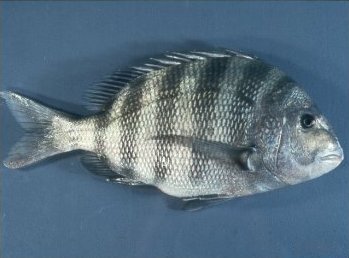
The Western Atlantic Seabream has an oval, somewhat laterally compressed body with a humped back. Its small, pointed head has asymmetrical convex profiles.[1][2]
Its back is light bluish and its underside is silvery white. A prominent black blotch occurs on the upper side above the pectoral fin, and its sides have seven irregular golden stripes.[3][4][5]
Its fins have an orange tint. The anal fin has three spines and nine to ten rays, with the second spine particularly strong.[6][7]
Its pectoral fins are substantially longer than its pelvic fins and reach the level of the second anal-fin spine. Its lateral line has 46–49 scales.[8][9]
Its cheeks and opercles are scaled, whereas its snout and the area between its eye and mouth lack scales. Vertical crossbars disappear as the fish ages.[10][11]
Males have partially or completely dark pelvic fins, whereas females have orange pelvic fins.[12]
Individuals usually grow to approximately 20 centimetres in length. The maximum published length is 33 centimetres, and the heaviest recorded individual weighed 0.55 kilograms.[13][14][15]
Habitat
The Western Atlantic Seabream inhabits muddy and sandy bottom environments, seagrass beds, and mangrove habitats. It is commonly found in mangrove swamps and over muddy or vegetated bottoms.[16][17][18]
It sometimes occurs in brackish water and is occasionally found over reefs near mangroves.[19][20]
Its documented range extends from waters off New Jersey and the northern Gulf of Mexico southward to Argentina. It occurs in other parts of the West Indies but is absent from the Bahamas.[21][22]
Diet
The Western Atlantic Seabream feeds mainly on small benthic invertebrates. Its documented food sources include bivalves, crustaceans, and aquatic plants.[23][24]
Uses
The Western Atlantic Seabream is consumed by people and has been described as a pan fish. It has not achieved the same popularity as a gamefish as its relative, the sheepshead.[25][26][27]
Similar species
The Western Atlantic Seabream resembles other members of its genus, including the sheepshead.[28]
Classification of the Western Atlantic Seabream
| Kingdom | Animalia |
|---|---|
| Phylum | Chordata |
| Subphylum | Vertebrata |
| Infraphylum | Gnathostomata |
| Parvphylum | Osteichthyes |
| Gigaclass | Actinopterygii |
| Superclass | Actinopteri |
| Class | Teleostei (Teleost) |
| Order | Perciformes |
| Suborder | Percoidei |
| Family | Sparidae (Porgies) |
| Genus | Archosargus (Sheepshead Porgies) |
| Species | Archosargus rhomboidalis (Linnaeus, 1758) |
Where the Western Atlantic Seabream is found
Checklists and occurrence records place Archosargus rhomboidalis in 19 countries. GBIF holds 1,466 georeferenced records of it.
Countries
- Belize 26
- Brazil 236
- Colombia 71
- Cuba 16
- Curacao 19
- French Guiana 3
- Guadeloupe 10
- Guatemala 14
- Haiti 3
- Honduras 11
- Jamaica 34
- Martinique 42
- Mexico 243
- Panama 41
- Puerto Rico 64
- Trinidad and Tobago 14
- U.S. Virgin Islands 10
- United States 581
- Venezuela 28
Regions and cities with the most records
- Florida, United States 152
- Sebastian, United States 131
- Little Havana, United States 56
- Miami, United States 56
- Allapattah, United States 55
- Key West, United States 55
- Miami Beach, United States 55
- Brownsville, United States 52
- West Little River, United States 51
- Pinewood, United States 50
- Coconut Grove, United States 49
- Coral Gables, United States 49
- Coral Terrace, United States 46
- Vero Beach South, United States 45
- Flagami, United States 44
- North Miami, United States 44
- Westchester, United States 44
- Glenvar Heights, United States 42
- Hialeah, United States 42
- Ducos, Martinique 41
- Kendall, United States 41
- Pinecrest, United States 41
- Palm Bay, United States 40
- Fort-de-France, Martinique 39
- Le Lamentin, Martinique 39
- Saint-Joseph, Martinique 39
- Cutler, United States 35
- Florida Ridge, United States 35
- Vero Beach, United States 33
- Golden Glades, United States 30
- Fort Pierce, United States 29
- Fountainebleau, United States 29
- Sunset, United States 29
- Ilha de Itamaracá, Brazil 25
- Melbourne, United States 25
- Pernambuco, Brazil 25
A number beside a place is its count of GBIF occurrence records. A place without a number comes from a checklist alone. Records show where a species has been observed or collected, which can include escapes and vagrants.
Common names
English
- Western Atlantic Seabream
- Brim
- Tropical Sheephead
- Sea Bream
Names in 7 other languages
- Chinese
- 菱羊鯛
- Czech
- mořan středoamerický
- French
- Rondeau brème, Rondeau des paturages
- Papiamento
- Briem
- Portuguese
- Caranha, Sargo-de-linhas-amarelas
- Russian
- Кагалона
- Spanish
- Bocayate, Chopa, Chopa Amarilla, Mojarra Amarilla, Mojarra Rayada, Sardo Rayado, Sargo, salema
Synonyms
4 other scientific names have been used for this species and are now treated as synonyms of Archosargus rhomboidalis.
- Archosargus unimaculatus (Bloch, 1792)
- Perca rhomboidalis Linnaeus, 1758
- Perca unimaculata Bloch, 1792
- Sargus unimaculatus Bloch, 1792
Related species
-
 SheepsheadArchosargus probatocephalus
-
 Blackspot PorgyArchosargus pourtalesii
-
 Gilt-head BreamSparus aurata
-
 BogueBoops boops
-
 Red Sea BreamPagrus major
-
 Salema PorgySarpa salpa
-
 White Sea BreamDiplodus sargus
-
 Red PorgyPagrus pagrus
Compare
Questions and answers
What is the scientific name of the Western Atlantic Seabream?
The scientific name of the Western Atlantic Seabream is Archosargus rhomboidalis. Written with its author, the full name is Archosargus rhomboidalis (Linnaeus, 1758).
Which family does the Western Atlantic Seabream belong to?
Archosargus rhomboidalis belongs to the family Sparidae, in the order Perciformes and the class Teleostei.
Where is the Western Atlantic Seabream found?
Checklists and occurrence records place Archosargus rhomboidalis in 19 countries, including United States, Mexico, Brazil, Colombia, Puerto Rico and Martinique.
What is the conservation status of the Western Atlantic Seabream?
The IUCN Red List category recorded for Archosargus rhomboidalis is Least Concern (LC).
What other names does the Western Atlantic Seabream have?
Archosargus rhomboidalis is also known in English as Brim, Tropical Sheephead and Sea Bream.
Sources
Passages the profile rests on
- The species has an oval, somewhat laterally compressed body with a humped back. Source passage: “Body oval, somewhat compressed, back humped” — biogeodb.stri.si.edu
- Its head is small and pointed, with asymmetrical convex profiles. Source passage: “head small, pointed, with asymetrical convex profiles” — biogeodb.stri.si.edu
- Its back is light bluish, while its underside is silvery white. Source passage: “Light bluish on back and silvery white below” — biogeodb.stri.si.edu
- A prominent black blotch occurs on the upper side above the pectoral fin. Source passage: “a prominent black blotch on upper side above pectoral fin” — biogeodb.stri.si.edu
- Its sides have seven irregular golden stripes. Source passage: “7 irregular golden stripes on side” — biogeodb.stri.si.edu
- Its fins have an orange tint. Source passage: “fins with an orange tint.” — biogeodb.stri.si.edu
- Its anal fin has three spines and nine to ten rays, with the second spine particularly strong. Source passage: “anal short, III, 9-10, second spine very strong” — biogeodb.stri.si.edu
- Its pectoral fins are substantially longer than its pelvic fins and reach the level of the second anal-fin spine. Source passage: “pectoral long, much longer than pelvic, reaching level of second anal spine” — biogeodb.stri.si.edu
- Its lateral line has 46–49 scales. Source passage: “lateral-line scales 46-49” — biogeodb.stri.si.edu
- Its cheeks and opercles are scaled, whereas its snout and the area between its eye and mouth lack scales. Source passage: “cheeks and opercles scaly, but no scales on snout or between the eye and mouth.” — biogeodb.stri.si.edu
- The species has vertical crossbars that disappear as it ages. Source passage: “It does have vertical crossbars, like the Sheepshead, but they disappear with age.” — English Wikipedia
- Males have partially or completely dark pelvic fins, whereas females have orange pelvic fins. Source passage: “in males, the fin is partially or totally dark, while in females it is an orange color.” — English Wikipedia
- The maximum published length of the species is 33 centimetres. Source passage: “The maximum published length of a Western Atlantic seabream is 33 centimetres (13 in)” — English Wikipedia
- Individuals usually grow to approximately 20 centimetres in length. Source passage: “though they usually grow to about 20 centimetres (7.9 in).” — English Wikipedia
- The heaviest recorded individual weighed 0.55 kilograms. Source passage: “The heaviest was recorded to weigh 0.55 kilograms (1.2 lb).” — English Wikipedia
- The species inhabits muddy and sandy bottom environments. Source passage: “Habitat: on mud and sand bottoms” — biogeodb.stri.si.edu
- It occurs in seagrass beds and mangrove habitats. Source passage: “in seagrass beds and mangroves” — biogeodb.stri.si.edu
- The species is commonly found in mangrove swamps and over muddy or vegetated bottoms. Source passage: “They are commonly found in mangrove swamps, and in muddy, or vegetated bottoms.” — English Wikipedia
- It sometimes occurs in brackish water. Source passage: “sometimes in brackish water.” — biogeodb.stri.si.edu
- It is occasionally found over reefs near mangroves. Source passage: “and over reefs near mangroves.” — English Wikipedia
- Its documented range extends from waters off New Jersey and the northern Gulf of Mexico southward to Argentina. Source passage: “known from waters off New Jersey and the northern Gulf of Mexico, south to Argentina.” — English Wikipedia
- The species is absent from the Bahamas despite occurring in other parts of the West Indies. Source passage: “they are not found near the Bahamas, though they are known from many other parts of the West Indies.” — English Wikipedia
- The species feeds mainly on small benthic invertebrates. Source passage: “Western Atlantic seabream feed mainly on small, benthic invertebrates” — English Wikipedia
- Its documented food sources include bivalves, crustaceans, and aquatic plants. Source passage: “such as bivalves, crustaceans and aquatic plants” — English Wikipedia
- The species is consumed by people. Source passage: “Although they are eaten” — English Wikipedia
- The species has been described as a pan fish. Source passage: “have been described as pan fish” — English Wikipedia
- The species has not achieved the same popularity as a gamefish as its relative, the sheepshead. Source passage: “Western Atlantic seabream have not gained the popularity as a gamefish that their relative, the sheepshead (A. probatocephalus) has.” — English Wikipedia
- The Western Atlantic seabream resembles other members of its genus, including the sheepshead. Source passage: “The Western Atlantic seabream is similar to other members of its genus, such as the sheepshead.” — English Wikipedia
Data
- Catalogue of Life, 2026-10-16 XR cc by
- Global Biodiversity Information Facility CC BY 4.0
- Wikidata CC0
- GeoNames CC BY 4.0
- Wikimedia Commons per image; credit shown with each image
- Within the Catalogue of Life, this name comes from World Register of Marine Species cc by
References
- Linnaeus, C. (1758) Systema Naturae per regna tria naturae, secundum classes, ordines, genera, species, cum characteribus, differentiis, synonymis, locis. Editio decima, reformata. Tomus I. Laurentii Salvii, Holmiae, (4) + 823 + (1) pp. https: // doi. org / 10.5962 / bhl. title. 542 where the name was published
This species in other databases
- Catalogue of Life 5W28G
- Wikidata Q2700401
- iNaturalist 132531
- WoRMS urn:lsid:marinespecies.org:taxname:159239
- ITIS 169190
Page built on 27 November 2026. See how the catalog is made and all sources and licences.
Cite this page
ScientificNames.org. (2026). Archosargus rhomboidalis (Western Atlantic Seabream). Retrieved November 27, 2026, from https://scientificnames.org/species/archosargus-rhomboidalis
“Archosargus rhomboidalis (Western Atlantic Seabream).” ScientificNames.org, 2026, scientificnames.org/species/archosargus-rhomboidalis. Accessed 27 Nov. 2026.
ScientificNames.org. “Archosargus rhomboidalis (Western Atlantic Seabream).” Accessed November 27, 2026. https://scientificnames.org/species/archosargus-rhomboidalis.
@misc{scientificnames_archosargus_rhomboidalis_western_atlantic_seabream,
  author = {{ScientificNames.org}},
  title = {Archosargus rhomboidalis (Western Atlantic Seabream)},
  year = {2026},
  url = {https://scientificnames.org/species/archosargus-rhomboidalis},
  note = {Accessed 2026-11-27}
}