Species · Reptiles
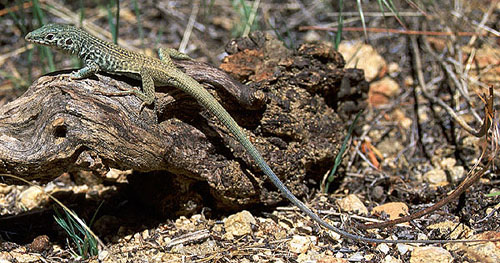
Yucatan Whiptail Aspidoscelis angusticeps
The scientific name of the Yucatan Whiptail is Aspidoscelis angusticeps. It is a species of reptile in the family Teiidae (tegus), order Squamata. The name dates from 1878.
- Scientific name
- Aspidoscelis angusticeps (Cope, 1878)
- Common name
- Yucatan Whiptail
- Genus
- Aspidoscelis
- Family
- Teiidae (Tegus)
- Order
- Squamata
- Class
- Reptilia
- Red List category
- LC Least Concern
- Recorded in
- 3 countries
- Name status
- accepted in the Catalogue of Life

Overview
Aspidoscelis angusticeps, the Yucatán whiptail, is a species of teiid lizard found in Mexico, Guatemala, and Belize.
Classification of the Yucatan Whiptail
| Kingdom | Animalia |
|---|---|
| Phylum | Chordata |
| Subphylum | Vertebrata |
| Infraphylum | Gnathostomata |
| Parvphylum | Osteichthyes |
| Megaclass | Tetrapoda |
| Class | Reptilia (Reptile) |
| Order | Squamata (Snakes) |
| Suborder | Autarchoglossa |
| Family | Teiidae (Tegus) |
| Genus | Aspidoscelis (North American Whiptails) |
| Species | Aspidoscelis angusticeps (Cope, 1878) |
Where the Yucatan Whiptail is found
Checklists and occurrence records place Aspidoscelis angusticeps in 3 countries across North America. GBIF holds 1,800 georeferenced records of it.
Countries
Regions and cities with the most records
- Yucatán, Mexico 1,205
- Chichén-Itzá, Mexico 375
- Quintana Roo, Mexico 181
- Campeche, Mexico 121
- Mérida, Mexico 119
- Kanasín, Mexico 107
- Motul, Mexico 95
- Tizimín, Mexico 86
- Progreso, Mexico 76
- Champotón, Mexico 60
- Valladolid, Mexico 56
- Umán, Mexico 32
- Belize District, Belize 20
- Felipe Carrillo Puerto, Mexico 18
- Petén, Guatemala 18
- Izamal, Mexico 14
- Hunucmá, Mexico 11
- Campeche, Mexico 9
- Cancún, Mexico 7
- Chetumal, Mexico 6
- Oxkutzkab, Mexico 5
- Oaxaca, Mexico 4
- Chiapas, Mexico 3
- Escárcega, Mexico 3
- Flores, Guatemala 3
- Orange Walk District, Belize 3
- San Benito, Guatemala 3
- Tecax, Mexico 3
- Ticul, Mexico 3
- Tulum, Mexico 3
Range as the checklists state it
Mexico (Yucatán, Quintana Roo, Campeche), Guatemala, Belize
A number beside a place is its count of GBIF occurrence records. A place without a number comes from a checklist alone. Records show where a species has been observed or collected, which can include escapes and vagrants.
Common names
English
- Yucatan Whiptail
- Black-bellied Racerunner
- Narrow-headed Whiptail
- Yucatán Whiptail
Names in 4 other languages
- Japanese
- ユカタンハシリトカゲ
- Portuguese
- Cauda-de-chicote-de-Yucatan
- Russian
- Узкоголовая хлыстохвостая ящерица
- Spanish
- Cuiji Yucateco, Huico yucateco
Synonyms
2 other scientific names have been used for this species and are now treated as synonyms of Aspidoscelis angusticeps.
- Cnemidophorus angusticeps Cope, 1878
- Cnemidophorus angusticeps petenensis Beargie & Mccoy, 1964
Subspecies and varieties
- Aspidoscelis angusticeps angusticeps (Narrowheaded Yucatán Whiptail) subspecies
- Aspidoscelis angusticeps petenensis (Peten Whiptail) subspecies
Related species
-
 New Mexico WhiptailAspidoscelis neomexicanus
-
 Desert Grassland Whiptail LizardAspidoscelis uniparens
-
 Six-lined RacerunnerAspidoscelis sexlineatus
-
 Western WhiptailAspidoscelis tigris
-
 Texas Spotted WhiptailAspidoscelis gularis
- Little Striped WhiptailAspidoscelis inornatus
-
 Chihuahuan Spotted WhiptailAspidoscelis exsanguis
-
 Plateau Striped WhiptailAspidoscelis velox
Compare
Questions and answers
What is the scientific name of the Yucatan Whiptail?
The scientific name of the Yucatan Whiptail is Aspidoscelis angusticeps. Written with its author, the full name is Aspidoscelis angusticeps (Cope, 1878).
Which family does the Yucatan Whiptail belong to?
Aspidoscelis angusticeps belongs to the family Teiidae, in the order Squamata and the class Reptilia.
Where is the Yucatan Whiptail found?
Checklists and occurrence records place Aspidoscelis angusticeps in 3 countries: Mexico, Belize and Guatemala.
What is the conservation status of the Yucatan Whiptail?
The IUCN Red List category recorded for Aspidoscelis angusticeps is Least Concern (LC).
What other names does the Yucatan Whiptail have?
Aspidoscelis angusticeps is also known in English as Black-bellied Racerunner, Narrow-headed Whiptail and Yucatán Whiptail.
Sources
Data
- Catalogue of Life, 2026-10-16 XR cc by
- Global Biodiversity Information Facility CC BY 4.0
- Wikidata CC0
- English Wikipedia CC BY-SA 4.0
- GeoNames CC BY 4.0
- Wikimedia Commons per image; credit shown with each image
- Within the Catalogue of Life, this name comes from The Reptile Database cc by
References
- Cope, E. D. (1878). Tenth contribution to the herpetology of Tropical America. Proc. Amer. Philos. Soc. 17: 85-98 [1877].
- Cope, E. D. (1892). A synopsis of the species of the teiid genus Cnemidophorus. Trans. Am. Phil. Soc. (Ser. 2) 17 (1): 27-52 [1893].
- Smith, Hobart M. (1939). Notes on Mexican reptiles and amphibians. Zoological Series of Field Museum of Natural History 24 (4): 15-35. Link
- Smith, H. M., & Taylor, E. H. (1950). An annotated checklist and key to the reptiles of Mexico exclusive of the snakes. Bull. US Natl. Mus. 199: 1-253.
- Duellman, W. E., & ZWEIFEL, R. G. (1962). A synopsis of the lizards of the sexlineatus group (genus Cnemidophorus). Bull. Amer. Mus. Nat. Hist. 123: 155-210.
- Stuart, L. C. (1963). A checklist of the herpetofauna of Guatemala. Misc. Publ. Mus. Zool., Univ. Michigan (No. 122): 1-150.
- Beargie, K., & McCoy, C. J. (1964). Variation and relationships of the teiid lizard Cnemidophorus angusticeps. Copeia 1964 (3): 561-570.
- Maslin, T., & Secoy, D. M. (1986). A checklist of the lizard genus Cnemidophorus (Teiidae). Contr. Zool. Univ. Colorado Mus. 1: 1-60.
- Moritz, Craig C.; Wright, John W.; Singh, V.; Brown, Wesley M. (1992). Mitochondrial DNA analysis and the origin and relative age of parthenogenetic Cnemidophorus. V. The cozumelae species group. Herpetologica 48 (4): 417-424.
- Lee, J. C. (1996). The amphibians and reptiles of the Yucatán Peninsula. Comstock, Cornell University Press, Ithaca, 500 Pp.
- Campbell, J. A. (1998). Amphibians and reptiles of northern Guatemala, the Yucatán, and Belize. Norman: University of Oklahoma Press, Xiii + 380 Pp.
- Köhler, G. (2000). Reptilien und Amphibien Mittelamerikas, Bd 1: Krokodile, Schildkröten, Echsen. Herpeton Verlag, Offenbach, 158 Pp.
- Lee, J. C. (2000). A field guide to the amphibians and reptiles of the Maya world. Cornell University Press, Ithaca,.
- REEDER, T.W.; CHARLES J. COLE AND HERBERT C. DESSAUER. (2002). Phylogenetic Relationships of Whiptail Lizards of the Genus Cnemidophorus (Squamata: Teiidae): A Test of Monophyly, Reevaluation of Karyotypic Evolution, and Review of Hybrid Origins. American Museum Novitates 3365: 1-64.
- Koller, & Rene. (2005). Herpetologoische waarnemingen in Belize, deel 2: reptielen. Lacerta 63 (1): 4-19.
- Köhler, G. (2008). Reptiles of Central America. 2nd Ed. Herpeton-Verlag, 400 Pp.
- Manríquez-Morán, Norma L., Fausto R. Méndez-de la Cruz, and Robert W. Murphy. (2014). Genetic Variation and Origin of Parthenogenesis in the Aspidoscelis cozumela Complex: Evidence from Mitochondrial Genes. Zoological Science 31, No. 1: 14-19.
- Taylor, Harry L.; Charles J. Cole, and Christopher R. Cooley. (2014). Origins and Evolution in the Aspidoscelis cozumela Complex of Parthenogenetic Teiid Lizards: Morphological and Karyotypic Evidence and Paradoxes. Journal of Herpetology Sep 2014, Vol. 48, No. 3: 343-354.
- Colston, Timothy J.; José António L. Barão-Nóbrega, Ryan Manders, Alice Lett, Jamie Wilmott, Gavin Cameron, Sidony Hunter, Adam Radage, Etienne Littlefair, Robert J. Williams, Antonio Lopez Cen, Kathy Slater. (2015). Amphibians and reptiles of the Calakmul Biosphere Reserve, México, with new records. Check List 11 (5): 1759.
- Nahuat-Cervera, & Pedro Enrique. (2020). Amphibians and reptiles of the Hobonil Educative Center, Tzucacab, Yucatán, Mexico. Rev. Latinoamer. Herp. 3 (1): 53-65.
- Aguilar-López JL, Luría-Manzano R, Pineda E, & Canseco-Márquez L. (2021). Selva Zoque, Mexico: an important Mesoamerican tropical region for reptile species diversity and conservation. ZooKeys 1054: 127-153.
- Badillo-Saldaña, L. M., Pineda, E., & Ramírez-Bautista, A. (2024). From tropical forest to agroecosystems: changes in functional and species diversity of lizards in Mexican Caribbean. Agroforest Syst (2024).
- Colston, Timothy J., Stacy Pirro, and R. Alexander Pyron. (2025). The Complete Genome Sequences of 101 Species of Reptiles. Biodiversity Genomes, February.
- Rojas-González, R. I., González-Tamay, E., Perera-Trejo, E. E., Mata-Silva, V., & Diaz-Ortega, I. E. (2026). Living on the Edge and the Mangrove Paradox: Herpetofaunal Diversity Across the Coastal Wetlands Communities of Los Petenes, Campeche, Mexico. Herpetological Conservation and Biology, 21(1), 240-254.
This species in other databases
Page built on 26 November 2026. See how the catalog is made and all sources and licences.
Cite this page
ScientificNames.org. (2026). Aspidoscelis angusticeps (Yucatan Whiptail). Retrieved November 26, 2026, from https://scientificnames.org/species/aspidoscelis-angusticeps
“Aspidoscelis angusticeps (Yucatan Whiptail).” ScientificNames.org, 2026, scientificnames.org/species/aspidoscelis-angusticeps. Accessed 26 Nov. 2026.
ScientificNames.org. “Aspidoscelis angusticeps (Yucatan Whiptail).” Accessed November 26, 2026. https://scientificnames.org/species/aspidoscelis-angusticeps.
@misc{scientificnames_aspidoscelis_angusticeps_yucatan_whiptail,
  author = {{ScientificNames.org}},
  title = {Aspidoscelis angusticeps (Yucatan Whiptail)},
  year = {2026},
  url = {https://scientificnames.org/species/aspidoscelis-angusticeps},
  note = {Accessed 2026-11-26}
}