Species · Reptiles
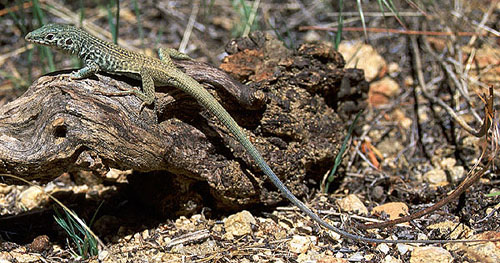
Plateau Striped Whiptail Aspidoscelis velox
The scientific name of the Plateau Striped Whiptail is Aspidoscelis velox. It is a species of reptile in the family Teiidae (tegus), order Squamata. The name dates from 1928.
- Scientific name
- Aspidoscelis velox (Springer, 1928)
- Common name
- Plateau Striped Whiptail
- Genus
- Aspidoscelis
- Family
- Teiidae (Tegus)
- Order
- Squamata
- Class
- Reptilia
- Red List category
- LC Least Concern
- Recorded in
- 2 countries
- Name status
- accepted in the Catalogue of Life

Overview
The Plateau Striped Whiptail is a teiid lizard in the family Teiidae, order Squamata, and class Reptilia. It occurs in Utah, Colorado, Arizona, and New Mexico in the United States. It was introduced to Cove Palisades State Park in Oregon by the 1960s, and the introduced population has persisted and expanded into surrounding areas.
Written 26 November 2026 from the sources listed below. Each statement was checked against the passage it cites; statements that could not be supported were removed.
Classification of the Plateau Striped Whiptail
| Kingdom | Animalia |
|---|---|
| Phylum | Chordata |
| Subphylum | Vertebrata |
| Infraphylum | Gnathostomata |
| Parvphylum | Osteichthyes |
| Megaclass | Tetrapoda |
| Class | Reptilia (Reptile) |
| Order | Squamata (Snakes) |
| Suborder | Autarchoglossa |
| Family | Teiidae (Tegus) |
| Genus | Aspidoscelis (North American Whiptails) |
| Species | Aspidoscelis velox (Springer, 1928) |
Where the Plateau Striped Whiptail is found
Checklists and occurrence records place Aspidoscelis velox in 2 countries. GBIF holds 4,493 georeferenced records of it.
Countries
Regions and cities with the most records
- New Mexico, United States 1,302
- Arizona, United States 1,084
- Utah, United States 620
- Colorado, United States 553
- Grand Junction, United States 159
- Santa Fe, United States 137
- Prescott, United States 134
- Clifton, United States 118
- Prescott Valley, United States 106
- Flagstaff, United States 68
- Albuquerque, United States 39
- South Valley, United States 35
- Rio Rancho, United States 33
- Cedar City, United States 26
- Durango, United States 24
- Montrose, United States 21
- Oregon, United States 21
- Hurricane, United States 20
- Washington, United States 20
- Farmington, United States 19
- Saint George, United States 19
- Gallup, United States 16
- Sierra Vista, United States 14
- Payson, United States 12
- Sonora, Mexico 9
- Cananea, Mexico 8
- Enchanted Hills, United States 8
- Magna, United States 8
- West Valley City, United States 8
- Agua Prieta, Mexico 7
- Douglas, United States 7
- Kearns, United States 5
- Kingman, United States 5
- Chihuahua, Mexico 4
- Redmond, United States 4
- American Fork, United States 3
Range as the checklists state it
USA (SE Utah, Colorado, N Arizona, N New Mexico). Introduced and established at Cove Palisades State Park, Jefferson County, Oregon (fide STEBBINS 1985).
A number beside a place is its count of GBIF occurrence records. A place without a number comes from a checklist alone. Records show where a species has been observed or collected, which can include escapes and vagrants.
Common names
English
- Plateau Striped Whiptail
Names in 2 other languages
- Portuguese
- Cauda-de-chicote-listrado-do-planalto
- Russian
- Полосатая равнинная ящерица-бегун
Synonyms
4 other scientific names have been used for this species and are now treated as synonyms of Aspidoscelis velox.
- Cnemidophorus innotatus Burger, 1950
- Cnemidophorus sackii innotatus Burger
- Cnemidophorus velox Springer, 1928
- Cnemidophorus gularis velox Springer, 1928 ambiguous synonym
Related species
-
 New Mexico WhiptailAspidoscelis neomexicanus
-
 Desert Grassland Whiptail LizardAspidoscelis uniparens
-
 Six-lined RacerunnerAspidoscelis sexlineatus
-
 Western WhiptailAspidoscelis tigris
-
 Texas Spotted WhiptailAspidoscelis gularis
- Little Striped WhiptailAspidoscelis inornatus
-
 Chihuahuan Spotted WhiptailAspidoscelis exsanguis
-
 Common Checkered WhiptailAspidoscelis tesselatus
Compare
Questions and answers
What is the scientific name of the Plateau Striped Whiptail?
The scientific name of the Plateau Striped Whiptail is Aspidoscelis velox. Written with its author, the full name is Aspidoscelis velox (Springer, 1928).
Which family does the Plateau Striped Whiptail belong to?
Aspidoscelis velox belongs to the family Teiidae, in the order Squamata and the class Reptilia.
Where is the Plateau Striped Whiptail found?
Checklists and occurrence records place Aspidoscelis velox in 2 countries: United States and Mexico.
What is the conservation status of the Plateau Striped Whiptail?
The IUCN Red List category recorded for Aspidoscelis velox is Least Concern (LC).
What kind of animal is a whiptail?
The Plateau Striped Whiptail is a reptile belonging to the teiid lizards.[1]
Sources
Passages the profile rests on
- Aspidoscelis velox belongs to the teiid lizards. Source passage: “is a species of teiid lizard” — English Wikipedia
Data
- Catalogue of Life, 2026-10-16 XR cc by
- Global Biodiversity Information Facility CC BY 4.0
- Wikidata CC0
- GeoNames CC BY 4.0
- Wikimedia Commons per image; credit shown with each image
- Within the Catalogue of Life, this name comes from The Reptile Database cc by
References
- Springer, & Stewart. (1928). An annotated list of the lizards of Lee’s Ferry, Arizona. Copeia 1928 (169): 100-104.
- Woodbury, & Angus Munn. (1928). The reptiles of Zion National Park. Copeia 1928 (166): 14-21.
- Tanner, Vasco M.;Hayward, C. Lynn. (1934). A biological study of the La Sal Mountains, Utah report No. 1 (Ecology). Proceedings of the Utah Academy of Sciences, Arts, and Letters 11: 209-235.
- Lowe, Charles H., Jr. (1955). A new species of whiptailed lizard (Genus Cnemidophorus) from the Colorado Plateau of Arizona, New Mexico, Colorado, and Utah. Breviora (47): 1-7.
- Duellman, W. E., & ZWEIFEL, R. G. (1962). A synopsis of the lizards of the sexlineatus group (genus Cnemidophorus). Bull. Amer. Mus. Nat. Hist. 123: 155-210.
- Taylor, Harry L. (1965). Morphological variation in selected populations of the teiid lizards Cnemidophorus velox and Cnemidophorus inornatus. University of Colorado Studies, Series in Bioogy (21): 1-27.
- Wright, J. W. (1966). Variation in two sympatric whiptail lizards (Cnemidophorus inornatus and C. velox) in New Mexico. Southwestern Naturalist 11 (1): 54-71.
- Lowe, Charles H., Jr;Wright, John W.;Cole, Charles J.;Bezy, Robert L. (1970). Chromosomes and evolution of the species groups of Cnemidophorus (Reptilia: Teiidae). Systematic Zoology 19: 128-141.
- Cuellar, & Orlando. (1977). Genetic homogeneity and speciation in the parthenogenetic lizards Cnemidophorus velox and C. neomexicanus: Evidence from intraspecific histocompatibility. Evolution 31 (1): 24-31.
- Jones, K.B.; Abbas, D.R. & Bergstedt, T. (1981). Herpetological records from Central and Northeastern Arizona. Herpetological Review 12 (1): 16.
- Kluge, Arnold G. (1984). Type-specimens of reptiles in the University of Michigan Museum of Zoology. [type catalogue]. Miscellaneous Publications, Museum of Zoology, University of Michigan (167): 1-85.
- Stebbins, R. C. (1985). A Field Guide to Western Reptiles and Amphibians, 2nd ed. Houghton Mifflin, Boston.
- Maslin, T., & Secoy, D. M. (1986). A checklist of the lizard genus Cnemidophorus (Teiidae). Contr. Zool. Univ. Colorado Mus. 1: 1-60.
- Cuellar, Orlando;Wright, John W. (1992). Isogenicity in the unisexual lizard Cnemidophorus velox. C.R. Soc. Biog_Ogr. 68 (4): 157-160.
- Wright, J. W. (1993). Evolution of the lizards of the genus Cnemidophorus. In: Wright,J.W. & Vitt,L.J. (eds.) Biology of Whiptail lizards (genus Cnemidophorus), pp. 27-81. Oklahoma Mus. Nat. Hist., Norman.
- Smith, Hobart M.;Thompson, Dorian. (1993). Four reptiles newly recorded from Ouray County, Colorado. Bull. Chicago Herp. Soc. 28 (4): 78-79.
- Degenhardt, William G.; C. W. Painter, and A. H. Price. (1996). Amphibians and reptiles of New Mexico. Univ. New Mexico Press, 431 Pp.
- Stuart, James N. (1998). Cnemidophorus velox. Catalogue of American Amphibians and Reptiles (656): 1-6.
- Crother, B. I. (2000). Scientific and standard English names of amphibians and reptiles of North America north of Mexico, with comments regarding confidence in our understanding. Herpetological Circular 29: 1-82.
- REEDER, T.W.; CHARLES J. COLE AND HERBERT C. DESSAUER. (2002). Phylogenetic Relationships of Whiptail Lizards of the Genus Cnemidophorus (Squamata: Teiidae): A Test of Monophyly, Reevaluation of Karyotypic Evolution, and Review of Hybrid Origins. American Museum Novitates 3365: 1-64.
- Cordes, James E. and James M. Walker. (2006). Evolutionary and Systematic Implications of Skin Histocompatibility Among Parthenogenetic Teiid Lizards: Three Color Pattern Classes of Aspidoscelis dixoni and One of Aspidoscelis tesselata. Copeia, 2006 (1):14-26.
- Jones, L. L., & Lovich, R. E. (2009). Lizards of the American Southwest. A photographic field guide. Rio Nuevo Publishers, Tucson, AZ, 568 Pp. [Review in Reptilia 86: 84].
- Taylor-Young, M. (2011). The Guide to Colorado Reptiles and Amphibians. Fulcrum Publishing, Golden, Colorado, 169 Pp.
- Crother, B. I. (ed.). (2012). Standard Common and Current Scientific Names for North American Amphibians, Turtles, Reptiles, and Crocodilians, Seventh Edition. Herpetological Circular 39: 1-92.
- Werning, & Heiko. (2012). Die Reptilien und Amphibien des Südwestens. Draco 13 (50): 18-60.
This species in other databases
Page built on 27 November 2026. See how the catalog is made and all sources and licences.
Cite this page
ScientificNames.org. (2026). Aspidoscelis velox (Plateau Striped Whiptail). Retrieved November 27, 2026, from https://scientificnames.org/species/aspidoscelis-velox
“Aspidoscelis velox (Plateau Striped Whiptail).” ScientificNames.org, 2026, scientificnames.org/species/aspidoscelis-velox. Accessed 27 Nov. 2026.
ScientificNames.org. “Aspidoscelis velox (Plateau Striped Whiptail).” Accessed November 27, 2026. https://scientificnames.org/species/aspidoscelis-velox.
@misc{scientificnames_aspidoscelis_velox_plateau_striped_whiptail,
  author = {{ScientificNames.org}},
  title = {Aspidoscelis velox (Plateau Striped Whiptail)},
  year = {2026},
  url = {https://scientificnames.org/species/aspidoscelis-velox},
  note = {Accessed 2026-11-27}
}