Species · Reptiles
Western Whiptail Aspidoscelis tigris
The scientific name of the Western Whiptail is Aspidoscelis tigris. It is a species of reptile in the family Teiidae (tegus), order Squamata. The name dates from 1852.
- Scientific name
- Aspidoscelis tigris (Baird & Girard, 1852)
- Common name
- Western Whiptail
- Genus
- Aspidoscelis
- Family
- Teiidae (Tegus)
- Order
- Squamata
- Class
- Reptilia
- Red List category
- LC Least Concern
- Recorded in
- 2 countries
- Name status
- accepted in the Catalogue of Life
Overview
The Western Whiptail is a species in the genus Aspidoscelis, formerly classified under Cnemidophorus. It occurs across much of the southwestern United States and northern Mexico.
Written 26 November 2026 from the sources listed below. Each statement was checked against the passage it cites; statements that could not be supported were removed.
Appearance
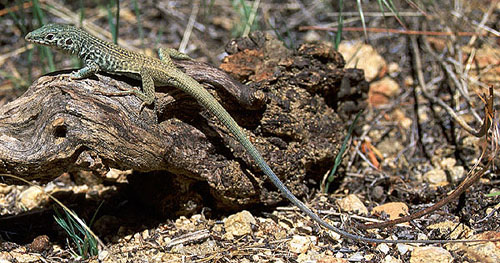
The Western Whiptail has a slender body, a triangular-shaped head, and an elongated tail. Its dorsal scales are small and slim, while its ventral scales are larger.[1][2]
Hatchlings are orange-yellow with dark brown or black spots or stripes. Juveniles have light orange coloration with dark spots or stripes.[3][4]
Habitat
The Western Whiptail inhabits deserts, semiarid shrublands, woodlands, open dry forests, riparian vegetation, grasslands, and arid forests. Its habitats also include canyons, hills, and river basins.[5][6][7]
The species occurs at elevations between 530 and 1,176 m. It frequently shelters in existing rodent burrows but can also dig its own burrows in loose soil.[8][9]
Desert populations use burrows to escape extreme heat. Burrows also provide protection from predators.[10][11]
Diet
The Western Whiptail primarily eats insects, spiders, scorpions, moths and butterflies, crickets, grasshoppers, and beetles. It captures prey using its jaws rather than its tongue.[12][13]
Behaviour
The Western Whiptail is diurnal and moves around to locate food, mates, and nesting sites. It is generally solitary and interacts with other members of its species primarily during the mating season.[14][15]
The species uses chemical sensory cues to detect predators and prey, including underground prey. It is partially fossorial and uses burrows for protection from predators.[16][11]
Reproduction and life cycle
The Western Whiptail reproduces sexually and has separate male and female individuals. The breeding season generally extends from mid-April through July.[17][18]
Eggs hatch after an incubation period of approximately 30 to 90 days. Eggs in northern populations generally begin hatching by mid-August.[19][20]
Females typically reach sexual maturity at 22 months, while males reach maturity at 20 months. Hatchlings are independent and receive no parental care.[21][22]
Conservation
Most populations appear stable, and the Western Whiptail is not listed as endangered in any state within its range.[23]
Similar species
The New Mexico whiptail is smaller than the Western Whiptail and has blue coloration on its underbelly and tail tips.[24]
Classification of the Western Whiptail
| Kingdom | Animalia |
|---|---|
| Phylum | Chordata |
| Subphylum | Vertebrata |
| Infraphylum | Gnathostomata |
| Parvphylum | Osteichthyes |
| Megaclass | Tetrapoda |
| Class | Reptilia (Reptile) |
| Order | Squamata (Snakes) |
| Suborder | Autarchoglossa |
| Family | Teiidae (Tegus) |
| Genus | Aspidoscelis (North American Whiptails) |
| Species | Aspidoscelis tigris (Baird & Girard, 1852) |
Where the Western Whiptail is found
Checklists and occurrence records place Aspidoscelis tigris in 2 countries across North America. GBIF holds 70,117 georeferenced records of it.
Countries
Regions and cities with the most records
- California, United States 19,059
- Arizona, United States 10,449
- Sonora, Mexico 7,597
- Nevada, United States 5,280
- Utah, United States 4,137
- New Mexico, United States 3,107
- Texas, United States 2,498
- Coahuila, Mexico 2,116
- Baja California, Mexico 1,828
- Flowing Wells, United States 1,649
- Casas Adobes, United States 1,633
- Catalina Foothills, United States 1,532
- Tucson, United States 1,389
- Oro Valley, United States 1,371
- Chihuahua, Mexico 1,276
- Baja California Sur, Mexico 1,086
- La Crescenta-Montrose, United States 988
- La Cañada Flintridge, United States 986
- Drexel Heights, United States 948
- Altadena, United States 929
- Glendale, United States 924
- Pasadena, United States 864
- Tanque Verde, United States 855
- Burbank, United States 853
- South Pasadena, United States 841
- Cathedral City, United States 825
- Fountain Hills, United States 811
- Rancho Mirage, United States 804
- Palm Desert, United States 788
- Alhambra, United States 777
- San Gabriel, United States 772
- Agoura, United States 765
- Arcadia, United States 761
- Agoura Hills, United States 739
- Temple City, United States 702
- Monterey Park, United States 693
Range as the checklists state it
USA (California),
Middle America
Global
A number beside a place is its count of GBIF occurrence records. A place without a number comes from a checklist alone. Records show where a species has been observed or collected, which can include escapes and vagrants.
Common names
English
- Western Whiptail
- Carmen Island Whiptail
- Tiger Whiptail
Names in 8 other languages
- Danish
- Tigerpiskehaleteju
- French
- Queue-fouet tigre
- German
- Tiger-Rennechse
- Japanese
- トラフハシリトカゲ
- Portuguese
- Cauda-de-chicote-tigre
- Russian
- Мраморная хлыстохвостая ящерица, Тигровая хлыстохвостая ящерица
- Spanish
- Huico Tigre, Huico de la Isla Carmen, Huico de la isla San José, Huico de la isla San Pedro Nolasco, Huico de la isla Santa Catalina, Huico tigre del noroeste, huico de la isla de San Lorenzo
- sei
- güico, huico
Synonyms
32 other scientific names have been used for this species and are now treated as synonyms of Aspidoscelis tigris.
- Aspidoscelis bacatus (Van Denburgh & Slevin, 1921)
- Aspidoscelis cana (Van Denburgh & Slevin, 1921)
- Aspidoscelis catalinensis (Van Denburgh & Slevin, 1921)
- Aspidoscelis celeripes (Dickerson, 1919)
- Aspidoscelis estebanensis (Dickerson, 1919)
- Aspidoscelis tigris vandenburghi (Dickerson, 1919)
- Cnemidophorus bacatus Van Denburgh & Slevin, 1921
- Cnemidophorus bartolomas Dickerson, 1919
- Cnemidophorus canus Van Denburgh & Slevin, 1921
- Cnemidophorus catalinensis Van Denburgh & Slevin, 1921
- Cnemidophorus celeripes Dickerson, 1919
- Cnemidophorus dickersonae Van Denburgh & Slevin, 1921
- Cnemidophorus disparilis Dickerson, 1919
- Cnemidophorus estebanensis Dickerson, 1919
- Cnemidophorus gadovi Burger, 1950
- Cnemidophorus gracilis Baird & Girard, 1852
- Cnemidophorus melanostethus Cope, 1864
- Cnemidophorus punctilinealis Dickerson, 1919
- Cnemidophorus stejnegeri Van Denburgh, 1894
- Cnemidophorus tesselatus aethiops Cope, 1900
- Cnemidophorus tesselatus multiscutatus Cope, 1892
- Cnemidophorus tesselatus rubidus Cope, 1892
- Cnemidophorus tigris Baird & Girard, 1852
- Cnemidophorus tigris gracilis Baird & Girard, 1852
- Cnemidophorus tigris mundus Camp, 1916
- Cnemidophorus tigris punctata Walker & Maslin, 1964
- Cnemidophorus tigris punctatus Walker & Maslin, 1965
- Cnemidophorus tigris septentrionalis Burger, 1950
- Cnemidophorus tigris vividus Walker, 1981
- Cnemidophorus vandenburghi Dickerson, 1919
- Cnemidophorus martyris Stejneger, 1892 ambiguous synonym
- Cnemidophorus undulatus Hallowell, 1854 ambiguous synonym
Subspecies and varieties
- Aspidoscelis tigris aethiops (Sonoran Tiger Whiptail) subspecies
- Aspidoscelis tigris dickersonae (Dickerson's Desert Whiptail) subspecies
- Aspidoscelis tigris disparilis (Isla Angel de la Guarda Tiger Whiptail) subspecies
- Aspidoscelis tigris multiscutatus (Coastal Whiptail) subspecies
- Aspidoscelis tigris mundus (California Whiptail) subspecies
- Aspidoscelis tigris punctatus (Spotted Tiger Whiptail) subspecies
- Aspidoscelis tigris punctilinealis (Sonoran Tiger Whiptail) subspecies
- Aspidoscelis tigris rubidus (Pink-tailed Whiptail) subspecies
- Aspidoscelis tigris septentrionalis (Northern Whiptail) subspecies
- Aspidoscelis tigris stejnegeri (Coastal Whiptail) subspecies
- Aspidoscelis tigris tigris (Great Basin Whiptail) subspecies
- Aspidoscelis tigris variolosus (Spotted Western Whiptail) subspecies
- Aspidoscelis tigris vividus (South Coronado Island Whiptail) subspecies
Related species
-
 New Mexico WhiptailAspidoscelis neomexicanus
-
 Desert Grassland Whiptail LizardAspidoscelis uniparens
-
 Six-lined RacerunnerAspidoscelis sexlineatus
-
 Texas Spotted WhiptailAspidoscelis gularis
- Little Striped WhiptailAspidoscelis inornatus
-
 Chihuahuan Spotted WhiptailAspidoscelis exsanguis
-
 Plateau Striped WhiptailAspidoscelis velox
-
 Common Checkered WhiptailAspidoscelis tesselatus
Compare
Questions and answers
What is the scientific name of the Western Whiptail?
The scientific name of the Western Whiptail is Aspidoscelis tigris. Written with its author, the full name is Aspidoscelis tigris (Baird & Girard, 1852).
Which family does the Western Whiptail belong to?
Aspidoscelis tigris belongs to the family Teiidae, in the order Squamata and the class Reptilia.
Where is the Western Whiptail found?
Checklists and occurrence records place Aspidoscelis tigris in 2 countries: United States and Mexico.
What is the conservation status of the Western Whiptail?
The IUCN Red List category recorded for Aspidoscelis tigris is Least Concern (LC).
What other names does the Western Whiptail have?
Aspidoscelis tigris is also known in English as Carmen Island Whiptail and Tiger Whiptail.
What is the scientific name for the whiptail lizard?
The scientific name of the Western Whiptail is Aspidoscelis tigris (Baird & Girard, 1852).[25][26]
How big do whiptail lizards get?
The maximum recorded snout-to-vent length is 102 mm, and the maximum total length, including the tail, is 305 mm. Adult males have snout-to-vent lengths ranging from 71 to 96 mm and average a mass of 18 g, while adult females range from 66 to 93 mm and average a mass of 11 g.[27][28][29][30]
Are whiptails all female?
No. The Western Whiptail reproduces sexually and has separate male and female individuals.[17]
What do whiptail lizards eat?
The Western Whiptail primarily eats insects, spiders, scorpions, moths and butterflies, crickets, grasshoppers, and beetles.[12]
What is a lizard's main diet?
The Western Whiptail primarily eats insects, spiders, scorpions, moths and butterflies, crickets, grasshoppers, and beetles.[12]
Sources
Passages the profile rests on
- The species has a slender body, a triangular-shaped head, and an elongated tail. Source passage: “Western whiptails have slender, triangular-shaped heads, slim bodies, and elongated tails.” — animaldiversity.org
- Its dorsal scales are small and slim, while its ventral scales are larger. Source passage: “Western whiptails have small, slim dorsal scales, with larger ventral scales.” — animaldiversity.org
- Hatchlings are orange-yellow with dark brown or black spots or stripes. Source passage: “Hatchlings are orange-yellow with dark brown-black spots or stripes.” — English Wikipedia
- Juveniles have light orange coloration with dark spots or stripes. Source passage: “Juvenile western whiptails are light orange in color with dark spots or stripes similar to adults.” — animaldiversity.org
- The species inhabits deserts, semiarid shrublands, woodlands, open dry forests, and riparian vegetation. Source passage: “It lives in a wide variety of habitats, including deserts and semiarid shrubland, usually in areas with sparse vegetation; it also may be found in woodland, open dry forest, and riparian growth.” — English Wikipedia
- It occurs in arid forests, grasslands, deserts, and woodland environments. Source passage: “Western whiptails are terrestrial, inhabiting deserts, arid forests, grasslands, and woodland habitats.” — animaldiversity.org
- Its habitats include canyons, hills, and river basins. Source passage: “They inhabit areas including canyons, hills, and riparian habitats such as river basins.” — animaldiversity.org
- The species occurs at elevations between 530 and 1,176 m. Source passage: “Western whiptails occur within an elevational range of 530 to 1,176 m.” — animaldiversity.org
- It frequently shelters in existing rodent burrows but can also dig its own burrows in loose soil. Source passage: “Western whiptails often use existing rodent burrows, but will also create their own burrows by digging up loose soil.” — animaldiversity.org
- Desert populations use burrows to escape extreme heat. Source passage: “Desert subspecies prefer habitat with vegetation such as sagebrush or shadscale, and rely on burrows to escape the desert heat.” — English Wikipedia
- The species is partially fossorial and uses burrows for protection from predators. Source passage: “Whiptails are partially fossorial, using burrows to seek shelter from predators” — animaldiversity.org
- The species primarily eats insects, spiders, scorpions, moths and butterflies, crickets, grasshoppers, and beetles. Source passage: “The western whiptail mostly eats insects, spiders, scorpions, lepidopterans, crickets, grasshoppers, and beetles.” — English Wikipedia
- It captures prey using its jaws rather than its tongue. Source passage: “They use their jaws instead of their tongue to capture their prey.” — English Wikipedia
- The species is diurnal and moves around to locate food, mates, and nesting sites. Source passage: “Western whiptails are diurnal and move around to find food, mates, and nesting grounds.” — animaldiversity.org
- It is generally solitary and interacts with other members of its species primarily during the mating season. Source passage: “Western whiptails are not a social species, and typically only interact with conspecifics during the mating season.” — animaldiversity.org
- The species uses chemical sensory cues to detect predators and prey, including underground prey. Source passage: “They use chemosensory tactics to detect predators or prey and can detect underground prey from above ground.” — animaldiversity.org
- The species reproduces sexually and has separate male and female individuals. Source passage: “It is also a bisexual species, containing both males and females, unlike other species of Aspidoscelis which are all-female.” — English Wikipedia
- The breeding season generally extends from mid-April through July. Source passage: “The breeding season of western whiptails extends from mid-April to July, with rare breeding events in August.” — animaldiversity.org
- Eggs in northern populations generally begin hatching by mid-August. Source passage: “The eggs usually begin hatching by mid-August.” — English Wikipedia
- Eggs hatch after an incubation period of approximately 30 to 90 days. Source passage: “The incubation period for eggs is 30 to 90 days.” — animaldiversity.org
- Females typically reach sexual maturity at 22 months, while males reach maturity at 20 months. Source passage: “Females typically reach sexual maturity at 22 months, while males reach it at 20 months.” — animaldiversity.org
- Hatchlings are independent and receive no parental care. Source passage: “Western whiptail hatchlings are precocial and require no parental care.” — animaldiversity.org
- Most populations appear stable, and the species is not listed as endangered in any state within its range. Source passage: “Most of its populations appear stable, and it is not listed as endangered in any of the states comprising its range.” — English Wikipedia
- The New Mexico whiptail is smaller than the western whiptail and has blue coloration on its underbelly and tail tips. Source passage: “New Mexico whiptails ( Aspidoscelis neomexicanus ) are a female-only species with a blue tint on their underbellies and on the ends of their tails. They are also comparatively smaller than western whiptails.” — animaldiversity.org
- The species was formerly classified under the genus Cnemidophorus. Source passage: “It was previously known as Cnemidophorus tigris, until phylogenetic analyses concluded that the genus Cnemidophorus was polyphyletic.” — English Wikipedia
- Sixteen subspecies of Aspidoscelis tigris are recognized as valid. Source passage: “Including the nominotypical subspecies, 16 subspecies of Aspidoscelis tigris are recognized as being valid.” — English Wikipedia
- The maximum recorded snout-to-vent length is 102 mm. Source passage: “The maximum snout-to-vent length (SVL) is 102 mm (about 4 inches)” — English Wikipedia
- The maximum total length, including the tail, is 305 mm. Source passage: “maximum total length (including tail) is 305 mm (about 12 inches).” — English Wikipedia
- Adult males have snout-to-vent lengths ranging from 71 to 96 mm and average a mass of 18 g. Source passage: “The snout-vent length (SVL) of adult males ranges from 71 to 96 mm and an average mass of 18 g (range: 15 to 20 g).” — animaldiversity.org
- Adult females have snout-to-vent lengths ranging from 66 to 93 mm and average a mass of 11 g. Source passage: “Adult females have SVLs of 66 to 93 mm and an average mass of 11 g (range: 6 to 18 g).” — animaldiversity.org
Data
- Catalogue of Life, 2026-10-16 XR cc by
- Global Biodiversity Information Facility CC BY 4.0
- Wikidata CC0
- GeoNames CC BY 4.0
- Wikimedia Commons per image; credit shown with each image
- Within the Catalogue of Life, this name comes from The Reptile Database cc by
References
- Baird, S.F. and Girard,C. (1852). Characteristics of some new reptiles in the Museum of the Smithsonian Institution. Proc. Acad. Nat. Sci. Philadelphia 6: 68-70.
- Cope, E. D. (1863). Descriptions of new American Squamata in the Museum of the Smtihsonian Institution. Proc. Acad. Nat. Sci. Philadelphia 15 [1863]: 100-106.
- Cope, E. D. (1892). A synopsis of the species of the teiid genus Cnemidophorus. Trans. Am. Phil. Soc. (Ser. 2) 17 (1): 27-52 [1893].
- Stejneger, L. H. (1893). Annotated list of the reptiles and batrachians collected by the Death Valley Expedition in 1891, with descriptions of new species. North American Fauna, No. 7: 159-228 (+ 14 Plates + 4 Maps).
- Van Denburgh, J. (1894). Descriptions of three new lizards from California and ower California, with a note on Phrynonsoma blainvillii. Proc. Cal. Acad. Sci. (Ser. 2), 4: 296-301.
- Van Denburgh, J. (1895). A review of the herpetology of Lower California. Part I - Reptiles. Proc. Cal. Acad. Sci. (2) 5: 77-163.
- McLain, & Robert Baird. (1899). Critical notes on a collection of reptiles from the Western Coast of the United States. Privately Published, Wheeling, WV: 1-13 (SSAR Misc. Publ. Reprint).
- Cope, E. D. (1900). The crocodilians, lizards and snakes of North America. Ann. Rep. U.S. Natl. Mus. 1898: 153-1270.
- Van Denburgh, & John. (1912). Notes on some reptiles and amphibians from Oregon, Idaho and Utah. Proc. Cal. Acad. Sci. 3: 155-160.
- Van Denburgh, John and Joseph R. Slevin. (1913). A list of the amphibians and reptiles of Arizona, with notes on the species in the collection of the Academy. Proc. Cal. Acad. Sci. 3 (13): 391-454.
- Camp, C. L. (1916). The subspecies of Sceloporus occidentalis, with description of a new form from the Sierra Nevada and systematic notes on other California lizards. Univ. California Publ. Zool. 17: 63-74.
- Stejneger, L.H., and T. Barbour. (1917). A Check List of North American Amphibians and Reptiles. Harvard University Press, Cambridge. 4: I-Iv, 1-125.
- Dickerson, M. C. (1919). Diagnoses of twenty-three new species and a new genus of lizards from Lower California. Bull. Amer. Mus. Nat. Hist. 41 (10): 461-477.
- Van Denburgh, J., & Slevin, J. R. (1921). Preliminary diagnoses of more new species of reptiles from islands in the gulf of California, Mexico. Proc. Cal. Acad. Sci. (4) 11 (17): 395-398.
- Van Denburgh, J., & Slevin, J. R. (1921). Preliminary diagnoses of new species of the peninsula of Lower California, with notes on the species in the collection of the Academy. Proc. Cal. Acad. Sci. (4) 11: 95-98.
- Van Denburgh, & John. (1922). The Reptiles of Western North America. Volume I. Lizards. Occ. Pap. Cal. Acad. Sci. (10): 1–612.
- Woodbury, & Angus Munn. (1928). The reptiles of Zion National Park. Copeia 1928 (166): 14-21.
- Tanner, Vasco M. (1930). The amphibians and reptiles of Bryce Canyon National Park, Utah. Copeia 1930 (2): 41-43.
- Burt, C. E. (1931). A study of the teiid lizards of the genus Cnemidophorus with special reference to their phylogenetic relationships. Bull. US Natl. Mus. 154: 286 Pp.
- Tanner, Vasco M.;Hayward, C. Lynn. (1934). A biological study of the La Sal Mountains, Utah report No. 1 (Ecology). Proceedings of the Utah Academy of Sciences, Arts, and Letters 11: 209-235.
- Eaton, Theodore H., Jr. (1935). Report on amphibians and reptiles of the Navajo country. Bulletin 3. Rainbow Bridge-Monument Valley Expedition : 1-20.
- Mosauer, & Walter. (1936). The reptilian fauna of sand dune areas of Vizcaino Desert and of northwestern Lower California. Occasional Papers of the Museum of Zoology, University of Michigan (329): 1-21.
- Taylor, & Edward Harrison. (1938). Notes on the herpetological fauna of the Mexican state of Sonora. Univ. Kansas Sci. Bull. 24 (19): 475-503 [1936].
- Smith, Hobart M. (1946). Handbook of Lizards: Lizards of the United States and of Canada. Comstock, Ithaca, NY, Xxii + 557 Pp.
- Burger, & Leslie, W. (1950). New, revived, and reallocated names for North American whiptailed lizards, Genus Cnemidophorus. Natural History Miscellanea, Chicago Acad. Sci. (65): 1-9.
This species in other databases
Page built on 27 November 2026. See how the catalog is made and all sources and licences.
Cite this page
ScientificNames.org. (2026). Aspidoscelis tigris (Western Whiptail). Retrieved November 27, 2026, from https://scientificnames.org/species/aspidoscelis-tigris
“Aspidoscelis tigris (Western Whiptail).” ScientificNames.org, 2026, scientificnames.org/species/aspidoscelis-tigris. Accessed 27 Nov. 2026.
ScientificNames.org. “Aspidoscelis tigris (Western Whiptail).” Accessed November 27, 2026. https://scientificnames.org/species/aspidoscelis-tigris.
@misc{scientificnames_aspidoscelis_tigris_western_whiptail,
  author = {{ScientificNames.org}},
  title = {Aspidoscelis tigris (Western Whiptail)},
  year = {2026},
  url = {https://scientificnames.org/species/aspidoscelis-tigris},
  note = {Accessed 2026-11-27}
}