Species · Reptiles
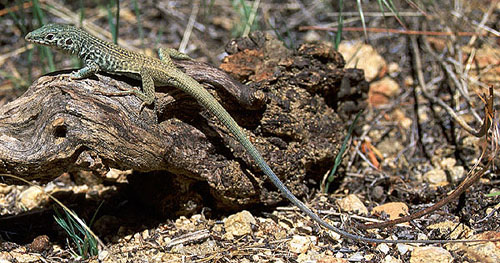
Texas Spotted Whiptail Aspidoscelis gularis
The scientific name of the Texas Spotted Whiptail is Aspidoscelis gularis. It is a species of reptile in the family Teiidae (tegus), order Squamata. The name dates from 1852.
- Scientific name
- Aspidoscelis gularis (Baird & Girard, 1852)
- Common name
- Texas Spotted Whiptail
- Genus
- Aspidoscelis
- Family
- Teiidae (Tegus)
- Order
- Squamata
- Class
- Reptilia
- Red List category
- LC Least Concern
- Recorded in
- 2 countries
- Name status
- accepted in the Catalogue of Life

Overview
The Texas spotted whiptail (Aspidoscelis gularis) is a species of long-tailed lizard, in the family Teiidae. The species is endemic to the south central and southwestern United States and northern Mexico. Six subspecies are recognized as being valid.
Classification of the Texas Spotted Whiptail
| Kingdom | Animalia |
|---|---|
| Phylum | Chordata |
| Subphylum | Vertebrata |
| Infraphylum | Gnathostomata |
| Parvphylum | Osteichthyes |
| Megaclass | Tetrapoda |
| Class | Reptilia (Reptile) |
| Order | Squamata (Snakes) |
| Suborder | Autarchoglossa |
| Family | Teiidae (Tegus) |
| Genus | Aspidoscelis (North American Whiptails) |
| Species | Aspidoscelis gularis (Baird & Girard, 1852) |
Where the Texas Spotted Whiptail is found
Checklists and occurrence records place Aspidoscelis gularis in 2 countries across North America. GBIF holds 29,957 georeferenced records of it.
Countries
Regions and cities with the most records
- Texas, United States 16,673
- Coahuila, Mexico 3,284
- Austin, United States 1,899
- McAllen, United States 1,235
- Pharr, United States 1,167
- Cedar Park, United States 1,127
- Reynosa, Mexico 1,123
- Nuevo León, Mexico 894
- Pflugerville, United States 878
- Round Rock, United States 857
- Mission, United States 816
- San Luis Potosí, Mexico 777
- Tamaulipas, Mexico 750
- Leander, United States 708
- San Antonio, United States 454
- Georgetown, United States 452
- Brownsville, United States 414
- Heroica Matamoros, Mexico 409
- Querétaro, Mexico 403
- Guanajuato, Mexico 384
- Chihuahua, Mexico 378
- Ciudad Río Bravo, Mexico 360
- Edinburg, United States 351
- San Marcos, United States 341
- New Braunfels, United States 287
- San Angelo, United States 287
- Fort Worth, United States 281
- Monterrey, Mexico 262
- Zacatecas, Mexico 248
- San Pedro Garza García, Mexico 247
- Corpus Christi, United States 240
- Oklahoma, United States 232
- San Nicolás de los Garza, Mexico 220
- Hidalgo, Mexico 215
- Durango, Mexico 207
- Guadalupe, Mexico 206
Range as the checklists state it
USA (New Mexico, Texas, Oklahoma),
A number beside a place is its count of GBIF occurrence records. A place without a number comes from a checklist alone. Records show where a species has been observed or collected, which can include escapes and vagrants.
Common names
English
- Texas Spotted Whiptail
- Common Spotted Whiptail
- Eastern Spotted Whiptail
Names in 6 other languages
- Danish
- Almindelig Plettet Piskehaleteju
- French
- Queue-fouet tacheté commun
- Japanese
- テキサスハシリトカゲ
- Portuguese
- Cauda-de-chicote-pintado
- Russian
- Техасская пятнистая хлыстохвостая ящерица
- Spanish
- Corredora Pinta Texana, Huico, Huico pinto del noreste, Huico texano
Synonyms
13 other scientific names have been used for this species and are now treated as synonyms of Aspidoscelis gularis.
- Aspidoscelis scalaris gularis (Baird & Girard, 1852)
- Cnemidophorus gularis Baird & Girard, 1852
- Cnemidophorus gularis colossus Dixon, Lieb & Ketchersid, 1971
- Cnemidophorus gularis gularis Baird & Girard, 1852
- Cnemidophorus gularis meeki Gadow, 1906
- Cnemidophorus gularis rauni Walker, 1967
- Cnemidophorus gularis sealous Cope, 1892
- Cnemidophorus gularis semiannulatus Walker, 1967
- Cnemidophorus gularis sericeus Cope, 1892
- Cnemidophorus septemvittatus pallidus Duellman & Zweifel, 1962
- Aspidoscelis townsendae Cole et al., 2023 ambiguous synonym
- Cnemidophorus gularis semifasciatus Cope, 1892 ambiguous synonym
- Cnemidophorus guttatus Hallowell, 1854 ambiguous synonym
Subspecies and varieties
- Aspidoscelis gularis colossus (Colossal Spotted Whiptail) subspecies
- Aspidoscelis gularis gularis (Texas Spotted Whiptail) subspecies
- Aspidoscelis gularis pallidus (Pallid Spotted Whiptail) subspecies
- Aspidoscelis gularis semiannulatus (Zacatecan Spotted Whiptail) subspecies
- Aspidoscelis gularis semifasciatus subspecies
Related species
-
 New Mexico WhiptailAspidoscelis neomexicanus
-
 Desert Grassland Whiptail LizardAspidoscelis uniparens
-
 Six-lined RacerunnerAspidoscelis sexlineatus
-
 Western WhiptailAspidoscelis tigris
- Little Striped WhiptailAspidoscelis inornatus
-
 Chihuahuan Spotted WhiptailAspidoscelis exsanguis
- Plateau Striped WhiptailAspidoscelis velox
-
 Common Checkered WhiptailAspidoscelis tesselatus
Compare
Questions and answers
What is the scientific name of the Texas Spotted Whiptail?
The scientific name of the Texas Spotted Whiptail is Aspidoscelis gularis. Written with its author, the full name is Aspidoscelis gularis (Baird & Girard, 1852).
Which family does the Texas Spotted Whiptail belong to?
Aspidoscelis gularis belongs to the family Teiidae, in the order Squamata and the class Reptilia.
Where is the Texas Spotted Whiptail found?
Checklists and occurrence records place Aspidoscelis gularis in 2 countries: United States and Mexico.
What is the conservation status of the Texas Spotted Whiptail?
The IUCN Red List category recorded for Aspidoscelis gularis is Least Concern (LC).
What other names does the Texas Spotted Whiptail have?
Aspidoscelis gularis is also known in English as Common Spotted Whiptail and Eastern Spotted Whiptail.
Sources
Data
- Catalogue of Life, 2026-10-16 XR cc by
- Global Biodiversity Information Facility CC BY 4.0
- Wikidata CC0
- English Wikipedia CC BY-SA 4.0
- GeoNames CC BY 4.0
- Wikimedia Commons per image; credit shown with each image
- Within the Catalogue of Life, this name comes from The Reptile Database cc by
References
- Baird, S.F. and Girard,C. (1852). Characteristics of some new reptiles in the Museum of the Smithsonian Institution, part 2. Proc. Acad. Nat. Sci. Philadelphia 6: 125-129.
- Hallowell, E. (1854). Notices of new reptiles from Texas. Proc. Acad. Nat. Sci. Philad. 1854: 192-193.
- Cope, E. D. (1892). Parallel color patterns in lizards. American Naturalist 26: 522.
- Cope, E. D. (1892). A synopsis of the species of the teiid genus Cnemidophorus. Trans. Am. Phil. Soc. (Ser. 2) 17 (1): 27-52 [1893].
- Gadow, H. (1906). A contribution to the study of evolution based upon the Mexican species of Cnemidophorus. Proc. Zool. Soc. London 1906: 277-375 (+ Maps).
- Van Denburgh, John and Joseph R. Slevin. (1913). A list of the amphibians and reptiles of Arizona, with notes on the species in the collection of the Academy. Proc. Cal. Acad. Sci. 3 (13): 391-454.
- Burt, C. E. (1931). A study of the teiid lizards of the genus Cnemidophorus with special reference to their phylogenetic relationships. Bull. US Natl. Mus. 154: 286 Pp.
- Stuart, L. C. (1935). A contribution to a knowledge of the herpetology of a portion of the savanna region of Central Peten, Guatemala. University of Michigan Museum of Zoology Miscellaneous Publications 29: 1-56.
- Gaige, H. (1936). Some reptiles and amphibians from Yucatan and Campeche, Mexico. Carnegie Inst. Wash. Publ., (457): 289-304.
- Smith, Hobart M. (1939). An annotated list of the Mexican amphibians and reptiles in the Carnegie Museum. Annals of the Carnegie Museum 27: 311-320.
- Schmidt, K.P., and D. Owens. (1944). Amphibians and reptiles of northern Coahuila, Mexico. Field Museum of Natural History, Zoological Series. Chicago. 29: 97-115.
- Smith, Hobart M. (1946). Handbook of Lizards: Lizards of the United States and of Canada. Comstock, Ithaca, NY, Xxii + 557 Pp.
- Schmidt, Karl P.;Shannon, Frederick A. (1947). Notes on amphibians and reptiles of Michoacan, Mexico. Zoological Series of Field Museum of Natural History 31 (9): 63-85.
- Taylor, E. H. (1949). A preliminary account of the herpetology of the state of San Luis Potosi, Mexico. Univ. Kansas Sci. Bull. 33 (2): 169-215.
- Smith, H. M., & Burger, W.L. (1950). Herpetological results of the University of Illinois field expedition, Spring 1949. III. Sauria. Transactions of the Kansas Academy of Science 53 (2): 165-175.
- Werler, J. E., & SMITH, H. M. (1952). Notes on a collection of reptiles and amphibians from Mexico, 1951-1952. Texas Journal of Science 14: 551-573.
- Lowe, Charles H., Jr. (1955). A new species of whiptailed lizard (Genus Cnemidophorus) from the Colorado Plateau of Arizona, New Mexico, Colorado, and Utah. Breviora (47): 1-7.
- Neill, Wilfred T. and E. Ross Allen. (1959). Studies on the amphibians and reptiles of British Honduras. Publications of the Research Division Ross Allen’s Reptiles Institute. 2 (1): 1-76.
- Duellman, W. E., & ZWEIFEL, R. G. (1962). A synopsis of the lizards of the sexlineatus group (genus Cnemidophorus). Bull. Amer. Mus. Nat. Hist. 123: 155-210.
- Williams, Kenneth L.;Smith, Hobart M. (1963). Misuse of the trivial name Septemvittatus in the lizard genus Cnemidophorus. Herpetologica 19 (1): 68-69.
- McCoy, Clarence J.;Richmond, Neil D. (1965). Herpetological Type-specimens in Carnegie Museum. [type catalogue]. Annals of the Carnegie Museum 38: 233-264 [1966].
- Lowe, Charles H., Jr;Wright, John W. (1966). Evolution of parthenogenetic species of Cnemidophorus (Whiptail lizards) in western North America. Journal of the Arizona Academy of Science 4 (2): 81-87.
- WALKER, J. M. (1967). Morphological variation in the teiid lizard Cnemidorphorus gularis. Dissertation Abstracts 28(4) [PhD Thesis, U of Colorado 1966].
- Dixon, J.R.; C.S. Lieb and C.A. Ketchersid. (1971). A new lizard of the genus Cnemidophorus (Teiidae) from Querètaro, Mèxico. Herpetologica 27 (3): 344-354.
- Schrank, G.D. & R.E. Ballinger. (1973). Male Reproductive Cycles in Two Species of Lizards (Cophosaurus texanus and Cnemidophorus gularis). Herpetologica 29 (3): 289-293.
This species in other databases
Page built on 26 November 2026. See how the catalog is made and all sources and licences.
Cite this page
ScientificNames.org. (2026). Aspidoscelis gularis (Texas Spotted Whiptail). Retrieved November 26, 2026, from https://scientificnames.org/species/aspidoscelis-gularis
“Aspidoscelis gularis (Texas Spotted Whiptail).” ScientificNames.org, 2026, scientificnames.org/species/aspidoscelis-gularis. Accessed 26 Nov. 2026.
ScientificNames.org. “Aspidoscelis gularis (Texas Spotted Whiptail).” Accessed November 26, 2026. https://scientificnames.org/species/aspidoscelis-gularis.
@misc{scientificnames_aspidoscelis_gularis_texas_spotted_whiptail,
  author = {{ScientificNames.org}},
  title = {Aspidoscelis gularis (Texas Spotted Whiptail)},
  year = {2026},
  url = {https://scientificnames.org/species/aspidoscelis-gularis},
  note = {Accessed 2026-11-26}
}