Species · Reptiles
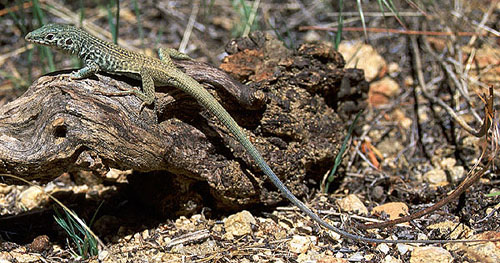
Chihuahuan Spotted Whiptail Aspidoscelis exsanguis
The scientific name of the Chihuahuan Spotted Whiptail is Aspidoscelis exsanguis. It is a species of reptile in the family Teiidae (tegus), order Squamata. The name dates from 1956.
- Scientific name
- Aspidoscelis exsanguis (Lowe, 1956)
- Common name
- Chihuahuan Spotted Whiptail
- Genus
- Aspidoscelis
- Family
- Teiidae (Tegus)
- Order
- Squamata
- Class
- Reptilia
- Red List category
- LC Least Concern
- Recorded in
- 3 countries
- Name status
- accepted in the Catalogue of Life

Overview
Aspidoscelis exsanguis occurs in southern Arizona, southern New Mexico, and southwestern Texas in the United States, as well as northern Chihuahua and northern Sonora in Mexico. It typically has reddish-brown coloration, six lighter-colored longitudinal stripes, spots between the stripes, and a tail nearly three times the length of its body.
Written 26 November 2026 from the sources listed below. Each statement was checked against the passage it cites; statements that could not be supported were removed.
Appearance
The species typically has reddish-brown coloration and a slender body. Its body has six lighter-colored longitudinal stripes with spots between them, and its underside is white or occasionally pale blue.[1][2][3][4]
The tail is nearly three times the length of the body. The species reaches a total length of 9.5 to 12 inches.[5][6]
Habitat
The species inhabits mostly arid environments, including deserts and desert grasslands. It also occurs in oak, pine, and juniper woodlands.[7][8]
The species lives in washes and canyons.[9]
Diet
Aspidoscelis exsanguis is insectivorous.[10]
Behaviour
The species is active during daylight hours.[11]
Reproduction and life cycle
The species is known to reproduce through parthenogenesis.[12]
It digs holes for egg laying.[13]
Conservation
The species is not considered threatened.[14]
Classification of the Chihuahuan Spotted Whiptail
| Kingdom | Animalia |
|---|---|
| Phylum | Chordata |
| Subphylum | Vertebrata |
| Infraphylum | Gnathostomata |
| Parvphylum | Osteichthyes |
| Megaclass | Tetrapoda |
| Class | Reptilia (Reptile) |
| Order | Squamata (Snakes) |
| Suborder | Autarchoglossa |
| Family | Teiidae (Tegus) |
| Genus | Aspidoscelis (North American Whiptails) |
| Species | Aspidoscelis exsanguis (Lowe, 1956) |
Where the Chihuahuan Spotted Whiptail is found
Checklists and occurrence records place Aspidoscelis exsanguis in 3 countries across North America. GBIF holds 8,893 georeferenced records of it.
Countries
Regions and cities with the most records
- New Mexico, United States 3,830
- Chihuahua, Mexico 1,276
- Texas, United States 1,242
- Arizona, United States 878
- Albuquerque, United States 386
- Las Cruces, United States 343
- Rio Rancho, United States 279
- Ciudad Delicias, Mexico 220
- Pedro Meoqui, Mexico 215
- South Valley, United States 210
- Sonora, Mexico 172
- Alamogordo, United States 171
- Enchanted Hills, United States 154
- El Paso, United States 148
- Sunland Park, United States 146
- Ciudad Juárez, Mexico 88
- Horizon City, United States 53
- Green Valley, United States 52
- Chihuahua, Mexico 50
- Carlsbad, United States 45
- Socorro, United States 45
- Roswell, United States 39
- Nuevo Casas Grandes, Mexico 37
- Socorro Mission Number 1 Colonia, United States 33
- Los Lunas, United States 32
- Sierra Vista, United States 29
- Tanque Verde, United States 29
- Catalina Foothills, United States 27
- Tucson, United States 27
- Casas Adobes, United States 26
- Flowing Wells, United States 26
- Oro Valley, United States 23
- Colorado, United States 14
- Sahuarita, United States 9
- Drexel Heights, United States 7
- Nogales, Mexico 7
Range as the checklists state it
USA (SE Arizona, New Mexico, SW Texas, Colorado),
A number beside a place is its count of GBIF occurrence records. A place without a number comes from a checklist alone. Records show where a species has been observed or collected, which can include escapes and vagrants.
Common names
English
- Chihuahuan Spotted Whiptail
- Neaves' Whiptail
Names in 5 other languages
- Danish
- Chihuahua-piskehaleteju
- Portuguese
- Cauda-de-chicote-manchado-de-chihuahua, Corredor-do-chihuahua
- Russian
- Чихуахуанская хлыстохвостая ящерица
- Spanish
- Corredora de Chihuahua, Huico pinto de Chihuahua
- sei
- huico
Synonyms
4 other scientific names have been used for this species and are now treated as synonyms of Aspidoscelis exsanguis.
- Aspidoscelis neavesi Cole, Taylor, Baumann & Baumann, 2014
- Cnemidophorus exsanguis Lowe, 1956
- Cnemidophorus sacki exsanguis Lowe, 1956
- Aspidoscelis townsendae Cole et al., 2023 ambiguous synonym
Related species
-
 New Mexico WhiptailAspidoscelis neomexicanus
-
 Desert Grassland Whiptail LizardAspidoscelis uniparens
-
 Six-lined RacerunnerAspidoscelis sexlineatus
-
 Western WhiptailAspidoscelis tigris
-
 Texas Spotted WhiptailAspidoscelis gularis
- Little Striped WhiptailAspidoscelis inornatus
-
 Plateau Striped WhiptailAspidoscelis velox
-
 Common Checkered WhiptailAspidoscelis tesselatus
Compare
Questions and answers
What is the scientific name of the Chihuahuan Spotted Whiptail?
The scientific name of the Chihuahuan Spotted Whiptail is Aspidoscelis exsanguis. Written with its author, the full name is Aspidoscelis exsanguis (Lowe, 1956).
Which family does the Chihuahuan Spotted Whiptail belong to?
Aspidoscelis exsanguis belongs to the family Teiidae, in the order Squamata and the class Reptilia.
Where is the Chihuahuan Spotted Whiptail found?
Checklists and occurrence records place Aspidoscelis exsanguis in 3 countries: United States, Mexico and U.S. Virgin Islands.
What is the conservation status of the Chihuahuan Spotted Whiptail?
The IUCN Red List category recorded for Aspidoscelis exsanguis is Least Concern (LC).
What other names does the Chihuahuan Spotted Whiptail have?
Aspidoscelis exsanguis is also known in English as Neaves' Whiptail.
What do whiptail lizards eat?
The Chihuahuan Spotted Whiptail is insectivorous.[10]
Sources
Passages the profile rests on
- The species typically has reddish-brown coloration. Source passage: “It is typically a reddish-brown in color” — English Wikipedia
- The body has six lighter-colored longitudinal stripes with spots between them. Source passage: “with six lighter colored stripes that run the length of the body, with spotting between the stripes.” — English Wikipedia
- The underside is white or occasionally pale blue. Source passage: “The underside is white or sometimes pale blue.” — English Wikipedia
- The species has a slender body. Source passage: “It is slender-bodied” — English Wikipedia
- The tail is nearly three times the length of the body. Source passage: “with a tail nearly three times its body length.” — English Wikipedia
- The species reaches a total length of 9.5 to 12 inches. Source passage: “The Chihuahuan spotted whiptail grows from 9.5 to 12 inches in length.” — English Wikipedia
- The species inhabits mostly arid environments, including deserts and desert grasslands. Source passage: “This species can be found in many kinds of mostly arid habitat, including desert, desert grassland,” — English Wikipedia
- The species occurs in oak, pine, and juniper woodlands. Source passage: “and oak, pine, and juniper woodland,” — English Wikipedia
- The species lives in washes and canyons. Source passage: “where it lives in washes and canyons.” — English Wikipedia
- Aspidoscelis exsanguis is insectivorous. Source passage: “the Chihuahua spotted whiptail is diurnal and insectivorous.” — English Wikipedia
- The species is active during daylight hours. Source passage: “the Chihuahua spotted whiptail is diurnal” — English Wikipedia
- The species is known to reproduce through parthenogenesis. Source passage: “It is one of many lizard species known to be parthenogenetic.” — English Wikipedia
- The species digs holes for egg laying. Source passage: “It digs holes to lay eggs.” — English Wikipedia
- The species is not considered threatened. Source passage: “This is not considered to be a threatened species.” — English Wikipedia
Data
- Catalogue of Life, 2026-10-16 XR cc by
- Global Biodiversity Information Facility CC BY 4.0
- Wikidata CC0
- GeoNames CC BY 4.0
- Wikimedia Commons per image; credit shown with each image
- Within the Catalogue of Life, this name comes from The Reptile Database cc by
References
- Lowe, Charles H., Jr. (1956). A new species and a new subspecies of whiptail lizards (genus Cnemidophorus) of the Inland Southwest. Bulletin of the Chicago Academy of Sciences 10 (9): 137-150.
- Maslin, & Paul, T. (1959). The nature of amphibian and reptilian species. Journal of the Arizona Academy of Science 1 (1): 8-17.
- Duellman, W. E., & ZWEIFEL, R. G. (1962). A synopsis of the lizards of the sexlineatus group (genus Cnemidophorus). Bull. Amer. Mus. Nat. Hist. 123: 155-210.
- Lowe, Charles H. & Wright, John W. (1964). Species of the Cnemidophorus exsanguis subgroup of whiptail lizards. Journal of the Arizona Academy of Science 3 (2): 78-80.
- Parker, W. S. (1973). Notes on reproduction of some lizards from Arizona, New Mexico, Texas, and Utah. Herpetologica 29 (3): 258-264.
- Lucchino, Ronald V. (1973). Biochemical Comparison of Two Sibling Species: Cnemidophorus exsanguis and Cnemidophorus sonorae (Sauria: Teiidae). Journal of Herpetology 7 (4): 379-380.
- Van Devender, Thomas R.; Lowe, Charles H. Lowe, Jr. (1977). Amphibians and reptiles of Yepomera, Chihuahua, Mexico. Journal of Herpetology 11 (1): 41-50.
- Jones, K.B.; Abbas, D.R. & Bergstedt, T. (1981). Herpetological records from Central and Northeastern Arizona. Herpetological Review 12 (1): 16.
- Good, D. A., & Wright, J. W. (1984). Allozymes and the hybrid origin of the parthenogenetic lizard Cnemidophorus exsanguis. Experientia 40: 1012-1014.
- Dessauer, H. C., & Cole, C. J. (1984). INFLUENCE OF GENE DOSAGE ON ELECTROPHORETIC PHENOTYPES OF PROTEINS FROM LIZARDS OF THE GENUS CNEMIDOPHORUS. Camp. Biochem. Physiol. 77B (1): 181-189.
- Stebbins, R. C. (1985). A Field Guide to Western Reptiles and Amphibians, 2nd ed. Houghton Mifflin, Boston.
- Dessauer, H. C., & Cole, C. J. (1986). Clonal inheritance in parthenogenetic whiptail lizards: Biochemical evidence. Journal of Heredity 77: 8-12.
- Maslin, T., & Secoy, D. M. (1986). A checklist of the lizard genus Cnemidophorus (Teiidae). Contr. Zool. Univ. Colorado Mus. 1: 1-60.
- Tanner, W. W. (1987). Lizards and turtles of Western Chihuahua. Great Basin Naturalist. 47: 383-421.
- Moritz, Craig C.; Wright, John W.; Brown, Wesley M. (1989). Mitochondrial-DNA analysis and the origin and relative age of parthenogenetic lizards (Genus Cnemidophorus). III. C. velox and C. exsanguis. Evolution 43 (5): 958-968.
- Stuart J N. (1991). Cnemidophorus exsanguis Lowe. Chihuahuan spotted whiptail lizard. Catalogue of American Amphibians and Reptiles ( 516: 1-4.
- Conant, R., & Collins, J. T. (1991). A Field Guide to Reptiles and Amphibians of Eastern/Central North America, 3rd ed. Houghton Mifflin (Boston/New York), Xx + 450 P.
- Stuart, James N. (1993). Cnemidophorus exsanguis (Chihuahuan Spotted Whiptail). USA: New Mexico. Herpetological Review 24 (2): 66.
- Degenhardt, William G.; C. W. Painter, and A. H. Price. (1996). Amphibians and reptiles of New Mexico. Univ. New Mexico Press, 431 Pp.
- Hardy, Laurence M. and Charles J. Cole. (1998). Morphology of a Sterile, Tetraploid, Hybrid Whiptail Lizard (Squamata: Teiidae: Cnemidophorus). American Museum Novitates 3228: 16 Pp.
- Bartlett, R. D., & Bartlett, P. (1999). A Field Guide to Texas Reptiles and Amphibians. Gulf Publishing Co., Houston, Texas, 331 Pp.
- Dixon, James R. (2000). Amphibians and reptiles of Texas, second edition. Texas A&M University Press, 421 Pp.
- REEDER, T.W.; CHARLES J. COLE AND HERBERT C. DESSAUER. (2002). Phylogenetic Relationships of Whiptail Lizards of the Genus Cnemidophorus (Squamata: Teiidae): A Test of Monophyly, Reevaluation of Karyotypic Evolution, and Review of Hybrid Origins. American Museum Novitates 3365: 1-64.
- Lemos-Espinal, Julio A., David Chiszar, and Hobart M. Smith. (2004). Selected Records of 2003 Lizards from Chihuahua and Sonora, Mexico. Bull. Chicago Herp. Soc. 39 (9): 164-168.
- Cooper Jr., W.E.; Vitt, L.J.; Caldwell, J.P. & Fox, S.F. (2005). Relationships among foraging variables, phylogeny, and foraging modes, with new data for nine North American lizard species. Herpetologica 61 (3): 250-259.
This species in other databases
Page built on 29 November 2026. See how the catalog is made and all sources and licences.
Cite this page
ScientificNames.org. (2026). Aspidoscelis exsanguis (Chihuahuan Spotted Whiptail). Retrieved November 29, 2026, from https://scientificnames.org/species/aspidoscelis-exsanguis
“Aspidoscelis exsanguis (Chihuahuan Spotted Whiptail).” ScientificNames.org, 2026, scientificnames.org/species/aspidoscelis-exsanguis. Accessed 29 Nov. 2026.
ScientificNames.org. “Aspidoscelis exsanguis (Chihuahuan Spotted Whiptail).” Accessed November 29, 2026. https://scientificnames.org/species/aspidoscelis-exsanguis.
@misc{scientificnames_aspidoscelis_exsanguis_chihuahuan_spotted_whiptail,
  author = {{ScientificNames.org}},
  title = {Aspidoscelis exsanguis (Chihuahuan Spotted Whiptail)},
  year = {2026},
  url = {https://scientificnames.org/species/aspidoscelis-exsanguis},
  note = {Accessed 2026-11-29}
}