Species · Reptiles
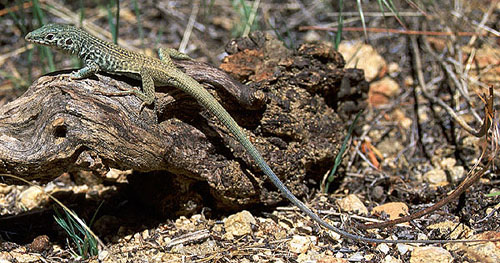
Arizona Striped Whiptail Aspidoscelis arizonae
The scientific name of the Arizona Striped Whiptail is Aspidoscelis arizonae. It is a species of reptile in the family Teiidae (tegus), order Squamata. The name dates from 1896.
- Scientific name
- Aspidoscelis arizonae (Van Denburgh, 1896)
- Common name
- Arizona Striped Whiptail
- Genus
- Aspidoscelis
- Family
- Teiidae (Tegus)
- Order
- Squamata
- Class
- Reptilia
- Red List category
- NT Near Threatened
- Recorded in
- 2 countries
- Name status
- accepted in the Catalogue of Life
Overview
The Arizona striped whiptail (Aspidoscelis arizonae) is a species of whiptail lizard endemic to the United States. This is a species of lizards that lives in Arizona's grassy desert areas and is normally found hiding in desert shrubs. They are approximately 72 millimetres (2.8 in) long, and, like all whiptails, they have a noticeably long whiplike tail hence the name whiptail and they are fast runners .
Classification of the Arizona Striped Whiptail
| Kingdom | Animalia |
|---|---|
| Phylum | Chordata |
| Subphylum | Vertebrata |
| Infraphylum | Gnathostomata |
| Parvphylum | Osteichthyes |
| Megaclass | Tetrapoda |
| Class | Reptilia (Reptile) |
| Order | Squamata (Snakes) |
| Suborder | Autarchoglossa |
| Family | Teiidae (Tegus) |
| Genus | Aspidoscelis (North American Whiptails) |
| Species | Aspidoscelis arizonae (Van Denburgh, 1896) |
Where the Arizona Striped Whiptail is found
Checklists and occurrence records place Aspidoscelis arizonae in 2 countries across North America. GBIF holds 1,650 georeferenced records of it.
Countries
Regions and cities with the most records
- New Mexico, United States 465
- Texas, United States 386
- Arizona, United States 285
- Chihuahua, Mexico 112
- Coahuila, Mexico 64
- El Paso, United States 52
- Sunland Park, United States 52
- Durango, Mexico 22
- Sonora, Mexico 22
- Ciudad Juárez, Mexico 19
- Santa Fe, United States 19
- Carlsbad, United States 18
- South Valley, United States 17
- Roswell, United States 15
- Albuquerque, United States 14
- Horizon City, United States 11
- Socorro, United States 10
- Socorro Mission Number 1 Colonia, United States 10
- Chihuahua, Mexico 9
- Rio Rancho, United States 8
- Las Cruces, United States 6
- Alamogordo, United States 4
- Los Lunas, United States 4
- Santa Rosalía de Camargo, Mexico 3
Range as the checklists state it
USA (SE Arizona)
North America
A number beside a place is its count of GBIF occurrence records. A place without a number comes from a checklist alone. Records show where a species has been observed or collected, which can include escapes and vagrants.
Common names
English
- Arizona Striped Whiptail
- Little Striped Whiptail
- Little White Whiptail [gypsi]
- Pai Striped Whiptail [pai]
- Trans-Pecos Striped Whiptail [heptagrammus]
Synonyms
6 other scientific names have been used for this species and are now treated as synonyms of Aspidoscelis arizonae.
- Aspidoscelis inornatus arizonae (Van Denburgh, 1896)
- Cnemidophorus arizonae Van Denburgh, 1896
- Cnemidophorus inornatus arizonae Van Denburgh, 1896
- Cnemidophorus inornatus gypsi Wright & Lowe, 1993
- Cnemidophorus inornatus heptagrammus Axtell, 1961
- Cnemidophorus inornatus pai Wright & Lowe, 1993
Subspecies and varieties
- Aspidoscelis arizonae arizonae (Arizona Striped Whiptail) subspecies
- Aspidoscelis arizonae gypsi (Little White Whiptail) subspecies
- Aspidoscelis arizonae heptagrammus (Trans-Pecos Striped Whiptail) subspecies
- Aspidoscelis arizonae pai (Pai Striped Whiptail) subspecies
Related species
-
 New Mexico WhiptailAspidoscelis neomexicanus
-
 Desert Grassland Whiptail LizardAspidoscelis uniparens
-
 Six-lined RacerunnerAspidoscelis sexlineatus
-
 Western WhiptailAspidoscelis tigris
-
 Texas Spotted WhiptailAspidoscelis gularis
- Little Striped WhiptailAspidoscelis inornatus
-
 Chihuahuan Spotted WhiptailAspidoscelis exsanguis
-
 Plateau Striped WhiptailAspidoscelis velox
Compare
Questions and answers
What is the scientific name of the Arizona Striped Whiptail?
The scientific name of the Arizona Striped Whiptail is Aspidoscelis arizonae. Written with its author, the full name is Aspidoscelis arizonae (Van Denburgh, 1896).
Which family does the Arizona Striped Whiptail belong to?
Aspidoscelis arizonae belongs to the family Teiidae, in the order Squamata and the class Reptilia.
Where is the Arizona Striped Whiptail found?
Checklists and occurrence records place Aspidoscelis arizonae in 2 countries: United States and Mexico.
What is the conservation status of the Arizona Striped Whiptail?
The IUCN Red List category recorded for Aspidoscelis arizonae is Near Threatened (NT).
What other names does the Arizona Striped Whiptail have?
Aspidoscelis arizonae is also known in English as Little Striped Whiptail, Little White Whiptail [gypsi], Pai Striped Whiptail [pai] and Trans-Pecos Striped Whiptail [heptagrammus].
Sources
Data
- Catalogue of Life, 2026-10-16 XR cc by
- Global Biodiversity Information Facility CC BY 4.0
- Wikidata CC0
- English Wikipedia CC BY-SA 4.0
- GeoNames CC BY 4.0
- Within the Catalogue of Life, this name comes from The Reptile Database cc by
References
- Baird, S. F. (1859). Description of new genera and species of North American lizards in the museum of the Smithsonian Institution. Proc. Acad. Nat. Sci. Philadelphia 10: 253-256 [1858].
- Günther, A. C. L. G. (1885). Reptilia and Batrachia. Biologia Centrali-Américana. Taylor, & Francis, London, 326 Pp. [Published in Parts from 1885-1902; Reprint by the SSAR 1987].
- Van Denburgh, & John. (1896). A list of some reptiles from Southeastern Arizona, with a description of a new species of Cnemidophorus. Proc. Cal. Acad. Sci. (2) 6: 338-349.
- Gadow, H. (1906). A contribution to the study of evolution based upon the Mexican species of Cnemidophorus. Proc. Zool. Soc. London 1906: 277-375 (+ Maps).
- Van Denburgh, John and Joseph R. Slevin. (1913). A list of the amphibians and reptiles of Arizona, with notes on the species in the collection of the Academy. Proc. Cal. Acad. Sci. 3 (13): 391-454.
- Van Denburgh, & John. (1922). The Reptiles of Western North America. Volume I. Lizards. Occ. Pap. Cal. Acad. Sci. (10): 1–612.
- Springer, & Stewart. (1928). An annotated list of the lizards of Lee’s Ferry, Arizona. Copeia 1928 (169): 100-104.
- Smith, Hobart M. (1939). Notes on Mexican reptiles and amphibians. Zoological Series of Field Museum of Natural History 24 (4): 15-35. Link
- Schmidt, K.P., and D. Owens. (1944). Amphibians and reptiles of northern Coahuila, Mexico. Field Museum of Natural History, Zoological Series. Chicago. 29: 97-115.
- Smith, Hobart M. (1946). Handbook of Lizards: Lizards of the United States and of Canada. Comstock, Ithaca, NY, Xxii + 557 Pp.
- Jameson, David H.;Flury, Alvin G. (1949). The reptiles and amphibians of the Sierra Vieja Range of southwestern Texas. Texas Journal of Science 1 (2): 54-77.
- Smith, H. M., & Taylor, E. H. (1950). An annotated checklist and key to the reptiles of Mexico exclusive of the snakes. Bull. US Natl. Mus. 199: 1-253.
- Fugler, Charles M.;Webb, Robert G. (1956). Distributional notes on some reptiles and amphibians from southern and central Coahuila. Herpetologica 12: 167-171.
- Milstead, W. W. (1957). A Reconsideration of the Nomenclature of the Small Whiptail Lizards (Cnemidophorus) of Southwestern Texas. Copeia 1957 (3): 228-229.
- Axtell, Ralph W. (1959). AMPHIBIANS AND REPTILES OF THE BLACK GAP WILDLIFE MANAGEMENT AREA, BREWSTER COUNTY, TEXAS. Southwestern Naturalist 4 (2): 88-109.
- Webb, Robert G.;Hensley, Max. (1959). Notes on reptiles from the Mexican State of Durango. Publications of the Museum - Michigan State University, Biological Series 1 (6): 249-258.
- Axtell, R. W. (1961). Cnemidophorus inornatus, the valid name for the little striped whiptail lizard, with the description of an annectant subspecies. Copeia 1961 (2): 148-158.
- Duellman, W. E., & ZWEIFEL, R. G. (1962). A synopsis of the lizards of the sexlineatus group (genus Cnemidophorus). Bull. Amer. Mus. Nat. Hist. 123: 155-210.
- Taylor, Harry L. (1965). Morphological variation in selected populations of the teiid lizards Cnemidophorus velox and Cnemidophorus inornatus. University of Colorado Studies, Series in Bioogy (21): 1-27.
- Wright, John W. & Lowe, Charles H. (1965). The rediscovery of Cnemidophorus arizonae Van Denburgh. Journal of the Arizona Academy of Science 3 (3): 164-168.
- Taylor, Harry L.; Medica, Philip A. (1966). Natural hybridization of the bisexual teiid lizard Cnemidophorus inornatus and the unisexual Cnemidophorus perplexus in southern New Mexico. University of Colorado Studies. Series in Biology (22): 1-9.
- Lowe, Charles H., Jr;Wright, John W. (1966). Evolution of parthenogenetic species of Cnemidophorus (Whiptail lizards) in western North America. Journal of the Arizona Academy of Science 4 (2): 81-87.
- Wright, John W.;Lowe, Charles H. (1967). Hybridization in nature between parthenogenetic and bisexual species of whiltail lizards (genus Cnemidophorus). American Museum Novitates (2286): 36.
- Williams, Kenneth L. (1968). A new subspecies of the teiid lizard Cnemidophorus inornatus from México. Journal of Herpetology 1 (1-4): 21-24.
- Christiansen, J.L., W.G. Degenhardt & J.E. White. (1971). Habitat Preferences of Cnemidophorus inornatus and C. neomexicanus with Reference to Conditions Contributing to their Hybridization. Copeia 1971 (2): 357-359.
This species in other databases
Page built on 26 November 2026. See how the catalog is made and all sources and licences.
Cite this page
ScientificNames.org. (2026). Aspidoscelis arizonae (Arizona Striped Whiptail). Retrieved November 26, 2026, from https://scientificnames.org/species/aspidoscelis-arizonae
“Aspidoscelis arizonae (Arizona Striped Whiptail).” ScientificNames.org, 2026, scientificnames.org/species/aspidoscelis-arizonae. Accessed 26 Nov. 2026.
ScientificNames.org. “Aspidoscelis arizonae (Arizona Striped Whiptail).” Accessed November 26, 2026. https://scientificnames.org/species/aspidoscelis-arizonae.
@misc{scientificnames_aspidoscelis_arizonae_arizona_striped_whiptail,
  author = {{ScientificNames.org}},
  title = {Aspidoscelis arizonae (Arizona Striped Whiptail)},
  year = {2026},
  url = {https://scientificnames.org/species/aspidoscelis-arizonae},
  note = {Accessed 2026-11-26}
}