Species · Reptiles
Canyon Spotted Whiptail Aspidoscelis burti
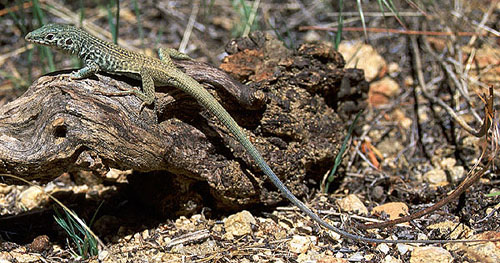
The scientific name of the Canyon Spotted Whiptail is Aspidoscelis burti. It is a species of reptile in the family Teiidae (tegus), order Squamata. The name dates from 1938.
- Scientific name
- Aspidoscelis burti (Taylor, 1938)
- Common name
- Canyon Spotted Whiptail
- Genus
- Aspidoscelis
- Family
- Teiidae (Tegus)
- Order
- Squamata
- Class
- Reptilia
- Red List category
- LC Least Concern
- Recorded in
- 2 countries
- Name status
- accepted in the Catalogue of Life

Overview
The canyon spotted whiptail (Aspidoscelis burti), also known commonly as el huico manchado de cañón in Mexican Spanish, is a species of lizard in the family Teiidae. The species is native to northwestern Mexico and the adjacent southwestern United States.
Classification of the Canyon Spotted Whiptail
| Kingdom | Animalia |
|---|---|
| Phylum | Chordata |
| Subphylum | Vertebrata |
| Infraphylum | Gnathostomata |
| Parvphylum | Osteichthyes |
| Megaclass | Tetrapoda |
| Class | Reptilia (Reptile) |
| Order | Squamata (Snakes) |
| Suborder | Autarchoglossa |
| Family | Teiidae (Tegus) |
| Genus | Aspidoscelis (North American Whiptails) |
| Species | Aspidoscelis burti (Taylor, 1938) |
Where the Canyon Spotted Whiptail is found
Checklists and occurrence records place Aspidoscelis burti in 2 countries across North America. GBIF holds 1,042 georeferenced records of it.
Countries
Regions and cities with the most records
- Sonora, Mexico 461
- Arizona, United States 345
- Heroica Guaymas, Mexico 271
- Empalme, Mexico 118
- Oro Valley, United States 67
- Catalina Foothills, United States 64
- Casas Adobes, United States 62
- Flowing Wells, United States 59
- Navojoa, Mexico 57
- Tucson, United States 57
- Tanque Verde, United States 50
- New Mexico, United States 34
- Rio Rico, United States 20
- Hermosillo, Mexico 19
- Nogales, United States 16
- Nogales, Mexico 15
- Drexel Heights, United States 4
- Sahuarita, United States 4
Range as the checklists state it
Mexico (Sonora), USA (Arizona)
A number beside a place is its count of GBIF occurrence records. A place without a number comes from a checklist alone. Records show where a species has been observed or collected, which can include escapes and vagrants.
Common names
English
- Canyon Spotted Whiptail
Names in 3 other languages
- Portuguese
- Cauda-de-chicote-do-cânion
- Russian
- Гигантская пятнистая хлыстохвостая ящерица
- Spanish
- Huico Manchado de Cañon, Huico Manchado de Cañón
Synonyms
2 other scientific names have been used for this species and are now treated as synonyms of Aspidoscelis burti.
- Cnemidophorus burti Taylor, 1938
- Cnemidophorus burti burti Taylor, 1938
Related species
-
 New Mexico WhiptailAspidoscelis neomexicanus
-
 Desert Grassland Whiptail LizardAspidoscelis uniparens
-
 Six-lined RacerunnerAspidoscelis sexlineatus
-
 Western WhiptailAspidoscelis tigris
-
 Texas Spotted WhiptailAspidoscelis gularis
- Little Striped WhiptailAspidoscelis inornatus
-
 Chihuahuan Spotted WhiptailAspidoscelis exsanguis
-
 Plateau Striped WhiptailAspidoscelis velox
Compare
Questions and answers
What is the scientific name of the Canyon Spotted Whiptail?
The scientific name of the Canyon Spotted Whiptail is Aspidoscelis burti. Written with its author, the full name is Aspidoscelis burti (Taylor, 1938).
Which family does the Canyon Spotted Whiptail belong to?
Aspidoscelis burti belongs to the family Teiidae, in the order Squamata and the class Reptilia.
Where is the Canyon Spotted Whiptail found?
Checklists and occurrence records place Aspidoscelis burti in 2 countries: Mexico and United States.
What is the conservation status of the Canyon Spotted Whiptail?
The IUCN Red List category recorded for Aspidoscelis burti is Least Concern (LC).
Sources
Data
- Catalogue of Life, 2026-10-16 XR cc by
- Global Biodiversity Information Facility CC BY 4.0
- Wikidata CC0
- English Wikipedia CC BY-SA 4.0
- GeoNames CC BY 4.0
- Wikimedia Commons per image; credit shown with each image
- Within the Catalogue of Life, this name comes from The Reptile Database cc by
References
- Taylor, & Edward Harrison. (1938). Notes on the herpetological fauna of the Mexican state of Sonora. Univ. Kansas Sci. Bull. 24 (19): 475-503 [1936].
- Burger, & Leslie, W. (1950). New, revived, and reallocated names for North American whiptailed lizards, Genus Cnemidophorus. Natural History Miscellanea, Chicago Acad. Sci. (65): 1-9.
- Duellman, William E. & Lowe, Charles H., Jr. (1953). A new lizard of the genus Cnemidophorus from Arizona. Natural History Miscellanea, Chicago Acad. Sci. (120): 1-8.
- Zweifel,R.G. and Norris,K.S. (1955). Contributions to the herpetology of Sonora, Mexico:Descriptions of new subspecies of snakes (Micruroides euryxanthus and Lampropeltis getulus) and miscellaneous collecting notes. American Midland Naturalist 54: 230-249.
- Duellman, W. E., & ZWEIFEL, R. G. (1962). A synopsis of the lizards of the sexlineatus group (genus Cnemidophorus). Bull. Amer. Mus. Nat. Hist. 123: 155-210.
- Stebbins, R. C. (1985). A Field Guide to Western Reptiles and Amphibians, 2nd ed. Houghton Mifflin, Boston.
- Maslin, T., & Secoy, D. M. (1986). A checklist of the lizard genus Cnemidophorus (Teiidae). Contr. Zool. Univ. Colorado Mus. 1: 1-60.
- Wright, J. W. (1993). Evolution of the lizards of the genus Cnemidophorus. In: Wright,J.W. & Vitt,L.J. (eds.) Biology of Whiptail lizards (genus Cnemidophorus), pp. 27-81. Oklahoma Mus. Nat. Hist., Norman.
- Degenhardt, William G.; C. W. Painter, and A. H. Price. (1996). Amphibians and reptiles of New Mexico. Univ. New Mexico Press, 431 Pp.
- Hardy, Laurence M. and Charles J. Cole. (1998). Morphology of a Sterile, Tetraploid, Hybrid Whiptail Lizard (Squamata: Teiidae: Cnemidophorus). American Museum Novitates 3228: 16 Pp.
- Crother, B. I. (2000). Scientific and standard English names of amphibians and reptiles of North America north of Mexico, with comments regarding confidence in our understanding. Herpetological Circular 29: 1-82.
- REEDER, T.W.; CHARLES J. COLE AND HERBERT C. DESSAUER. (2002). Phylogenetic Relationships of Whiptail Lizards of the Genus Cnemidophorus (Squamata: Teiidae): A Test of Monophyly, Reevaluation of Karyotypic Evolution, and Review of Hybrid Origins. American Museum Novitates 3365: 1-64.
- Jones, L. L., & Lovich, R. E. (2009). Lizards of the American Southwest. A photographic field guide. Rio Nuevo Publishers, Tucson, AZ, 568 Pp. [Review in Reptilia 86: 84].
- Collins, J.T. and T. W. Taggart. (2009). Standard Common and Current Scientific Names for North American Amphibians, Turtles, Reptiles, and Crocodilians, Sixth Edition. Center for North American Herpetology, 48 Pp.
- Beolens, B., & Michael Watkins, a. M. G. (2011). The Eponym Dictionary of Reptiles. Johns Hopkins University Press, Baltimore, USA.
- Crother, B. I. (ed.). (2012). Standard Common and Current Scientific Names for North American Amphibians, Turtles, Reptiles, and Crocodilians, Seventh Edition. Herpetological Circular 39: 1-92.
- Nevárez-de los Reyes; Manuel, David Lazcano, Javier Banda-Leal and Ian Recchio. (2014). Notes on Mexican Herpetofauna 22: Herpetofauna of the Continental Portion of the Municipality of Hermosillo, Sonora, Mexico. Bull. Chicago Herp. Soc. 49(8):105-115.
- Bezy, Robert L. and Charles J. Cole. (2014). Amphibians and Reptiles of the Madrean Archipelago of Arizona and New Mexico. American Museum Novitates (3810): 1-24.
- Lemos-Espinal JA, Smith GR, & Rorabaugh JC. (2019). A conservation checklist of the amphibians and reptiles of Sonora, Mexico, with updated species lists. ZooKeys 829: 131-160.
- Barley, Anthony J.; Tod W. Reeder, Adrián Nieto-Montes de Oca, Charles J. Cole, Robert C. Thomson. (2021). A new diploid parthenogenetic whiptail lizard from Sonora, Mexico is the ‘missing link’ in the evolutionary transition to polyploidy. American Naturalist 198 (2): 295-309.
- Uetz, P. H., Patel, M., Gbadamosi, Z., Nguyen, A., & Shoope, S. (2024). A Reference Database of Reptile Images. Taxonomy 4: 723–732.
- Turner, D. S., Rorabaugh, J. C., Van Devender, T. R., & Hale, S. F. (2025). Amphibians and Reptiles of the Sierra El Tigre Region, Sonora, Mexico. Sonoran Herpetologist 38 (2): 81.
This species in other databases
Page built on 26 November 2026. See how the catalog is made and all sources and licences.
Cite this page
ScientificNames.org. (2026). Aspidoscelis burti (Canyon Spotted Whiptail). Retrieved November 26, 2026, from https://scientificnames.org/species/aspidoscelis-burti
“Aspidoscelis burti (Canyon Spotted Whiptail).” ScientificNames.org, 2026, scientificnames.org/species/aspidoscelis-burti. Accessed 26 Nov. 2026.
ScientificNames.org. “Aspidoscelis burti (Canyon Spotted Whiptail).” Accessed November 26, 2026. https://scientificnames.org/species/aspidoscelis-burti.
@misc{scientificnames_aspidoscelis_burti_canyon_spotted_whiptail,
  author = {{ScientificNames.org}},
  title = {Aspidoscelis burti (Canyon Spotted Whiptail)},
  year = {2026},
  url = {https://scientificnames.org/species/aspidoscelis-burti},
  note = {Accessed 2026-11-26}
}