Species · Reptiles
Western Mexico Whiptail Aspidoscelis costatus
The scientific name of the Western Mexico Whiptail is Aspidoscelis costatus. It is a species of reptile in the family Teiidae (tegus), order Squamata. The name dates from 1878.
- Scientific name
- Aspidoscelis costatus (Cope, 1878)
- Common name
- Western Mexico Whiptail
- Genus
- Aspidoscelis
- Family
- Teiidae (Tegus)
- Order
- Squamata
- Class
- Reptilia
- Red List category
- LC Least Concern
- Recorded in
- 1 country
- Name status
- accepted in the Catalogue of Life

Overview
Aspidoscelis costatus is endemic to Mexico, with a documented distribution that includes Guerrero, Morelos, and Puebla in southern Mexico. It has scaly skin, multiple straight dorsal stripes, bowed legs, a pointed snout, and no vertebral crests.
Written 26 November 2026 from the sources listed below. Each statement was checked against the passage it cites; statements that could not be supported were removed.
Appearance
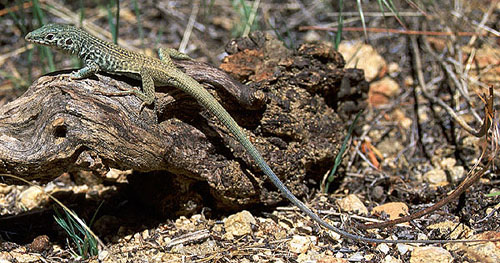
The Western Mexico Whiptail has scaly skin, bowed legs, and a pointed snout. It lacks vertebral crests.[1][2]
Its dorsal coloration consists of multiple straight stripes on grey, brown, or black backgrounds. Pale spots or bar-like markings may occur alongside the stripes.[3][4]
Its abdominal and pelvic regions can be cream-colored or light to medium blue, and the pelvic region can sometimes be red. The throat can display pink to red coloration.[5][6][7]
Males generally develop more colorful ventral patterns than females as they mature. Females retain their dorsal striping as they grow.[8][9]
Its snout-to-vent length can reach approximately 4 inches. Its tail can exceed twice its snout-to-vent length when it has not recently been shortened, and its total length can approach one foot.[10][11][12]
Habitat
The Western Mexico Whiptail inhabits savannas and shrublands in brushy, broken terrain. Its habitats include open areas of tropical low deciduous forest, thorn forest, low spiny sub-evergreen forest, and medium sub-deciduous forest.[13][14][15]
Its habitat range spans temperate and tropical climates in western and southwestern Mexico. The species can also inhabit densely populated urban areas.[16][17]
Individuals are often found beneath low desert shrubs, under rocks, and among leaf litter.[18]
Behaviour
The Western Mexico Whiptail is diurnal and mostly solitary outside the breeding season. During the breeding season, individuals become associated with females.[19][20]
The species is an active forager rather than a sit-and-wait ambush predator. Foraging is its primary activity throughout the day, and individuals frequently probe leaf litter, crevices, and accumulated debris while searching for food.[21][22][23]
When escaping threats, individuals can run at speeds reaching 18 mph (29 km/h).[24]
When attacked by a predator, the species can shed part of its tail. The detached tail can continue contracting and moving.[25][26]
The species is preyed upon by snakes and predatory birds.[27]
Reproduction and life cycle
The Western Mexico Whiptail reproduces sexually and has separate male and female reproductive individuals. It does not reproduce through parthenogenesis.[28][29]
Female reproductive activity has been recorded from April through August. Reproductive timing is associated with day length rather than temperature, and males and females reach peak reproductive activity during the same period.[30][31][32]
Males reach reproductive maturity at approximately 2 inches SVL, compared with approximately 2.5 inches for females.[33]
During courtship, males may accompany females for 2–5 days, remaining within 0.5 metres or less of them. Accompanied females copulate 6.7 times more frequently with their accompanying males.[34][35][36]
Copulation involves the male and female pressing their cloacas together. The mating pair can remain motionless in this position for 5–10 minutes.[37][38]
Females store ejaculated sperm in a seminal receptacle within the cloaca.[39]
Similar species
The Western Mexico Whiptail can be confused with the Western Whiptail, Aspidoscelis tigris.[40]
Classification of the Western Mexico Whiptail
| Kingdom | Animalia |
|---|---|
| Phylum | Chordata |
| Subphylum | Vertebrata |
| Infraphylum | Gnathostomata |
| Parvphylum | Osteichthyes |
| Megaclass | Tetrapoda |
| Class | Reptilia (Reptile) |
| Order | Squamata (Snakes) |
| Suborder | Autarchoglossa |
| Family | Teiidae (Tegus) |
| Genus | Aspidoscelis (North American Whiptails) |
| Species | Aspidoscelis costatus (Cope, 1878) |
Where the Western Mexico Whiptail is found
Checklists and occurrence records place Aspidoscelis costatus in 1 country across North America. GBIF holds 5,109 georeferenced records of it.
Countries
Regions and cities with the most records
- Sinaloa, Mexico 1,333
- Nayarit, Mexico 986
- Sonora, Mexico 980
- Jalisco, Mexico 252
- Mazatlán, Mexico 189
- Guerrero, Mexico 180
- Puebla, Mexico 160
- Morelos, Mexico 147
- Chihuahua, Mexico 144
- Culiacán, Mexico 139
- Santiago Ixcuintla, Mexico 129
- Oaxaca, Mexico 127
- Michoacán, Mexico 93
- El Rosario, Mexico 82
- Emiliano Zapata, Mexico 81
- Xochitepec, Mexico 80
- Xalisco, Mexico 76
- Temixco, Mexico 75
- Xoxocotla, Mexico 71
- Santa Rosa Treinta, Mexico 70
- Zacatepec de Hidalgo, Mexico 70
- Tuxpan, Mexico 68
- Escuinapa de Hidalgo, Mexico 66
- Tepic, Mexico 66
- Puente de Ixtla, Mexico 65
- México, Mexico 64
- Ixtlán del Río, Mexico 63
- Guasave, Mexico 62
- Tlaxcala, Mexico 62
- Guamúchil, Mexico 59
- Jojutla, Mexico 56
- Tlaquiltenango, Mexico 56
- Yautepec, Mexico 56
- Axochiapan, Mexico 54
- Jiutepec, Mexico 54
- Tres de Mayo, Mexico 54
Range as the checklists state it
Mexico (Sonora, Morelos, Sinaloa, Nayarit, Tlaxcala [HR 34: 383], Oaxaca, Jalisco, Guerrero, Durango, Veracruz, Chihuahua, Colima, Zacatecas)
A number beside a place is its count of GBIF occurrence records. A place without a number comes from a checklist alone. Records show where a species has been observed or collected, which can include escapes and vagrants.
Common names
English
- Western Mexico Whiptail
Names in 5 other languages
- Danish
- Vestmexicansk Piskehaleteju
- Portuguese
- Cauda-de-chicote-mexicano-ocidental
- Russian
- Альпийская хлыстохвостая ящерица
- Spanish
- Huico Llanero, Huico del oeste mexicano, Huico del oeste-mexicano
- sei
- huico
Synonyms
10 other scientific names have been used for this species and are now treated as synonyms of Aspidoscelis costatus.
- Aspidoscelis alpinus (Maslin, Walker & Martin, 1965)
- Cnemidophorus alpinus Maslin & Walker, 1965
- Cnemidophorus communis occidentalis Gadow, 1906
- Cnemidophorus sacki barrancorum Zweifel, 1959
- Cnemidophorus sacki griseocephalus Zweifel, 1959
- Cnemidophorus sacki huico Zweifel, 1959
- Cnemidophorus sacki mazatlanensis Zweifel, 1959
- Cnemidophorus sacki nigrigularis Zweifel, 1959
- Cnemidophorus sacki zweifeli Duellman, 1960
- Cnemidophorus costatus Cope, 1878 ambiguous synonym
Subspecies and varieties
- Aspidoscelis costatus barrancorum (Barranca Whiptail) subspecies
- Aspidoscelis costatus costatus (Balsas Basin Whiptail) subspecies
- Aspidoscelis costatus griseocephalus (Blue-throated Whiptail) subspecies
- Aspidoscelis costatus huico (Blue-chested Whiptail) subspecies
- Aspidoscelis costatus mazatlanensis (Sinaloan Whiptail) subspecies
- Aspidoscelis costatus nigrigularis (Black-throated Whiptail) subspecies
- Aspidoscelis costatus occidentalis (Western México Whiptail) subspecies
- Aspidoscelis costatus zweifeli (Zweifel's Whiptail) subspecies
Related species
-
 New Mexico WhiptailAspidoscelis neomexicanus
-
 Desert Grassland Whiptail LizardAspidoscelis uniparens
-
 Six-lined RacerunnerAspidoscelis sexlineatus
-
 Western WhiptailAspidoscelis tigris
-
 Texas Spotted WhiptailAspidoscelis gularis
- Little Striped WhiptailAspidoscelis inornatus
-
 Chihuahuan Spotted WhiptailAspidoscelis exsanguis
-
 Plateau Striped WhiptailAspidoscelis velox
Compare
Questions and answers
What is the scientific name of the Western Mexico Whiptail?
The scientific name of the Western Mexico Whiptail is Aspidoscelis costatus. Written with its author, the full name is Aspidoscelis costatus (Cope, 1878).
Which family does the Western Mexico Whiptail belong to?
Aspidoscelis costatus belongs to the family Teiidae, in the order Squamata and the class Reptilia.
Where is the Western Mexico Whiptail found?
Checklists and occurrence records place Aspidoscelis costatus in 1 country: Mexico.
What is the conservation status of the Western Mexico Whiptail?
The IUCN Red List category recorded for Aspidoscelis costatus is Least Concern (LC).
Sources
Passages the profile rests on
- The species has scaly skin with stripes, bowed legs, and a pointed snout. Source passage: “Western Mexico Whiptails have scaly skin with stripes, bowed legs, and pointed snout.” — English Wikipedia
- The species lacks vertebral crests. Source passage: “It does not have any vertebral crests (spines).” — English Wikipedia
- Its dorsal coloration includes multiple straight stripes on grey, brown, or black backgrounds. Source passage: “They have multiple straight dorsal stripes with varying color patterns on grey, brown, or black ground” — English Wikipedia
- Pale spots or bar-like markings may occur alongside its dorsal stripes. Source passage: “often mixed with pale-hued spots, or bar-like pattern.” — English Wikipedia
- Its abdominal and pelvic regions can be cream-colored or light to medium blue. Source passage: “Ventrally, the lizard has abdominal, and pelvic regions that are either cream colored, or sometimes light to medium blue” — English Wikipedia
- The pelvic region can sometimes be red. Source passage: “sometimes even red in the pelvic region.” — English Wikipedia
- The throat region can display pink to red coloration. Source passage: “The gular (throat) region can have increased intensity of coloration that ranges from pink to red.” — English Wikipedia
- Males generally develop more colorful ventral patterns than females as they mature. Source passage: “with males becoming more colorful than females.” — English Wikipedia
- Females retain their dorsal striping as they grow. Source passage: “females representing all stages of color patterns showed similar changes but did not lose striping as they grew.” — English Wikipedia
- Its snout-to-vent length can reach approximately 4 inches. Source passage: “A small lizard, up to only 4 inches SVL (snout to vent length)” — English Wikipedia
- Its tail can exceed twice its snout-to-vent length when it has not recently been shortened. Source passage: “may be more than two times its SVL.” — English Wikipedia
- Its total length, including the tail, can approach one foot. Source passage: “it can reach a total length of close to 1 foot, tail included” — English Wikipedia
- The species inhabits savannas and shrublands in brushy, broken terrain. Source passage: “Aspidoscelis costatus prefers natural habitats such as savanna, and shrubland in brushy, broken country.” — English Wikipedia
- Its habitats include open areas of tropical low deciduous forest and thorn forest. Source passage: “open areas of tropical low deciduous forest and thorn forest” — English Wikipedia
- It also occurs in low spiny sub-evergreen forest and medium sub-deciduous forest. Source passage: “low spiny sub-evergreen forest and medium sub-deciduous forest.” — English Wikipedia
- Its habitat range spans temperate and tropical climates in western and southwestern Mexico. Source passage: “spanning both temperate and tropical climates in western and southwestern Mexico.” — English Wikipedia
- The species can inhabit densely populated urban areas. Source passage: “we are starting to see urban population of Aspidoscelis costatus, even in densely populated cities” — English Wikipedia
- Individuals are often found beneath low desert shrubs, under rocks, and among leaf litter. Source passage: “They are often found under low desert scrubs, rocks, or nosing around leaf litter.” — English Wikipedia
- The species is diurnal and mostly solitary outside the breeding season. Source passage: “Whiptails are diurnal but mostly solitary creatures” — English Wikipedia
- Individuals become associated with females during the breeding season. Source passage: “except during the breeding season, when males start accompanying females around.” — English Wikipedia
- The species is an active forager rather than a sit-and-wait ambush predator. Source passage: “Aspidoscelis are not sit-and-wait ambush predators. Instead, they are non-territorial, active "widely foraging" lizards.” — English Wikipedia
- Foraging is the species' primary activity throughout the day. Source passage: “Foraging is their primary activity throughout the day.” — English Wikipedia
- Individuals frequently probe leaf litter, crevices, and accumulated debris while searching for food. Source passage: “They are aseen busy probing with their snouts under leaf-litter, in crevices, scratching in the ground, or digging furiously through piles of accumulated debris.” — English Wikipedia
- Individuals can run at speeds reaching 18 mph (29 km/h) when escaping threats. Source passage: “they run fast at top speeds of 18 mph (29 km/h)” — English Wikipedia
- The species can shed part of its tail when attacked by a predator. Source passage: “whiptail lizard will drop a portion of their tail in response to an attack by a predator.” — English Wikipedia
- Its tail can continue contracting and moving after being detached. Source passage: “muscles in the tail would continue contracting, causing the tail to flop and wiggle around.” — English Wikipedia
- The species is preyed upon by snakes and predatory birds. Source passage: “This species and virtually all Aspidoscelis species are preyed upon by snakes and predaceous birds.” — English Wikipedia
- The Western Mexico Whiptail reproduces sexually rather than through parthenogenesis. Source passage: “This is not the case with Western Mexico Whiptail lizard, which is a bisexual species.” — English Wikipedia
- The species has separate male and female reproductive individuals. Source passage: “They have sexual and dioecious (having the male and female reproductive organs in separate individuals) reproduction.” — English Wikipedia
- Female reproductive activity has been recorded from April through August. Source passage: “Female reproductive cycle was markedly seasonal, recorded from April (end of the dry season) through August (middle of the rainy season).” — English Wikipedia
- The timing of reproduction is associated with day length rather than temperature. Source passage: “Reproduction is associated with day length rather than with temperature.” — English Wikipedia
- Males and females reach peak reproductive activity during the same period. Source passage: “in which males and females reach the maximum sperm production, mating, and ovulation activities during the same period.” — English Wikipedia
- Males reach reproductive maturity at approximately 2 inches SVL, compared with approximately 2.5 inches for females. Source passage: “about 2 inches for male versus 2.5 inches for female” — English Wikipedia
- Males may accompany females for 2–5 days during courtship. Source passage: “for only 9 hours per day for 2–5 days” — English Wikipedia
- During accompaniment, males remain within 0.5 metres or less of females. Source passage: “at a distance of 0.5 m or less” — English Wikipedia
- Accompanied females copulate 6.7 times more frequently with their accompanying males. Source passage: “Accompanied females copulated 6.7 times more with consensual, accompanying males.” — English Wikipedia
- Copulation involves the male and female pressing their cloacas together. Source passage: “Mating is performed by cloacal (see Physical Description) copulation, commonly referred to as cloacal kiss or cloacal apposition.” — English Wikipedia
- The mating pair can remain motionless in the copulatory position for 5–10 minutes. Source passage: “They remain in this position for 5~10 minutes, during which time ejaculation takes place.” — English Wikipedia
- Females store ejaculated sperm in a seminal receptacle within the cloaca. Source passage: “Sperm ejaculated is actually stored in a "sperm storage structure" (the seminal receptacle) in the female cloaca.” — English Wikipedia
- The Western Mexico Whiptail can be confused with the Western Whiptail, Aspidoscelis tigris. Source passage: “can easily be confused with the Western Whiptail, which refers to a different lizard, Aspidoscelis tigris.” — English Wikipedia
- The Western Mexico Whiptail is endemic to Mexico. Source passage: “Aspidoscelis costatus, also known as the western Mexico whiptail, is a species of whiptail lizard endemic to Mexico” — English Wikipedia
- The species has eight recognized subspecies, all endemic to Mexico. Source passage: “Aspidoscelis costatus has 8 subspecies, all of which are endemic to Mexico.” — English Wikipedia
Data
- Catalogue of Life, 2026-10-16 XR cc by
- Global Biodiversity Information Facility CC BY 4.0
- Wikidata CC0
- GeoNames CC BY 4.0
- Wikimedia Commons per image; credit shown with each image
- Within the Catalogue of Life, this name comes from The Reptile Database cc by
References
- Cope, E. D. (1878). Tenth contribution to the herpetology of Tropical America. Proc. Amer. Philos. Soc. 17: 85-98 [1877].
- Günther, A. C. L. G. (1885). Reptilia and Batrachia. Biologia Centrali-Américana. Taylor, & Francis, London, 326 Pp. [Published in Parts from 1885-1902; Reprint by the SSAR 1987].
- Gadow, H. (1906). A contribution to the study of evolution based upon the Mexican species of Cnemidophorus. Proc. Zool. Soc. London 1906: 277-375 (+ Maps).
- Zweifel, Richard G. (1959). Variation in and distribution of lizards of western Mexico related to Cnemidophorus sacki. Bull. Amer. Mus. Nat. Hist. 117 (2): 57-116.
- Duellman, W. E. (1960). A new subspecies of lizard, Cnemidophorus sacki, from Michoacan, México. Univ. Kansas Publ. Mus. Nat. Hist. 10: 587-598.
- Zweifel, Richard G. (1961). Relationship of two whiptail lizards (genus Cnemidophorus) in western Mexico. Copeia 1961 (1): 98-103.
- Duellman, W. E., & ZWEIFEL, R. G. (1962). A synopsis of the lizards of the sexlineatus group (genus Cnemidophorus). Bull. Amer. Mus. Nat. Hist. 123: 155-210.
- McCoy, Clarence J.;Richmond, Neil D. (1965). Herpetological Type-specimens in Carnegie Museum. [type catalogue]. Annals of the Carnegie Museum 38: 233-264 [1966].
- Maslin, T. ; Paul Walker, & J. Martin. (1965). Cnemidophorus alpinus: A new species of teiid lizard from Puebla, Mexico. University of Colorado Studies. Series in Biology (19): 1-8.
- Hardy, L.M., & McDiarmid, R.W. (1969). The amphibians and reptiles of Sinaloa, Mexico. Univ. Kansas Publ. Mus. Nat. Hist. 18 (3): 39-252.
- McDiarmid, R.W., Copp, J.F., & Breedlove, D.E. (1976). Notes on the herpetofauna of western Mexico: new records from Sinaloa and the Tres Marias Islands. Contributions in Science, Los Angeles (275): 1-17.
- Kluge, Arnold G. (1984). Type-specimens of reptiles in the University of Michigan Museum of Zoology. [type catalogue]. Miscellaneous Publications, Museum of Zoology, University of Michigan (167): 1-85.
- Webb, R. G. (1984). Herpetogeography in the Mazatlán-Durango Region of the Sierra Madre Occidental, Mexico. Vetrebrate Ecology and Systematics - A Ribute to Henry S. Fitch; Museum of Natural History, University of Kansas, Lawrence, Pp. 217-241.
- Maslin, T., & Secoy, D. M. (1986). A checklist of the lizard genus Cnemidophorus (Teiidae). Contr. Zool. Univ. Colorado Mus. 1: 1-60.
- Tanner, W. W. (1987). Lizards and turtles of Western Chihuahua. Great Basin Naturalist. 47: 383-421.
- Brooks, G. R., & Mitchell, J. C. (1989). Predator-Prey Size Relations in Three Species of Lizards from Sonora, Mexico. The Southwestern Naturalist, 34(4), 541–546.
- Wright, J. W. (1993). Evolution of the lizards of the genus Cnemidophorus. In: Wright,J.W. & Vitt,L.J. (eds.) Biology of Whiptail lizards (genus Cnemidophorus), pp. 27-81. Oklahoma Mus. Nat. Hist., Norman.
- Castro-Franco, Rubén, & María Guasalupe Bustos-Zagal. (1994). List of reptiles of Morelos, Mexico, and their distribution in relation to vegetation types. Southwestern Naturalist 39 (2): 171-175.
- REEDER, T.W.; CHARLES J. COLE AND HERBERT C. DESSAUER. (2002). Phylogenetic Relationships of Whiptail Lizards of the Genus Cnemidophorus (Squamata: Teiidae): A Test of Monophyly, Reevaluation of Karyotypic Evolution, and Review of Hybrid Origins. American Museum Novitates 3365: 1-64.
- Castro Franco, R. & M. G. Bustos-Zagal. (2003). Lagartijas de Morelos, México: distribución, hábitat y conservación. Acta Zoológica Mexicana (N.S.) 88:123-142.
- Lemos-Espinal, Julio A., David Chiszar, and Hobart M. Smith. (2004). Selected Records of 2003 Lizards from Chihuahua and Sonora, Mexico. Bull. Chicago Herp. Soc. 39 (9): 164-168.
- Crawford, N.G. et al. (2008). Thirteen polymorphic microsatellite DNA loci from whiptails of the genus Aspidoscelis (Teiidae: Squamata) and related cnemidophorine lizards. Molecular Ecology Resources 8: 219–223.
- Jones, L. L., & Lovich, R. E. (2009). Lizards of the American Southwest. A photographic field guide. Rio Nuevo Publishers, Tucson, AZ, 568 Pp. [Review in Reptilia 86: 84].
- Walker, James M. (2010). Aspidoscelis costata griseocephala: Reproduction. Herpetological Review 41 (3): 351.
- Cobarrubias, E. F., & Daniel Cruz-Sáenz, a. D. L. (2012). Notes on the Herpetofauna of Western Mexico 6: Amphibians and Reptiles of Hostotipaquillo, Jalisco, Mexico. Bull. Chicago Herp. Soc. 47 (2):21-26.
This species in other databases
Page built on 28 November 2026. See how the catalog is made and all sources and licences.
Cite this page
ScientificNames.org. (2026). Aspidoscelis costatus (Western Mexico Whiptail). Retrieved November 28, 2026, from https://scientificnames.org/species/aspidoscelis-costatus
“Aspidoscelis costatus (Western Mexico Whiptail).” ScientificNames.org, 2026, scientificnames.org/species/aspidoscelis-costatus. Accessed 28 Nov. 2026.
ScientificNames.org. “Aspidoscelis costatus (Western Mexico Whiptail).” Accessed November 28, 2026. https://scientificnames.org/species/aspidoscelis-costatus.
@misc{scientificnames_aspidoscelis_costatus_western_mexico_whiptail,
  author = {{ScientificNames.org}},
  title = {Aspidoscelis costatus (Western Mexico Whiptail)},
  year = {2026},
  url = {https://scientificnames.org/species/aspidoscelis-costatus},
  note = {Accessed 2026-11-28}
}