Species · Reptiles
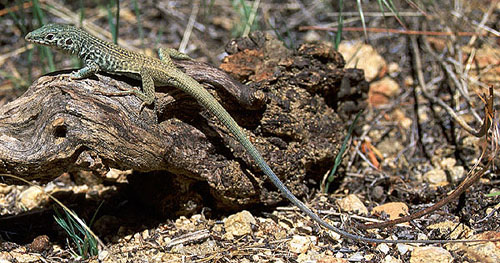
Blackbelly Racerunner Aspidoscelis deppii
The scientific name of the Blackbelly Racerunner is Aspidoscelis deppii. It is a species of reptile in the family Teiidae (tegus), order Squamata. The name dates from 1834.
- Scientific name
- Aspidoscelis deppii (Wiegmann, 1834)
- Common name
- Blackbelly Racerunner
- Genus
- Aspidoscelis
- Family
- Teiidae (Tegus)
- Order
- Squamata
- Class
- Reptilia
- Red List category
- LC Least Concern
- Recorded in
- 6 countries
- Name status
- accepted in the Catalogue of Life

Overview
Aspidoscelis deppii, known commonly as the blackbelly racerunner, is a species of lizard in the family Teiidae. The species is native to Central America and southern Mexico. There are three recognized subspecies.
Classification of the Blackbelly Racerunner
| Kingdom | Animalia |
|---|---|
| Phylum | Chordata |
| Subphylum | Vertebrata |
| Infraphylum | Gnathostomata |
| Parvphylum | Osteichthyes |
| Megaclass | Tetrapoda |
| Class | Reptilia (Reptile) |
| Order | Squamata (Snakes) |
| Suborder | Autarchoglossa |
| Family | Teiidae (Tegus) |
| Genus | Aspidoscelis (North American Whiptails) |
| Species | Aspidoscelis deppii (Wiegmann, 1834) |
Where the Blackbelly Racerunner is found
Checklists and occurrence records place Aspidoscelis deppii in 6 countries across North America. GBIF holds 8,871 georeferenced records of it.
Countries
Regions and cities with the most records
- Chiapas, Mexico 1,862
- Oaxaca, Mexico 1,710
- Santo Domingo Tehuantepec, Mexico 707
- Guerrero, Mexico 552
- Veracruz, Mexico 543
- Guanacaste Province, Costa Rica 377
- Veracruz, Mexico 275
- Salina Cruz, Mexico 231
- Michoacán, Mexico 204
- El Progreso, Guatemala 174
- Acapulco de Juárez, Mexico 151
- Tuxtla, Mexico 142
- Morelos, Mexico 136
- Chiapa de Corzo, Mexico 132
- Campeche, Mexico 115
- Rivas Department, Nicaragua 92
- Huehuetenango, Guatemala 90
- Ciudad del Carmen, Mexico 86
- Colima, Mexico 77
- Puntarenas Province, Costa Rica 64
- Cortés Department, Honduras 63
- La Paz Department, El Salvador 63
- Apatzingán, Mexico 62
- Emiliano Zapata, Mexico 49
- Temixco, Mexico 49
- San Pedro Sula, Honduras 47
- Pijijiapan, Mexico 46
- Ciudad Lázaro Cárdenas, Mexico 43
- Ciudad de Villa de Álvarez, Mexico 43
- Colima, Mexico 43
- La Lima, Honduras 43
- Jiutepec, Mexico 42
- Nayarit, Mexico 35
- Cuernavaca, Mexico 32
- Jalisco, Mexico 32
- Masaya, Nicaragua 32
Range as the checklists state it
Mexico (Morelos, Michoacan; Guerrero, Oaxaca, Chiapas, Jalisco, Colima),
A number beside a place is its count of GBIF occurrence records. A place without a number comes from a checklist alone. Records show where a species has been observed or collected, which can include escapes and vagrants.
Common names
English
- Blackbelly Racerunner
- Black-bellied Racerunner
- Blackbelly Whiptail
Names in 6 other languages
- Danish
- Sortbuget Piskehaleteju
- Italian
- Lucertola corritrice ventre nero
- Japanese
- デップハシリトカゲ
- Portuguese
- Cauda-de-chicote-de-barriga-preta, Corredor-de-barriga-preta
- Russian
- Семиполосая ящерица-бегун
- Spanish
- Chisbala rayada, Cuiji Panzanegra, Huico siete líneas
Synonyms
8 other scientific names have been used for this species and are now treated as synonyms of Aspidoscelis deppii.
- Cnemidophorus alfaronis Cope, 1894
- Cnemidophorus decemlineatus Hallowell, 1861
- Cnemidophorus deppei oligoporus Smith, 1939
- Cnemidophorus deppei schizophorus Smith & Brandon, 1968
- Cnemidophorus deppii Wiegmann, 1834
- Cnemidophorus deppii infernalis Duellman & Wellman, 1969
- Cnemidophorus lativittis Cope, 1878
- Aspidoscelis deppii infernalis (Duellman & Wellman, 1960) ambiguous synonym
Subspecies and varieties
- Aspidoscelis deppii deppii (Black-bellied Racerunner) subspecies
- Aspidoscelis deppii infernalis (Deppe's Inferno Racerunner) subspecies
- Aspidoscelis deppii schizophorus (Deppe's Split Racerunner) subspecies
Related species
-
 New Mexico WhiptailAspidoscelis neomexicanus
-
 Desert Grassland Whiptail LizardAspidoscelis uniparens
-
 Six-lined RacerunnerAspidoscelis sexlineatus
-
 Western WhiptailAspidoscelis tigris
-
 Texas Spotted WhiptailAspidoscelis gularis
- Little Striped WhiptailAspidoscelis inornatus
-
 Chihuahuan Spotted WhiptailAspidoscelis exsanguis
- Plateau Striped WhiptailAspidoscelis velox
Compare
Questions and answers
What is the scientific name of the Blackbelly Racerunner?
The scientific name of the Blackbelly Racerunner is Aspidoscelis deppii. Written with its author, the full name is Aspidoscelis deppii (Wiegmann, 1834).
Which family does the Blackbelly Racerunner belong to?
Aspidoscelis deppii belongs to the family Teiidae, in the order Squamata and the class Reptilia.
Where is the Blackbelly Racerunner found?
Checklists and occurrence records place Aspidoscelis deppii in 6 countries: Mexico, Costa Rica, Guatemala, Nicaragua, Honduras and El Salvador.
What is the conservation status of the Blackbelly Racerunner?
The IUCN Red List category recorded for Aspidoscelis deppii is Least Concern (LC).
What other names does the Blackbelly Racerunner have?
Aspidoscelis deppii is also known in English as Black-bellied Racerunner and Blackbelly Whiptail.
Sources
Data
- Catalogue of Life, 2026-10-16 XR cc by
- Global Biodiversity Information Facility CC BY 4.0
- Wikidata CC0
- English Wikipedia CC BY-SA 4.0
- GeoNames CC BY 4.0
- Wikimedia Commons per image; credit shown with each image
- Within the Catalogue of Life, this name comes from The Reptile Database cc by
References
- Wiegmann, A. F. A. (1834). Herpetologia Mexicana, seu descriptio amphibiorum novae hispaniae , quae itineribus comitis de Sack, Ferdinandi Deppe et Chr. Guil. Schiede im Museum Zoologicum Berolinense Pervenerunt. Pars prima, saurorum species. Berlin, Lüderitz, Iv + 54 Pp.
- Hallowell, E. (1861). Report upon the Reptilia of the North Pacific Exploring Expedition, under command of Capt. John Rogers, U. S. N. Proc. Acad. Nat. Sci. Philadelphia 12 [1860]: 480 - 510.
- Cope, E. D. (1878). Tenth contribution to the herpetology of Tropical America. Proc. Amer. Philos. Soc. 17: 85-98 [1877].
- Günther, A. C. L. G. (1885). Reptilia and Batrachia. Biologia Centrali-Américana. Taylor, & Francis, London, 326 Pp. [Published in Parts from 1885-1902; Reprint by the SSAR 1987].
- Cope, E. D. (1892). A synopsis of the species of the teiid genus Cnemidophorus. Trans. Am. Phil. Soc. (Ser. 2) 17 (1): 27-52 [1893].
- Cope, E. D. (1894). Third addition to a knowledge of the batrachia and reptilia of Costa Rica. Proc. Acad. Nat. Sci. Philadelphia 1894: 194-206.
- Gadow, H. (1906). A contribution to the study of evolution based upon the Mexican species of Cnemidophorus. Proc. Zool. Soc. London 1906: 277-375 (+ Maps).
- Loveridge, & Arthur. (1929). East African reptiles and amphibians in the United States National Museum. Bull. US Natl. Mus. (151): 1-135.
- Burt, C. E. (1931). A study of the teiid lizards of the genus Cnemidophorus with special reference to their phylogenetic relationships. Bull. US Natl. Mus. 154: 286 Pp.
- Smith, Hobart M. (1939). Notes on Mexican reptiles and amphibians. Zoological Series of Field Museum of Natural History 24 (4): 15-35. Link
- Smith, Hobart M. (1944). Additions to the list of Mexican amphibians and reptiles in the Carnegie Museum. Annals of the Carnegie Museum 30: 87-92.
- Smith, H. M., & Burger, W.L. (1950). Herpetological results of the University of Illinois field expedition, Spring 1949. III. Sauria. Transactions of the Kansas Academy of Science 53 (2): 165-175.
- Smith, H. M., & Taylor, E. H. (1950). An annotated checklist and key to the reptiles of Mexico exclusive of the snakes. Bull. US Natl. Mus. 199: 1-253.
- Werler, J. E., & SMITH, H. M. (1952). Notes on a collection of reptiles and amphibians from Mexico, 1951-1952. Texas Journal of Science 14: 551-573.
- Mertens, R. (1952). Die Amphibien und Reptilien von El Salvador. Abh. Senckenb. Naturf. Ges. (Frankfurt) (No. 487): 120 Pp.
- Brongersma, L. D. (1954). On some lizards from the Republic of El Salvador. Konikl. Nederl. Akad. Van Wetenschappen (Amsterdam) 57 (2): 165-174.
- Taylor, E. H. (1956). A review of the lizards of Costa Rica. Univ. Kansas Sci. Bull. 38 (Part 1): 3-322.
- Duellman, W. E., & WELLMAN, J. (1960). A systematic study of the lizards of the deppei group (genus Cnemidophorus) in México and Guatemala. Misc. Publ. Mus. Zool. Univ. Michigan (No. 111): 1-81.
- Stuart, L. C. (1963). A checklist of the herpetofauna of Guatemala. Misc. Publ. Mus. Zool., Univ. Michigan (No. 122): 1-150.
- Smith, H.M., and R. Brandon. (1968). Data nova herpetologica Mexicana. Transactions of the Kansas Academy of Science 71: 49-61. Link
- Lowe, Charles H., Jr;Wright, John W.;Cole, Charles J.;Bezy, Robert L. (1970). Chromosomes and evolution of the species groups of Cnemidophorus (Reptilia: Teiidae). Systematic Zoology 19: 128-141.
- Fitch, Henry S. (1973). Population structure and survivorship in some Costa Rican lizards. Occ. Pap. Mus. Nat. Hist. Univ. Kansas 18: 1-41.
- Alvarez DEL TORO, M. (1982). Los Reptiles de Chiapas. 3rd ed. México: Tuxtla Gutiérrez, 248 Pp.
- Maslin, T., & Secoy, D. M. (1986). A checklist of the lizard genus Cnemidophorus (Teiidae). Contr. Zool. Univ. Colorado Mus. 1: 1-60.
- Vitt, L. J., Zani, P. A., Caldwell, J. P., & Durtsche, R. D. (1993). Ecology of the whiptail lizard Cnemidophorus deppii on a tropical beach. Canadian Journal of Zoology 71: 2391-2400.
This species in other databases
Page built on 26 November 2026. See how the catalog is made and all sources and licences.
Cite this page
ScientificNames.org. (2026). Aspidoscelis deppii (Blackbelly Racerunner). Retrieved November 26, 2026, from https://scientificnames.org/species/aspidoscelis-deppii
“Aspidoscelis deppii (Blackbelly Racerunner).” ScientificNames.org, 2026, scientificnames.org/species/aspidoscelis-deppii. Accessed 26 Nov. 2026.
ScientificNames.org. “Aspidoscelis deppii (Blackbelly Racerunner).” Accessed November 26, 2026. https://scientificnames.org/species/aspidoscelis-deppii.
@misc{scientificnames_aspidoscelis_deppii_blackbelly_racerunner,
  author = {{ScientificNames.org}},
  title = {Aspidoscelis deppii (Blackbelly Racerunner)},
  year = {2026},
  url = {https://scientificnames.org/species/aspidoscelis-deppii},
  note = {Accessed 2026-11-26}
}