Species · Reptiles
Gray Checkered Whiptail Aspidoscelis dixoni
The scientific name of the Gray Checkered Whiptail is Aspidoscelis dixoni. It is a species of reptile in the family Teiidae (tegus), order Squamata. The name dates from 1973.
- Scientific name
- Aspidoscelis dixoni (Scudday, 1973)
- Common name
- Gray Checkered Whiptail
- Genus
- Aspidoscelis
- Family
- Teiidae (Tegus)
- Order
- Squamata
- Class
- Reptilia
- Red List category
- NT Near Threatened
- Recorded in
- 1 country
- Name status
- accepted in the Catalogue of Life

Overview
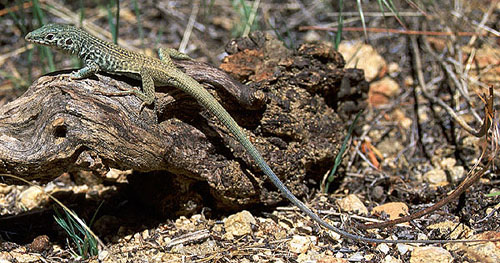
The Gray checkered whiptail is an all-female lizard species. It occurs in geographically scattered patches. It is typically gray with 10–12 white or yellow longitudinal stripes that may have spotting or checkering, and has a thin body and a long tail.
Written 28 November 2026 from the sources listed below. Each statement was checked against the passage it cites; statements that could not be supported were removed.
Appearance
The Gray checkered whiptail is typically gray with 10–12 white or yellow longitudinal stripes that may have spotting or checkering. It has a thin body and a long tail.[1][2]
It measures 20–30 centimetres in total length, including its tail, and reaches a maximum total length of 36.5 centimetres.[3][4]
Reproduction and life cycle
The Gray checkered whiptail is an all-female lizard species.[5]
Similar species
Aspidoscelis dixoni is considered a synonym of the common checkered whiptail (Aspidoscelis tesselatus).[6]
Classification of the Gray Checkered Whiptail
| Kingdom | Animalia |
|---|---|
| Phylum | Chordata |
| Subphylum | Vertebrata |
| Infraphylum | Gnathostomata |
| Parvphylum | Osteichthyes |
| Megaclass | Tetrapoda |
| Class | Reptilia (Reptile) |
| Order | Squamata (Snakes) |
| Suborder | Autarchoglossa |
| Family | Teiidae (Tegus) |
| Genus | Aspidoscelis (North American Whiptails) |
| Species | Aspidoscelis dixoni (Scudday, 1973) |
Where the Gray Checkered Whiptail is found
Checklists and occurrence records place Aspidoscelis dixoni in 1 country across North America. GBIF holds 96 georeferenced records of it.
Countries
Regions and cities with the most records
Range as the checklists state it
USA (New Mexico: Hidalgo County; Texas: Presidio County)
A number beside a place is its count of GBIF occurrence records. A place without a number comes from a checklist alone. Records show where a species has been observed or collected, which can include escapes and vagrants.
Common names
English
- Gray Checkered Whiptail
- Gray-checkered Whiptail
Synonyms
One other scientific name has been used for this species and is now treated as a synonym of Aspidoscelis dixoni.
- Cnemidophorus dixoni Scudday, 1973
Related species
-
 New Mexico WhiptailAspidoscelis neomexicanus
-
 Desert Grassland Whiptail LizardAspidoscelis uniparens
-
 Six-lined RacerunnerAspidoscelis sexlineatus
-
 Western WhiptailAspidoscelis tigris
-
 Texas Spotted WhiptailAspidoscelis gularis
- Little Striped WhiptailAspidoscelis inornatus
-
 Chihuahuan Spotted WhiptailAspidoscelis exsanguis
-
 Plateau Striped WhiptailAspidoscelis velox
Compare
Questions and answers
What is the scientific name of the Gray Checkered Whiptail?
The scientific name of the Gray Checkered Whiptail is Aspidoscelis dixoni. Written with its author, the full name is Aspidoscelis dixoni (Scudday, 1973).
Which family does the Gray Checkered Whiptail belong to?
Aspidoscelis dixoni belongs to the family Teiidae, in the order Squamata and the class Reptilia.
Where is the Gray Checkered Whiptail found?
Checklists and occurrence records place Aspidoscelis dixoni in 1 country: United States.
What is the conservation status of the Gray Checkered Whiptail?
The IUCN Red List category recorded for Aspidoscelis dixoni is Near Threatened (NT).
What other names does the Gray Checkered Whiptail have?
Aspidoscelis dixoni is also known in English as Gray-checkered Whiptail.
What is the scientific name for the whiptail lizard?
The scientific name of the Gray checkered whiptail is Aspidoscelis dixoni.[6]
Are whiptails all female?
The Gray checkered whiptail is an all-female lizard species.[5]
Sources
Passages the profile rests on
- The gray checkered whiptail is typically gray with 10–12 white or yellow longitudinal stripes that may have spotting or checkering. Source passage: “It is typically gray in color, with 10–12 white or yellow stripes that go the length of the body, often with spotting or checkering on the stripes.” — English Wikipedia
- The gray checkered whiptail has a thin body and a long tail. Source passage: “It is thin-bodied, with a long tail.” — English Wikipedia
- The gray checkered whiptail measures 20–30 centimetres in total length, including its tail. Source passage: “The gray checkered whiptail grows to between 20 and 30 centimetres (8 and 12 in) in total length (including tail).” — English Wikipedia
- The gray-checkered whiptail reaches a maximum total length of 36.5 centimetres. Source passage: “Gray-checkered Whiptail (Aspidoscelis dixoni) is a relatively large (up to 36.5 cm total length)” — nhnm.unm.edu
- The gray-checkered whiptail is an all-female lizard species. Source passage: “is a relatively large (up to 36.5 cm total length) all-female species of lizard” — nhnm.unm.edu
- Aspidoscelis dixoni is considered a synonym of the common checkered whiptail (Aspidoscelis tesselatus). Source passage: “The gray checkered whiptail (A. dixoni), once considered a species, is now considered to be a synonym of the common checkered whiptail.” — English Wikipedia
Data
- Catalogue of Life, 2026-10-16 XR cc by
- Global Biodiversity Information Facility CC BY 4.0
- Wikidata CC0
- GeoNames CC BY 4.0
- Wikimedia Commons per image; credit shown with each image
- Within the Catalogue of Life, this name comes from The Reptile Database cc by
References
- Scudday, J. F. (1973). A New Species of Lizard of the Cnemidophorus tesselatus Group from Texas. Journal of Herpetology 7 (4): 363-371. Link
- Stebbins, R. C. (1985). A Field Guide to Western Reptiles and Amphibians, 2nd ed. Houghton Mifflin, Boston.
- Wright, J. W. (1993). Evolution of the lizards of the genus Cnemidophorus. In: Wright,J.W. & Vitt,L.J. (eds.) Biology of Whiptail lizards (genus Cnemidophorus), pp. 27-81. Oklahoma Mus. Nat. Hist., Norman.
- Walker, J. M., Cordes, J. E., Cohn, C. C., Taylor, H. L., Kilambi, R. V., & Meyer, R. L. (1994). Life History Characteristics of 3 Morphotypes in the Parthenogenetic Cnemidophorus dixoni Complex (Sauria, Teiidae) in Texas and New-Mexico. Texas Journal of Science 46 (1): 27-33.
- Bartlett, R. D., & Bartlett, P. (1999). A Field Guide to Texas Reptiles and Amphibians. Gulf Publishing Co., Houston, Texas, 331 Pp.
- REEDER, T.W.; CHARLES J. COLE AND HERBERT C. DESSAUER. (2002). Phylogenetic Relationships of Whiptail Lizards of the Genus Cnemidophorus (Squamata: Teiidae): A Test of Monophyly, Reevaluation of Karyotypic Evolution, and Review of Hybrid Origins. American Museum Novitates 3365: 1-64.
- Cordes, James E. and James M. Walker. (2006). Evolutionary and Systematic Implications of Skin Histocompatibility Among Parthenogenetic Teiid Lizards: Three Color Pattern Classes of Aspidoscelis dixoni and One of Aspidoscelis tesselata. Copeia, 2006 (1):14-26.
- Jones, L. L., & Lovich, R. E. (2009). Lizards of the American Southwest. A photographic field guide. Rio Nuevo Publishers, Tucson, AZ, 568 Pp. [Review in Reptilia 86: 84].
- Collins, J.T. and T. W. Taggart. (2009). Standard Common and Current Scientific Names for North American Amphibians, Turtles, Reptiles, and Crocodilians, Sixth Edition. Center for North American Herpetology, 48 Pp.
- Lemos-Espinal, Julio A. (ed.). (2015). Amphibians and Reptiles of the US - Mexico Border States / Anfibios y Reptiles de los Estados de la Frontera México - Estados Unidos. Texas A&M University Press, College Station, Texas. X + 614 Pp.; ISBN 978-1-62349-306-6.
- Weidler, & M, J. (2019). Protected areas of Texas in relation to Texas reptiles. Herpetological Review 50 (3): 462-473.
This species in other databases
Page built on 29 November 2026. See how the catalog is made and all sources and licences.
Cite this page
ScientificNames.org. (2026). Aspidoscelis dixoni (Gray Checkered Whiptail). Retrieved November 29, 2026, from https://scientificnames.org/species/aspidoscelis-dixoni
“Aspidoscelis dixoni (Gray Checkered Whiptail).” ScientificNames.org, 2026, scientificnames.org/species/aspidoscelis-dixoni. Accessed 29 Nov. 2026.
ScientificNames.org. “Aspidoscelis dixoni (Gray Checkered Whiptail).” Accessed November 29, 2026. https://scientificnames.org/species/aspidoscelis-dixoni.
@misc{scientificnames_aspidoscelis_dixoni_gray_checkered_whiptail,
  author = {{ScientificNames.org}},
  title = {Aspidoscelis dixoni (Gray Checkered Whiptail)},
  year = {2026},
  url = {https://scientificnames.org/species/aspidoscelis-dixoni},
  note = {Accessed 2026-11-29}
}