Species · Reptiles
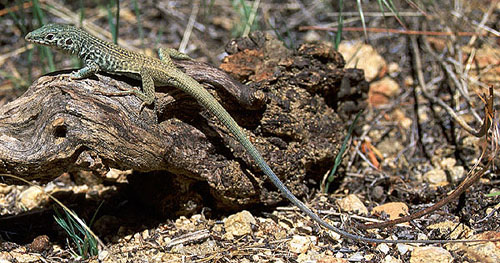
Espiritu Santo Whiptail Aspidoscelis espiritensis
The scientific name of the Espiritu Santo Whiptail is Aspidoscelis espiritensis. It is a species of reptile in the family Teiidae (tegus), order Squamata. The name dates from 1921.
- Scientific name
- Aspidoscelis espiritensis (Van Denburgh & Slevin, 1921)
- Common name
- Espiritu Santo Whiptail
- Genus
- Aspidoscelis
- Family
- Teiidae (Tegus)
- Order
- Squamata
- Class
- Reptilia
- Red List category
- LC Least Concern
- Recorded in
- 1 country
- Name status
- accepted in the Catalogue of Life
Overview
Aspidoscelis espiritensis, the Espiritu Santo whiptail, is a species of teiid lizard endemic to Isla Espíritu Santo in Mexico.
Classification of the Espiritu Santo Whiptail
| Kingdom | Animalia |
|---|---|
| Phylum | Chordata |
| Subphylum | Vertebrata |
| Infraphylum | Gnathostomata |
| Parvphylum | Osteichthyes |
| Megaclass | Tetrapoda |
| Class | Reptilia (Reptile) |
| Order | Squamata (Snakes) |
| Suborder | Autarchoglossa |
| Family | Teiidae (Tegus) |
| Genus | Aspidoscelis (North American Whiptails) |
| Species | Aspidoscelis espiritensis (Van Denburgh & Slevin, 1921) |
Where the Espiritu Santo Whiptail is found
Checklists and occurrence records place Aspidoscelis espiritensis in 1 country across North America. GBIF holds 64 georeferenced records of it.
Countries
Regions and cities with the most records
Range as the checklists state it
Mexico (Baja California, Espiritu Santo Island)
A number beside a place is its count of GBIF occurrence records. A place without a number comes from a checklist alone. Records show where a species has been observed or collected, which can include escapes and vagrants.
Common names
English
- Espiritu Santo Whiptail
- Espiritu Santo Island Whiptail
- Isla Espiritu Santo Whiptail
- Isla Espíritu Santo Whiptail
Names in 4 other languages
- German
- Espiritu Santo Rennechse
- Portuguese
- Cauda-de-chicote-da-ilha-espíritu-santo
- Spanish
- Huico de Espíritu Santo, Huico de la isla Espíritu Santo
- sei
- güico
Synonyms
3 other scientific names have been used for this species and are now treated as synonyms of Aspidoscelis espiritensis.
- Cnemidophorus espiritensis (Van Denburgh & Slevin, 1921)
- Cnemidophorus hyperythrus espiritensis (Van Denburgh & Slevin, 1921)
- Verticaria espiritensis Van Denburgh & Slevin, 1921 ambiguous synonym
Related species
-
 New Mexico WhiptailAspidoscelis neomexicanus
-
 Desert Grassland Whiptail LizardAspidoscelis uniparens
-
 Six-lined RacerunnerAspidoscelis sexlineatus
-
 Western WhiptailAspidoscelis tigris
-
 Texas Spotted WhiptailAspidoscelis gularis
- Little Striped WhiptailAspidoscelis inornatus
-
 Chihuahuan Spotted WhiptailAspidoscelis exsanguis
- Plateau Striped WhiptailAspidoscelis velox
Compare
Questions and answers
What is the scientific name of the Espiritu Santo Whiptail?
The scientific name of the Espiritu Santo Whiptail is Aspidoscelis espiritensis. Written with its author, the full name is Aspidoscelis espiritensis (Van Denburgh & Slevin, 1921).
Which family does the Espiritu Santo Whiptail belong to?
Aspidoscelis espiritensis belongs to the family Teiidae, in the order Squamata and the class Reptilia.
Where is the Espiritu Santo Whiptail found?
Checklists and occurrence records place Aspidoscelis espiritensis in 1 country: Mexico.
What is the conservation status of the Espiritu Santo Whiptail?
The IUCN Red List category recorded for Aspidoscelis espiritensis is Least Concern (LC).
What other names does the Espiritu Santo Whiptail have?
Aspidoscelis espiritensis is also known in English as Espiritu Santo Island Whiptail, Isla Espiritu Santo Whiptail and Isla Espíritu Santo Whiptail.
Sources
Data
- Catalogue of Life, 2026-10-16 XR cc by
- Global Biodiversity Information Facility CC BY 4.0
- Wikidata CC0
- English Wikipedia CC BY-SA 4.0
- GeoNames CC BY 4.0
- Within the Catalogue of Life, this name comes from The Reptile Database cc by
References
- Van Denburgh, J., & Slevin, J. R. (1921). Preliminary diagnoses of more new species of reptiles from islands in the gulf of California, Mexico. Proc. Cal. Acad. Sci. (4) 11 (17): 395-398.
- Maslin, T., & Secoy, D. M. (1986). A checklist of the lizard genus Cnemidophorus (Teiidae). Contr. Zool. Univ. Colorado Mus. 1: 1-60.
- Grismer, & Lee, L. (1999). Phylogeny, taxonomy, and biogeography of Cnemidophorus hyperythrus and C. ceralbensis (Squamata: Teiidae) in Baja California, México. Herpetologica 55 (1): 28-42.
- Liner, Ernest A., and Gustavo Casas-Andreu. (2008). Standard Spanish, English and Scientific Names of the Amphibians and Reptiles of Mexico. Herpetological Circular 38: 167 P.
- Jones, L. L., & Lovich, R. E. (2009). Lizards of the American Southwest. A photographic field guide. Rio Nuevo Publishers, Tucson, AZ, 568 Pp. [Review in Reptilia 86: 84].
- Taylor, Harry L. and James M. Walker. (2014). Pattern of Differential Divergence Among Five Insular Species of the Aspidoscelis hyperythra Complex (Squamata: Teiidae), Baja California Sur, México. Journal of Herpetology Sep 2014, Vol. 48, No. 3: 355-362.
- Taylor, Harry L. and James M. Walker. (2014). Pan-Peninsular pattern of morphological variation in Aspidoscelis hyperythra (Squamata: Teiidae), Baja California, Mexico. Southwestern Naturalist Jun 2014, Vol. 59, No. 2: 221-227.
- Johnson, J. D., L. D. Wilson, V. Mata-Silva, E. García-Padilla, and D. L. DeSantis. (2017). The endemic herpetofauna of Mexico: organisms of global significance in severe peril. Mesoamerican Herpetology 4 (3): 544–620.
- Peralta-García A, Valdez-Villavicencio JH, Fucsko LA, Hollingsworth BD, Johnson JD, Mata-Silva V, Rocha A, DeSantis DL, Porras LW, and Wilson LD. (2023). The herpetofauna of the Baja California Peninsula and its adjacent islands, Mexico: composition, distribution, and conservation status. Amphibian & Reptile Conservation 17(1&2): 57–142.
This species in other databases
Page built on 25 November 2026. See how the catalog is made and all sources and licences.
Cite this page
ScientificNames.org. (2026). Aspidoscelis espiritensis (Espiritu Santo Whiptail). Retrieved November 25, 2026, from https://scientificnames.org/species/aspidoscelis-espiritensis
“Aspidoscelis espiritensis (Espiritu Santo Whiptail).” ScientificNames.org, 2026, scientificnames.org/species/aspidoscelis-espiritensis. Accessed 25 Nov. 2026.
ScientificNames.org. “Aspidoscelis espiritensis (Espiritu Santo Whiptail).” Accessed November 25, 2026. https://scientificnames.org/species/aspidoscelis-espiritensis.
@misc{scientificnames_aspidoscelis_espiritensis_espiritu_santo_whiptail,
  author = {{ScientificNames.org}},
  title = {Aspidoscelis espiritensis (Espiritu Santo Whiptail)},
  year = {2026},
  url = {https://scientificnames.org/species/aspidoscelis-espiritensis},
  note = {Accessed 2026-11-25}
}