Species · Reptiles
Common Checkered Whiptail Aspidoscelis tesselatus
The scientific name of the Common Checkered Whiptail is Aspidoscelis tesselatus. It is a species of reptile in the family Teiidae (tegus), order Squamata. The name dates from 1822.
- Scientific name
- Aspidoscelis tesselatus (Say, 1822)
- Common name
- Common Checkered Whiptail
- Genus
- Aspidoscelis
- Family
- Teiidae (Tegus)
- Order
- Squamata
- Class
- Reptilia
- Red List category
- LC Least Concern
- Recorded in
- 3 countries
- Name status
- accepted in the Catalogue of Life

Overview
Aspidoscelis tesselatus occurs in Colorado, Texas, and New Mexico in the southwestern United States, as well as Chihuahua and Coahuila in northern Mexico. It is a diploid species that reproduces through parthenogenesis.
Written 26 November 2026 from the sources listed below. Each statement was checked against the passage it cites; statements that could not be supported were removed.
Similar species
Aspidoscelis dixoni, formerly recognized as a separate species, is now treated as a synonym of Aspidoscelis tesselatus.[1]
Appearance
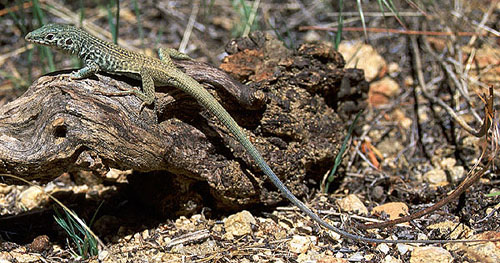
The Common Checkered Whiptail has variable brown or black markings, including blotches, checks, or stripes, against a pale yellow or white background. Its rear legs commonly bear dark spots.[2][3]
Its underside is generally white, with dark flecking around the throat. It has a slender body and a long tail.[4][5]
The checkered whiptail grows to approximately 4 inches in length.[6]
Habitat
The Common Checkered Whiptail inhabits semi-arid, rocky environments, particularly canyon lands and hilly regions.[7]
Diet
The Common Checkered Whiptail is insectivorous.[8]
Behaviour
The Common Checkered Whiptail is active during daylight hours. It is wary, energetic, and fast-moving, and retreats into cover when approached.[9][10]
Reproduction and life cycle
The Common Checkered Whiptail reproduces through parthenogenesis. Females lay as many as eight unfertilized eggs in mid-summer.[11][12]
The eggs hatch approximately six to eight weeks after being laid.[13]
Classification of the Common Checkered Whiptail
| Kingdom | Animalia |
|---|---|
| Phylum | Chordata |
| Subphylum | Vertebrata |
| Infraphylum | Gnathostomata |
| Parvphylum | Osteichthyes |
| Megaclass | Tetrapoda |
| Class | Reptilia (Reptile) |
| Order | Squamata (Snakes) |
| Suborder | Autarchoglossa |
| Family | Teiidae (Tegus) |
| Genus | Aspidoscelis (North American Whiptails) |
| Species | Aspidoscelis tesselatus (Say, 1822) |
Where the Common Checkered Whiptail is found
Checklists and occurrence records place Aspidoscelis tesselatus in 3 countries across North America. GBIF holds 7,304 georeferenced records of it.
Countries
Regions and cities with the most records
- New Mexico, United States 2,648
- Texas, United States 1,849
- Chihuahua, Mexico 679
- Coahuila, Mexico 294
- Las Cruces, United States 259
- El Paso, United States 218
- Sunland Park, United States 208
- Carlsbad, United States 170
- Colorado, United States 162
- Ciudad Juárez, Mexico 133
- Midland, United States 125
- Ciudad Delicias, Mexico 111
- Pedro Meoqui, Mexico 86
- Manuel Ojinaga, Mexico 71
- Enchanted Hills, United States 60
- Ojinaga, Mexico 59
- Roswell, United States 59
- Oklahoma, United States 52
- Rio Rancho, United States 50
- Socorro, United States 41
- Albuquerque, United States 31
- Socorro Mission Number 1 Colonia, United States 27
- Alamogordo, United States 26
- Horizon City, United States 26
- Baja California, Mexico 21
- Sonora, Mexico 21
- South Valley, United States 17
- Odessa, United States 13
- West Odessa, United States 12
- Cañon City, United States 10
- Pueblo West, United States 8
- Zacatecas, Mexico 8
- Los Lunas, United States 7
- Pueblo, United States 7
- Arizona, United States 6
- Charlotte Amalie, U.S. Virgin Islands 6
Range as the checklists state it
USA (SE Colorado, New Mexico, W Texas, Nevada),
A number beside a place is its count of GBIF occurrence records. A place without a number comes from a checklist alone. Records show where a species has been observed or collected, which can include escapes and vagrants.
Common names
English
- Common Checkered Whiptail
- Diploid Checkered Whiptail
- Diploid Colorado Checkered Whiptail
- Gray Checkered Whiptail
Names in 5 other languages
- French
- Cnémidophore marqueté
- German
- Würfelrennechse
- Portuguese
- Cauda-de-chicote-xadrez-comum, Cauda-de-chicote-xadrez-diploide-do-colorado
- Russian
- Полосатая хлыстохвостая ящерица, Пёстрая хлыстохвостая ящерица, Хлыстохвостая ящерица Диксона
- Spanish
- Huico Teselado, Huico gris, huico de cuadros norteño
Synonyms
3 other scientific names have been used for this species and are now treated as synonyms of Aspidoscelis tesselatus.
- Ameiva tesselata Say, 1822
- Cnemidophorus grahamii Baird & Girard, 1852
- Cnemidophorus tesselatus (Say in James, 1823)
Related species
-
 New Mexico WhiptailAspidoscelis neomexicanus
-
 Desert Grassland Whiptail LizardAspidoscelis uniparens
-
 Six-lined RacerunnerAspidoscelis sexlineatus
-
 Western WhiptailAspidoscelis tigris
-
 Texas Spotted WhiptailAspidoscelis gularis
- Little Striped WhiptailAspidoscelis inornatus
-
 Chihuahuan Spotted WhiptailAspidoscelis exsanguis
-
 Plateau Striped WhiptailAspidoscelis velox
Compare
Questions and answers
What is the scientific name of the Common Checkered Whiptail?
The scientific name of the Common Checkered Whiptail is Aspidoscelis tesselatus. Written with its author, the full name is Aspidoscelis tesselatus (Say, 1822).
Which family does the Common Checkered Whiptail belong to?
Aspidoscelis tesselatus belongs to the family Teiidae, in the order Squamata and the class Reptilia.
Where is the Common Checkered Whiptail found?
Checklists and occurrence records place Aspidoscelis tesselatus in 3 countries: United States, Mexico and U.S. Virgin Islands.
What is the conservation status of the Common Checkered Whiptail?
The IUCN Red List category recorded for Aspidoscelis tesselatus is Least Concern (LC).
What other names does the Common Checkered Whiptail have?
Aspidoscelis tesselatus is also known in English as Diploid Checkered Whiptail, Diploid Colorado Checkered Whiptail and Gray Checkered Whiptail.
Are whiptails all female?
The Common Checkered Whiptail reproduces through parthenogenesis. Females lay as many as eight unfertilized eggs in mid-summer.[11][12]
How big do whiptail lizards get?
The Common Checkered Whiptail grows to approximately 4 inches in length.[6]
What do whiptail lizards eat?
The Common Checkered Whiptail is insectivorous.[8]
Sources
Passages the profile rests on
- Aspidoscelis dixoni, formerly recognized as a separate species, is now treated as a synonym of Aspidoscelis tesselatus. Source passage: “The gray checkered whiptail (A. dixoni), once considered a species, is now considered to be a synonym of the common checkered whiptail.” — English Wikipedia
- The species has variable brown or black markings, including blotches, checks, or stripes, against a pale yellow or white background. Source passage: “Their pattern and base coloration varies widely, with brown or black blotching, checkering or striping on a pale yellow or white base color.” — English Wikipedia
- Its rear legs commonly bear dark spots. Source passage: “Their rear legs often have dark spotting” — English Wikipedia
- Its underside is generally white, with dark flecking around the throat. Source passage: “their underside is usually white with dark flecking on the throat area.” — English Wikipedia
- The species has a slender body and a long tail. Source passage: “They are slender bodied, with a long tail.” — English Wikipedia
- The checkered whiptail grows to approximately 4 inches in length. Source passage: “The checkered whiptail grows to about 4 inches in length.” — English Wikipedia
- The species inhabits semi-arid, rocky environments, particularly canyon lands and hilly regions. Source passage: “They are found in semi-arid, rocky habitats, normally in canyon lands or hilled regions.” — English Wikipedia
- The checkered whiptail is insectivorous. Source passage: “Like other species of whiptail lizard, the checkered whiptail is diurnal and insectivorous.” — English Wikipedia
- The species is active during daylight hours. Source passage: “Like other species of whiptail lizard, the checkered whiptail is diurnal and insectivorous.” — English Wikipedia
- The checkered whiptail is wary, energetic, and fast-moving, and it retreats into cover when approached. Source passage: “They are wary, energetic, and fast moving, darting for cover if approached.” — English Wikipedia
- Aspidoscelis tesselatus reproduces through parthenogenesis. Source passage: “It is one of many lizard species known to be parthenogenetic.” — English Wikipedia
- Females lay as many as eight unfertilized eggs in mid-summer. Source passage: “They are parthenogenic, laying up to eight unfertilized eggs in mid summer” — English Wikipedia
- The eggs hatch approximately six to eight weeks after being laid. Source passage: “which hatch in six to eight weeks.” — English Wikipedia
Data
- Catalogue of Life, 2026-10-16 XR cc by
- Global Biodiversity Information Facility CC BY 4.0
- Wikidata CC0
- GeoNames CC BY 4.0
- Wikimedia Commons per image; credit shown with each image
- Within the Catalogue of Life, this name comes from The Reptile Database cc by
References
- James, 1823 where the name was published
- Say, T. (1822). In James, E. Account of an expedition from Pittsburgh to the Rocky Mountains, performed in the years 1819, ’20, by order of the Hon. J. C. Calhoun, Secretary of War, under the command of Major Stephen H. Long. Vol. 2. Philadelphia, H. C. Carey & I. Lea. [1823, Fide Woodman 2010].
- Baird, S.F. and Girard,C. (1852). Characteristics of some new reptiles in the Museum of the Smithsonian Institution, part 2. Proc. Acad. Nat. Sci. Philadelphia 6: 125-129.
- Günther, A. C. L. G. (1885). Reptilia and Batrachia. Biologia Centrali-Américana. Taylor, & Francis, London, 326 Pp. [Published in Parts from 1885-1902; Reprint by the SSAR 1987].
- Cope, E. D. (1892). A synopsis of the species of the teiid genus Cnemidophorus. Trans. Am. Phil. Soc. (Ser. 2) 17 (1): 27-52 [1893].
- Mocquard, F. (1899). Contribution a la faune herpétologique de la Basse-Californie. Nouv. Arch. Mus. Hist. Natur.Paris, 4th Series, Vol. 1: 297-343 + Plates XI-XIII.
- Van Denburgh,J. and Slevin,J.R. (1921). A list of the amphibians and reptiles of Nevada, with notes on the species in the collection of the academy. Proc. Cal. Acad. Sci. (4) 11 (2): 27-38.
- Burt, C. E. (1931). A study of the teiid lizards of the genus Cnemidophorus with special reference to their phylogenetic relationships. Bull. US Natl. Mus. 154: 286 Pp.
- Burt, Charles E. (1933). Some lizards from the Great Basin of the West and adjacent areas, with comments on the status of various forms. American Midland Naturalist 14: 228-250.
- Knowlton, G., & Janes, M. (1934). Distributional and Food Habits Notes on Utah Lizards. Copeia, 1934(1), 10-14.
- Burt, Charles E. (1935). Further records of the ecology and distribution of amphibians and reptiles in the middle west. American Midland Naturalist 16 (3): 311-336.
- Gloyd, Howard K. (1937). A herpetological consideration of faunal areas in Southern Arizona. Bulletin of the Chicago Academy of Sciences 5 (5): 77-136.
- Schmidt, K.P., and D. Owens. (1944). Amphibians and reptiles of northern Coahuila, Mexico. Field Museum of Natural History, Zoological Series. Chicago. 29: 97-115.
- Smith, Hobart M. (1946). Handbook of Lizards: Lizards of the United States and of Canada. Comstock, Ithaca, NY, Xxii + 557 Pp.
- Jameson, David H.;Flury, Alvin G. (1949). The reptiles and amphibians of the Sierra Vieja Range of southwestern Texas. Texas Journal of Science 1 (2): 54-77.
- Smith, Hobart M.; Burger, W. Leslie. (1949). The identity of Ameiva tesselata Say. Bulletin of the Chicago Academy of Sciences 8 (13): 277-284.
- Glass, Bryan P.;Dundee, Harold A. (1950). Cnemidophorus tesselatus (Say) in Oklahoma. Herpetologica 6: 30.
- Smith, H. M., & Taylor, E. H. (1950). An annotated checklist and key to the reptiles of Mexico exclusive of the snakes. Bull. US Natl. Mus. 199: 1-253.
- Williams, Kenneth L.;Smith, Hobart M.;Chrapliwy, Pete S. (1960). Turtles and lizards from Northern Mexico. Transactions of the Illinois State Academy of Science 53 (1/2): 36-45.
- Zweifel, R. G. (1965). Variation in and distribution of the unisexual lizard, Cnemidophorus tesselatus. American Museum Novitates 2235: 1-49.
- Wright, John W.;Lowe, Charles H. (1967). Evolution of the alloploid parthenospecies Cnemidophorus tesselatus (Say). Mammalian Chromosomes Newsletter 8 (2): 95-96 + 2 Plates.
- Maslin, T. P. (1967). Skin grafting in the bisexual teiid lizard Cnemidophorus sexlineatus and in the unisexual C. tesselatus. Journal of Experimental Zoology 166 (1): 137-150.
- Lowe, Charles H., Jr;Wright, John W.;Cole, Charles J.;Bezy, Robert L. (1970). Chromosomes and evolution of the species groups of Cnemidophorus (Reptilia: Teiidae). Systematic Zoology 19: 128-141.
- Maslin, & Paul, T. (1971). Conclusive evidence of parthenogenesis in three species of Cnemidophorus (Teiidae). Copeia 1971 (1): 156-158.
- Parker, W. S. (1973). Notes on reproduction of some lizards from Arizona, New Mexico, Texas, and Utah. Herpetologica 29 (3): 258-264.
This species in other databases
Page built on 28 November 2026. See how the catalog is made and all sources and licences.
Cite this page
ScientificNames.org. (2026). Aspidoscelis tesselatus (Common Checkered Whiptail). Retrieved November 28, 2026, from https://scientificnames.org/species/aspidoscelis-tesselatus
“Aspidoscelis tesselatus (Common Checkered Whiptail).” ScientificNames.org, 2026, scientificnames.org/species/aspidoscelis-tesselatus. Accessed 28 Nov. 2026.
ScientificNames.org. “Aspidoscelis tesselatus (Common Checkered Whiptail).” Accessed November 28, 2026. https://scientificnames.org/species/aspidoscelis-tesselatus.
@misc{scientificnames_aspidoscelis_tesselatus_common_checkered_whiptail,
  author = {{ScientificNames.org}},
  title = {Aspidoscelis tesselatus (Common Checkered Whiptail)},
  year = {2026},
  url = {https://scientificnames.org/species/aspidoscelis-tesselatus},
  note = {Accessed 2026-11-28}
}