Species · Reptiles
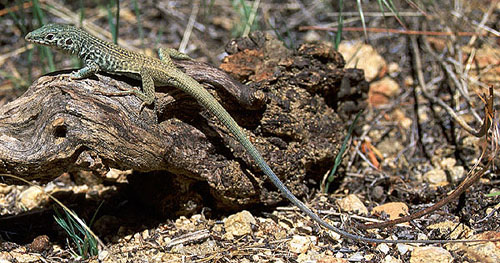
Mexican Racerunner Aspidoscelis guttatus
The scientific name of the Mexican Racerunner is Aspidoscelis guttatus. It is a species of reptile in the family Teiidae (tegus), order Squamata. The name dates from 1834.
- Scientific name
- Aspidoscelis guttatus (Wiegmann, 1834)
- Common name
- Mexican Racerunner
- Genus
- Aspidoscelis
- Family
- Teiidae (Tegus)
- Order
- Squamata
- Class
- Reptilia
- Red List category
- LC Least Concern
- Recorded in
- 2 countries
- Name status
- accepted in the Catalogue of Life

Overview
Aspidoscelis guttatus, the Mexican racerunner, is a species of teiid lizard endemic to Mexico.
Classification of the Mexican Racerunner
| Kingdom | Animalia |
|---|---|
| Phylum | Chordata |
| Subphylum | Vertebrata |
| Infraphylum | Gnathostomata |
| Parvphylum | Osteichthyes |
| Megaclass | Tetrapoda |
| Class | Reptilia (Reptile) |
| Order | Squamata (Snakes) |
| Suborder | Autarchoglossa |
| Family | Teiidae (Tegus) |
| Genus | Aspidoscelis (North American Whiptails) |
| Species | Aspidoscelis guttatus (Wiegmann, 1834) |
Where the Mexican Racerunner is found
Checklists and occurrence records place Aspidoscelis guttatus in 2 countries. GBIF holds 3,062 georeferenced records of it.
Countries
Regions and cities with the most records
- Oaxaca, Mexico 847
- Veracruz, Mexico 603
- Chiapas, Mexico 510
- Guerrero, Mexico 344
- Veracruz, Mexico 301
- Valente Diaz, Mexico 296
- Santo Domingo Tehuantepec, Mexico 224
- Crucecita, Mexico 151
- Salina Cruz, Mexico 138
- Tonalá, Mexico 136
- Acapulco de Juárez, Mexico 94
- Arriaga, Mexico 84
- Cintalapa de Figueroa, Mexico 59
- Alvarado, Mexico 56
- Ixtepec, Mexico 56
- José Cardel, Mexico 27
- Heroica Ciudad de Juchitán de Zaragoza, Mexico 26
- Michoacán, Mexico 26
- Puerto Escondido, Mexico 21
- Chilpancingo, Mexico 20
- Lerdo de Tejada, Mexico 19
- San Andrés Tuxtla, Mexico 16
- Santiago Tuxtla, Mexico 15
- Coatepec, Mexico 14
- Allende, Mexico 13
- Banderilla, Mexico 13
- Manzanillo, Mexico 13
- Xalapa de Enríquez, Mexico 13
- Xico, Mexico 13
- Ayutla de los Libres, Mexico 12
- Coatzacoalcos, Mexico 12
- Nanchital de Lázaro Cárdenas del Río, Mexico 12
- Acayucan, Mexico 11
- Iguala de la Independencia, Mexico 11
- Ciudad de Huitzuco, Mexico 10
- Ixtapa-Zihuatanejo, Mexico 10
Range as the checklists state it
SE Mexico (Veracruz, Oaxaca, Guerrero through Chiapas)
A number beside a place is its count of GBIF occurrence records. A place without a number comes from a checklist alone. Records show where a species has been observed or collected, which can include escapes and vagrants.
Common names
English
- Mexican Racerunner
Names in 3 other languages
- German
- Mexikanische Fleckenrennechse
- Portuguese
- Corredor-mexicano
- Spanish
- Huico Ticuiliche Mexicano, Huico mexicano, Huico picuiliche, Ticuiliche mexicano
Synonyms
7 other scientific names have been used for this species and are now treated as synonyms of Aspidoscelis guttatus.
- Cnemidophorus guttatus flavilineatus Duellman & Wellman, 1960
- Cnemidophorus guttatus immutabilis Cope, 1892
- Cnemidophorus guttatus striatus Gadow, 1903
- Cnemidophorus immutabilis Cope, 1878
- Cnemidophorus microlepidopus Cope, 1877
- Cnemidophorus unicolor Cope, 1878
- Cnemidophorus guttatus Wiegmann, 1834 ambiguous synonym
Subspecies and varieties
- Aspidoscelis guttatus flavilineatus subspecies
- Aspidoscelis guttatus guttatus subspecies
- Aspidoscelis guttatus immutabilis subspecies
Related species
-
 New Mexico WhiptailAspidoscelis neomexicanus
-
 Desert Grassland Whiptail LizardAspidoscelis uniparens
-
 Six-lined RacerunnerAspidoscelis sexlineatus
-
 Western WhiptailAspidoscelis tigris
-
 Texas Spotted WhiptailAspidoscelis gularis
- Little Striped WhiptailAspidoscelis inornatus
-
 Chihuahuan Spotted WhiptailAspidoscelis exsanguis
-
 Plateau Striped WhiptailAspidoscelis velox
Compare
Questions and answers
What is the scientific name of the Mexican Racerunner?
The scientific name of the Mexican Racerunner is Aspidoscelis guttatus. Written with its author, the full name is Aspidoscelis guttatus (Wiegmann, 1834).
Which family does the Mexican Racerunner belong to?
Aspidoscelis guttatus belongs to the family Teiidae, in the order Squamata and the class Reptilia.
Where is the Mexican Racerunner found?
Checklists and occurrence records place Aspidoscelis guttatus in 2 countries: Mexico and Guatemala.
What is the conservation status of the Mexican Racerunner?
The IUCN Red List category recorded for Aspidoscelis guttatus is Least Concern (LC).
Sources
Data
- Catalogue of Life, 2026-10-16 XR cc by
- Global Biodiversity Information Facility CC BY 4.0
- Wikidata CC0
- English Wikipedia CC BY-SA 4.0
- GeoNames CC BY 4.0
- Wikimedia Commons per image; credit shown with each image
- Within the Catalogue of Life, this name comes from The Reptile Database cc by
References
- Wiegmann, A. F. A. (1834). Herpetologia Mexicana, seu descriptio amphibiorum novae hispaniae , quae itineribus comitis de Sack, Ferdinandi Deppe et Chr. Guil. Schiede im Museum Zoologicum Berolinense Pervenerunt. Pars prima, saurorum species. Berlin, Lüderitz, Iv + 54 Pp.
- Cope, E. D. (1878). Tenth contribution to the herpetology of Tropical America. Proc. Amer. Philos. Soc. 17: 85-98 [1877].
- Günther, A. C. L. G. (1885). Reptilia and Batrachia. Biologia Centrali-Américana. Taylor, & Francis, London, 326 Pp. [Published in Parts from 1885-1902; Reprint by the SSAR 1987].
- Cope, E. D. (1892). A synopsis of the species of the teiid genus Cnemidophorus. Trans. Am. Phil. Soc. (Ser. 2) 17 (1): 27-52 [1893].
- Gadow, H. (1903). Proc. Roy. Soc. London 72: 115.
- Gadow, H. (1906). A contribution to the study of evolution based upon the Mexican species of Cnemidophorus. Proc. Zool. Soc. London 1906: 277-375 (+ Maps).
- Werner, F. (1910). Über neue oder seltene Reptilien des Naturhistorischen Museums in Hamburg. ii. Eidechsen. Jahrb. Hamburg. Wiss. Anst., Vol. 27 (1909), Suppl. No. 2, 1910, Pp. 1-46; Reprinted: 1910, Mitteil. Naturhist. Mus. Hamburg, Vol. 27: 205-).
- Burt, C. E. (1931). A study of the teiid lizards of the genus Cnemidophorus with special reference to their phylogenetic relationships. Bull. US Natl. Mus. 154: 286 Pp.
- Smith, H. M., & Burger, W.L. (1950). Herpetological results of the University of Illinois field expedition, Spring 1949. III. Sauria. Transactions of the Kansas Academy of Science 53 (2): 165-175.
- Duellman, W. E., & WELLMAN, J. (1960). A systematic study of the lizards of the deppei group (genus Cnemidophorus) in México and Guatemala. Misc. Publ. Mus. Zool. Univ. Michigan (No. 111): 1-81.
- Malnate, Edmond V. (1971). A catalogue of primary types in the Herpetological Collections of the Academy of Natural Sciences, Philadelphia (ANSP). Proccedings of the Academy of Natural Sciences of Philadelphia 123 (9): 345-375.
- Alvarez DEL TORO, M. (1982). Los Reptiles de Chiapas. 3rd ed. México: Tuxtla Gutiérrez, 248 Pp.
- Maslin, T., & Secoy, D. M. (1986). A checklist of the lizard genus Cnemidophorus (Teiidae). Contr. Zool. Univ. Colorado Mus. 1: 1-60.
- Bauer, A.M. and R. Günther. (1994). An annotated type catalogue of the teiid and microteiid lizards in the Zoological Museum, Berlin (Reptilia: Squamata: Teiidae and Gymnophthalmidae). Mitt. Zool. Mus. Berlin 70:267-280.
- Castro-Franco, Rubén, & María Guasalupe Bustos-Zagal. (1994). List of reptiles of Morelos, Mexico, and their distribution in relation to vegetation types. Southwestern Naturalist 39 (2): 171-175.
- Köhler, G. (2000). Reptilien und Amphibien Mittelamerikas, Bd 1: Krokodile, Schildkröten, Echsen. Herpeton Verlag, Offenbach, 158 Pp.
- REEDER, T.W.; CHARLES J. COLE AND HERBERT C. DESSAUER. (2002). Phylogenetic Relationships of Whiptail Lizards of the Genus Cnemidophorus (Squamata: Teiidae): A Test of Monophyly, Reevaluation of Karyotypic Evolution, and Review of Hybrid Origins. American Museum Novitates 3365: 1-64.
- Castro Franco, R. & M. G. Bustos-Zagal. (2003). Lagartijas de Morelos, México: distribución, hábitat y conservación. Acta Zoológica Mexicana (N.S.) 88:123-142.
- Casas-Andreu, G., F.R. Méndez-De la Cruz and X. Aguilar-Miguel. (2004). Anfibios y Reptiles; pp. 375–390, in A.J.M. García-Mendoza, J. Ordoñez and M. Briones-Salas (ed.). Biodiversidad de Oaxaca. Instituto de Biología, UNAM-Fondo Oaxaqueño Para La Conservación de La Naturaleza-World Wildlife Fund, México, D. F.
- Peterson, A.T. et al. (2004). A preliminary biological survey of Cerro Piedra Larga, Oaxaca, Mexico: Birds, mammals, reptiles, amphibians, and plants. Anales Del Instituto de Biología, Universidad Nacional Autónoma de México, Serie Zoología 75(2): 439-466.
- Pyron, R. Alexander; Frank T. Burbrink. (2013). Early origin of viviparity and multiple reversions to oviparity in squamate reptiles. Ecology Letters 17 (1): 13–21 (Published Online 2013, in Print 2014), DOI: 10.1111/Ele.12168.
- Johnson, Jerry D.; Vicente Mata-Silva, Elí García Padilla, and Larry David Wilson. (2015). The Herpetofauna of Chiapas, Mexico: composition, distribution, and conservation. Mesoamerican Herpetology 2 (3): 272–329.
- Mata-Silva, Vicente, Jerry D. Johnson, Larry David Wilson and Elí García-Padilla. (2015). The herpetofauna of Oaxaca, Mexico: composition, physiographic distribution, and conservation status. Mesoamerican Herpetology 2 (1): 6–62.
- Mata-González, Stephanye, Vicente Mata-Silva, Dominic L. DeSantis, Elí García-Padilla and Larry David Wilson. (2016). Aspidoscelis guttata (Wiegmann, 1834). Opportunistic water acquisition. Mesoamerican Herpetology 3 (2): 483-484.
- Palacios-Aguilar, Ricardo, & OSCAR FLORES-VILLELA. (2018). An updated checklist of the herpetofauna from Guerrero, Mexico. Zootaxa 4422 (1): 1-24.
This species in other databases
Page built on 28 November 2026. See how the catalog is made and all sources and licences.
Cite this page
ScientificNames.org. (2026). Aspidoscelis guttatus (Mexican Racerunner). Retrieved November 28, 2026, from https://scientificnames.org/species/aspidoscelis-guttatus
“Aspidoscelis guttatus (Mexican Racerunner).” ScientificNames.org, 2026, scientificnames.org/species/aspidoscelis-guttatus. Accessed 28 Nov. 2026.
ScientificNames.org. “Aspidoscelis guttatus (Mexican Racerunner).” Accessed November 28, 2026. https://scientificnames.org/species/aspidoscelis-guttatus.
@misc{scientificnames_aspidoscelis_guttatus_mexican_racerunner,
  author = {{ScientificNames.org}},
  title = {Aspidoscelis guttatus (Mexican Racerunner)},
  year = {2026},
  url = {https://scientificnames.org/species/aspidoscelis-guttatus},
  note = {Accessed 2026-11-28}
}