Species · Reptiles
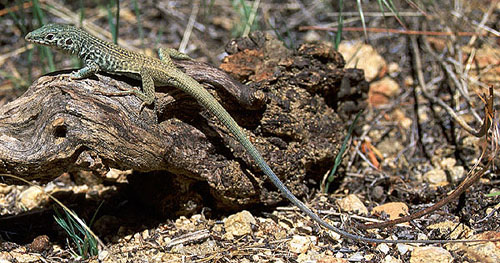
Orange-throated Whiptail Aspidoscelis hyperythrus
The scientific name of the Orange-throated Whiptail is Aspidoscelis hyperythrus. It is a species of reptile in the family Teiidae (tegus), order Squamata. The name dates from 1863.
- Scientific name
- Aspidoscelis hyperythrus (Cope, 1863)
- Common name
- Orange-throated Whiptail
- Genus
- Aspidoscelis
- Family
- Teiidae (Tegus)
- Order
- Squamata
- Class
- Reptilia
- Recorded in
- 2 countries
- Name status
- accepted in the Catalogue of Life
Overview
Wikidata describes Aspidoscelis hyperythrus as “species of reptile”.
Classification of the Orange-throated Whiptail
| Kingdom | Animalia |
|---|---|
| Phylum | Chordata |
| Subphylum | Vertebrata |
| Infraphylum | Gnathostomata |
| Parvphylum | Osteichthyes |
| Megaclass | Tetrapoda |
| Class | Reptilia (Reptile) |
| Order | Squamata (Snakes) |
| Suborder | Autarchoglossa |
| Family | Teiidae (Tegus) |
| Genus | Aspidoscelis (North American Whiptails) |
| Species | Aspidoscelis hyperythrus (Cope, 1863) |
Where the Orange-throated Whiptail is found
Checklists and occurrence records place Aspidoscelis hyperythrus in 2 countries across North America. GBIF holds 9,508 georeferenced records of it.
Countries
Regions and cities with the most records
- Baja California Sur, Mexico 4,156
- California, United States 3,355
- National City, United States 1,136
- San Diego, United States 1,080
- La Mesa, United States 993
- Santee, United States 922
- Chula Vista, United States 859
- El Cajon, United States 854
- Baja California, Mexico 842
- Poway, United States 795
- Encinitas, United States 487
- San Marcos, United States 382
- Escondido, United States 328
- Moreno Valley, United States 284
- La Paz, Mexico 280
- San José del Cabo, Mexico 271
- Riverside, United States 247
- Irvine, United States 224
- Lake Forest, United States 216
- Tustin, United States 210
- Vista, United States 210
- Colton, United States 204
- Mission Viejo, United States 203
- Redlands, United States 200
- Aliso Viejo, United States 198
- San Bernardino, United States 198
- Carlsbad, United States 196
- Laguna Niguel, United States 194
- Cabo San Lucas, Mexico 191
- Colonia del Sol, Mexico 191
- Rialto, United States 191
- Tijuana, Mexico 188
- Santa Ana, United States 183
- Rancho Santa Margarita, United States 172
- Fontana, United States 166
- Ensenada, Mexico 164
Range as the checklists state it
USA (S California),
A number beside a place is its count of GBIF occurrence records. A place without a number comes from a checklist alone. Records show where a species has been observed or collected, which can include escapes and vagrants.
Common names
English
- Orange-throated Whiptail
- Carmen Island Whiptail
- Orange-throated Race-runner
- Orangethroat Whiptail
- Race-runner
- Big Water Whiptail
Names in 8 other languages
- Czech
- bičochvost oranžovohrdlý
- Danish
- Almindelig Orangestrubet Piskehaleteju
- French
- Coureur, Coureur À Gorge Orange
- German
- Orangekehlige Rennechse
- Portuguese
- Cauda-de-chicote-de-garganta-laranja
- Russian
- Оранжевогорлая хлыстохвостая ящерица
- Spanish
- Corredor Gorguinaranja, Huico Garganta Naranja, Huico de Garganta Naranja, Huico peninsular de garganta anaranjada
- sei
- güico
Synonyms
7 other scientific names have been used for this species and are now treated as synonyms of Aspidoscelis hyperythrus.
- Aspidoscelis hyperythra (Cope, 1863)
- Cnemidophorus hyperythrus Cope, 1864
- Cnemidophorus hyperythrus hyperythrus Cope, 1863
- Verticaria beldingi Stejneger, 1894
- Verticaria hyperythra schmidti Van Denburgh & Slevin, 1921
- Verticaria espiritensis Van Denburgh & Slevin, 1921 ambiguous synonym
- Verticaria franciscensis Van Denburgh & Slevin, 1921 ambiguous synonym
Subspecies and varieties
- Aspidoscelis hyperythrus beldingi (Belding's Orange-throated Whiptail) subspecies
- Aspidoscelis hyperythrus hyperythrus (Cape Orange-throated Whiptail) subspecies
- Aspidoscelis hyperythrus schmidti subspecies
Related species
-
 New Mexico WhiptailAspidoscelis neomexicanus
-
 Desert Grassland Whiptail LizardAspidoscelis uniparens
-
 Six-lined RacerunnerAspidoscelis sexlineatus
-
 Western WhiptailAspidoscelis tigris
-
 Texas Spotted WhiptailAspidoscelis gularis
- Little Striped WhiptailAspidoscelis inornatus
-
 Chihuahuan Spotted WhiptailAspidoscelis exsanguis
- Plateau Striped WhiptailAspidoscelis velox
Compare
Questions and answers
What is the scientific name of the Orange-throated Whiptail?
The scientific name of the Orange-throated Whiptail is Aspidoscelis hyperythrus. Written with its author, the full name is Aspidoscelis hyperythrus (Cope, 1863).
Which family does the Orange-throated Whiptail belong to?
Aspidoscelis hyperythrus belongs to the family Teiidae, in the order Squamata and the class Reptilia.
Where is the Orange-throated Whiptail found?
Checklists and occurrence records place Aspidoscelis hyperythrus in 2 countries: Mexico and United States.
What other names does the Orange-throated Whiptail have?
Aspidoscelis hyperythrus is also known in English as Carmen Island Whiptail, Orange-throated Race-runner, Orangethroat Whiptail, Race-runner and Big Water Whiptail.
Sources
Data
- Catalogue of Life, 2026-10-16 XR cc by
- Global Biodiversity Information Facility CC BY 4.0
- Wikidata CC0
- GeoNames CC BY 4.0
- Within the Catalogue of Life, this name comes from The Reptile Database cc by
References
- Cope, E. D. (1863). Descriptions of new American Squamata in the Museum of the Smtihsonian Institution. Proc. Acad. Nat. Sci. Philadelphia 15 [1863]: 100-106.
- Stejneger, L. (1894). Description of a new lizard (Verticaria beldingi), from California. Proc. US Natl. Mus. 17: 17-18.
- Van Denburgh, J. (1895). A review of the herpetology of Lower California. Part I - Reptiles. Proc. Cal. Acad. Sci. (2) 5: 77-163.
- Mocquard, F. (1899). Contribution a la faune herpétologique de la Basse-Californie. Nouv. Arch. Mus. Hist. Natur.Paris, 4th Series, Vol. 1: 297-343 + Plates XI-XIII.
- Gadow, H. (1906). A contribution to the study of evolution based upon the Mexican species of Cnemidophorus. Proc. Zool. Soc. London 1906: 277-375 (+ Maps).
- Van Denburgh, & John. (1912). Notes on a collection of reptiles from Southern California and Arizona. Proc. Cal. Acad. Sci. 3: 147-154.
- Grinnell, J., & CAMP, C. L. (1917). A distributional list of the amphibians and reptiles of California. Univ. California Publ. Zool. 17: 127-208.
- Dickerson, M. C. (1919). Diagnoses of twenty-three new species and a new genus of lizards from Lower California. Bull. Amer. Mus. Nat. Hist. 41 (10): 461-477.
- Van Denburgh, J., & Slevin, J. R. (1921). Preliminary diagnoses of more new species of reptiles from islands in the gulf of California, Mexico. Proc. Cal. Acad. Sci. (4) 11 (17): 395-398.
- Van Denburgh, J., & Slevin, J. R. (1921). Preliminary diagnoses of new species of the peninsula of Lower California, with notes on the species in the collection of the Academy. Proc. Cal. Acad. Sci. (4) 11: 95-98.
- Van Denburgh, & John. (1922). The Reptiles of Western North America. Volume I. Lizards. Occ. Pap. Cal. Acad. Sci. (10): 1–612.
- Klauber, L. M. (1928). A list of amphibians and reptiles of San Diego County, California. Zoological Society of San Diego (Bulletin #4): 1-8.
- Burt, C. E. (1931). A study of the teiid lizards of the genus Cnemidophorus with special reference to their phylogenetic relationships. Bull. US Natl. Mus. 154: 286 Pp.
- Wright, A.A. & A.H. Wright. (1931). Some Stejneger Species. Photographs from Life. Copeia 1931 (3): 84-85.
- Linsdale, J. M. (1932). Amphibians and reptiles from lower California. Univ. California Publ. Zool. 38 (6): 345-386.
- Smith, Hobart M. (1939). An annotated list of the Mexican amphibians and reptiles in the Carnegie Museum. Annals of the Carnegie Museum 27: 311-320.
- Tevis, lloyd, Jr. (1944). Herpetological notes from lower California. Copeia 1944 (1): 6-18.
- Zweifel, Richard G. (1958). Results of the Puritan-American Museum of Natural History Expedition to western Mexico 2. Notes on reptiles and amphibians from the Pacific Coastal Islands of Baja California. American Museum Novitates (1895): 1-17.
- Leviton, Alan E.; Banta, Benjamin H. (1964). Midwinter reconnaissance of the herpetofauna of the Cape Region of Baja California, Mexico. Proc. Cal. Acad. Sci. 30 (7): 127-156.
- Walker, J. Martin;Taylor, Harry L. (1968). Geographical variation in the teiid lizard Cnemidophorus hyperythrus. I. The caeruleus-like subspecies. American Midland Naturalist 80 (1): 1-27.
- Turner, Frederick B.; Robert I. Jennrich, Joel D. Weintraub. (1969). Home Ranges and Body Size of Lizards. Ecology 50 (6): 1076-1081.
- Bostic, D. L. (1971). Herpetofauna of the Pacific Coast of north central Baja California, Mexico, with a description of a new subspecies of Phyllodactylus xanti. Transactions of the San Diego Society of Natural History, 16: 237—263.
- Stebbins, R. C. (1985). A Field Guide to Western Reptiles and Amphibians, 2nd ed. Houghton Mifflin, Boston.
- Maslin, T., & Secoy, D. M. (1986). A checklist of the lizard genus Cnemidophorus (Teiidae). Contr. Zool. Univ. Colorado Mus. 1: 1-60.
- Thompson, J. S., Brian I. Crother and Andrew H. Price. (1998). Cnemidophorus hyperythrus. Catalogue of American Amphibians and Reptiles 655: 1-6.
This species in other databases
Page built on 25 November 2026. See how the catalog is made and all sources and licences.
Cite this page
ScientificNames.org. (2026). Aspidoscelis hyperythrus (Orange-throated Whiptail). Retrieved November 25, 2026, from https://scientificnames.org/species/aspidoscelis-hyperythrus
“Aspidoscelis hyperythrus (Orange-throated Whiptail).” ScientificNames.org, 2026, scientificnames.org/species/aspidoscelis-hyperythrus. Accessed 25 Nov. 2026.
ScientificNames.org. “Aspidoscelis hyperythrus (Orange-throated Whiptail).” Accessed November 25, 2026. https://scientificnames.org/species/aspidoscelis-hyperythrus.
@misc{scientificnames_aspidoscelis_hyperythrus_orange_throated_whiptail,
  author = {{ScientificNames.org}},
  title = {Aspidoscelis hyperythrus (Orange-throated Whiptail)},
  year = {2026},
  url = {https://scientificnames.org/species/aspidoscelis-hyperythrus},
  note = {Accessed 2026-11-25}
}